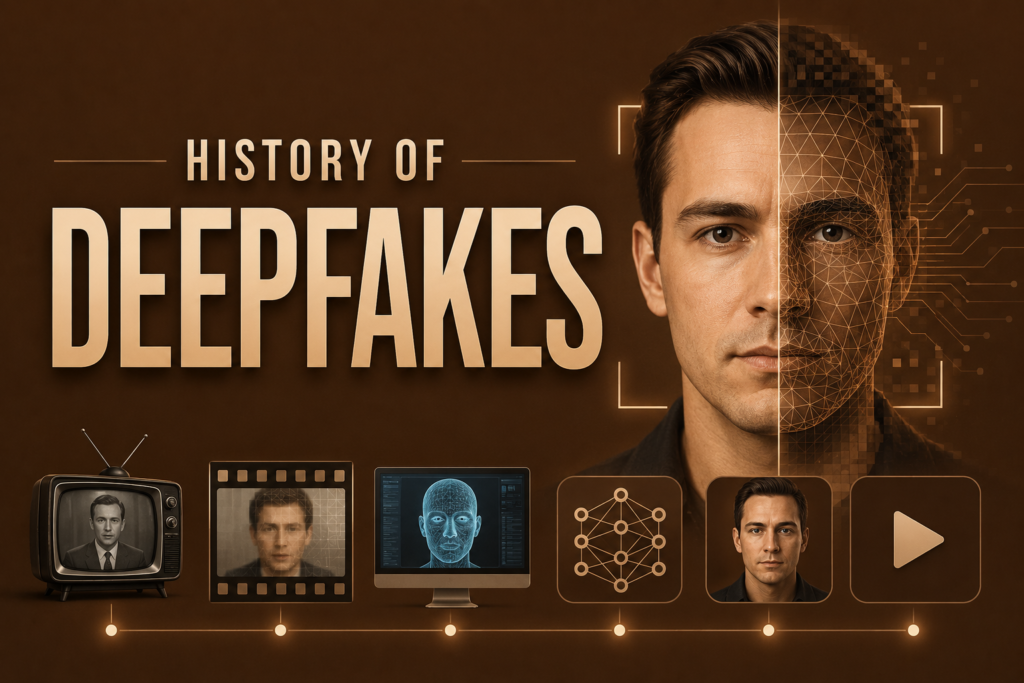
Few terms in modern technology carry as much weight, and as much controversy, as “deepfake.” The history of deepfakes is relatively short compared to most topics in computer vision, spanning less than a decade, yet it has had an outsized impact on conversations about trust, media, identity, and the responsible use of artificial intelligence. This article traces that history from its origins through its underlying technology, its evolution into a broader category of synthetic media, and the ongoing efforts to detect and regulate it.
Origin of the Term Deepfake (2017)
Origin of the term deepfake is unusually well documented compared to most technical terminology, which often emerges gradually without a clear point of origin. Reddit user “deepfakes” (2017) is widely credited with popularizing the term, posting AI-generated videos that swapped the faces of celebrities into existing video content on the Reddit platform in late 2017.
The term itself is a combination of “deep learning,” referring to the neural network techniques underlying the technology, and “fake,” referring to the manipulated nature of the resulting content. This portmanteau quickly became the standard term used across media coverage, research, and policy discussions, even as the underlying technology and its applications expanded well beyond the specific type of content first associated with the term.
The Underlying Technology: Autoencoders and GANs
History of AI video manipulation using deep learning relies on a combination of techniques that had been developed for other purposes within the broader history of ai image generation. Autoencoder architectures, neural networks trained to compress an input into a smaller representation and then reconstruct it, formed the technical foundation of many early deepfake tools.
A typical approach involved training an autoencoder, or a pair of related autoencoders, on images of two different faces. By training a shared encoder, the part of the network that compresses an image into a smaller representation, alongside separate decoders for each face, the system could learn to encode a face’s expression and pose in a way that could then be decoded using a different person’s facial appearance, effectively transferring expressions and movements from one face onto another.
Generative Adversarial Networks (GANs), introduced in 2014 and discussed extensively in the broader history of ai image generation, also played a significant role, particularly in improving the realism and quality of generated faces, building on techniques originally developed for entirely different creative applications.
Evolution of Face Swapping Software (2017 – 2019)
Evolution of face swapping software accelerated rapidly following the initial 2017 posts. Early open source deepfake code repositories emerged within months, making the underlying techniques accessible to a much broader audience than the original researchers and hobbyists who had first experimented with the approach.
FaceSwap pipeline and DeepFaceLab open source tool became two of the most widely known software projects in this space, providing relatively accessible interfaces for the technically complex process of training models to swap faces in video content. These tools lowered the barrier to entry significantly, though producing convincing results still generally required substantial training data, computational resources, and technical know-how.
This rapid evolution connects directly to the broader deep learning transformed computer vision narrative, illustrating how techniques developed within research contexts, autoencoders, GANs, and the broader architectural advances driving the history of facial recognition, could be recombined and applied to entirely new use cases within a remarkably short timeframe once made publicly available.
First Malicious Uses and Public Concern (2017 – 2019)
First malicious deepfake videos history reflects the period when public concern about this technology shifted from curiosity to alarm. Early applications of face-swapping technology raised immediate and serious concerns, particularly regarding non-consensual content depicting real individuals in fabricated scenarios they had never actually participated in.
Biometric identity theft became a significant concept within discussions of deepfakes during this period, extending concerns previously associated with facial recognition and privacy into new territory. If a person’s face could be convincingly placed onto video content they had no part in creating, questions arose about consent, reputation, and the potential for this technology to be used for harassment, fraud, or disinformation.
This period also saw growing recognition that deepfake technology intersected with broader concerns about misinformation in digital media, as the increasing realism of generated content made it progressively more difficult for viewers to distinguish authentic footage from fabricated content through casual observation alone.
Beyond Face Swapping: The Broader Synthetic Media Landscape (2019 – 2022)
Deepfake technology timeline in synthetic media broadened considerably as the underlying techniques expanded beyond simple face swapping. Lip-syncing synthesis emerged as a related but distinct application, where existing video footage of a person could be modified so that their mouth movements matched a different audio track, creating the appearance that they had said words they never actually spoke.
Deepfake audio voice cloning history developed in parallel, applying similar deep learning principles to audio rather than video. Voice cloning systems could be trained on samples of a person’s speech and then used to generate new audio in that person’s voice, saying words they never said, extending synthetic media concerns from visual content into audio as well.
This broader landscape connects to the history of multimodal AI in an important way, as systems capable of generating realistic synthetic content across multiple modalities, video, audio, and eventually combined audiovisual content, raised compounding concerns about the overall trustworthiness of digital media more generally.
Deepfake Detection: The Technical Response (2018 – 2026)
History of deepfake detection software developed largely in response to the concerns raised by the technology’s spread. Digital forensics engineering approaches to deepfake detection generally fall into several categories, including analyzing subtle artifacts left behind by the generation process that may not be visible to casual human observation.
Temporal consistency errors became an important focus area for detection research. Because many early deepfake generation approaches processed video frame by frame, subtle inconsistencies in how features like lighting, shadows, or facial details changed between consecutive frames could sometimes reveal manipulated content, even when individual frames appeared convincing in isolation.
Content authenticity watermarks represent a different, more proactive approach to the broader problem. Rather than attempting to detect manipulation after the fact, this approach involves embedding verifiable information about an image or video’s origin and editing history at the time of creation, an approach that connects to broader content provenance efforts discussed in relation to the history of dall·e and other generative systems.
The relationship between deepfake generation and detection has often been described as an ongoing technical competition, with improvements in generation techniques sometimes outpacing detection methods, and detection improvements in turn prompting refinements in generation techniques, a dynamic that continues to evolve.
Regulation and Legal Responses (2019 – 2026)
History of deepfake regulations and legal bans reflects how governments and institutions around the world have responded to the concerns raised by this technology. Various jurisdictions have introduced legislation specifically addressing non-consensual deepfake content, particularly regarding intimate imagery, as well as regulations addressing the use of deepfakes in political contexts, such as fabricated statements attributed to candidates or public officials.
These regulatory efforts connect to the broader facial recognition and privacy debates occurring across computer vision technology more generally, reflecting a recurring pattern where rapid technical advancement outpaces the development of legal and policy frameworks adequate to address the resulting concerns.
The regulatory landscape remains actively evolving, with different jurisdictions taking different approaches regarding disclosure requirements for AI-generated content, penalties for malicious use, and the responsibilities of platforms that host or distribute synthetic media.
Deepfakes and the Broader History of Computer Vision
The history of deepfakes sits at an interesting intersection within the broader history of computer vision. The same advances that enabled the history of facial recognition to identify individuals with high accuracy also enabled the techniques used to convincingly alter how individuals appear in video. The same generative architectures explored in the history of ai image generation for creative purposes also underlie deepfake technology.
This dual-use nature, where the same underlying technical capabilities enable both beneficial creative applications and potentially harmful misuse, is not unique to deepfakes, but the history of deepfakes represents one of the clearest and most widely discussed examples of this dynamic within computer vision technology, prompting ongoing conversations about how research and development in this space should be approached responsibly.
Frequently Asked Questions
Where did the term deepfake come from?
The term deepfake originated in late 2017, when a Reddit user using the username “deepfakes” posted AI-generated videos that swapped faces in existing video content. The term combines “deep learning” with “fake” and quickly became the standard term for this category of synthetic media.
How do deepfakes work technically?
Many early deepfake techniques relied on autoencoder architectures, neural networks trained to compress and reconstruct images, often combined with Generative Adversarial Networks to improve realism. By training these systems on images of different faces, expressions and movements from one person could be transferred onto another person’s face in video content.
How can deepfakes be detected?
Deepfake detection approaches include analyzing subtle artifacts left by the generation process, examining temporal consistency between video frames for inconsistencies that may not be visible to casual viewers, and content authenticity approaches that embed verifiable information about a piece of media’s origin at the time of its creation.
Are deepfakes illegal?
Legality varies significantly by jurisdiction. Many regions have introduced specific legislation addressing certain uses of deepfake technology, particularly regarding non-consensual intimate content and use in political contexts, while the broader legal landscape continues to evolve as both the technology and its applications change.
What is the difference between deepfakes and other AI image generation?
Deepfakes specifically involve altering or fabricating depictions of real, identifiable individuals, often in video, using techniques like face swapping or voice cloning. Broader AI image generation, as seen in tools related to the history of ai image generation, often focuses on creating entirely new content rather than specifically manipulating depictions of real people, though the underlying generative technologies are often closely related.
Conclusion
The history of deepfakes spans less than a decade but has had a profound impact on conversations about trust, media, and the responsible development of AI. From a single Reddit post in 2017 to a broad category of synthetic media encompassing video, audio, and increasingly sophisticated combinations of both, the technology has evolved rapidly, prompting equally rapid development of detection tools and regulatory responses.
Understanding the history of deepfakes means understanding a recurring theme throughout the broader story of computer vision technology: powerful capabilities, once developed, tend to find applications their original creators may never have anticipated, for better and for worse, making ongoing conversations about responsible development and use just as important as the technical capabilities themselves.