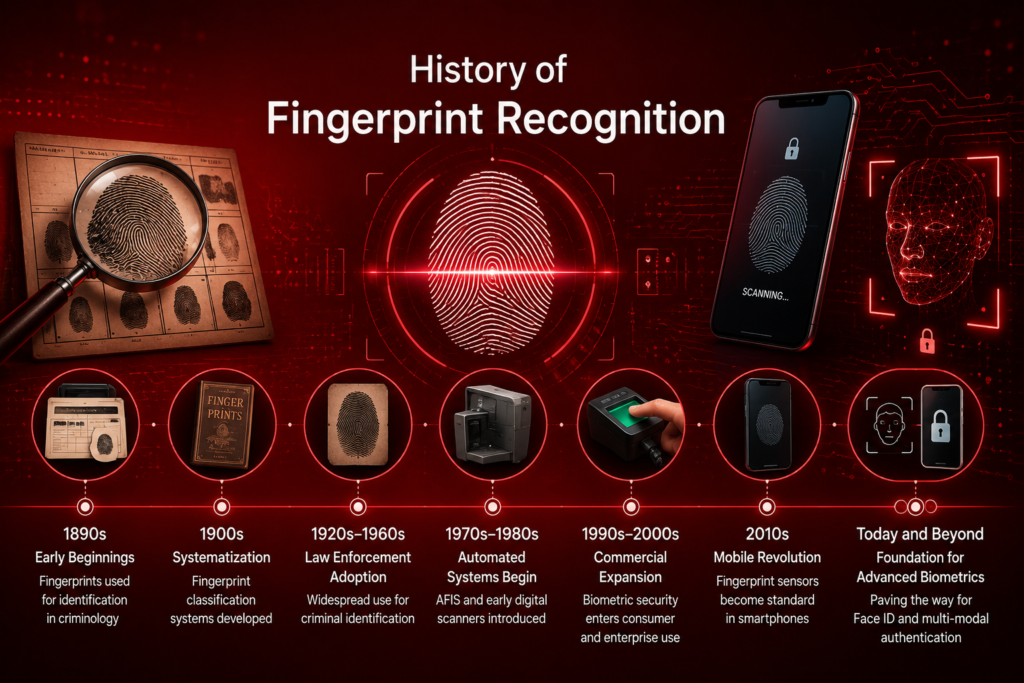
Long before facial recognition could unlock a smartphone, another biometric technology had already spent more than a century proving that individual identification was possible through careful measurement of the human body. The history of fingerprint recognition stretches back to the late nineteenth century, decades before the history of computer vision as a computational discipline even existed, and it remains one of the most widely deployed biometric technologies in the world today. This article traces that history from its scientific origins through digital transformation to its role in modern devices.
The Scientific Origins of Fingerprint Identification (1880 – 1900)
Sir Francis Galton is one of the most important figures in the early history of fingerprint recognition, conducting extensive scientific study of fingerprints during the late nineteenth century. Galton’s work helped establish that fingerprints were both unique to individuals and stable over a person’s lifetime, two properties essential to any biometric identification system.
Friction ridge patterns, the raised lines that form the distinctive patterns on fingertips, became the focus of this early scientific study. Researchers during this period began cataloging and classifying these patterns, identifying recurring shapes including loops, whorls, and arches, laying the groundwork for systematic comparison between different fingerprints.
This period predates the first computer vision experiments by roughly eighty years, meaning all of this early work was conducted entirely through manual observation, measurement, and comparison, without any computational assistance whatsoever. Yet the fundamental insight, that the human body contains unique, stable, and measurable patterns that can serve as a reliable form of identification, would prove directly applicable once computing technology eventually became available.
Edward Henry and Classification Systems (1897 – 1900)
Henry Classification System history represents one of the most significant practical developments in the early history of fingerprint identification. Edward Henry, building on earlier classification work, developed a systematic method for organizing and classifying fingerprints based on the patterns of ridges present on each finger.
This classification system addressed a critical practical problem: with growing collections of fingerprint records, law enforcement agencies needed a way to efficiently search through these records to find potential matches, rather than comparing a new fingerprint against every record in a collection one at a time. The Henry Classification System provided a structured way to categorize fingerprints, dramatically narrowing the search space for any given comparison.
This classification approach became the standard method used by law enforcement agencies around the world for decades, representing one of the earliest examples of organizing biometric data specifically to facilitate efficient searching and matching, a problem that would become central to the broader history of pattern recognition decades later when computational approaches became available.
Manual Matching: Ink and Roll Verification (1900 – 1960)
Throughout the first half of the twentieth century, fingerprint identification relied entirely on Ink and roll verification, the process of physically applying ink to a person’s fingertips and rolling them onto paper cards to create a permanent record of their fingerprint patterns. These cards could then be filed according to classification systems like Henry’s and manually compared against other cards when needed.
This manual process was labor-intensive and required significant expertise. Trained examiners would visually compare the friction ridge patterns on different cards, looking for matching features at specific points, an early form of what would later be formalized as minutiae point extraction once computational tools became available.
The fundamental approach during this period, comparing specific distinctive features between fingerprints rather than attempting to compare entire patterns as undifferentiated images, established a methodology that would directly inform how computerized fingerprint recognition systems were eventually designed.
Minutiae: The Key to Computerized Matching
Minutiae matching technology historical background centers on a specific approach to representing and comparing fingerprints that proved well suited to computational implementation. Rather than comparing entire fingerprint images directly, minutiae-based approaches focus on specific points within a fingerprint where ridges end, split, or otherwise deviate from a smooth, continuous pattern.
Ridge bifurcations and endings represent the two most common types of minutiae points. A ridge bifurcation occurs where a single ridge splits into two separate ridges. A ridge ending occurs where a ridge simply terminates. By identifying the locations and orientations of these minutiae points across a fingerprint, a compact representation could be created that captured the distinctive characteristics of that fingerprint without requiring storage or comparison of the full image.
This minutiae-based approach connects to broader themes within the history of pattern recognition, since it represents a specific instance of the general principle that complex patterns can often be represented and compared more efficiently through carefully chosen distinctive features rather than through direct comparison of raw data, a principle that recurs throughout the history of computer vision in contexts ranging from early edge detection to modern deep learning based feature extraction.
The Rise of Automated Fingerprint Identification Systems (1960 – 1990)
Evolution of automated fingerprint identification systems began in earnest as computing technology advanced enough to make automated minutiae extraction and matching practically feasible. Automated Fingerprint Identification System (AFIS) technology emerged during this period, representing the computerization of the classification and matching processes that had previously required extensive manual effort.
History of FBI IAFIS database development represents one of the most significant large-scale deployments of this technology. The Integrated Automated Fingerprint Identification System, developed by the FBI, represented a massive undertaking to digitize and computerize fingerprint records that had previously existed only as physical ink and roll cards, enabling searches across millions of records that would have been practically impossible to conduct manually within any reasonable timeframe.
First commercial biometric fingerprint scanner history also traces back to this period, as the underlying technology for automated fingerprint matching began to be adapted for commercial applications beyond law enforcement, including access control and identity verification for various institutional and commercial purposes.
Digital Sensors: From Ink to Electronics (1990 – 2010)
Inventions of digital fingerprint scanning sensors represent a major technological shift in the history of fingerprint recognition, moving away from the ink and paper methods that had been used for nearly a century toward electronic sensors capable of capturing fingerprint images directly.
Early digital sensors generally used optical methods, essentially capturing a digital photograph of a fingertip pressed against a glass or plastic surface, illuminated in a way designed to highlight the friction ridge patterns clearly. This digital capture then fed directly into the minutiae extraction and matching algorithms that had been developed for automated systems, eliminating the need for the physical ink and paper intermediate step entirely.
Biometric matching scores became an increasingly important concept during this period, representing a numerical measure of how closely two fingerprint representations matched, allowing systems to make probabilistic determinations about whether two fingerprints likely came from the same finger, rather than requiring a definitive yes or no answer based purely on exact matches.
Smartphones Bring Fingerprint Recognition to Everyone (2010 – 2020)
Evolution of smartphone capacitive fingerprint sensors represents the moment fingerprint recognition truly went mainstream, reaching billions of consumer devices. Capacitive sensors work by detecting tiny electrical differences between the ridges and valleys of a fingerprint pressed against the sensor surface, essentially mapping the fingerprint pattern through electrical rather than purely optical means.
This technology became widely deployed across smartphones starting in the early 2010s, allowing users to unlock their devices, authenticate payments, and access secure applications using their fingerprint rather than relying solely on passwords or PIN codes. This represented one of the largest deployments of biometric authentication technology in history up to that point, predating the widespread adoption of facial recognition through systems like the history of apple face id.
Timeline of optical vs ultrasonic fingerprint recognition reflects continued evolution in sensor technology during this period. Ultrasonic pulse reflection represents a more advanced sensing approach, using ultrasonic waves to create a detailed three-dimensional map of a fingerprint’s ridge structure, including features beneath the immediate surface of the skin, offering potential advantages over purely optical or capacitive approaches in terms of accuracy and resistance to certain types of spoofing.
Fingerprint Recognition Alongside Facial Recognition
The relationship between fingerprint recognition and the history of facial recognition is worth examining directly, since both represent major biometric authentication approaches that have become widely deployed in consumer devices. False Acceptance Rate (FAR), a measure of how often a biometric system incorrectly matches two different individuals as the same person, represents an important metric for comparing the security characteristics of different biometric approaches, including both fingerprint and facial recognition systems.
History of latent fingerprint analysis algorithms continues to develop alongside these consumer applications, particularly within forensic contexts, where fingerprints recovered from crime scenes, often partial, smudged, or otherwise degraded compared to the clean prints captured by consumer sensors, require more sophisticated analysis techniques. This forensic application connects to broader themes within computer vision technology, where systems must handle significantly degraded or incomplete input data compared to the controlled conditions of consumer applications.
The continued relevance of fingerprint recognition alongside newer biometric technologies like facial recognition reflects a broader pattern in computer vision technology: rather than each new biometric approach completely replacing previous ones, multiple biometric modalities often coexist, each with different strengths, weaknesses, and appropriate use cases, with many modern devices and systems supporting multiple biometric options simultaneously.
Frequently Asked Questions
Who is credited with early fingerprint identification research?
Sir Francis Galton conducted extensive scientific study of fingerprints in the late nineteenth century, helping establish that fingerprint patterns were unique to individuals and stable over time. Edward Henry subsequently developed a classification system that became the standard method for organizing fingerprint records for decades, forming the foundation of modern automated fingerprint identification systems.
What are minutiae in fingerprint recognition?
Minutiae are specific distinctive points within a fingerprint, primarily ridge endings and bifurcations, where ridges terminate or split into multiple ridges. By identifying the location and orientation of these points, fingerprint recognition systems can create a compact representation of a fingerprint that can be efficiently compared against other fingerprints without requiring full image comparison.
When did fingerprint recognition become available on smartphones?
Capacitive fingerprint sensors became widely available on smartphones starting in the early 2010s, allowing users to unlock devices and authenticate transactions using their fingerprint. This represented one of the largest deployments of biometric authentication technology in consumer devices, predating widespread facial recognition adoption.
What is the difference between optical and ultrasonic fingerprint sensors?
Optical fingerprint sensors essentially capture a digital image of a fingerprint pressed against a surface. Ultrasonic sensors use ultrasonic pulse reflection to create a three-dimensional map of a fingerprint’s ridge structure, including features beneath the immediate skin surface, potentially offering advantages in accuracy and resistance to certain spoofing techniques compared to purely optical approaches.
Is fingerprint recognition still used alongside facial recognition?
Yes. Many modern devices and systems support multiple biometric authentication methods, including both fingerprint and facial recognition, allowing users to choose their preferred method or providing backup options if one method is unavailable. Each biometric modality has different strengths and appropriate use cases, and they often coexist rather than one completely replacing the other.
Conclusion
The history of fingerprint recognition spans more than a century, from Sir Francis Galton’s scientific studies in the late 1800s and Edward Henry’s classification system, through decades of manual ink and roll verification, to the automated fingerprint identification systems and digital sensors that eventually brought biometric authentication to billions of smartphones worldwide.
This long history established many of the foundational principles, representing complex patterns through distinctive features, building large-scale databases for matching, and developing metrics for evaluating accuracy, that would later prove directly applicable to other biometric technologies, including facial recognition. Within the broader story of computer vision technology, fingerprint recognition stands as a reminder that some of the most important groundwork for modern biometric systems was laid long before computers, or computer vision as a field, existed at all.