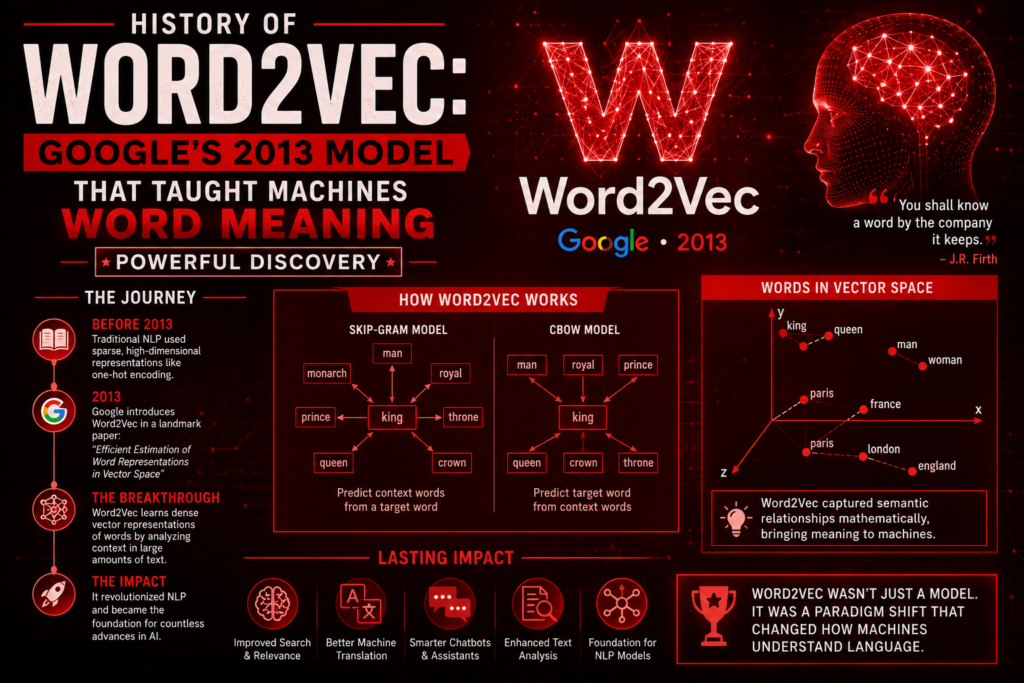
History of word2vec became one of the most revolutionary chapters in natural language processing after Google introduced Word2Vec in 2013. Before this breakthrough, machines struggled to understand the meaning of words, relationships between terms, and contextual language patterns. Computers could process text statistically, but they lacked true semantic understanding.
The arrival of Word2Vec completely changed natural language understanding. Instead of treating words as isolated symbols, Word2Vec transformed words into mathematical vectors inside a semantic vector space. This allowed machines to recognize similarities, relationships, and lexical meaning in a surprisingly human-like way.
The impact of history of word2vec can now be seen across chatbots, search engines, recommendation systems, translation tools, and modern transformer neural networks. What began as a Google Research project eventually became one of the foundations of modern AI language systems.
Today, Word2Vec remains one of the most influential breakthroughs in NLP vectorization and distributed representations.
Early Natural Language Processing Before Word2Vec (1950 – 2000)
To understand the history of word2vec, we first need to explore how computers processed language before semantic embeddings existed.
Early NLP systems relied heavily on symbolic rules and statistical counting methods.
Researchers used techniques such as:
- Bag-of-words models
- Frequency analysis
- One-hot encoding
- Statistical language models
These methods treated words independently without understanding relationships or context.
For example:
- “King” and “queen” appeared unrelated mathematically
- “Dog” and “puppy” had no semantic connection
- Synonyms remained difficult for machines to recognize
This limitation slowed natural language understanding progress for decades.
Researchers studying history of ai often describe early NLP as highly mechanical because machines lacked contextual understanding.
Neural Networks and Distributed Representations
The foundations of the history of word2vec began forming through neural network research.
During the 1980s and 1990s, researchers explored distributed representations, where information could be encoded across multiple dimensions instead of single symbolic labels.
The famous history of rnn research also helped scientists understand sequential text processing and contextual learning.
Neural systems gradually improved:
- Feature learning
- Text processing
- Semantic clustering
- Context modeling
- Embedding layers
At the same time, advances in computational power and GPU acceleration allowed larger neural models to train efficiently.
This environment prepared the perfect conditions for Word2Vec.
Geoffrey Hinton and the Deep Learning Revival (2006)
The modern history of word2vec became possible partly because of Geoffrey Hinton’s deep learning revival in 2006.
Hinton’s breakthroughs in deep architectures, feature learning, and distributed neural training helped restart interest in neural NLP systems.
Researchers discussing history of deep learning often recognize this period as the beginning of modern AI language research.
The deep learning revival improved:
- Neural optimization
- Gradient flow
- Large-scale text training
- Representation learning
- Neural network depth
Without this revival, large language embedding systems may never have succeeded.
Tomas Mikolov and Google Research
The biggest breakthrough in the history of word2vec happened in 2013 when Tomas Mikolov and researchers at Google introduced Word2Vec.
Mikolov’s goal was simple but revolutionary:
Teach machines to understand word meaning through context.
Instead of storing words as isolated symbols, Word2Vec represented words as vectors inside a high-dimensional semantic vector space.
Words appearing in similar context windows developed similar vector representations.
For example:
- “King” and “queen” became mathematically related
- “Paris” and “France” formed meaningful relationships
- “Apple” and “fruit” clustered together
This breakthrough transformed natural language understanding forever.
What Made Word2Vec Revolutionary
The history of word2vec became groundbreaking because the model captured semantic relationships automatically from large text corpora.
Instead of relying on manually programmed dictionaries, Word2Vec learned directly from data.
The system analyzed billions of words and discovered patterns naturally.
This introduced several major breakthroughs:
- Semantic vector space learning
- Word analogies
- Linguistic clusters
- Distributed representations
- Contextual meaning extraction
Machines could finally recognize relationships between words mathematically.
The Mathematics Behind Word2Vec
Word2Vec relied on neural embedding learning.
Each word became a dense vector representation.
The model optimized word probabilities based on nearby context windows.
Two main architectures powered Word2Vec:
Continuous Bag of Words (CBOW)
CBOW predicts a target word using surrounding context words.
Example:
Input: “The cat sat on the ___”
Prediction: “mat”
Skip-gram Model
Skip-gram predicts surrounding context words from a target word.
Example:
Input: “cat”
Predicted context:
- animal
- pet
- fur
- kitten
P(wO∣wI)=∑w=1Wexp(vw′TvwI)exp(vwO′TvwI)
Where:
- = Probability of output word given input word
- = Vector representation of the input word
- ′ = Vector representation of the output word
- = Total vocabulary size
- = Exponential function
- = Transpose of the vector
This optimization process allowed Word2Vec to learn semantic meaning efficiently.
Skip-gram vs CBOW
The history of word2vec heavily revolves around the difference between Skip-gram and CBOW architectures.
CBOW Advantages
- Faster training
- Better for frequent words
- Efficient on large corpora
Skip-gram Advantages
- Better for rare words
- Captures detailed semantics
- Stronger contextual learning
Both approaches became foundational in NLP vectorization research.
Word Analogies Shocked Researchers
One of the most surprising discoveries in the history of word2vec involved vector math analogies.
Researchers found that word relationships could be solved mathematically.
Example:
This shocked the AI community because the network learned abstract relationships without explicit programming.
Word embeddings captured:
- Gender relationships
- Country-capital relationships
- Verb tense patterns
- Semantic similarity
This became one of the greatest research breakthroughs in NLP history.
Cosine Similarity and Semantic Relationships
Word2Vec measured semantic closeness using cosine similarity.
The formula is:
Where:
- and = word vectors
Higher cosine similarity indicated stronger semantic relationships.
This allowed machines to identify related meanings automatically.
For example:
- “Doctor” and “nurse” cluster closely
- “Car” and “engine” appear related
- “Pizza” and “planet” remain distant
This transformed natural language understanding dramatically.
Word2Vec and the Rise of Modern NLP
The history of word2vec directly influenced modern NLP systems.
Word embeddings became foundational for:
- Machine translation
- Search engines
- Chatbots
- Recommendation systems
- Sequence models
- Transformer architectures
Researchers studying sequence to sequence models often recognize Word2Vec embeddings as critical components in early neural translation systems.
The rise of embedding layers improved almost every major NLP application.
Word2Vec and Deep Learning Growth
The success of Word2Vec accelerated the broader deep learning revolution.
Researchers exploring what is deep learning frequently mention embeddings as one of the technologies that allowed neural systems to understand language more naturally.
Word2Vec also influenced:
- Generative AI
- Conversational systems
- Search ranking
- Voice assistants
- Semantic search
Its influence reached nearly every branch of NLP research.
Word2Vec vs Modern Transformers
Today, transformer models dominate NLP research, but Word2Vec remains historically important.
Researchers discussing transformer neural networks often view Word2Vec as one of the earliest successful language representation systems.
Transformers improved contextual understanding using attention mechanisms.
However, Word2Vec introduced the critical concept that words could exist inside meaningful vector spaces.
Without Word2Vec, modern language models may have evolved much more slowly.
The Influence of Tomas Mikolov
Tomas Mikolov became one of the most respected NLP researchers because of Word2Vec.
His work at Google Research changed how machines process language forever.
The history of word2vec remains closely connected to Mikolov’s contributions in:
- Distributed representations
- Semantic embeddings
- Efficient neural NLP
- Vectorized language learning
His research inspired later embedding systems such as:
- GloVe
- FastText
- BERT embeddings
- Transformer token representations
Word2Vec in Today’s AI Systems
Modern AI systems still rely heavily on embedding principles inspired by Word2Vec.
Many of today’s best free ai tools use embedding layers for semantic understanding, recommendation systems, and conversational AI.
Embedding systems now power:
- Search ranking
- AI assistants
- E-commerce recommendations
- Document retrieval
- Semantic analysis
Even advanced language models still build upon vectorization ideas introduced by Word2Vec.
The Lasting Legacy of Word2Vec
The history of word2vec represents one of the most important turning points in natural language processing.
Word2Vec taught machines that words contain relationships, patterns, and semantic meaning beyond simple symbols.
This breakthrough transformed machines from text processors into systems capable of contextual language understanding.
The influence of Word2Vec continues shaping AI today.
FAQs About Word2Vec
What is Word2Vec?
Word2Vec is a neural language model introduced by Google in 2013 that converts words into semantic vector embeddings.
Who invented Word2Vec?
Tomas Mikolov and researchers at Google Research developed Word2Vec.
Why is Word2Vec important?
Word2Vec allowed machines to understand semantic relationships between words using vector representations.
What are word embeddings?
Word embeddings are mathematical vector representations that capture semantic meaning and contextual relationships between words.
What is the difference between CBOW and Skip-gram?
CBOW predicts target words from context, while Skip-gram predicts surrounding context from target words.
Is Word2Vec still used today?
Yes. Word2Vec concepts remain foundational in modern NLP systems and embedding architectures.
Conclusion
The story of history of word2vec represents one of the greatest breakthroughs in natural language processing. Before Word2Vec, machines struggled to understand semantic relationships and contextual meaning.
Tomas Mikolov and Google Research changed this forever in 2013 by introducing word embeddings, Skip-gram learning, CBOW architectures, and semantic vector spaces.
The rise of Word2Vec became deeply connected to history of deep learning, history of rnn, sequence to sequence models, transformer neural networks, and what is deep learning research.
Today, Word2Vec continues influencing search engines, recommendation systems, chatbots, and generative AI worldwide.
As AI language systems continue evolving, the legacy of Word2Vec will remain one of the most important milestones in artificial intelligence history.