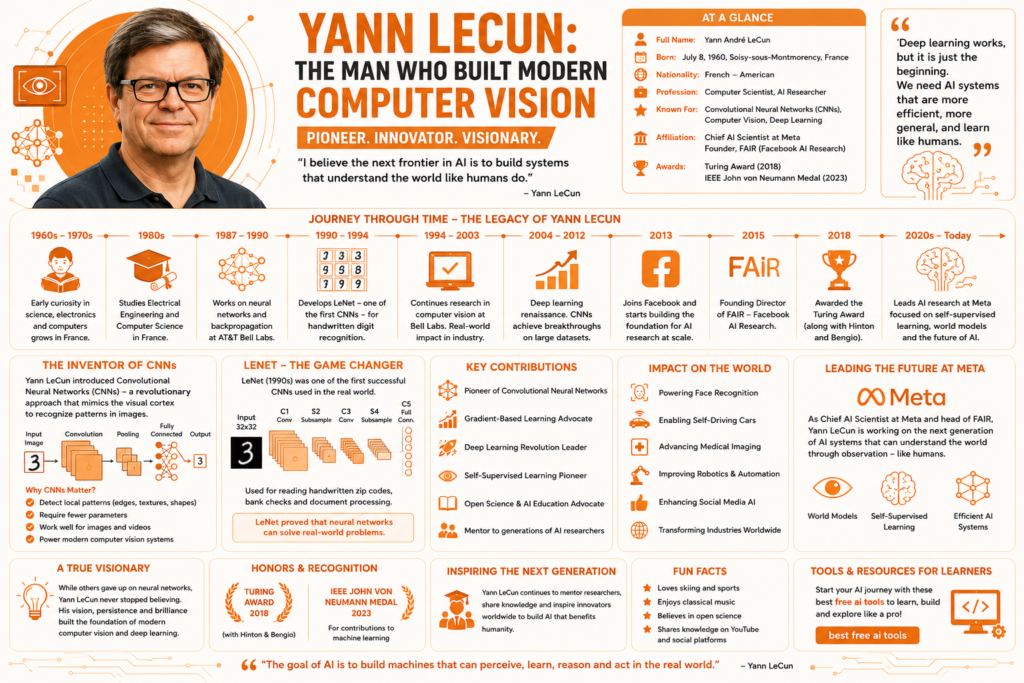
Yann lecun biography is one of the most important stories in artificial intelligence because Yann LeCun helped create the foundations of modern computer vision. Long before AI became globally popular, LeCun believed neural networks could eventually recognize images, understand visual patterns, and power intelligent machines.
At a time when many researchers doubted neural networks completely, LeCun continued improving convolutional neural networks and gradient-based learning systems. His work eventually transformed computer vision, image recognition, autonomous systems, and modern deep learning.
Today, the influence of yann lecun biography can be seen everywhere:
- Face recognition
- Self-driving cars
- Medical imaging
- Smartphone cameras
- Social media AI
- Robotics
LeCun’s contributions changed artificial intelligence forever and helped launch the modern AI revolution.
Early Life of Yann LeCun (1960 – 1980)
The story of yann lecun biography began in France, where Yann LeCun was born in 1960 near Paris.
From an early age, he became fascinated by science, electronics, mathematics, and engineering.
LeCun enjoyed:
- Building electronic devices
- Exploring physics
- Understanding how machines work
- Studying computation
His curiosity eventually led him toward computer engineering and artificial intelligence.
During this period, AI research itself remained highly experimental.
Researchers discussing history of ai often describe the 1970s as a difficult era filled with limited computing power and uncertain progress.
Despite these limitations, LeCun became deeply interested in machine intelligence.
Education and Early Research
The yann lecun biography journey continued when he studied electrical engineering in France.
LeCun later joined Université Pierre et Marie Curie, where he focused heavily on neural network research.
At the time, neural networks were not popular.
Many researchers believed symbolic AI would dominate the future.
However, LeCun strongly believed learning systems inspired by biology could achieve far greater flexibility.
This belief shaped his entire scientific career.
Neural Networks Before LeCun
To understand the importance of yann lecun biography, we must examine the state of neural networks before his breakthroughs.
Early neural research began with the famous mcculloch and pitts neural network model in 1943.
Later, perceptrons introduced simple learning systems.
However, neural networks faced severe criticism during the AI winters.
The famous perceptron controversy greatly damaged confidence in neural research.
Many scientists abandoned neural networks entirely.
Yann LeCun became one of the few researchers who continued believing in their potential.
Backpropagation and Neural Learning
One major breakthrough in the yann lecun biography story involved backpropagation.
Researchers discussing history of backpropagation often identify LeCun as one of the scientists who helped popularize gradient-based neural training.
Backpropagation updates neural weights through error minimization:
Where:
- = neural weight
- = learning rate
- = error
This method allowed deep networks to learn complex patterns effectively.
LeCun recognized its enormous potential for visual recognition tasks.
The Birth of Convolutional Neural Networks
The defining breakthrough in yann lecun biography arrived through convolutional neural networks.
LeCun realized traditional neural networks struggled with images because they ignored spatial structure.
Images contain local patterns such as:
- Edges
- Shapes
- Textures
- Spatial relationships
LeCun designed CNNs to process images more efficiently using convolution layers.
The convolution operation became:
Where:
- = image
- = kernel filter
This architecture transformed computer vision forever.
LeNet and Handwritten Digit Recognition
One of the most important milestones in the yann lecun biography story was LeNet.
LeNet became one of the earliest successful convolutional neural networks.
The system recognized handwritten digits automatically.
Applications included:
- Bank check reading
- Postal code recognition
- Document processing
LeNet used:
- Convolution layers
- Pooling layers
- Gradient-based learning
This became one of the first practical deep learning successes in history.
Researchers discussing history of cnn often identify LeNet as the true beginning of modern computer vision.
Bell Labs and Practical AI Systems
The yann lecun biography journey expanded further when LeCun joined Bell Labs.
Bell Labs provided an environment for large-scale AI experimentation.
LeCun continued improving:
- CNN architectures
- Image recognition systems
- Neural optimization
- Pattern recognition
At Bell Labs, LeCun demonstrated that neural networks could solve real-world industrial problems.
This practical success became extremely important during a time when many researchers still doubted neural AI.
AI Winters and Persistence
One of the most inspiring aspects of yann lecun biography involves persistence during difficult periods.
During the 1990s and early 2000s, neural networks lost popularity again.
Researchers discussing second ai winter often describe this period as highly discouraging for neural research.
Many scientists shifted toward:
- Support Vector Machines
- Probabilistic methods
- Symbolic AI
However, LeCun continued improving convolutional systems despite limited recognition.
His persistence eventually changed AI history.
Deep Learning Revival (2006 – 2012)
The modern yann lecun biography became deeply connected to the deep learning revival.
Researchers discussing history of deep learning often group Yann LeCun together with Geoffrey Hinton and Yoshua Bengio as the “Godfathers of Deep Learning.”
The revival became possible because of:
- GPU acceleration
- Larger datasets
- Improved hardware
- Better optimization
Researchers discussing gpu history in ai frequently highlight GPUs as essential for CNN success.
Deep learning suddenly achieved dramatic breakthroughs in image recognition tasks.
LeCun’s earlier CNN research became globally important.
ImageNet and the CNN Revolution
One major turning point in yann lecun biography came through ImageNet competitions.
Researchers discussing history of imagenet often identify CNNs as the architecture that transformed computer vision permanently.
In 2012, AlexNet achieved stunning ImageNet performance using deep convolutional networks.
This victory shocked the AI community.
CNNs quickly became dominant across:
- Facial recognition
- Medical imaging
- Autonomous vehicles
- Security systems
LeCun’s decades of research finally received worldwide recognition.
Facebook AI Research (FAIR)
The yann lecun biography story entered a new phase when LeCun joined Facebook, later called Meta.
He founded FAIR:
Facebook AI Research.
FAIR became one of the world’s leading AI research organizations.
LeCun helped advance:
- Open science
- Self-supervised learning
- Computer vision
- Language modeling
- Robotics research
His leadership strongly influenced modern AI development.
Self-Supervised Learning and Future AI
The modern yann lecun biography increasingly focuses on self-supervised learning.
LeCun believes future AI systems should learn similarly to humans through observation rather than enormous labeled datasets.
Self-supervised systems learn hidden structure directly from data.
This approach may help solve major AI limitations involving:
- Data efficiency
- General reasoning
- Adaptability
LeCun continues advocating strongly for these methods today.
Yann LeCun and Computer Vision
The greatest contribution in yann lecun biography remains computer vision.
Modern computer vision systems now power:
- Self-driving cars
- Medical diagnosis
- Surveillance systems
- Smartphone cameras
- Robotics
Researchers discussing cnn computer vision history often describe LeCun as the scientist who built the foundations of modern image recognition.
Without CNNs, many modern AI systems would not exist.
LeCun vs Transformers
The yann lecun biography story also includes interesting debates about AI architectures.
Researchers discussing transformer neural networks often compare transformer systems with CNN approaches.
Although transformers dominate language AI today, CNNs remain highly important in:
- Vision systems
- Image segmentation
- Embedded AI
- Edge computing
LeCun also advocates for future architectures beyond current transformer models.
Open Science and AI Advocacy
Another important part of yann lecun biography involves scientific advocacy.
LeCun strongly supports:
- Open research
- Academic collaboration
- Public AI discussion
- Ethical AI development
He frequently shares educational content online and participates in AI debates globally.
His influence extends beyond research into public scientific communication.
Turing Award and Global Recognition
The achievements in yann lecun biography eventually earned worldwide recognition.
In 2018, Yann LeCun received the Turing Award alongside Geoffrey Hinton and Yoshua Bengio.
The Turing Award is often called the “Nobel Prize of Computing.”
This award recognized their contributions to:
- Deep learning
- Neural networks
- Artificial intelligence
The honor confirmed LeCun’s enormous influence on modern technology.
Yann LeCun’s Influence on Modern AI
Today, the influence of yann lecun biography reaches nearly every AI application.
CNNs now support:
- Autonomous driving
- Medical image analysis
- Social media AI
- Robotics
- Security systems
- Scientific imaging
Researchers discussing self driving cars and ai frequently rely on convolutional computer vision systems originally inspired by LeCun’s work.
His influence remains foundational to modern machine intelligence.
AI Criticism and Scientific Debate
LeCun is also known for openly debating AI ideas.
He frequently discusses:
- AGI limitations
- Language model weaknesses
- Future AI architectures
- AI safety
These debates help shape global conversations about artificial intelligence research.
His scientific influence extends far beyond convolutional networks alone.
The Future Vision of Yann LeCun
The future direction of yann lecun biography continues evolving.
LeCun now focuses heavily on:
- Autonomous intelligence
- World models
- Self-supervised learning
- Energy-efficient AI
He believes current AI systems still lack true understanding of the physical world.
Future systems may become:
- More adaptive
- More efficient
- More human-like
His ideas continue shaping future AI research globally.
The Lasting Legacy of Yann LeCun
The story of yann lecun biography represents one of the most important journeys in artificial intelligence history.
From LeNet to FAIR and modern computer vision, Yann LeCun helped transform neural networks from unpopular research ideas into world-changing technologies.
The combination of:
- CNN invention
- Gradient-based learning
- Computer vision research
- Open science advocacy
- Deep learning leadership
created the foundations of modern visual AI systems.
Today, many of the world’s best free ai tools rely directly or indirectly on technologies influenced by LeCun’s pioneering research.
His legacy continues shaping the future of artificial intelligence worldwide.
FAQs About Yann LeCun
Who is Yann LeCun?
Yann LeCun is a French-American computer scientist known for pioneering convolutional neural networks and modern computer vision.
Why is Yann LeCun famous?
He helped invent CNNs, developed LeNet, and became one of the Godfathers of Deep Learning.
What is LeNet?
LeNet is one of the earliest successful convolutional neural networks designed for handwritten digit recognition.
What is FAIR?
FAIR stands for Facebook AI Research, the AI research division founded by Yann LeCun at Meta.
Did Yann LeCun win the Turing Award?
Yes. Yann LeCun won the 2018 Turing Award alongside Geoffrey Hinton and Yoshua Bengio.
Why are CNNs important?
CNNs transformed computer vision and power many modern AI systems including image recognition and autonomous driving.
Conclusion
The story of yann lecun biography represents one of the greatest scientific journeys in modern artificial intelligence. Through convolutional neural networks, computer vision research, and deep learning advocacy, Yann LeCun helped build the foundations of modern AI.
His work became deeply connected to history of cnn, history of deep learning, history of imagenet, gpu history in ai, and self driving cars and ai research.
Today, CNNs continue powering visual intelligence systems across healthcare, robotics, autonomous vehicles, and social media platforms worldwide.
As artificial intelligence evolves further, Yann LeCun’s contributions will remain among the most influential breakthroughs in the history of computing.