Light had puzzled physicists for centuries, but nothing prepared them for the strange behavior uncovered in the late nineteenth century, when scientists noticed that shining light on certain metals could knock electrons loose from their surface. This phenomenon, known today through the photoelectric effect explained by quantum theory, defied every prediction classical wave theory could offer. It took Max Planck’s radical idea of energy quanta, combined with Albert Einstein’s fearless application of that idea, to finally solve one of the strangest puzzles in the history of physics.
Understanding the photoelectric effect explained through quantum theory means understanding how two towering scientific minds, working just five years apart, transformed a baffling laboratory observation into one of the strongest pieces of evidence for the reality of quantum mechanics.
What Is the Photoelectric Effect?
The photoelectric effect refers to the emission of electrons from a metal surface when light shines upon it. This phenomenon was first observed experimentally in the 1880s, closely tied to earlier studies involving cathode rays and electron behavior in metals. At first glance, this seemed like a simple, almost mundane observation. Light hits metal, and electrons are ejected.
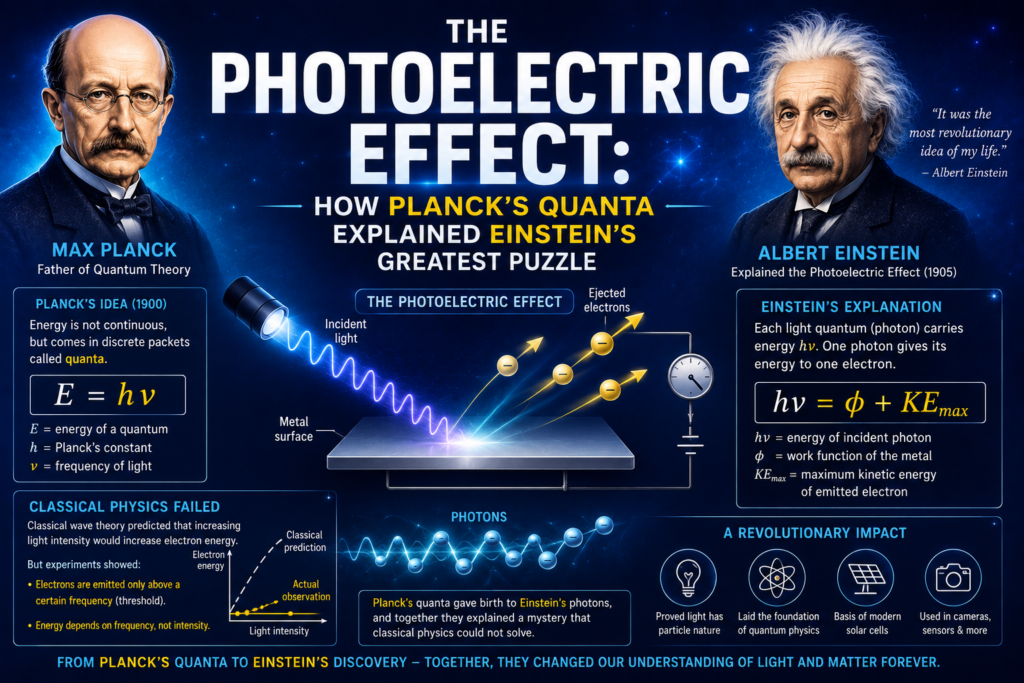
The real mystery emerged when scientists studied the details more closely. According to classical wave theory, increasing the intensity of light should increase the energy of ejected electrons, since more intense waves carry more energy. However, real experiments showed something completely different, setting the stage for one of the most important puzzles the photoelectric effect explained would eventually resolve.
The Failure of Classical Wave Theory
Classical physics assumed light behaved purely as a continuous electromagnetic wave, as described by James Clerk Maxwell’s equations. Under this assumption, brighter light, carrying more energy, should always produce electrons with greater kinetic energy of electrons, regardless of the light’s color or frequency.
Experiments proved this wrong in three critical ways. First, electron emission occurred only if light exceeded a specific threshold frequency, no matter how intense the light became below that point. Second, increasing light intensity increased the number of emitted electrons, not their individual energy. Third, electron emission happened almost instantaneously, with no measurable delay, something classical wave theory could not explain at all. This wave theory failure left physicists searching desperately for an alternative explanation.
Planck’s Quantum Hypothesis Enters the Picture (1900)
The missing piece came from an unexpected source. In 1900, Max Planck proposed a solution to the entirely separate blackbody radiation problem, suggesting that energy is emitted and absorbed only in fixed, discrete packets called quanta. This became known as the quantum hypothesis, expressed through the now famous equation:
E = hν
Here, E represents the energy of a single quantum, ν (nu) is frequency, and h is planck’s constant, approximately 6.626 × 10⁻³⁴ joule seconds. Planck himself never intended this idea to apply to light itself, viewing it purely as a mathematical tool for solving his specific radiation puzzle.
Einstein’s Bold Leap: The Photon Theory of Light (1905)
Five years later, Albert Einstein made an audacious intellectual leap that Planck himself had hesitated to take. Einstein proposed that light itself is composed of discrete energy packets, later called photons, each carrying energy according to the same formula, E = hν. This became known as the photon theory of light, sometimes referred to using older terminology as a form of corpuscular theory revived through quantum principles.
Using this framework, Einstein finally provided the photoelectric effect explained in a way that matched experimental observations perfectly. According to Einstein, a single photon transfers its entire energy to a single electron upon absorption. If that photon’s energy, determined by its frequency, exceeds the metal’s work function physics, the minimum energy needed to free an electron, the electron is ejected instantly.
The Mathematics Behind Einstein’s Explanation
Einstein’s explanation can be expressed through a precise mathematical relationship. The maximum kinetic energy of an ejected electron is given by:
K_max = hν − φ
Here, K_max represents the maximum kinetic energy of electrons, h is planck’s constant, ν is the frequency of incoming light, and φ (phi) represents the work function, a value specific to each metal representing the minimum energy required to release an electron from its surface.
This equation elegantly explained every puzzling observation. Below the threshold frequency, where hν is smaller than φ, no electrons are emitted regardless of intensity, since individual photons simply lack sufficient energy. Above the threshold, increasing light intensity increases the number of photons striking the surface, and therefore the number of ejected electrons, without increasing each electron’s individual kinetic energy of electrons. This matched real experimental data precisely, something classical wave theory had never managed to achieve.
Confirming the Theory: Millikan’s Experiments (1914 – 1916)
Although Einstein’s explanation was mathematically elegant, it required experimental confirmation before gaining widespread acceptance. American physicist Robert Millikan, initially skeptical of Einstein’s photon theory, spent nearly a decade conducting precise experiments, building upon techniques refined through his earlier millikan oil drop experiment work measuring fundamental charge.
Between 1914 and 1916, Millikan’s meticulous measurements confirmed Einstein’s equation with remarkable accuracy, providing strong experimental support for quanta absorption as a genuine physical process. Ironically, Millikan’s careful verification, despite his initial doubts, helped cement Einstein’s photon theory as scientific fact rather than speculative hypothesis.
Why This Discovery Earned the Nobel Prize (1921)
In 1921, Einstein received the Nobel Prize in Physics specifically for his explanation of the photoelectric effect, not for his more famous theory of relativity, which remained controversial at the time. This recognition highlighted just how significant the photoelectric effect explained through quantum theory truly was to the scientific community.
This achievement also solidified the deep intellectual connection between planck and einstein, since Einstein’s Nobel-winning work depended entirely on extending Planck’s original quantum hypothesis into an entirely new domain of physics.
Establishing Wave-Particle Duality
The photoelectric effect explained through photon theory raised a fascinating question. If light behaves as discrete particles in this experiment, how could it also produce interference patterns, a behavior only explainable through wave theory? This apparent contradiction led directly to the concept of wave-particle duality, the idea that light, and later matter itself, exhibits both wave-like and particle-like properties depending on how it is observed and measured.
This dual nature became a cornerstone principle of the emerging quantum revolution, fundamentally reshaping how physicists understood the nature of light and matter at the smallest scales.
Real World Applications of the Photoelectric Effect
Beyond its historical significance, the photoelectric effect explained through quantum theory now powers countless modern technologies. Solar panels rely directly on this principle to convert sunlight into electricity. Digital cameras, photocopiers, and light sensors all depend on electron emission triggered by photon absorption, a direct practical legacy of Einstein’s theoretical breakthrough.
The Legacy: Max Planck Quantum Universe
The photoelectric effect stands as one of the clearest confirmations of what is now called the Max Planck Quantum Universe, a reality governed by discrete photon energy rather than smooth classical wave behavior. This discovery, born from Planck’s reluctant quantum hypothesis and confirmed through Einstein’s bold theoretical leap, remains foundational to modern physics and technology alike.
Frequently Asked Questions
What is the photoelectric effect explained simply?
The photoelectric effect refers to the emission of electrons from a metal surface when light of sufficient frequency strikes it, a phenomenon explained through Einstein’s photon theory of light.
Why couldn’t classical physics explain the photoelectric effect?
Classical wave theory predicted that electron energy should depend on light intensity, but experiments showed it depended only on frequency, a contradiction only quantum theory could resolve.
How did Einstein use Planck’s ideas to explain the photoelectric effect?
Einstein applied Planck’s quantum hypothesis to light itself, proposing that light consists of discrete photons whose energy depends on frequency, directly explaining electron emission patterns.
Did Einstein win the Nobel Prize for the photoelectric effect?
Yes, Einstein received the 1921 Nobel Prize in Physics specifically for his explanation of the photoelectric effect, not for his theory of relativity.
How is the photoelectric effect used in modern technology?
The photoelectric effect underlies solar panels, digital cameras, and various light sensors, all of which rely on photon absorption triggering electron emission.
Conclusion
The photoelectric effect explained through quantum theory stands as one of the most elegant confirmations of Planck’s original quantum hypothesis. What began as a puzzling laboratory observation, defying every classical prediction, was ultimately resolved through Einstein’s bold application of energy quanta to light itself. This breakthrough not only earned Einstein the Nobel Prize but also cemented the reality of quantum mechanics, launching wave-particle duality and reshaping modern physics forever. More than a century later, the photoelectric effect continues to power the technology of everyday life, a lasting testament to the strange and beautiful quantum universe Planck and Einstein helped reveal.