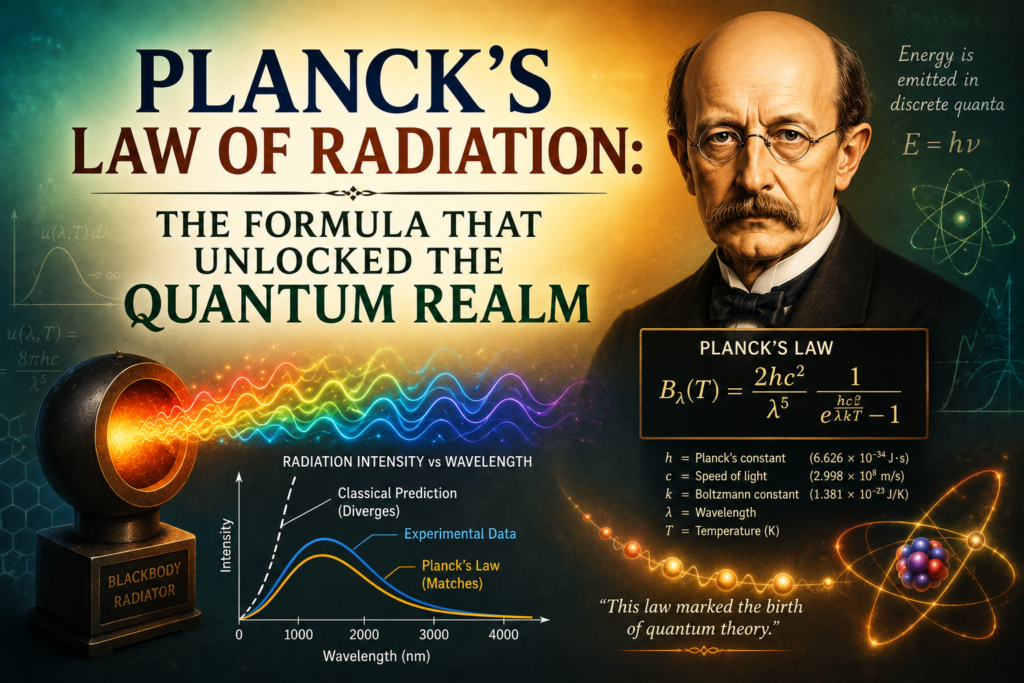
Some equations solve a problem. Others open an entirely new universe. Planck’s law of radiation belongs firmly in the second category. What started as an attempt to fix a broken thermodynamics formula ended up handing humanity the mathematical key to the quantum realm, a hidden layer of reality where energy behaves nothing like the smooth, predictable world described by classical physics.
To truly appreciate planck’s law of radiation, you have to understand both the desperate scientific need that created it and the strange, powerful implications hidden inside its structure.
Why Physicists Needed a New Radiation Formula (1859 – 1900)
Long before Planck entered the picture, physicists were fascinated by how heated objects emit light and heat. Gustav Kirchhoff formalized the concept of an ideal black body in 1859, an object that absorbs all radiation striking it and emits energy based purely on temperature.
The trouble was that no existing formula could correctly describe this emission across the entire spectrum. This challenge became known as the blackbody radiation problem, and by the late 1800s it had turned into one of the most embarrassing unsolved puzzles in physics. Classical formulas either worked at long wavelengths and failed at short ones, or the reverse, but never both at once.
The Failure That Forced a Breakthrough
The most damaging failure came from the Rayleigh-Jeans formula, built entirely on classical thermodynamics and wave theory. It performed reasonably well at longer wavelengths but predicted something physically absurd at shorter, ultraviolet wavelengths: infinite emitted energy. This impossible result became known as the ultraviolet catastrophe, and it proved that classical physics had hit a genuine wall.
Scientists needed a formula that could behave correctly at both extremes of the spectrum without breaking down. Nothing built from classical assumptions alone seemed capable of doing that.
Planck’s Path to a Working Formula (1900)
Max Planck approached this problem differently than his predecessors. Rather than beginning purely from theoretical principles, he worked backward from the actual experimental data fit of the blackbody curve, adjusting his mathematics until it matched observed results across every wavelength simultaneously.
This process, sometimes described as mathematical interpolation, eventually led him to a startling conclusion. The formula would only work correctly if the oscillators emitting radiation inside a heated cavity carried energy in fixed, discrete amounts rather than continuous values. This assumption became known as the quantum hypothesis, and it directly gave rise to planck’s law of radiation.
Building the Formula Step by Step
Planck assumed that each oscillator’s energy could only take specific values, expressed as whole number multiples of a basic unit:
E = nhν
Here, n is a positive integer, ν (nu) is the oscillation frequency, and h is planck’s constant, valued at approximately 6.626 × 10⁻³⁴ joule seconds. Using statistical tools related to the boltzmann distribution, Planck calculated the average oscillator energy at a given absolute temperature T:
⟨E⟩ = hν / (e^(hν / kT) − 1)
Combining this average energy with the known frequency distribution of oscillating modes inside the cavity produced the complete expression for spectral radiance, B_ν(T):
B_ν(T) = (2hν³ / c²) × 1 / (e^(hν / kT) − 1)
This is planck’s law of radiation, where c represents the speed of light and k is the Boltzmann constant. Every symbol in this equation carries physical meaning, and together they describe the radiation density emitted at any frequency and temperature.
How the Formula Solved Two Problems at Once
The true elegance of planck’s law of radiation lies in how it behaves at the extremes. At low frequencies, a mathematical approximation of the exponential term causes the formula to collapse neatly into the older Rayleigh-Jeans result, preserving accuracy where classical physics already worked.
At high frequencies, the exponential term grows so rapidly that the overall expression shrinks toward zero instead of exploding toward infinity. This single mathematical feature quietly eliminated the ultraviolet catastrophe, giving physicists their first formula capable of matching the entire blackbody curve with precision.
What the Formula Revealed About Reality
Planck’s law of radiation was not simply a clever mathematical patch. Its success depended entirely on accepting that energy exists in discrete quanta rather than flowing continuously, a claim that directly contradicted the deterministic, smooth worldview of classical physics.
This meant that oscillating particles could not gradually absorb or release energy. They could only jump between fixed, quantized levels. By limiting how much energy could realistically populate high frequency modes, this restriction directly resolved the runaway prediction responsible for the ultraviolet catastrophe, revealing something genuinely new about how nature operates at small scales.
From Mathematical Trick to Physical Law
Interestingly, Planck himself was initially unconvinced that quantization reflected true physical reality, treating it more as a useful mathematical device. It took further discoveries to confirm that his formula described something real.
In 1905, Albert Einstein extended these same quantum ideas to explain the photoelectric effect, proposing that light itself travels in discrete photon packets. The relationship between planck and einstein proved crucial in transforming planck’s law of radiation from an abstract equation into an accepted description of physical reality, launching what would become known as the quantum revolution.
Where This Formula Is Used Today
The influence of planck’s law of radiation reaches far beyond nineteenth century physics laboratories. Astronomers use it to calculate the surface temperature of distant stars simply by analyzing their emitted light spectrum. Engineers rely on it when designing thermal cameras, infrared sensors, and industrial heating systems.
Cosmologists also depend on principles rooted in planck’s law of radiation when studying the cosmic microwave background, one of the strongest pieces of observational evidence supporting the Big Bang theory. A formula born from one narrow radiation puzzle has become a permanent tool across astrophysics, engineering, and mathematical physics.
Why This Formula Changed Everything
Before planck’s law of radiation, physicists assumed energy was continuous and infinitely divisible. After it, they were forced to accept that nature operates on discrete, quantized principles at its most fundamental level. This was not a minor correction. It marked the beginning of the birth of quantum mechanics, an entirely new framework that would eventually explain atomic structure, chemical bonding, and the behavior of subatomic particles.
The Legacy: Max Planck Quantum Universe
The success of planck’s law of radiation opened the door to what is now widely known as the Max Planck Quantum Universe, a reality governed by discrete energy levels rather than the smooth continuity classical physics once assumed. More than a century later, this single formula continues to influence modern astrophysics, thermal engineering, and quantum research happening today.
Frequently Asked Questions
What is planck’s law of radiation used for?
Planck’s law of radiation is used to calculate how much electromagnetic energy a black body emits at a given wavelength and temperature, with applications in astrophysics, engineering, and cosmology.
Why did Planck introduce quantized energy in his formula?
Planck introduced quantized energy because it was the only way his formula could accurately match experimental blackbody radiation data across the entire electromagnetic spectrum without predicting infinite energy.
How does planck’s law of radiation avoid the ultraviolet catastrophe?
At high frequencies, the exponential term in the formula grows rapidly, causing predicted energy to shrink toward zero rather than diverge toward infinity, eliminating the ultraviolet catastrophe entirely.
What role does planck’s constant play in this formula?
Planck’s constant determines the size of each energy quantum, directly shaping how energy is distributed across different frequencies within the equation.
Is planck’s law of radiation still relevant today?
Yes, it remains essential in astrophysics for measuring star temperatures, in engineering for thermal imaging, and in cosmology for analyzing cosmic microwave background radiation.
Conclusion
Planck’s law of radiation stands as proof that the pursuit of a single accurate equation can quietly reshape all of science. Born from painstaking mathematical interpolation rather than pure theoretical inspiration, this formula ended a decades long crisis in classical physics while revealing something far more profound underneath. What began as an attempt to fix a broken radiation formula ultimately unlocked the quantum realm, a discovery whose influence continues to shape physics, astronomy, and technology well over a century later.