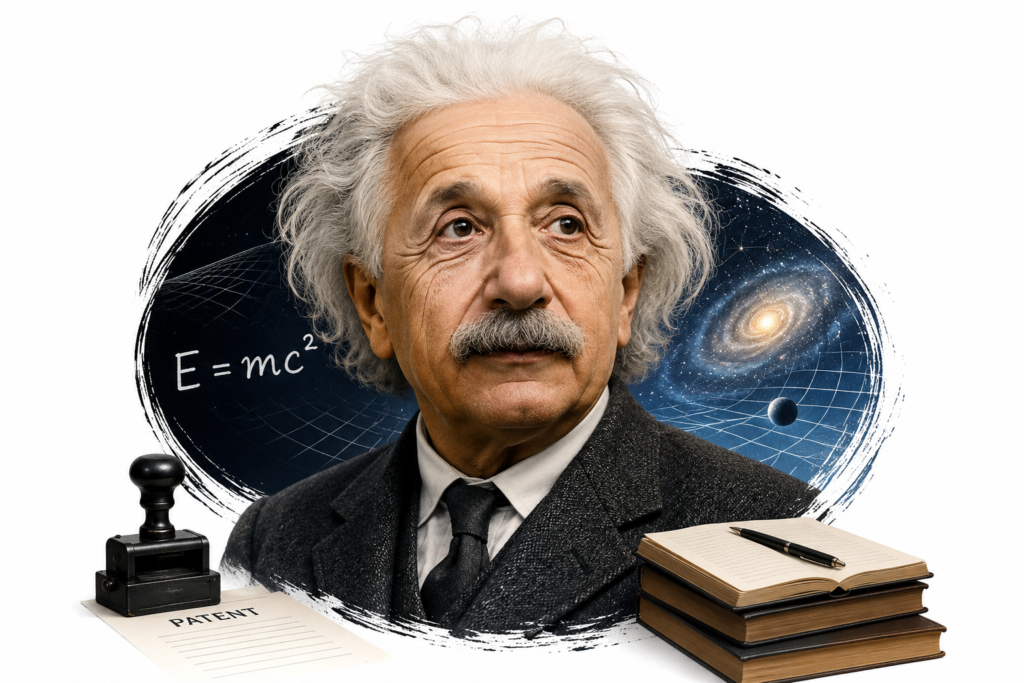
Few names in history carry the same weight as Albert Einstein, yet the question who was albert einstein deserves a closer look than the popular image of a wild haired genius scribbling equations on a chalkboard. The real answer is far more surprising. He was, for years, an obscure patent clerk in Switzerland, overlooked by the academic establishment, quietly working out ideas that would soon dismantle two centuries of confident physics and change human civilization forever.
Understanding who was albert einstein means tracing the journey of a German-born physicist who transformed from an unemployed graduate with no university position into arguably the most famous scientist in history.
Early Life and a Difficult Start (1879 – 1900)
Albert Einstein was born on March 14, 1879, in Ulm, Germany, into a middle class Jewish family. Contrary to popular myth, young Albert Einstein was not a poor student. He excelled particularly in mathematics and physics from an early age, though he famously disliked the rigid, authoritarian teaching methods common in German schools at the time.
Einstein’s family later moved to Italy, and he eventually enrolled at Zurich Polytechnic in Switzerland to study theoretical physics and mathematics. Anyone researching who was albert einstein academically will find that his university years were marked by independent thinking and a somewhat rebellious attitude toward professors, traits that would define his entire scientific career.
The Struggle Before Success
After graduating in 1900, Einstein struggled significantly to find an academic position, a surprising detail for anyone learning who was albert einstein for the first time. Despite his obvious talent, his independent streak and occasional friction with professors left him without the recommendations needed for a university post.
Eventually, Einstein secured a position at the Swiss Patent Office Bern, working as a patent examiner third class, evaluating technical applications for a modest salary. Far from wasted time, this period gave Einstein the mental space to develop his own ideas, often through creative thought experiments, known in German as Gedankenexperiment, while completing his official duties efficiently enough to leave hours free for independent research.
The Miracle Year: 1905
The definitive answer to who was albert einstein arrived suddenly in 1905, a period now famously called Einstein’s Annus Mirabilis, or miracle year. While still working at the patent office, Einstein published four groundbreaking scientific papers 1905 in the prestigious journal Annalen der Physik, any one of which would have secured a remarkable scientific legacy on its own.
These papers addressed Brownian motion explained through statistical physics, the photoelectric effect, special relativity, and mass-energy equivalence. Together, they represented one of the most productive scientific outputs by any single individual in the history of physics, produced almost entirely outside the traditional academic system.
Explaining the Photoelectric Effect
One of Einstein’s 1905 papers tackled a puzzle that classical physics could not solve. Building on Max Planck’s earlier quantum hypothesis, Einstein proposed that light itself travels as discrete packets of energy, later called photons. This became known as einstein photoelectric effect theory, explaining why light striking a metal surface only ejects electrons above a specific threshold frequency, regardless of intensity.
This single insight, connecting directly to einstein and planck‘s intertwined legacy, eventually earned Einstein the Nobel Prize in Physics in 1921, not for his more famous work on relativity, which remained scientifically controversial at the time.
Special Relativity: Rewriting Space and Time (1905)
Perhaps the most transformative of Einstein’s 1905 papers introduced special relativity explained through two deceptively simple postulates. First, the laws of physics remain identical for all observers moving at constant velocity. Second, and far more radical, the speed of light constant remains the same for every observer, regardless of their own motion.
From these two assumptions, Einstein derived astonishing consequences, including time dilation explained through the equation:
t’ = t / √(1 − v²/c²)
Here, t’ represents time as measured by a moving observer, t is time measured by a stationary observer, v is velocity, and c is the speed of light. This equation revealed that time itself is not absolute, but instead depends on relative motion, a discovery that shattered classical mechanics breakdown assumptions rooted deeply in Newtonian physics limits.
E equals mc squared: The Most Famous Equation in History
From special relativity, Einstein derived what remains the most recognizable equation in scientific history:
E = mc²
Here, E represents energy, m represents mass, and c is the speed of light. This E=mc² explained relationship revealed that mass and energy are fundamentally interchangeable, an insight with implications far beyond pure theoretical physics, eventually connecting directly to einstein and nuclear energy applications decades later.
General Relativity: Gravity Reimagined (1907 – 1915)
Building on his earlier work, Einstein spent the following decade developing general relativity explained through an entirely new understanding of gravity. Rather than viewing gravity as a force acting instantly across distance, as Newton had proposed, Einstein suggested that gravity is curved spacetime, a geometric distortion caused by the presence of mass and energy.
This radical reimagining relied on what Einstein called the equivalence principle, the idea that acceleration and gravity produce indistinguishable physical effects. Published in 1915, general relativity successfully predicted phenomena including the bending of starlight around massive objects, a prediction spectacularly confirmed during a solar eclipse observation in 1919, instantly transforming Einstein into an international celebrity.
Personal Life: Collaboration and Complexity
Einstein’s personal life included his marriage to Mileva Marić, a fellow physics student he met at Zurich Polytechnic, along with close intellectual friendships, including his lifelong bond with engineer Michele Besso, who Einstein credited as an important sounding board during his early theoretical development. These relationships formed an important backdrop to the intense intellectual period that produced his most famous work.
Escaping Nazi Germany and Life at Princeton (1933 onward)
As antisemitism intensified in Germany during the early 1930s, Einstein experienced academic exile, eventually emigrating to the United States. He accepted a position at the newly established Institute for Advanced Study Princeton, settling permanently in Princeton New Jersey, where he continued his theoretical work while becoming an outspoken advocate for pacifism and science throughout the remainder of his life.
The Einstein Letter to Roosevelt and Nuclear Age (1939)
Despite his deep commitment to pacifism, Einstein’s einstein letter to roosevelt in 1939 warned of the potential for Nazi Germany to develop nuclear weapons, urging the United States to begin its own research. This letter, born from Einstein’s earlier mass-energy equivalence discovery, directly influenced the eventual creation of the Manhattan Project, connecting Einstein indirectly to the atomic age pioneer developments that would define the remainder of the twentieth century.
Predictions Later Proven True
Remarkably, many of Einstein’s most radical theoretical predictions were confirmed only decades after his death. Einstein predictions proven include gravitational waves, directly detected in 2015 nearly a century after general relativity first predicted their existence, along with black holes, phenomena Einstein initially found mathematically troubling within his own equations, tied closely to modern research on einstein and black holes physics.
Why Einstein’s Legacy Still Matters
The Albert Einstein legacy extends far beyond theoretical physics into practical technology used daily throughout modern civilization. GPS satellites require constant correction for relativistic time dilation effects to remain accurate. Nuclear power plants operate based directly on mass-energy equivalence principles. Even Einstein’s more philosophical reflections, including his famous quote regarding God does not play dice, continue influencing debates about quantum mechanics and the philosophy of science today.
Frequently Asked Questions
Who was Albert Einstein in simple terms?
Albert Einstein was a German-born theoretical physicist who developed the theories of special and general relativity, fundamentally transforming humanity’s understanding of space, time, gravity, and energy.
What did Einstein discover in his miracle year?
In 1905, Einstein published four groundbreaking papers covering Brownian motion, the photoelectric effect, special relativity, and mass-energy equivalence, transforming modern physics within a single year.
Did Einstein win the Nobel Prize for relativity?
No, Einstein received the Nobel Prize in Physics in 1921 specifically for his explanation of the photoelectric effect, since relativity remained scientifically debated at the time.
Why did Einstein move to the United States?
Einstein emigrated to the United States in the early 1930s due to rising antisemitism in Nazi Germany, eventually settling at Princeton’s Institute for Advanced Study.
What is Einstein’s most famous equation?
Einstein’s most famous equation, E equals mc squared, describes the equivalence between mass and energy, a discovery with profound implications for nuclear physics and energy production.
Conclusion
So, who was albert einstein, truly? He was a curious, independent thinker who transformed from an overlooked patent clerk into the most recognizable scientist in history, rewriting the fundamental laws governing space, time, gravity, and energy along the way. From his miracle year in 1905 to his lasting influence on nuclear physics and modern technology, the Albert Einstein legacy remains woven into nearly every aspect of contemporary science. More than a century after his groundbreaking discoveries, the question of who was albert einstein continues to represent one of the most remarkable stories of genius, perseverance, and scientific revolution in human history.