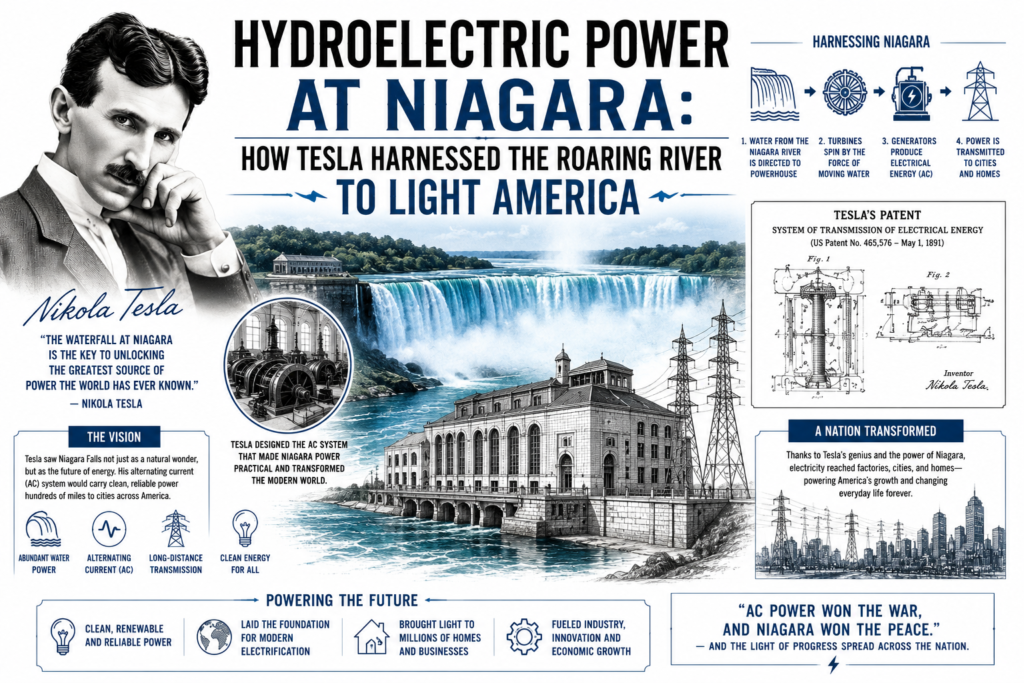
The story of niagara falls hydroelectric power is not simply a tale of water, steel, and wire. It is the story of human ambition crashing against nature’s force and winning. It is the story of a Serbian-American genius who refused to let the world stay in the dark. When Nikola Tesla stood at the edge of Niagara Falls in the 1880s and declared that he would one day harness that thundering river to power cities, most men laughed. By 1896, nobody was laughing anymore.
This is how one roaring waterfall, one brilliant mind, and one revolutionary technology permanently rewired the way the modern world generates and consumes energy.
The Untamed Power of Niagara Falls Before 1890
Long before turbines and copper wire entered the picture, Niagara Falls was already recognized as one of the most awe-inspiring natural spectacles on earth. Roughly 168,000 cubic meters of water per minute plunge over the Horseshoe Falls alone, descending approximately 57 meters before crashing into the Niagara River below. That raw kinetic to electrical potential was obvious to anyone who looked closely enough.
Early milling operations in the 1700s and 1800s had already tried to tap a fraction of this mechanical river energy through wooden millwheels and simple raceways. Small mills ground flour, cut lumber, and spun textile machinery using diverted canal water. But this was scratching the surface. The real question, the one that kept engineers awake at night, was whether hydraulic head pressure at Niagara could be channeled into something transformative, something that could drive the machinery of an entire civilization.
The hydraulic head at Niagara, the vertical difference in water elevation that drives water-driven dynamos and turbines, was immense. Engineers calculated it at roughly 43 to 50 meters of usable head at the site chosen for the eventual powerhouse. Using the fundamental hydraulic power formula:
P = ρ × g × Q × h × η
Where:
- P = Power output (Watts)
- ρ = Density of water (1,000 kg/m³)
- g = Gravitational acceleration (9.81 m/s²)
- Q = Volume flow rate (m³/s)
- h = Net hydraulic head (meters)
- η = Efficiency of turbine and generator (typically 0.85 to 0.92)
For a single early turbine unit at Niagara passing approximately 14 m³/s through a 43-meter head with an efficiency of 0.87:
P = 1,000 × 9.81 × 14 × 43 × 0.87 ≈ 5,100,000 W = 5.1 MW
That was staggering for the era. Ten such units could theoretically produce over 50 MW, enough to power an entire region. The math was breathtaking. The engineering challenge, however, was equally daunting.
The War of Currents and Why AC Won (1880 – 1893)
Before a single turbine blade rotation could be channeled into America’s homes and factories, the world had to settle a brutal technical and commercial war. On one side stood Thomas Edison, king of direct current (DC) systems, determined to wire every city in America with his network of coal-burning power stations. On the other side stood Nikola Tesla visionary inventor and his champion investor George Westinghouse, pushing alternating current (AC) with ferocious belief.
The core argument was about transmission efficiency. DC power lost enormous energy over even short distances due to resistive heating in copper cables. The relationship governing this loss is:
P_loss = I² × R
Where I is current in amperes and R is cable resistance in ohms. To reduce transmission losses over long distances, you either need to dramatically reduce I (current) or reduce R. Reducing R means heavier, more expensive cables. Reducing I means raising voltage, which is exactly what AC transformers could do with breathtaking simplicity.
For a transmission line carrying 1,000 kW over a given resistance, transmitting at 1,000 V versus 10,000 V illustrates the difference:
- At 1,000 V: I = 1,000,000 / 1,000 = 1,000 A → P_loss = (1,000)² × R = 1,000,000 × R
- At 10,000 V: I = 1,000,000 / 10,000 = 100 A → P_loss = (100)² × R = 10,000 × R
Transmitting at ten times the voltage reduces losses by a factor of 100. This was the decisive mathematical argument that settled the edison vs tesla debate once and for all.
AC transformers could step voltage up for long-distance transmission and then step it back down for safe local use. DC had no equivalent solution at the time. When the 1893 World’s Columbian Exposition in Chicago was lit brilliantly by Westinghouse and Tesla using AC power, public opinion shifted decisively. The path to Niagara was now open.
Designing the Edward Dean Adams Power Plant (1893 – 1895)
The Cataract Construction Company, formed in 1889 and reorganized under the leadership of Edward Dean Adams, assembled an international panel of the finest engineers and scientists to determine the best system for the edward dean adams power plant at Niagara. Prominent names including Lord Kelvin, who initially favored DC, eventually conceded to AC after studying the long transmission requirements.
The core infrastructure required solutions to several simultaneous engineering problems.
Penstock water delivery was the starting point. A massive intake structure was built at the brink of the falls to channel water into a deep underground penstock, essentially a large pressure pipe or tunnel, that carried water at high velocity down to the turbine chambers in the powerhouse. These penstocks were constructed from brick-lined tunnels roughly 2.4 meters in diameter, descending through bedrock to a depth of approximately 47 meters before entering the wheel pit.
Water volume exploitation was maximized by the tailrace tunnel, an extraordinary piece of powerhouse engineering, measuring nearly 2 kilometers in length, which carried discharged water back to the Niagara River below the falls. This continuous current flow ensured that turbines kept spinning at all hours of the day, delivering what engineers described as the first true baseline power supply from a large public utility generation system.
The water turbine mechanisms selected were vertical-shaft Francis turbines, designed to operate efficiently under the available hydraulic head. Each turbine was rated at approximately 5,000 horsepower (roughly 3.7 MW). The mechanical energy conversion from falling water to rotating shaft was achieved through spiral casings that directed water against the turbine runner blades at optimal angles, maximizing extraction of kinetic energy.
Tesla’s Polyphase System: The Engine Behind Niagara (1895 – 1896)
The generators installed at Niagara were direct embodiments of Nikola Tesla’s revolutionary patents. Tesla had developed his tesla polyphase system throughout the late 1880s, building on his insight into the rotating magnetic field. In a polyphase AC system, multiple sinusoidal voltages, offset in phase by equal angles, are transmitted simultaneously through separate conductors.
For a three-phase system, three voltages are separated by 120° each:
v₁(t) = V_m × sin(ωt)
v₂(t) = V_m × sin(ωt − 120°)
v₃(t) = V_m × sin(ωt − 240°)
Where:
- V_m = Peak voltage
- ω = Angular frequency = 2πf (f = frequency in Hz)
- t = time
The power delivered in a balanced three-phase system is:
P_total = √3 × V_L × I_L × cos(φ)
Where V_L is line voltage, I_L is line current, and cos(φ) is the power factor. This formula reveals that three-phase power transmission carries significantly more power per unit of conductor weight than single-phase systems, a critical advantage for industrial dynamos and regional infrastructure at massive scale.
The Niagara generators, built by Westinghouse Electric using tesla alternating current designs, were enormous machines. Each generator rotor, among the first heavy generator rotors ever constructed at this scale, weighed over 45 tons. The machines operated at 25 Hz (cycles per second) and produced two-phase AC at 2,200 volts. Transformers then stepped this up to 11,000 volts for transmission to Buffalo, approximately 35 kilometers away.
The rotating magnetic field that Tesla had visualized and patented was here at Niagara made real on an industrial scale. The relationship between mechanical rotation and electrical output in these generators followed Faraday’s law of electromagnetic induction:
EMF = −N × dΦ/dt
Where N is the number of coil turns and dΦ/dt is the rate of change of magnetic flux. As the massive rotor spun, the alternating magnetic field swept through the stator coils, producing the alternating voltage that would travel to cities, homes, and factories.
Power Flows to Buffalo: Electrifying a City (1896 – 1900)
On November 16, 1896, niagara falls hydroelectric power was transmitted commercially for the first time in history. Electricity generated at the Niagara powerhouse traveled 35 kilometers of high-voltage transmission lines to reach the streets of Buffalo, New York. The first major customer was the Pittsburgh Reduction Company, an aluminum smelter that required enormous quantities of constant power flow to run electrolytic reduction cells.
The power plant topology chosen allowed power to fan out from the central Niagara generation site to multiple localized load centers across the region. Buffalo streetcars ran on electricity from Niagara Falls, replacing horse-drawn vehicles practically overnight. Street lighting, which had previously relied on coal gas or Edison’s expensive DC stations, was now powered by clean, cheap hydroelectric current. The renewable resource grid that emerged in those early years was primitive by modern standards, but it was the direct ancestor of every electrical grid operating on earth today.
The economic impact was immediate and staggering. Electricity prices in Buffalo dropped by more than 80% within a few years of Niagara power arriving. Industries that had been shackled to locations near coal deposits could now relocate anywhere within transmission range. Early industrial grid expansion accelerated manufacturing throughout western New York and southern Ontario.
The tesla niagara falls project was declared one of the engineering wonders of the age by publications across North America and Europe. Lord Kelvin, who had once lobbied for DC power at Niagara, sent a congratulatory telegram to Westinghouse that acknowledged the complete triumph of Tesla’s AC vision.
Scaling Up: The Growth of Niagara’s Generating Capacity (1900 – 1920)
The original Niagara Power Station, known as Station No. 1, was quickly followed by Station No. 2 on the Canadian side of the falls. Together, these facilities expanded total generating capacity from an initial 11 generators producing approximately 37,500 horsepower to dozens of units eventually generating hundreds of thousands of horsepower. Massive scale electrification of North America had found its anchor point.
Engineers refined the hydraulic calculations continuously. The net power available from any hydro facility is bounded by the continuity equation:
Q = A × v
Where Q is volumetric flow rate (m³/s), A is the cross-sectional area of the penstock or channel, and v is average water velocity (m/s). Maximizing Q without impairing downstream ecology or violating treaty obligations governing Niagara’s scenic flow became a permanent engineering and political challenge.
By 1910, niagara falls hydroelectric power was widely recognized as the model for water volume exploitation at industrial scale, demonstrating that renewable energy origin need not come from burning anything at all. Coal-burning plants struggled to match the cost per kilowatt-hour that Niagara delivered continuously. The sustainable energy milestones established at Niagara during this period set benchmarks that influenced hydroelectric generator design globally for decades.
Tesla’s Broader Vision: What Niagara Represented to Him
For Tesla, Niagara was proof of concept for something far larger. He had long believed in a world powered entirely by natural forces, water, wind, and ultimately the very electromagnetic activity of the earth itself. The success of the tesla induction motor driving industrial loads at Niagara fed his ambition toward wireless power transmission and global energy distribution.
Tesla wrote in his autobiography that as a child he had dreamed of harnessing Niagara Falls. When that dream became a mechanical reality, it did not satisfy him; it ignited him. He pushed forward into experiments with high-frequency currents, X-ray experiments, and eventually his towering vision of wireless energy broadcast from his Wardenclyffe Tower project on Long Island.
As a Nikola Tesla visionary inventor, he understood that niagara falls hydroelectric power was not the destination but the launchpad. The engineering monument that rose at the edge of those falls in the 1890s was the foundation stone of the renewable energy civilization that the 21st century is still struggling to complete.
Engineering Legacy: How Niagara Shaped Modern Hydroelectric Design
The power plant topology, water turbine mechanisms, and grid scaling solutions developed at Niagara established templates still visible in hydroelectric installations from the Hoover Dam to the Three Gorges Dam. Every large hydro facility on earth uses some version of the principles that engineers proved at Niagara between 1893 and 1900.
The penstock water delivery systems now used in modern plants are engineering evolutions of the brick tunnels bored through Niagara’s bedrock. The hydraulic head pressure calculations, the turbine blade rotation optimization, and the multi-unit plant configurations all trace their lineage directly to the edward dean adams power plant decisions made in the 1890s.
The specific speed of a turbine, a dimensionless parameter used in hydroelectric generator design to match turbine type to available head and flow, is expressed as:
N_s = N × √P / H^(5/4)
Where N is rotational speed (rpm), P is power output, and H is the net head. This parameter, refined through operational experience at Niagara, is still used by every turbine manufacturer and power plant designer in the world today.
FAQs: Niagara Falls Hydroelectric Power and Tesla
What made niagara falls hydroelectric power historically significant?
Niagara was the first large-scale demonstration that alternating current could transmit electricity over long distances efficiently, powering an entire industrial city from a single water-driven source. It proved that renewable energy could replace coal at industrial scale, making it one of the most consequential early clean energy demonstrations in history.
How did Tesla’s polyphase system work at Niagara?
Tesla’s polyphase system used multiple AC voltages offset in phase to transmit greater power through lighter conductors. At Niagara, two-phase power was generated, stepped up to 11,000 volts by transformers, transmitted 35 km to Buffalo, and stepped down again for local use. The rotating magnetic field in the generators converted mechanical turbine rotation into electrical output through electromagnetic induction.
How much power did the original Niagara plant produce?
Each of the original ten generators at Station No. 1 produced approximately 5,000 horsepower (roughly 3.7 MW). Combined initial capacity was around 37,500 horsepower (approximately 28 MW), enough to supply Buffalo streetcars, smelters, and city lighting simultaneously.
Why was AC chosen over DC for Niagara?
AC was chosen because transformers could raise its voltage dramatically for long-distance transmission, reducing line losses by the square of the voltage increase ratio. DC technology of the era could not be stepped up in voltage efficiently, making it unsuitable for the 35-kilometer transmission distance to Buffalo.
Did Tesla personally design the Niagara generators?
Tesla’s patents on the polyphase AC system and induction motor formed the intellectual and technical foundation of the Niagara generators. Westinghouse Electric’s engineering team, working under license from Tesla, translated those patents into the actual machines. Tesla was involved in consultation and his design principles were central to every specification.
What happened to niagara falls hydroelectric power in the 20th century?
Generation capacity at Niagara expanded dramatically through the early and mid-20th century. The Robert Moses Niagara Power Plant, completed in 1961, eventually became one of the largest hydroelectric facilities in the United States, with a capacity exceeding 2,400 MW, building directly on the foundation laid in the 1890s.
Conclusion
The story of niagara falls hydroelectric power is ultimately the story of what happens when visionary science meets unstoppable natural force. Nikola Tesla dreamed it as a boy. He mathematically proved it as a young engineer. He watched it become reality as generators roared to life and copper cables carried clean power to a waiting city. The hydraulic head at Niagara, the turbine blade rotation, the polyphase generators, the high-voltage transmission lines, and the grid scaling that followed were not separate innovations but one unified demonstration of what engineering ambition can achieve.
The water still falls. The turbines still spin. The power still flows. Every kilowatt-hour generated by moving water anywhere on earth carries the intellectual fingerprint of what Tesla proved at Niagara in 1896. That is a legacy worthy of the roaring river that inspired it.