
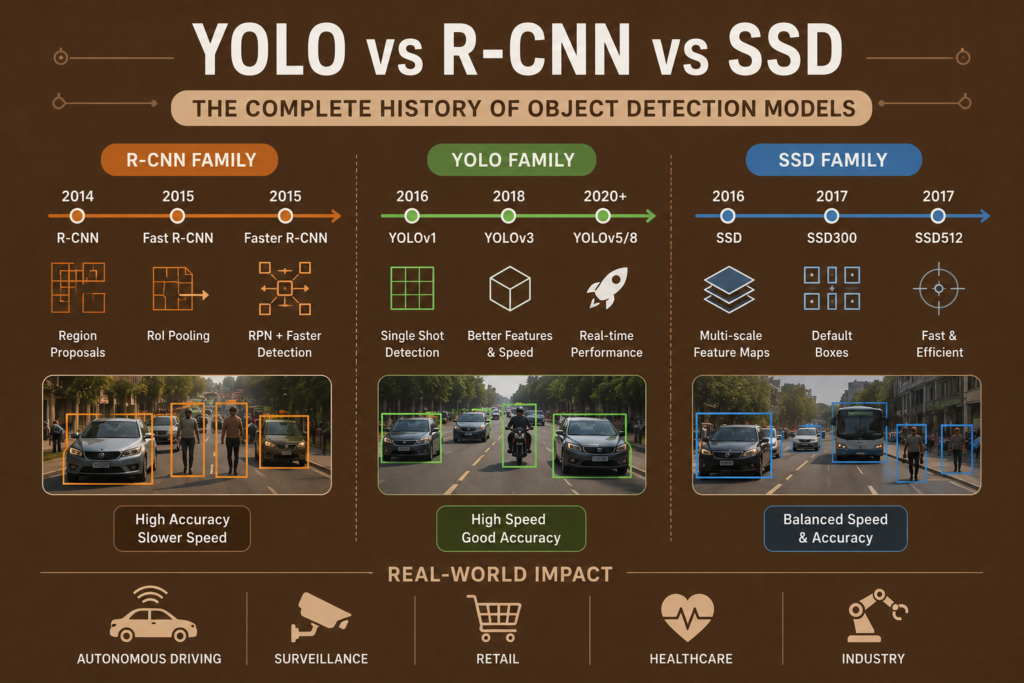
If you spend any time studying object detection, you will quickly run into the same three names again and again. The yolo vs r-cnn vs ssd debate sits at the heart of nearly every practical decision about how to build a system that needs to find and identify objects within images or video. Each of these three model families represents a different philosophy about how to balance speed, accuracy, and architectural complexity, and each has left a lasting mark on the broader history of computer vision. This article walks through the history, architecture, and practical tradeoffs of all three, giving you a complete picture of how they compare and when each one makes sense.
Why This Comparison Matters
Object detection is one of the most demanding tasks in computer vision because it requires a system to do two things simultaneously: identify what objects are present in an image, and determine exactly where each one is located. Different applications place very different demands on this process. A system analyzing medical scans might prioritize accuracy above all else, willing to wait several seconds for a result. A system guiding a self-driving car needs to process video at real-time frame rates, where even small delays can have serious consequences.
The yolo vs r-cnn vs ssd comparison exists precisely because no single architecture optimizes for everything. Understanding the history of how these three approaches developed, and the architectural decisions that define them, is essential for understanding why modern object detection looks the way it does.
R-CNN: The Two Stage Pioneer (2014)
The history of r-cnn begins in 2014, when Ross Girshick and collaborators introduced Regions with CNN features, the first widely successful application of deep convolutional neural networks to object detection. R-CNN established what became known as the single-stage vs two-stage architecture distinction, with R-CNN firmly representing the two-stage approach.
In a two-stage detector, the first stage generates a set of candidate regions, areas of the image that might contain an object, using an algorithm separate from the main neural network. The second stage then processes each candidate region individually, extracting features and classifying what, if anything, is present, along with refining the bounding box coordinates.
This approach prioritized accuracy. By examining each candidate region carefully and individually, R-CNN and its successors, including the history of Faster R-CNN, could achieve strong bounding box accuracy comparison results, particularly for objects that were difficult to distinguish from their surroundings. The tradeoff, however, was speed. The regional proposal overheads involved in generating and processing thousands of candidate regions per image made the original R-CNN far too slow for real-time applications, often taking tens of seconds per image.
Faster R-CNN addressed much of this overhead by integrating region proposal directly into the neural network using a learned region proposal network, dramatically improving speed while maintaining the core two-stage philosophy. Even with these improvements, two-stage detectors generally remain slower than their one-stage counterparts, a tradeoff that defines much of the yolo vs r-cnn vs ssd discussion.
YOLO: The One Stage Speed Champion (2015)
The history of yolo represents the clearest alternative to the two-stage philosophy. Introduced by Joseph Redmon and collaborators in 2015, YOLO, short for “You Only Look Once,” treats object detection as a single regression problem, predicting all bounding boxes and class probabilities directly from the full image in one pass.
This single-stage vs two-stage architecture distinction is the most fundamental difference in the yolo vs r-cnn vs ssd comparison. Rather than generating and individually processing candidate regions, YOLO divides the image into a grid and has the network predict, for each grid cell, whether an object is centered there, what its bounding box looks like, and what class it belongs to, all simultaneously.
The result is dramatically improved real-time video processing inference. YOLO and its many successors have consistently achieved latency constraints (FPS) suitable for live video applications, often processing dozens of frames per second on standard hardware. This made YOLO the architecture of choice for applications including self-driving cars and computer vision, drones and computer vision, and computer vision in sports, where processing speed is often as important as accuracy.
The original YOLO did have a notable weakness: small object detection performance was weaker than two-stage detectors, particularly for objects that appeared close together or were small relative to the grid cell size. Later versions of YOLO addressed this through multi-scale feature maps, allowing the network to make predictions at several different resolutions simultaneously, significantly improving its ability to detect objects of varying sizes.
SSD: A Middle Ground Emerges (2016)
The single shot detector, commonly known as SSD, was introduced in 2016 and represents an important middle position in the yolo vs r-cnn vs ssd landscape. Like YOLO, SSD is a one-stage detector, predicting bounding boxes and class probabilities in a single pass without a separate region proposal stage.
What distinguishes SSD architecturally is its more extensive use of multi-scale feature maps throughout the network. Rather than making predictions from a single layer near the end of the network, SSD makes predictions from multiple layers at different depths, with earlier layers, which capture finer spatial detail, used to detect smaller objects, and later layers, which capture more abstract and larger-scale features, used to detect larger objects.
SSD also relies heavily on anchor-based priors comparison, using a set of predefined box shapes and sizes at each prediction location, similar in spirit to the anchor boxes in object detection introduced in Faster R-CNN, but applied within a fully single-stage architecture. This gave SSD a useful balance: faster than two-stage detectors like Faster R-CNN, generally more accurate on small objects than the original YOLO, though still a one-stage detector overall.
Architectural review yolo vs r-cnn vs ssd discussions often place SSD between the other two in terms of both speed and accuracy, making it a popular choice for applications that need real-time or near-real-time performance but cannot fully sacrifice accuracy on smaller objects.
Architectural Differences in Detail
Structural differences in popular object detection models come down to a few key design choices that recur across the yolo vs r-cnn vs ssd comparison.
Dense vs sparse predictions is one such distinction. Two-stage detectors like R-CNN produce sparse predictions, since they only generate outputs for the relatively small number of candidate regions identified in the first stage. One-stage detectors like YOLO and SSD produce dense predictions, generating outputs for every position in a grid or feature map, regardless of whether an object is actually present, relying on confidence scores and non-maximum suppression to filter out the vast majority of these predictions.
Deep network backbones, the underlying convolutional architectures used to extract features from the input image, also vary across these models and have evolved considerably over time. Early R-CNN implementations used architectures based on AlexNet, while later versions of all three model families adopted more advanced backbones, including those derived from the history of VGGNet, the history of GoogLeNet, and the history of ResNet, as well as more efficient mobile-oriented backbones for deployment on resource-constrained devices.
Feature map exploitation yolo vs r-cnn vs ssd reveals another important distinction. SSD and later versions of YOLO make extensive use of feature maps from multiple layers at different resolutions, an approach that has become standard across modern object detectors regardless of whether they are one-stage or two-stage, because it directly addresses the challenge of detecting objects across a wide range of sizes within the same image.
Speed vs Accuracy: The Core Tradeoff
Speed vs accuracy comparison YOLO R-CNN SSD is, in many ways, the central question that the entire yolo vs r-cnn vs ssd comparison revolves around. Two-stage detectors, particularly Faster R-CNN and its descendants, generally achieve the highest accuracy on standard benchmarks, particularly for challenging cases involving small or overlapping objects, but at the cost of slower inference speed.
One-stage detectors, particularly modern versions of YOLO, have closed much of this accuracy gap while maintaining a significant speed advantage. Localization error tradeoffs between the two approaches have narrowed considerably as architectures have matured, with techniques originally developed for one family often being adopted by the other. Anchor boxes in object detection, originally a hallmark of two-stage detectors, became standard in early YOLO versions and SSD, while later anchor-free approaches in newer YOLO versions have influenced research into two-stage detectors as well.
Benchmarks for YOLO R-CNN and single shot detector typically evaluate performance using metrics like mean average precision, which captures both classification accuracy and bounding box localization quality, alongside inference speed measured in frames per second. The relative rankings of these three families on such benchmarks have shifted considerably over the years as each has gone through multiple generations of improvements.
Choosing Between YOLO, R-CNN, and SSD for Deployment
Choosing between YOLO R-CNN and SSD for deployment ultimately depends on the specific requirements of the application. For applications requiring real-time video processing inference, such as live surveillance technology systems, autonomous vehicles, or interactive applications using history of augmented reality, YOLO and SSD are generally preferred due to their speed advantages.
For applications where accuracy is paramount and processing time is less critical, such as detailed analysis of medical imaging ai scans or thorough inspection in computer vision in manufacturing where each item can be examined for a longer period, two-stage detectors descended from R-CNN may still offer advantages, particularly for detecting small defects or subtle abnormalities.
Many modern deployments also consider factors beyond the core yolo vs r-cnn vs ssd comparison, including how well a given architecture supports transfer learning in computer vision, how easily it can be deployed on edge devices with limited computational resources, and how actively the architecture continues to be maintained and improved by the broader research and developer community.
Frequently Asked Questions
What is the main difference between YOLO, R-CNN, and SSD?
The main difference is architectural philosophy. R-CNN and its descendants are two-stage detectors that first propose candidate regions and then classify each one individually, prioritizing accuracy. YOLO and SSD are one-stage detectors that predict all bounding boxes and classes in a single pass, prioritizing speed. SSD sits somewhat between the two extremes by using extensive multi-scale feature maps within a one-stage design.
Which is faster, YOLO or SSD?
Generally, YOLO has historically been faster than SSD, particularly in its more recent versions, though both are considered one-stage detectors capable of real-time performance. SSD often performs better on smaller objects due to its extensive use of multi-scale feature maps, while modern YOLO versions have largely closed this gap through similar techniques.
Is R-CNN still used today?
The original R-CNN is rarely used directly due to its slow speed, but its descendants, particularly Faster R-CNN, remain in use for applications where accuracy is prioritized over speed. The conceptual framework R-CNN introduced, region proposals followed by classification and localization, continues to influence two-stage object detection research.
Why did YOLO become so popular for real-time applications?
YOLO became popular for real-time applications because its single-pass architecture allows it to process images significantly faster than two-stage detectors, achieving frame rates suitable for live video. This made it the preferred choice for applications like self-driving cars and computer vision, drones and computer vision, and live computer vision in sports analysis, where processing delays are not acceptable.
How do anchor boxes relate to the yolo vs r-cnn vs ssd comparison?
Anchor boxes in object detection, a set of predefined bounding box shapes and sizes, were introduced as part of Faster R-CNN’s region proposal network and were later adopted by SSD and early YOLO versions as well. They provided a useful way for one-stage and two-stage detectors alike to predict bounding boxes of varying shapes more effectively, though more recent YOLO versions have moved toward anchor-free designs.
Conclusion
The yolo vs r-cnn vs ssd comparison is not really a competition with a single winner. It is a story of three different answers to the same fundamental question: how do you balance speed and accuracy when teaching a machine to find objects within an image? R-CNN and its descendants pioneered the two-stage approach, prioritizing accuracy through careful region proposal and classification. YOLO pioneered the one-stage approach, prioritizing speed through single-pass prediction. SSD found a middle ground, bringing multi-scale feature maps into a one-stage design.
All three families continue to evolve, often borrowing ideas from each other, and all three remain relevant for different applications built on computer vision technology today. Understanding their history and architectural tradeoffs is essential for anyone choosing how to build a system that needs to see, locate, and identify objects in the real world.