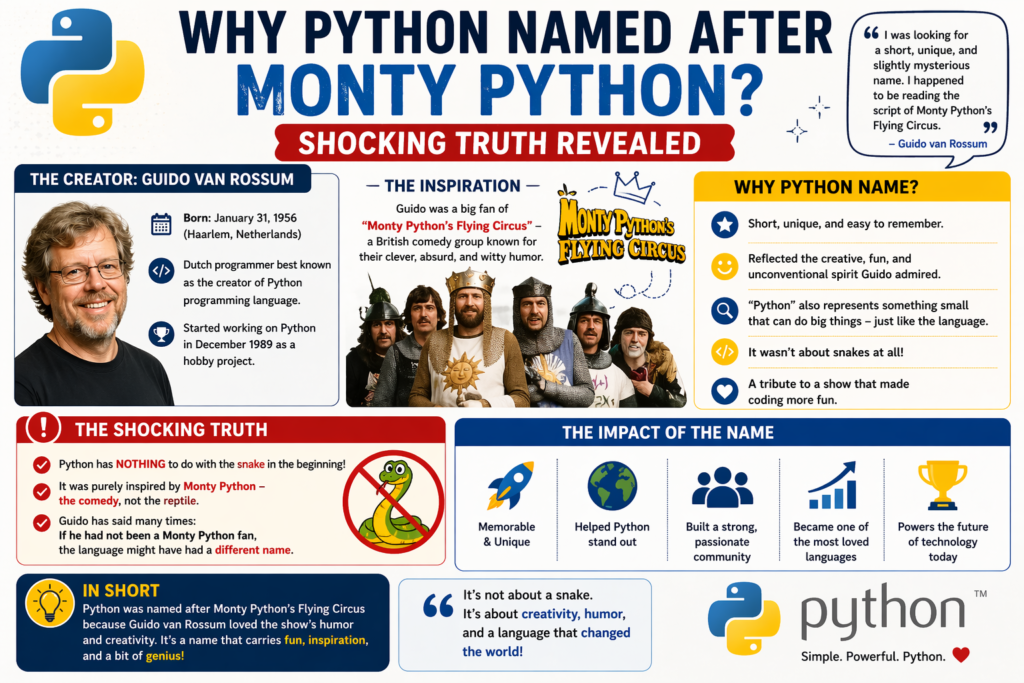
When you first hear the word python, your mind likely slithers toward images of a massive constrictor snake coiled in the rainforest. But here is a shocking revelation that will completely change your perspective. The enormously popular programming language did not get its name from the reptile. The truth is far more hilarious and unexpected. You will be amazed to learn that the real inspiration came from a quirky British comedy group from the 1970s. Yes, you read that correctly. python named after monty python the legendary BBC comedy troupe behind “Monty Python’s Flying Circus.” This bizarre origin story remains one of the most delightful pieces of programming lore that every developer should know. Let me take you on an entertaining journey through time, comedy, and code that explains how a serpentine name became synonymous with software development.
The Birth of a Programming Language (1989 – 1991)
To understand why this happened, we need to travel back to the late 1980s. A Dutch programmer named Guido van Rossum was working at the Centrum Wiskunde & Informatica (CWI) in the Netherlands. During the Christmas holidays of 1989, Guido felt bored. His office was empty. His regular projects seemed uninspiring. So he decided to create a new scripting language as a hobby project. He wanted something that would fix the flaws he saw in existing languages like ABC, which was too rigid, and C, which was too complex for beginners. Guido envisioned a language that emphasized code readability and simplicity. He wanted developers to express concepts in fewer lines of code than possible in C++ or Java. But while building this technical marvel, he faced one surprisingly difficult creative decision. What should he name this beautiful new tool? The answer came from an unexpected place far outside the world of computer science.
The Comedy That Inspired a Language (1969 – 1974)
Guido van Rossum was not just a brilliant coder. He was also a huge fan of British comedy. During the late 1970s and early 1980s, he spent countless hours watching reruns of “Monty Python’s Flying Circus.” This revolutionary BBC series featured John Cleese, Eric Idle, Michael Palin, Terry Gilliam, Terry Jones, and Graham Chapman. Their surreal sketches, absurd transitions, and intellectual humor created a cultural phenomenon. Shows like the “Dead Parrot Sketch” and the “Spanish Inquisition” became legendary. Guido loved how Monty Python broke every conventional rule of television comedy. They mixed animation with live action. They ended sketches without punchlines. They created jokes within jokes. This fearless creativity deeply resonated with Guido’s own philosophy about programming. He believed coding should be joyful, playful, and expressive. So when the moment came to name his new language, he didn’t choose a serious mathematical term or a corporate friendly label. Instead, he chose a name that would make him smile every single day.
The Shocking Truth: Why Python Named After Monty Python
Here is the moment of revelation. python named after monty python because Guido van Rossum was reading the published scripts from “Monty Python’s Flying Circus” at home. He wanted a name that was short, unique, and slightly mysterious. “Python” hit all those marks. It was easy to type. It sounded catchy. And it paid hilarious tribute to his favorite comedians. Guido has confirmed this story multiple times in interviews and email archives dating back to the 1990s. He specifically chose “Python” instead of “Monty” or “Circus” because the single word felt more like a programming language. The snake connection was purely coincidental. In fact, Guido has openly admitted that he is not particularly fascinated by snakes. The reptile never crossed his mind during the naming process. This revelation shocks most beginners because the logo features two intertwined snakes. However, that logo came years later through community design contests. The name came first and came from pure comedy. This makes Python one of the only major programming languages named after a television show rather than a mathematical concept or a company product.
The Official Confirmation and Documentation (1996 – Present)
For years, skeptics doubted the story. They argued that naming a serious programming language after a comedy show seemed unprofessional. But Guido van Rossum has consistently confirmed the truth. In the official History of Python documentation, Guido wrote explicitly, “I named it after Monty Python’s Flying Circus.” He also mentioned that he wanted a name that was “slightly irreverent” because computer science took itself too seriously in the 1980s. Many early contributors to the language were also comedy fans. They added numerous Python Easter eggs inside the language for fun. For example, if you type import this in any Python interpreter, it prints “The Zen of Python” a collection of 19 guiding principles. If you type import antigravity, it opens a webcomic about flying. If you type import __hello__, it prints “Hello world!” in a playful way. These hidden jokes directly reference the absurdist spirit of Monty Python. The IDLE editor name itself stands for “Integrated Development and Learning Environment” but the word “Idle” also matches Eric Idle one of the Pythons. Everywhere you look, the Pythonic humor shines through.
How the Snake Logo Confused Everyone (2000 – 2006)
Despite the clear comedic origin, the snake imagery became inevitable. In the early 2000s, the Python Software Foundation needed a logo. Designers submitted various options. The winning logo featured two interlocking shapes that accidentally looked like snakes. The community loved it because the visual was memorable and scalable. However, this logo created massive confusion for newcomers. For over two decades, thousands of blog posts and articles incorrectly claimed that Python was named after the snake. Even some technical books made this error. The myth grew so powerful that many developers today still believe the reptile story. Guido found this misunderstanding amusing rather than frustrating. He joked that if he had known about the snake confusion, he might have picked a different Monty Python reference like “Spam” or “Lumberjack.” But the name “Python” was already too popular to change. This mix up between a reptile and a comedy troupe represents one of the strangest branding in tech stories ever told. It proves that pop culture influence can sometimes overshadow factual history.
Why This Unconventional Naming Matters
You might wonder why any of this history matters for your coding journey. The answer is profound. The fact that python named after monty python teaches us that programming is a creative human activity not a cold robotic process. Guido van Rossum deliberately chose joy over seriousness. He valued humor over corporate branding. This philosophy directly shaped the language’s culture. Python emphasizes readability, fun, and community. The famous “batteries included” philosophy means the language comes with many built in libraries so you can start building projects immediately without tedious setup. The community’s guiding document “The Zen of Python” includes aphorisms like “Beautiful is better than ugly” and “Simple is better than complex.” These are not technical metrics. They are aesthetic and emotional values. Understanding the Monty Python origin helps you appreciate that coding can be playful. You do not need to be a严肃 mathematician or a robotic engineer. You can be a creative problem solver who enjoys unconventional naming and hidden jokes. This perspective reduces anxiety for Python for Beginners who might feel intimidated by other languages.
The Legacy of Guido van Rossum’s Humor
Guido van Rossum served as Python’s benevolent dictator for life (BDFL) until 2018. Throughout his leadership, he ensured that humor remained part of the language’s identity. The annual PyCon conferences often feature Monty Python references. Tutorials use sketches like “The Cheese Shop” to explain coding concepts. The official documentation includes jokes and witty asides. This creative inspiration from British comedy created a unique language identity that stands apart from Java, C++, or JavaScript. While those languages were created by corporations or academic committees, Python was created by one man during a bored holiday who loved a TV show. That origin story attracts people who value authenticity and individuality. It also serves as a powerful case study for history of programming languages scholars. Most languages get named after existing technical terms. FORTRAN means “Formula Translation.” COBOL means “Common Business Oriented Language.” LISP means “List Processing.” Python breaks this entire pattern. It is the only major language named purely for entertainment value.
Common Misconceptions and Myths
Let me clear up some persistent falsehoods. Many people believe that Python’s creator chose the name because snakes are fast and efficient killers. Wrong. Others think the name refers to the snake in the Garden of Eden representing knowledge. Also wrong. A popular myth claims that Guido wanted a name that started with “Py” because he liked the element pyrite. Completely false. The absolute truth is simple and hilarious. python named after monty python because Guido was a fanboy. He wanted to chuckle every time he launched his interpreter. He succeeded beyond his wildest dreams. Today over 8 million developers use Python worldwide. It powers Instagram, Google, Netflix, and NASA. It dominates Python for Data Science and Python Web Development frameworks like Django and Flask. It simplifies Python Automation tasks for system administrators. All of this massive success traces back to a comedy show that ended in 1974. That is the real software history trivia that every coder should share at parties.
The Future of Python and Its Name
Looking ahead, the name “Python” will likely continue confusing newcomers for decades. The snake logo is now too iconic to change. The Monty Python comedy troupe members are aging. John Cleese and Eric Idle remain active but the group’s cultural relevance has faded among younger generations. However, the Future of Python remains incredibly bright. The language consistently ranks as the most wanted and most loved language in Stack Overflow surveys. Its dominance in artificial intelligence, machine learning, and web development is undisputed. And the original naming story will always be there as a charming footnote. Educational materials now routinely include the Monty Python origin to prevent misinformation. Books like “Python Crash Course” and “Automate the Boring Stuff with Python” mention the comedy roots in their opening chapters. Online courses include this trivia as a fun fact. The snake vs name debate will continue but the truth is now well documented. When you install Python using any Python Installation Guide you are not installing a reptile. You are installing three decades of humor, creativity, and joyful rebellion against boring software.
Frequently Asked Questions (FAQs)
Q1: Is it true that python named after monty python the comedy group?
Yes absolutely. Guido van Rossum confirmed he chose the name after reading Monty Python scripts.
Q2: Why does Python have a snake logo if it is named after comedy?
The snake logo was designed years later by the community. Guido did not choose it.
Q3: Did Monty Python members ever react to the programming language?
Yes. Eric Idle joked about it on Twitter and John Cleese found it amusing.
Q4: What is the Zen of Python and does it relate to Monty Python?
The Zen of Python is a collection of 19 principles. The name “Zen” is a separate joke not directly related to Monty Python.
Q5: Could the name ever change to avoid snake confusion?
No. Python is far too popular. The name will remain forever.
Conclusion
The shocking truth is undeniable python named after monty python a legendary BBC comedy troupe not a serpent. This story transforms how you view programming languages. It proves that software development does not need to be dry or serious. It shows that one person’s creative joy can shape an entire industry. Guido van Rossum’s decision to prioritize fun over convention created a language community that values readability, playfulness, and hidden jokes. The next time you write a Python script, remember that you are participating in a tradition of humor that began in 1969 on British television. Ignore the snake on the logo. Ignore the confused blog posts. Smile knowing that your favorite programming language was named by a fan who simply loved to laugh. That is not just coding. That is Pythonic living.