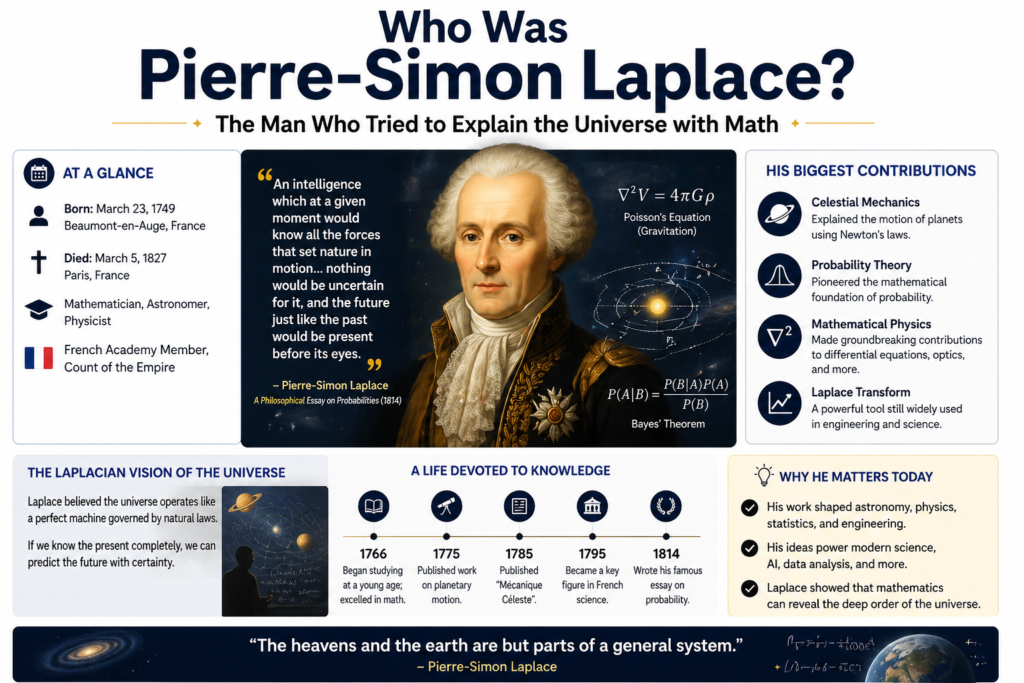
pierre simon laplace stands among the most powerful minds in human history. Often called the French Newton, he was a true polymath whose work shaped modern science in ways that still influence our daily lives. From astronomy history to probability theory, pierre simon laplace transformed abstract ideas into precise mathematical laws.
In this Biography of Laplace, we explore his life, education, achievements, and legacy. His journey during the Scientific Revolution era and the French Revolution shows how intellect can rise even in turbulent times. The legacy of laplace continues to guide scientific method, mathematical physics, and intellectual history today.
Early Life and Background (1749 – 1765)
Pierre Simon Laplace was born in 1749 in Normandy, France. Coming from a modest farming family, his rise to greatness is nothing short of inspiring. Unlike many Enlightenment scientists, pierre simon laplace did not come from wealth or privilege. His early education was supported by local patrons who recognized his extraordinary talent.
As a young student, he showed a deep interest in calculus and mathematics. This curiosity laid the foundation for his future as a mathematical genius. During this time, Europe was undergoing intellectual transformation, and the influence of the Scientific Revolution was everywhere.
Education and Academic Growth (1766 – 1773)
Pierre simon laplace moved to Paris to pursue higher education, where he entered a world filled with brilliant thinkers. He quickly became associated with the Académie des Sciences, a prestigious institution that nurtured many great scientists.
His education focused heavily on mathematical physics and probability theory. It was during these years that pierre simon laplace began forming ideas that would later revolutionize celestial mechanics and determinism.
His intellectual growth was not just academic. He learned how to apply the scientific method rigorously, combining observation with precise calculations. This approach made him one of the most respected Enlightenment scientists of his time.
Rise to Fame and Scientific Career (1774 – 1800)
The period between 1774 and 1800 marked the rise of pierre simon laplace as a dominant force in science. His contributions to astronomy history and celestial mechanics earned him recognition across Europe.
He worked on complex problems related to planetary motion, helping to explain how the solar system remains stable over time. His work in mathematical physics demonstrated the power of calculus when applied to real-world phenomena.
During this time, pierre simon laplace also interacted with political leaders. His association with Napoleon Bonaparte patronage helped him secure important positions. Despite political changes during the French Revolution, he maintained his influence through sheer intellectual authority.
Key Contributions and Discoveries (Overview)
Pierre simon laplace made several groundbreaking contributions. While this article focuses on his life, it is important to briefly mention his major ideas.
- His work on celestial mechanics provided a mathematical explanation of planetary motion.
- He introduced concepts related to probability theory, earning recognition as the father of probability.
- His theoretical ideas even touched on what we now call early black hole theory, showing his forward thinking nature.
- His famous philosophical idea known as laplace’s demon explored determinism and the predictability of the universe.
- His masterpiece, mécanique céleste, remains one of the most important works in scientific literature.
These achievements highlight why pierre simon laplace is often considered one of the greatest scientific minds ever.
Laplace as a Polymath and Thinker
Pierre simon laplace was not limited to one field. As a polymath, he contributed to astronomy, physics, mathematics, and philosophy. His work reflects the essence of Enlightenment scientist thinking.
He believed that the universe operates under fixed laws. This idea of determinism suggests that if we know all forces and positions, we can predict the future. This concept influenced modern discussions in science and philosophy.
His ability to connect different disciplines made him a true mathematical genius. His work continues to inspire modern innovations such as API automation, script execution, and workflow optimization, where precise calculations and logical systems are essential.
Role During the French Revolution (1789 – 1799)
The French Revolution was a period of chaos, but pierre simon laplace managed to navigate it successfully. While many intellectuals struggled, he adapted to the changing political environment.
He contributed to the development of the metric system, which remains a global standard today. His involvement in scientific institutions ensured that knowledge continued to grow even during unstable times.
Pierre simon laplace also maintained connections with influential figures. His association with Napoleon Bonaparte patronage allowed him to continue his work without interruption.
Personal Life and Character
Pierre simon laplace was known for his calm and logical personality. Unlike many scientists who sought fame, he focused on his work and intellectual pursuits.
He valued precision and clarity, which is evident in his writings. His dedication to the scientific method made him a role model for future generations.
Despite his achievements, he remained grounded. His journey from a small village to becoming Marquis de Laplace shows the power of determination and knowledge.
Legacy of pierre simon laplace in Modern Science
The legacy of laplace is immense. His influence can be seen in fields like probability theory, astronomy, and mathematical physics.
Today, concepts derived from his work are used in areas like data extraction, batch processing, and even robotic process automation RPA. His logical frameworks inspire modern productivity hacks and task scheduling systems.
In technology, ideas related to determinism and precise calculations are essential for web scraping for data, bot development, and headless browser operations. Even modern tools that handle repetitive tasks and script automation rely on principles similar to those developed by pierre simon laplace.
His legacy also extends to education, where his work continues to shape how calculus and probability are taught.
Influence on Modern Technology and Innovation
Although pierre simon laplace lived centuries ago, his ideas are surprisingly relevant today. Modern innovations like schedule tasks Python, automating Excel with Openpyxl, email automation, and PDF manipulation all depend on logical structures and mathematical precision.
Even tools like Selenium web automation and PyAutoGUI reflect the same principles of control and predictability that pierre simon laplace explored. These technologies aim to optimize workflows and improve efficiency, much like his work aimed to simplify the understanding of the universe
Connection to Broader Scientific History
Pierre simon laplace was deeply influenced by earlier thinkers. His work builds on the foundations laid by ancient scholars and Enlightenment scientists.
Understanding his contributions helps us appreciate how science evolves over time. The transition from early philosophical ideas to precise mathematical models is a key part of intellectual history.
FAQs About pierre simon laplace
Who was pierre simon laplace?
Pierre simon laplace was a French mathematician and Enlightenment scientist known for his contributions to probability theory, astronomy, and mathematical physics.
Why is pierre simon laplace called the French Newton?
He is called the French Newton because his work in celestial mechanics and mathematical physics expanded on Newton’s ideas and provided deeper explanations.
What is laplace’s demon?
Laplace’s demon is a philosophical concept that represents determinism, suggesting that the future can be predicted if all variables are known.
What was laplace’s role in the French Revolution?
He contributed to scientific advancements like the metric system and maintained his influence through intellectual authority during the revolution.
What is the legacy of laplace today?
The legacy of laplace includes major contributions to probability theory, astronomy, and modern scientific methods that influence technology and innovation.
Conclusion
Pierre simon laplace was more than just a scientist. He was a visionary who believed that the universe could be understood through mathematics. His journey from humble beginnings to becoming a Marquis de Laplace is a testament to the power of knowledge and determination.
His work continues to inspire modern science, technology, and innovation. From probability theory to celestial mechanics, his influence is everywhere. To truly understand the evolution of science, we must also explore how ancient greek scientists changed modern science, as their ideas laid the groundwork for thinkers like laplace.
The story of pierre simon laplace reminds us that curiosity and logic can unlock the deepest secrets of the universe.