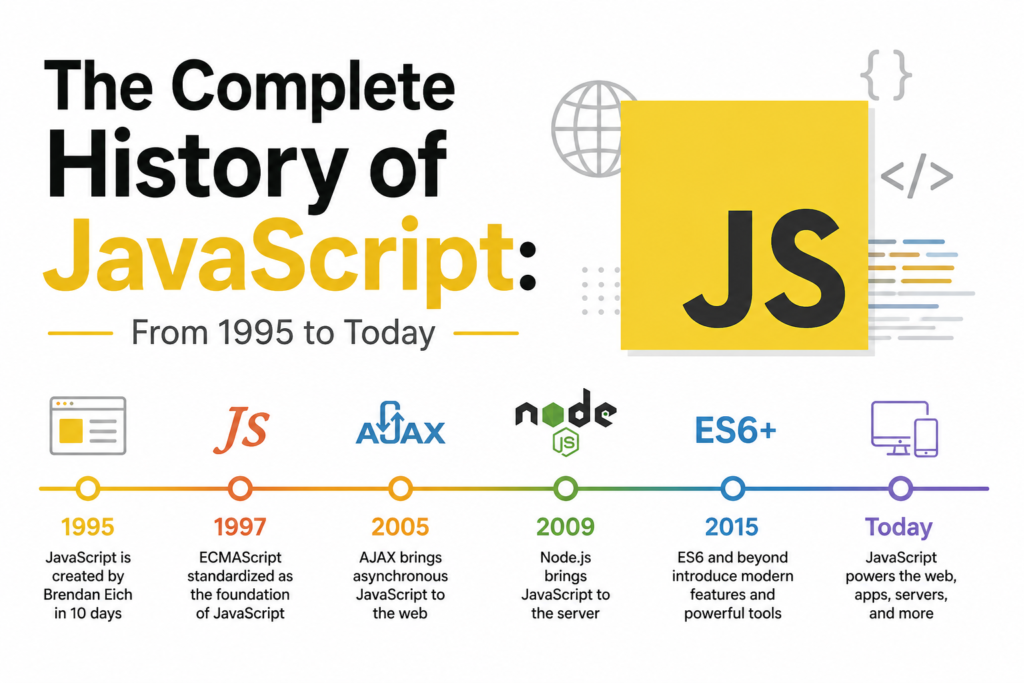
Every time you click a button on a website, every time a page updates without reloading, every time an animation plays smoothly, you are witnessing the work of JavaScript. This language powers the modern web. Yet its origin story is one of the most remarkable in technology. The history of javascript begins in 1995 with a single developer and a crazy deadline. Ten days. That is all he had to create a programming language. This fascinating history of javascript will take you from that desperate sprint to today’s world where JavaScript runs on servers, desktops, mobile devices, and even robots. You will learn about the browser wars, the dark ages of cross browser hell, the AJAX revolution, and the Node.js explosion. The history of javascript is also the history of web development itself. Let me take you on this journey through time. Every version, every battle, every breakthrough.
The Birth of the Web and the Need for Interactivity (1990 – 1994)
Before we explore the history of javascript , we must understand the world that created it. Tim Berners Lee invented the World Wide Web in 1989. The first web browser appeared in 1990. But early websites were static. They displayed text and images. Nothing moved. Nothing responded. You clicked a link and waited for a completely new page to load. This was fine for academic documents. But companies wanted more. They wanted interactive forms, shopping carts, and games. The web needed a client-side scripting language. Something that ran inside the browser, not on a distant server. Several companies tried to fill this gap. Microsoft had Visual Basic Script. Others proposed Java applets. But nothing caught on. Then came Netscape. This software development milestone set the stage for everything that followed.
Brendan Eich and the 10 Day Sprint (May 1995)
The most important moment in the history of javascript happened in May 1995. Brendan Eich was a young engineer who had just joined Netscape Communications. The company wanted a scripting language for their Navigator browser. They had considered licensing an existing language like Scheme. But negotiations fell through. So they asked Brendan Eich to create something new. The deadline was impossibly tight. Ten days. Eich locked himself in his office. He worked 18 to 20 hours daily. He borrowed syntax from Java to make the language familiar. He borrowed functional concepts from Scheme. He borrowed prototype based objects from Self. On the tenth day, he had a working prototype. He called it Mocha. This first version of javascript was rough. It had bugs and quirks. But it worked. And it shipped. This rapid prototyping achievement is unmatched in programming language history.
From Mocha to LiveScript to JavaScript (1995 – 1996)
The name changed twice during the early history of javascript . First, Netscape marketers renamed Mocha to LiveScript. They thought it sounded more descriptive. LiveScript was the official name for a few months in late 1995. Then Sun Microsystems entered the picture. Sun had created Java, which was incredibly popular. Netscape and Sun formed a Sun Microsystems partnership to promote Java in the browser. Sun wanted to leverage Java’s brand recognition. They asked Netscape to rename LiveScript to JavaScript. This was purely a marketing decision. Despite the name, why javascript is not java is a common question for beginners. Java is compiled, class based, and statically typed. JavaScript is interpreted, prototype based, and dynamically typed. They share almost nothing except the C style syntax. But the name worked. In December 1995, Navigator 2.0 shipped with JavaScript. The history of javascript had officially begun.
The Browser Wars and JScript (1996 – 1999)
The browser wars were brutal. Microsoft wanted to destroy Netscape. Internet Explorer was gaining market share. Microsoft needed JavaScript support. But they could not call it JavaScript for legal reasons. So they created their own version called JScript vs JavaScript became a huge problem. JScript was similar but not identical. Microsoft also added proprietary features. Netscape did the same. This created cross-browser compatibility nightmares for developers. A website that worked perfectly in Netscape would break in Internet Explorer. The opposite was also true. Developers wasted countless hours writing browser detection code. They maintained two or three versions of every script. This dark period in the history of javascript lasted for years. Yet JavaScript survived. It was too useful to abandon. Developers created libraries to hide the differences. The demand for interactivity only grew.
Standardizing JavaScript with ECMAScript (1997 – 1999)
Something had to be done. The chaos was unsustainable. Netscape submitted JavaScript to Ecma International for standardizing javascript . This led to ECMA-262 , the official language specification. The standardized language was called ECMAScript to avoid trademark issues. The first edition was published in 1997. Language specification brought order. Browser vendors agreed to implement the same core features. The evolution of ECMAScript began. Version 2 came in 1998. Version 3 came in 1999. ECMAScript 3 was a major improvement. It added regular expressions, better string handling, and try/catch for error handling. It became the baseline that all browsers supported. This was a turning point in the history of javascript . Developers could finally write code that worked everywhere. Well, mostly. Internet Explorer continued doing its own thing for years. But progress was happening.
The Dark Ages and the jQuery Era (2000 – 2008)
The early 2000s were frustrating for web developers. Internet Explorer dominated with over 90% market share. Microsoft stopped improving IE after version 6. New web standards were ignored. The history of javascript entered a dormant period. Many developers abandoned JavaScript for Flash or Silverlight. But the community kept innovating. jQuery era began in 2006 when John Resig released jQuery. This library transformed JavaScript development. jQuery abstracted away all browser differences. You wrote simple, elegant code. jQuery handled the messy DOM manipulation behind the scenes. For a generation of developers, jQuery was the only way to build interactive websites. It dominated until the mid 2010s. The history of web development owes a huge debt to jQuery. It kept JavaScript alive during the dark ages. It proved that a better developer experience was possible.
The AJAX Revolution (2005)
The most important innovation in the history of javascript between 1995 and today was AJAX. The term AJAX (Asynchronous JavaScript and XML) was coined in 2005. But the technology existed earlier. In 1999, Internet Explorer 5 introduced the XMLHttpRequest object. This allowed JavaScript to fetch data from a server without reloading the page. No one paid much attention. Then Google built Gmail and Google Maps. These applications used AJAX heavily. The experience was revolutionary. You could drag maps. You could check email without waiting for page reloads. Suddenly, everyone wanted AJAX. The AJAX revolution made JavaScript cool. It enabled web 2.0 applications like Flickr, Delicious, and later Facebook. Developers realized JavaScript was not just for form validation anymore. It could build real applications. The history of javascript had entered a new era.
The Google V8 Engine and Performance Revolution (2008)
Performance had always been JavaScript’s weakness. It was interpreted, not compiled. It was slow. Google decided to fix this. In 2008, Google released the Chrome browser with the Google V8 engine . V8 was revolutionary. It compiled JavaScript to machine code on the fly using JIT (Just In Time) compilation. JavaScript ran nearly as fast as native code. Other browsers scrambled to catch up. Firefox got SpiderMonkey. Safari got Nitro. Microsoft got Chakra. The language adoption exploded. Faster JavaScript enabled more complex applications. In browser games became possible. Video editors ran in the browser. Music production software appeared. The performance revolution changed what developers thought JavaScript could do. The history of javascript was no longer about surviving. It was about conquering.
Node.js JavaScript on the Server (2009)
The biggest shift in the history of javascript came from an unexpected place. Ryan Dahl took Google’s V8 engine and wrapped it in a server environment. He called it Node.js. Released in 2009, Node.js allowed JavaScript to run on servers. This was revolutionary. For the first time, what is node.js became a question every developer asked. You could use the same language on frontend and backend. The event driven, non blocking model was perfect for I/O heavy applications. Companies loved the productivity gains. One language for everything. No context switching between languages. The npm package manager exploded. Today, npm is the largest software registry in history. Node.js changed the future of software engineering forever. Full stack JavaScript became a career path. The history of javascript had expanded beyond the browser.
ES6 The Modern JavaScript Revolution (2015)
After years of stagnation, JavaScript got its biggest update ever. ES6 (ECMAScript 2015) was a landmark release. It added features that developers had wanted for over a decade. let and const for block scoping. Arrow functions for concise syntax. Classes for object oriented programming. Template literals for easier string formatting. Destructuring for extracting values. Promises for asynchronous code. Modules for organizing code. The evolution of ECMAScript accelerated after ES6. ES7 (2016) added exponentiation operator and array includes. ES8 (2017) added async/await, making asynchronous code readable. ES9 (2018) added rest/spread properties. ES10 (2019) added flat and flatMap. ES11 (2020) added optional chaining and nullish coalescing. ES12 (2021) added logical assignment operators. ES13 (2022) added top level await. ES14 (2023) added array find from last. Today, the future of javascript includes yearly releases with steady improvements. The language has matured into a professional, powerful tool.
The Framework Wars React vs Vue vs Angular (2015 – Present)
Modern JavaScript development is defined by frameworks. The react vs vue vs angular comparison dominates conversations. Angular was released by Google in 2010 (originally AngularJS). It is a full featured framework with everything included. React was released by Facebook in 2013. It is a library focused on components and the virtual DOM. It introduced JSX, which lets you write HTML inside JavaScript. Vue was released by Evan You in 2014. It is progressive and approachable. The framework wars have pushed all three to improve rapidly. Each has strengths. React has the largest ecosystem. Angular has enterprise features. Vue balances power and simplicity. The history of javascript frameworks shows a trend toward component based architecture. These frameworks power millions of websites and applications. Learning at least one is essential for javascript beginner guide readers.
The Rise of TypeScript (2012 – Today)
JavaScript was not designed for large applications. Its dynamic typing causes bugs at scale. Microsoft created TypeScript in 2012 to solve this. TypeScript adds optional static types to JavaScript. You write TypeScript code. It compiles to plain JavaScript. Types catch errors before runtime. They also enable better tooling and autocomplete. Today, TypeScript is exploding in popularity. Major frameworks like Angular, React (with Next.js), and Vue have first class TypeScript support. Many developers argue that TypeScript is the best way to write javascript functions explained code. Microsoft’s open-source advocate approach won over the community. The history of javascript now includes a superset language that is taking over.
JavaScript Today and Tomorrow (2024 – 2026)
Where does the history of javascript stand today? JavaScript runs everywhere. On every browser. On every server. On mobile devices via React Native. On desktops via Electron. On embedded devices via Espruino. According to Stack Overflow surveys, JavaScript has been the most commonly used programming language for over a decade. The future of javascript includes WebAssembly integration for near native performance. Records and tuples for immutable data. Pattern matching for concise logic. Temporal API for better date handling. JavaScript is not going anywhere. It evolves constantly while maintaining backward compatibility . Old code runs on new browsers. This commitment to compatibility is rare and valuable.
Frequently Asked Questions (FAQs)
Q1: What is the history of javascript in simple terms?
JavaScript was created in 10 days in 1995 by Brendan Eich at Netscape. It grew from a simple browser language to the world’s most used programming language.
Q2: What is the difference between JavaScript and ECMAScript?
ECMAScript is the official language specification. JavaScript is an implementation of that specification. They are often used interchangeably.
Q3: Why is ES6 (ECMAScript 2015) considered such a big deal?
ES6 added major features like classes, arrow functions, promises, and modules that completely modernized JavaScript development.
Q4: What was the jQuery era?
jQuery (2006) simplified cross-browser DOM manipulation. It dominated web development until the rise of modern frameworks around 2015.
Q5: Is JavaScript still relevant in 2026?
Yes. JavaScript is more relevant than ever. It runs on browsers, servers, mobile apps, and desktop apps. It remains the most used language globally.
Conclusion
The history of javascript is a story of resilience. Born in a frantic ten day sprint during 1995, it was mocked as a toy language. It survived the browser wars and Microsoft’s neglect. It endured the dark ages of Internet Explorer 6. It reinvented itself with AJAX, then with jQuery, then with Node.js, then with ES6, then with frameworks, and now with TypeScript. Today, JavaScript is the undisputed king of the web. It runs on nearly every device with a screen. It powers the servers that deliver content. It builds mobile and desktop applications. The future of javascript includes WebAssembly, better performance, and continued evolution. The future of software engineering increasingly depends on JavaScript and its massive ecosystem. Brendan Eich created a prototype in ten days. Millions of developers have built upon that foundation. The history of javascript continues to be written. And you can be part of it.