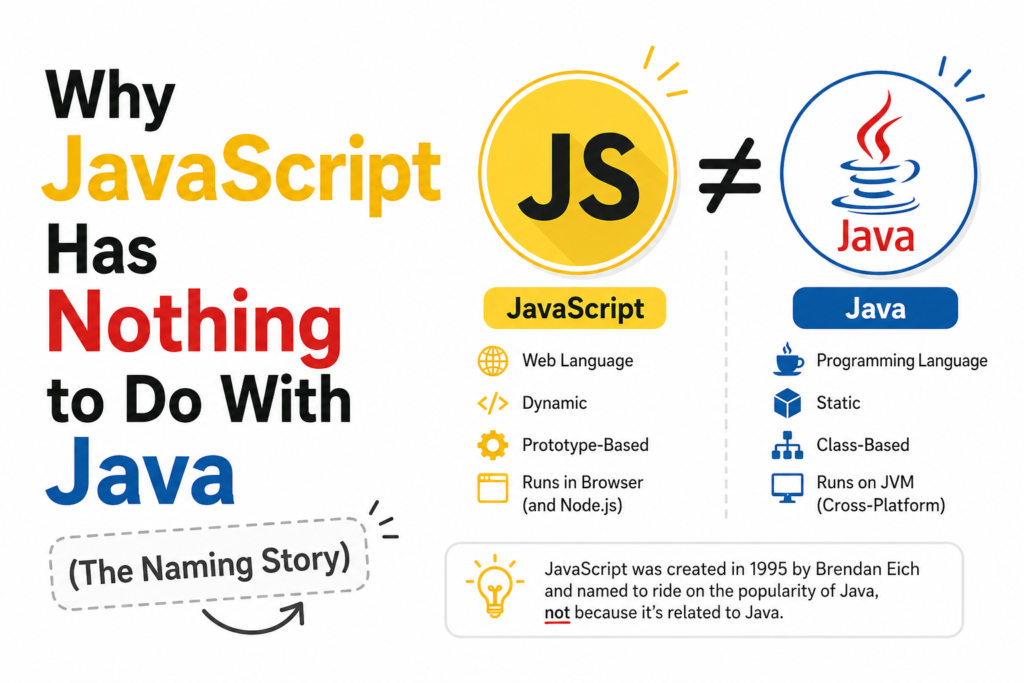
Every day, thousands of new programmers ask the same question. If JavaScript has “Java” in its name, are they related? The answer shocks most beginners. JavaScript and Java have absolutely nothing in common. Zero. Zip. No technical relationship whatsoever. This is the most confusing programming language naming decision in history. The why javascript is not java story is one of marketing, corporate deals, and a massive missed opportunity for clarity. This fascinating article will reveal the shocking truth. You will learn how a ten day prototype called Mocha became LiveScript and then was renamed to JavaScript purely for brand identity purposes. You will understand the real Java vs JavaScript differences . By the end, you will never confuse these two languages again. Let me start with the most important fact. Brendan Eich created JavaScript in 1995. Sun Microsystems created Java. The names sound similar. The technologies could not be more different.
The Birth of Two Very Different Languages (1991 – 1995)
To understand why javascript is not java , we must go back to the early 1990s. Java was born first. James Gosling and his team at Sun Microsystems started working on a project called Oak in 1991. They renamed it Java in 1994. Java was designed for set top boxes and embedded devices. It was a compiled, statically typed, class based language. It ran on the JVM (Java Virtual Machine) . Java was serious, complex, and aimed at professional programmers. Meanwhile, Brendan Eich was working at Netscape. In May 1995, he created a completely different language in just ten days. His language was interpreted, dynamically typed, and prototype based. It was designed for non professional programmers and web designers. These two languages had different creators, different purposes, different object-oriented vs prototype-based architectures, and different target audiences. The only similarity was a superficial shared syntax origins borrowing from C. That is it. Yet the naming disaster was about to begin.
Mocha and LiveScript The Original Names (May 1995 – November 1995)
The Mocha/LiveScript naming phase is crucial to understanding why javascript is not java . When Brendan Eich first built his language, he called it Mocha. This was an internal code name at Netscape. Mocha referenced both coffee and the company’s love of fun names. By September 1995, Netscape decided Mocha was not marketable. They wanted a descriptive name. Something that suggested the language would make web pages “live” and dynamic. So they renamed it LiveScript. The name LiveScript appeared in early Netscape branding materials. It was a decent name. It was accurate. It had no confusion with any other language. If Netscape had kept the name LiveScript, this article would not exist. But the internet was about to change everything. A corporate deal was brewing. And LiveScript was about to become JavaScript.
The Sun Microsystems Partnership (December 1995)
The shocking reason behind why javascript is not java is pure marketing. In late 1995, Netscape and Sun Microsystems formed a strategic corporate partnerships agreement. Sun had created Java. Java was the hottest technology in the programming world. Every media outlet was writing about Java. Every company wanted to use Java. But Java was too heavy for simple web scripts. It required compilation. It required the JVM. It was overkill for form validation and image rollovers. Netscape had LiveScript, which was perfect for those tasks. Sun saw an opportunity. They wanted to associate their brand with web scripting. Netscape wanted to ride Java’s popularity. The deal was simple. Netscape would rename LiveScript to JavaScript. Sun would endorse it. This was pure language marketing . No technology changed. No code was shared. The only change was a name. Brendan Eich has confirmed this many times. He agreed reluctantly. He knew the confusion would last forever.
The Official Launch (December 1995)
In December 1995, Netscape Navigator 2.0 Beta shipped with first version of javascript under its new name. The press release announced JavaScript alongside Java. Many readers assumed they were related. This was intentional. The false association between Java and JavaScript was not an accident. It was the entire point of the renaming. For Netscape and Sun, confusion was a feature, not a bug. Every confused developer who investigated Java also saw LiveScript. Wait, now called JavaScript. The trademark history is complicated. Sun owned the trademark on Java. They allowed Netscape to use the “Java” prefix under strict conditions. JavaScript had to be positioned as a complement to Java, not a competitor. This marketing strategy worked in the short term. JavaScript got massive attention. But the long term damage was decades of confusion. Every newcomer to programming asks the same question. Are Java and JavaScript related? The answer remains no.
Java vs JavaScript The Technical Differences
Let me clearly explain Java vs JavaScript differences so you never confuse them again. Java is a compiled language. You write code, run it through a compiler, and get bytecode. That bytecode runs on the JVM. JavaScript is an interpreted language. The browser reads and executes the code directly. There is no separate compilation step. Java uses static typing. You must declare that a variable is an integer, string, or boolean. JavaScript uses dynamic typing. A variable can hold any type, and the type can change. Java is class based. Everything belongs to a class. You cannot have code outside a class. JavaScript is prototype based. Objects inherit directly from other objects. Java runs on the JVM, which must be installed separately. JavaScript runs inside web browsers and Node.js. Java is used for Android apps, enterprise systems, and big data. JavaScript is used for websites, web apps, and servers. The only web scripting similarity is that both use C style syntax with curly braces and semicolons. That is it. This confusion is a masterpiece of internet branding gone wrong.
Syntax Similarities That Fool Beginners
Why do so many beginners believe Java and JavaScript are related? The answer is coding terminology surface similarities. Both languages use curly braces {} to define code blocks. Both use semicolons ; at the end of statements. Both use if, else, for, while, switch, and try/catch. These similarities exist because both languages borrowed syntax from C. C was the dominant language in the 1980s and 1990s. Almost every new language copied its syntax. But borrowing syntax is not the same as being related. English and German share vocabulary. That does not make them the same language. Java and JavaScript share syntax. That does not make them the same. A javascript beginner guide should start by clarifying this confusion. If you know Java, you will recognize JavaScript’s syntax. But everything underneath is completely different. The execution model, the type system, the object model, and the runtime environment are worlds apart.
The Confusion Continues Decades Later
The technical distinctions between Java and JavaScript should have become common knowledge. But confusion persists. A 2018 survey found that 35% of non programmers believed Java and JavaScript were the same language. Even some programmers are fuzzy on the details. Job postings sometimes accidentally ask for “Java developers with JavaScript experience” as if they are the same skill. The confusion between languages has real consequences. Beginners waste hours learning the wrong language. Companies hire the wrong developers. Tutorials get bombarded with irrelevant Java questions in JavaScript forums. Brendan Eich has expressed regret about the naming. He wishes he had fought harder to keep the name LiveScript. But in 1995, he was a junior engineer at Netscape. He did not have the power to override a strategic partnership with Sun Microsystems. The decision came from executives, not engineers.
The Parallel Evolution of Two Languages (1996 – Today)
Despite their different origins, Java and JavaScript both evolved dramatically. Java added generics, lambdas, and modules. JavaScript added javascript ES6 features classes, arrow functions, promises, and async/await. Java became the language of Android and enterprise backends. JavaScript became the language of the web and servers via what is node.js . Java runs on billions of devices through the JVM. JavaScript runs on every browser and millions of servers. Both are enormously successful. Both have thriving communities. But they have never converged. The future of javascript includes WebAssembly, better performance, and new syntax features. The future of Java includes Project Loom for virtual threads and Valhalla for value types. They remain separate. A Java developer cannot write JavaScript without learning it fresh. A JavaScript developer cannot write Java without study. The script vs compiled language divide remains absolute.
Real World Consequences of the Naming
The misleading name causes real problems. New programmers often ask “Should I learn Java or JavaScript first?” The answer depends entirely on their goals. Web development? JavaScript. Android or enterprise backends? Java. The naming does not help. Many students enroll in Java courses expecting to learn JavaScript. They are disappointed. They wasted time and money. Job seekers list “Java” on their resumes when they mean “JavaScript.” Recruiters get confused. Interviews go badly. The technical distinctions matter. Another consequence is prejudice. Some Java developers dismiss JavaScript as a “toy scripting language” because of the name association. This is unfair. Modern JavaScript with ES6, TypeScript, and powerful frameworks is a serious language. It powers applications with millions of users. The language marketing decision from 1995 continues to create friction between two excellent communities.
What If It Was Called LiveScript?
Imagine an alternate timeline. What if Netscape had kept the name LiveScript? The why javascript is not java question would not exist. Beginners would learn LiveScript without confusion. There would be no “Java vs JavaScript” articles. No frustrated students. No misinformed job postings. The programming language naming landscape would be cleaner. LiveScript accurately described what the language did. It made web pages live and interactive. It was a good name. But LiveScript lacked the marketing power of “Java.” Sun Microsystems would not have promoted a language called LiveScript. The partnership might not have happened. Would JavaScript have become as popular without the Java association? We will never know. The name JavaScript gave the language instant recognition. Millions of people heard “Java” and paid attention. The brand identity that confuses us today also accelerated adoption.
Learning JavaScript Without Java Confusion
If you are reading this as a javascript beginner guide , let me give you clear advice. Forget the name. Java does not exist in the JavaScript world. When you learn javascript variables explained , remember they are dynamically typed. When you study javascript data types and operators , note the loose equality == versus strict equality ===. When you master javascript functions explained , understand they are first class citizens. When you practice javascript DOM manipulation guide , know that you are changing HTML elements. Java has none of these concepts in the same way. Java has static methods and classes. JavaScript has functions and prototypes. The javascript fetch API tutorial teaches you to get data from servers. The asynchronous javascript explained covers promises and async/await. The javascript design patterns are different from Java patterns. Learn JavaScript on its own terms. Do not compare it to Java. That comparison will only confuse you.
The Legacy of a Marketing Decision
The why javascript is not java story is a case study in branding. It shows how a single marketing decision can shape technology perception for decades. Sun Microsystems got free promotion for Java. Netscape got credibility from the Java association. Brendan Eich got his language adopted widely. The losers were developers who endured decades of confusion. Every “Is JavaScript related to Java?” question traces back to a conference room in 1995. Some executives signed a deal. A name changed. And confusion became permanent. Today, TC39 committee maintains JavaScript. Oracle (which bought Sun) owns Java. The two languages evolve independently. The future of software engineering includes both. But they remain separate. The name is nothing but historical baggage.
Frequently Asked Questions (FAQs)
Q1: Why javascript is not java despite the similar name?
JavaScript was renamed as a marketing deal. Java and JavaScript were created by different people for different purposes.
Q2: What is the real difference between Java and JavaScript?
Java is compiled, statically typed, and class based. JavaScript is interpreted, dynamically typed, and prototype based.
Q3: Did Brendan Eich have any role in creating Java?
No. Brendan Eich created JavaScript. James Gosling and his team at Sun Microsystems created Java.
Q4: Can Java and JavaScript code work together?
Only through specific bridges like REST APIs. They cannot directly call each other’s functions or share memory.
Q5: Should I learn Java or JavaScript first?
If you want web development, learn JavaScript. If you want Android or enterprise backends, learn Java. They are completely different paths.
Conclusion
The why javascript is not java truth is finally clear. JavaScript has nothing to do with Java. The similar names came from a 1995 marketing deal between Netscape and Sun Microsystems. The original language was called Mocha, then LiveScript. Executives renamed it JavaScript to ride Java’s popularity wave. Brendan Eich created the language. He did not create Java. He named it, reluctantly, for business reasons. Java is compiled, statically typed, and runs on the JVM. JavaScript is interpreted, dynamically typed, and runs in browsers or Node.js. They share no code, no architecture, and no design philosophy. The future of javascript is bright, independent, and separate from Java. The future of software engineering includes both languages serving different needs. Now you know the shocking truth. Share it with every confused beginner you meet. Help end the decades of misunderstanding. And never confuse Java with JavaScript again.