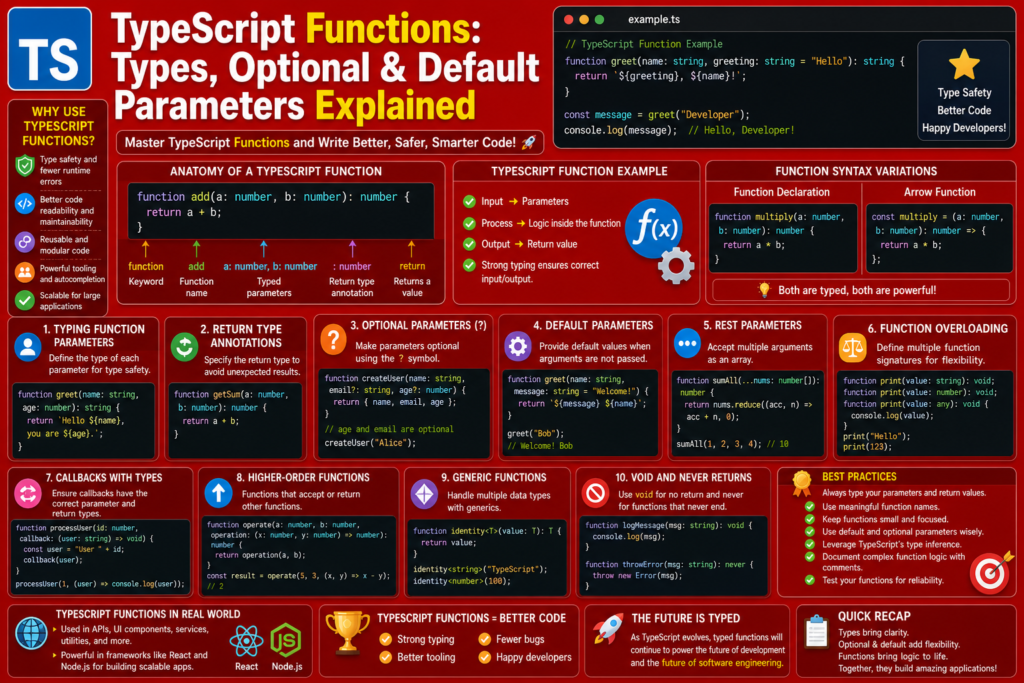
Understanding typescript functions is one of the most powerful steps toward mastering modern development. Functions are the building blocks of any application, and learning how to use typescript functions properly can significantly improve your coding skills. Whether you are a beginner or an experienced developer, knowing how typescript functions work helps you write cleaner, more maintainable, and scalable code.
TypeScript enhances JavaScript functions by adding type safety, better structure, and advanced features. In this guide, we will explore everything about typescript functions, including parameter types, optional parameters, default values, and more.
The Evolution of Functions in Programming (1995 – Present)
Before diving into typescript functions, it is important to understand how functions evolved. In early JavaScript, functions were flexible but lacked type checking, which often led to runtime errors.
In 2012, TypeScript was introduced by Anders Hejlsberg, bringing a powerful type system to JavaScript. The typescript history shows how TypeScript improved function reliability through static typing and compile time checks.
This evolution made typescript functions a key feature in modern programming.
What Are TypeScript Functions?
At their core, typescript functions are reusable blocks of code designed to perform specific tasks. They accept inputs, process data, and return outputs.
If you are wondering what is typescript?, it is a superset of JavaScript that adds type safety and advanced features. This means functions can have defined input and output types.
Using typescript functions, developers can ensure that data flows correctly through the application, improving logic flow and reducing errors.
Typing Function Parameters
One of the most important aspects of typescript functions is typing function parameters. This ensures that functions receive the correct type of input.
For example, you can define whether a parameter should be a string, number, or boolean. This improves type safety and prevents unexpected behavior.
Typing parameters is essential for building reliable applications and maintaining code quality.
Return Type Annotations
Return type annotations define what type of value a function returns. This is a key feature of typescript functions.
By specifying return types, developers can ensure consistency and avoid errors. It also improves code readability and documentation.
Return type annotations are especially useful in large projects where functions are used extensively.
Optional Parameters Explained
Optional parameters are a powerful feature of typescript functions. They allow you to define parameters that are not required when calling a function.
These parameters are marked with a question mark. This flexibility makes functions more versatile and easier to use.
Optional parameters are commonly used in real world applications to handle different scenarios.
Default Parameters and Their Benefits
Default parameters provide predefined values for function parameters. This means if no value is provided, the function uses the default value.
In typescript functions, default parameters improve usability and reduce the need for additional checks. They also simplify code and make it more readable.
Using default parameters is a best practice for writing efficient functions.
Rest Parameters and Argument Handling
Rest parameters allow functions to accept multiple arguments as an array. This is useful when the number of arguments is unknown.
In typescript functions, rest parameters enhance flexibility and support dynamic input handling. They are commonly used in higher order functions and functional programming.
Understanding rest parameters is essential for advanced development.
Arrow Functions in TypeScript
Arrow functions are a modern way to write functions. They provide a concise syntax and are widely used in TypeScript.
Arrow functions in TS support type annotations, making them a powerful tool for developers. They also improve readability and simplify code.
Using arrow functions is a common practice in modern development.
Function Overloading in TypeScript
Function overloading allows you to define multiple function signatures for a single function. This is a unique feature of typescript functions.
It enables developers to handle different input types and scenarios within the same function. This improves code flexibility and usability.
Function overloading is particularly useful in complex applications.
Callbacks and Higher Order Functions
Callbacks and higher order functions are advanced concepts in typescript functions. They involve passing functions as arguments or returning functions from other functions.
These concepts are widely used in functional programming and help create reusable code. They also improve modularity and maintainability.
Understanding callbacks is essential for building dynamic applications.
Function Scope and Execution Context
Function scope determines where variables are accessible within a function. In TypeScript, scope follows lexical rules, ensuring predictable behavior.
Execution context defines how functions are executed and how variables are managed. These concepts are crucial for understanding typescript functions.
Proper handling of scope and context improves code reliability.
TypeScript Functions vs JavaScript Functions
When comparing typescript vs javascript, the main difference lies in type safety. JavaScript functions are flexible but lack type checking.
TypeScript functions, on the other hand, provide compile time checks and better tooling support. This improves code quality and reduces errors.
Understanding this comparison highlights the advantages of typescript functions.
Practical Examples for Beginners
For those learning typescript for beginners, practicing simple examples is the best approach. Start with basic functions and gradually add type annotations.
Experiment with optional and default parameters to understand how they work. These exercises help you build confidence and improve your skills.
Practice is key to mastering typescript functions.
Using Functions in Real World Applications
In real world applications, typescript functions are used extensively. They help organize code, manage logic, and improve maintainability.
Functions are used in frameworks like React and Node.js. Learning typescript with react and typescript with nodejs enhances your ability to build modern applications.
Understanding real world usage is essential for becoming a skilled developer.
Common Mistakes and Best Practices
While learning typescript functions, developers often make mistakes such as incorrect type annotations or misuse of parameters.
To avoid these issues, follow best practices like defining clear types, using default values, and maintaining consistency.
Learning from mistakes will help you improve and write better code.
Future of TypeScript Functions
The future of typescript is closely tied to its function capabilities. As the language evolves, new features will enhance its power and flexibility.
TypeScript will play a major role in the future of software engineering, helping developers build scalable and reliable applications.
Mastering typescript functions will remain a valuable skill.
FAQs About TypeScript Functions
What are TypeScript functions?
They are reusable blocks of code with type annotations for inputs and outputs.
What is a return type in TypeScript?
It defines the type of value a function returns.
What are optional parameters?
Parameters that are not required when calling a function.
What are default parameters?
Parameters with predefined values used when no argument is provided.
Are TypeScript functions better than JavaScript functions?
They provide better type safety and reduce errors.
Conclusion
Learning typescript functions is essential for building modern applications. From basic parameter typing to advanced concepts like overloading and callbacks, TypeScript provides powerful tools for developers.
By mastering typescript functions, you can improve code quality, enhance maintainability, and build scalable applications. As technology continues to evolve, understanding functions will remain a core skill in programming.
Start practicing today and unlock the full potential of TypeScript in your projects.