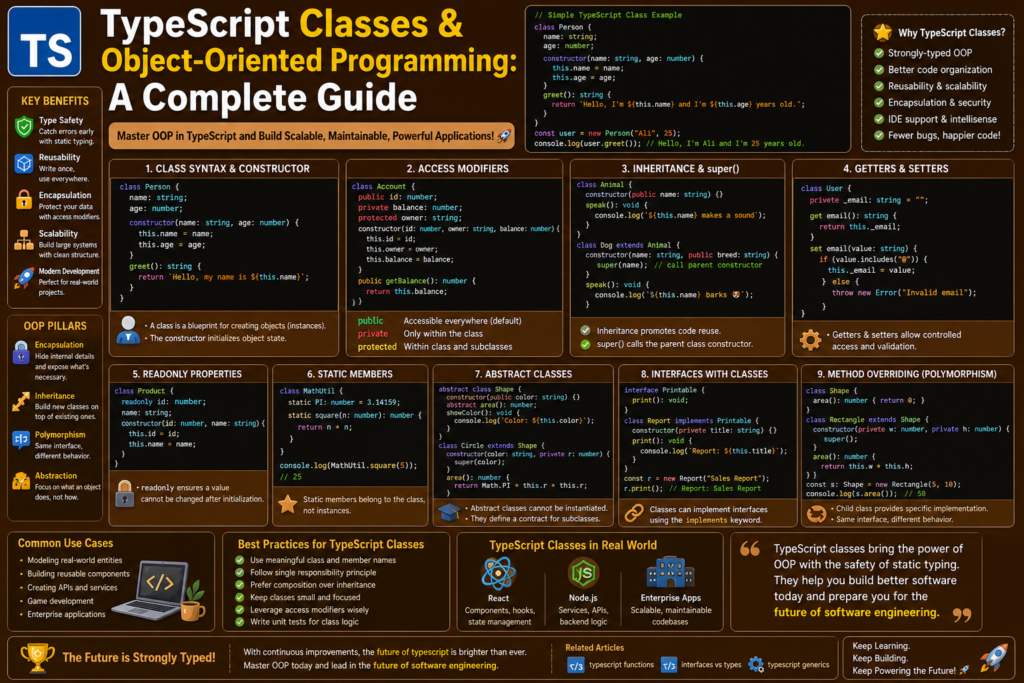
Understanding typescript classes is a powerful step toward mastering modern programming. If you want to build scalable applications with clean structure and reusable logic, learning typescript classes is essential. In today’s development landscape, object oriented programming plays a major role in software architecture, and TypeScript enhances it with strong typing and advanced features.
When developers explore typescript classes, they gain the ability to create blueprints for objects, manage object state, and implement real world logic effectively. This guide will walk you through everything you need to know about typescript classes, including constructors, inheritance, encapsulation, and more with practical code examples.
Evolution of Object Oriented Programming (1960 – 2026)
Object oriented programming began evolving in the 1960s and became widely adopted in the 1990s with languages like Java and C++. JavaScript later introduced prototype based inheritance, but it lacked structured OOP support.
In 2012, TypeScript was introduced by Anders Hejlsberg, bringing class based syntax and a strong type system. The typescript history shows how this innovation simplified OOP concepts in JavaScript.
Today, typescript classes provide a clean and modern way to implement encapsulation, polymorphism, and inheritance in web development.
What Are TypeScript Classes?
At its core, typescript classes are blueprints used to create objects. They define properties and methods that describe the behavior of objects.
If you are wondering what is typescript?, it is a superset of JavaScript that adds static typing and structured programming features. Classes are one of the most powerful features in TypeScript.
With typescript classes, developers can create reusable components, manage data effectively, and build scalable applications with better organization.
Basic Class Syntax in TypeScript
Let’s start with a simple example of typescript classes:
class Person {
  name: string;
  age: number;

  constructor(name: string, age: number) {
    this.name = name;
    this.age = age;
  }

  greet(): string {
    return `Hello, my name is ${this.name}`;
  }
}

const user = new Person("Ali", 25);
console.log(user.greet());
In this example, the class acts as a blueprint, and the object is an instance of that class. This demonstrates how typescript classes help define structure and behavior.
Constructors and Initialization
Constructors are special methods used to initialize objects. They are a key part of typescript classes.
The constructor function runs when a new instance is created. It assigns values to member variables and sets up the object state.
Using constructors ensures that objects are properly initialized and ready for use.
Access Modifiers Explained
TypeScript introduces access modifiers to control visibility. These include public, private, and protected.
class Car {
  public brand: string;
  private speed: number;

  constructor(brand: string, speed: number) {
    this.brand = brand;
    this.speed = speed;
  }

  public getSpeed(): number {
    return this.speed;
  }
}
Access modifiers improve encapsulation and protect sensitive data. They are a key feature of typescript classes and enhance code security.
Readonly Properties
Readonly properties ensure that values cannot be changed after initialization.
class Product {
  readonly id: number;

  constructor(id: number) {
    this.id = id;
  }
}
This feature is useful for maintaining data integrity and preventing accidental changes in typescript classes.
Inheritance in TypeScript
Inheritance allows one class to extend another, creating a class hierarchy. This is a fundamental concept in OOP.
class Animal {
  speak(): void {
    console.log("Animal makes a sound");
  }
}

class Dog extends Animal {
  speak(): void {
    console.log("Dog barks");
  }
}
Inheritance promotes code reuse and simplifies complex systems. It is a core feature of typescript classes.
The super() Keyword
The super() function is used to call the constructor of a parent class.
class Employee extends Person {
  role: string;

  constructor(name: string, age: number, role: string) {
    super(name, age);
    this.role = role;
  }
}
This ensures proper initialization of inherited properties.
Abstract Classes and Interfaces
Abstract classes cannot be instantiated directly. They serve as a base for other classes.
abstract class Shape {
  abstract area(): number;
}

class Circle extends Shape {
  constructor(private radius: number) {
    super();
  }

  area(): number {
    return Math.PI * this.radius * this.radius;
  }
}
Abstract classes are useful for defining common behavior. They work well with interfaces vs types concepts.
Getters and Setters
Getters and setters allow controlled access to properties.
class User {
  private _name: string = "";

  get name(): string {
    return this._name;
  }

  set name(value: string) {
    this._name = value;
  }
}
This improves encapsulation and allows validation logic.
Static Methods and Properties
Static members belong to the class rather than instances.
class MathHelper {
  static add(a: number, b: number): number {
    return a + b;
  }
}

console.log(MathHelper.add(5, 3));
Static methods are useful for utility functions in typescript classes.
Polymorphism in TypeScript
Polymorphism allows objects to behave differently based on their class.
class Bird {
  fly(): void {
    console.log("Bird flies");
  }
}

class Penguin extends Bird {
  fly(): void {
    console.log("Penguin cannot fly");
  }
}
This concept enhances flexibility and supports dynamic behavior.
TypeScript Classes vs JavaScript Classes
When comparing typescript vs javascript, TypeScript classes provide better type safety and structure.
JavaScript classes rely on the prototype chain, while TypeScript adds static typing and compile time checks.
This makes typescript classes more reliable and easier to maintain.
Practical Use Cases in Modern Development
In real world projects, typescript classes are used in frameworks and applications. Developers often combine them with typescript functions and other features.
They are widely used in frontend and backend development, especially in large applications.
Learning typescript with nodejs and typescript with react enhances your ability to use classes effectively
Common Mistakes and Best Practices
While working with typescript classes, developers often make mistakes like overusing inheritance or ignoring encapsulation.
Best practices include using clear naming conventions, keeping classes small, and focusing on single responsibility.
Understanding these practices helps you build better applications.
Role in Future Development
The future of typescript is closely tied to object oriented programming. Classes will continue to play a major role in building scalable applications.
TypeScript will also influence the future of software engineering, helping developers create better systems with strong architecture.
Mastering typescript classes ensures long term success in programming.
FAQs About TypeScript Classes
What are TypeScript classes?
They are blueprints used to create objects with properties and methods.
What is inheritance in TypeScript?
It allows one class to extend another and reuse code.
What are access modifiers?
They control the visibility of class members.
What is polymorphism?
It allows objects to behave differently based on their type.
Are TypeScript classes better than JavaScript classes?
They provide better structure, type safety, and maintainability.
Conclusion
Learning typescript classes is essential for building modern applications. From basic syntax to advanced OOP concepts, TypeScript provides powerful tools for developers.
By mastering typescript classes, you can improve code quality, enhance maintainability, and build scalable systems. As technology evolves, these skills will remain valuable in the world of programming.
Start practicing today and unlock the full potential of TypeScript in your development journey.