The history of bluetooth is one of the most fascinating stories in modern technology. What started as a small wireless research project inside Ericsson in 1994 eventually became a worldwide communication standard used by billions of devices every single day.
Today, Bluetooth powers smartphones, earbuds, speakers, cars, gaming controllers, smartwatches, laptops, and countless smart devices. The technology completely changed wireless communication history and helped create the connected digital world we live in today.
Understanding the history of bluetooth helps us appreciate how rapidly technology evolved over the past three decades. From early experiments with short-range radio communication to modern Bluetooth 5.4 systems, the journey has been extraordinary.
This article explores the complete history of bluetooth, major milestones, important inventors, version improvements, industry adoption, and the future of this revolutionary wireless technology.
The Wireless Communication Challenge (1980 – 1993)
Before Bluetooth existed, electronic devices depended heavily on cables. Mobile phones could not easily communicate with computers or accessories. Data transfer standards were limited, slow, and inconvenient.
Technology companies wanted a universal wireless system that could support electronic data exchange between devices without physical connections.
During the late 1980s and early 1990s, engineers explored several wireless communication methods using the 2.4 GHz band. Researchers believed short-range radio systems could replace cables entirely.
At this stage, the world was entering a major telecommunications revolution. Mobile devices were becoming more common, and consumers wanted easier connectivity solutions.
This challenge laid the foundation for the history of bluetooth.
Ericsson Starts the Bluetooth Project (1994)
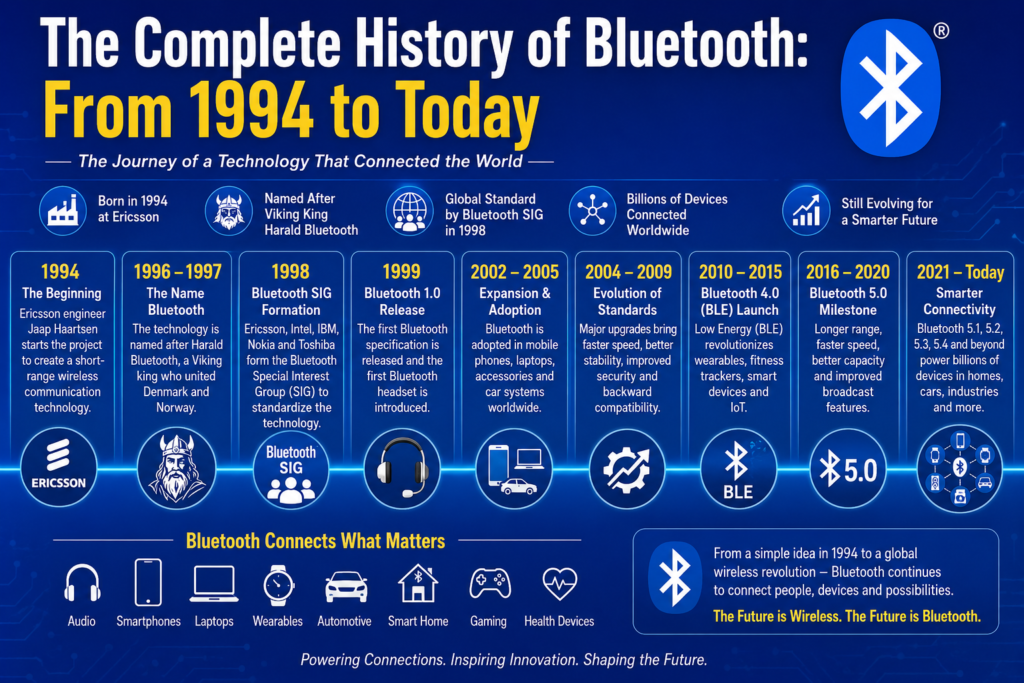
The real beginning of the history of bluetooth started in 1994 at Ericsson.
Ericsson engineer Jaap Haartsen led the development of a new wireless communication system designed for mobile devices. Sven Mattisson also played a critical engineering role in the project.
The goal was simple but incredibly ambitious:
Create a universal short-range wireless technology capable of connecting electronic devices without cables.
The Ericsson engineering team focused on low-power radio frequency communication that could work reliably across multiple devices.
The project relied on advanced protocol development techniques and frequency hopping technology. Frequency hopping allowed signals to switch rapidly between radio channels, reducing interference and improving stability.
This 1994 tech breakthrough became the starting point for one of the greatest connectivity milestones in modern history.
The Name Bluetooth and Its Viking Origins (1996 – 1997)
One of the most interesting chapters in the history of bluetooth is the origin of its name.
If you want the full explanation, you can explore why bluetooth is called bluetooth in greater detail.
The technology was named after Harald Bluetooth, a Viking king who united Denmark and Norway during the 10th century.
The idea behind the name was symbolic. Bluetooth technology would unite electronic devices from different manufacturers just as Harald Bluetooth united kingdoms.
Intel engineer Jim Kardach proposed the name during industry discussions involving Ericsson and other technology companies.
The Bluetooth logo itself combines Nordic runes representing Harald Bluetooth’s initials.
This unique branding became one of the most recognizable technology symbols in the world.
Bluetooth SIG Formation and Industry Collaboration (1998)
The Bluetooth SIG formation marked a turning point in the history of bluetooth.
In 1998, several major technology companies joined together to support industry standardization for Bluetooth technology.
The founding members included:
- Ericsson
- Intel
- IBM
- Nokia
- Toshiba
Nokia and IBM involvement helped accelerate Bluetooth market adoption globally.
The Bluetooth Special Interest Group, commonly called SIG, managed the evolution of Bluetooth standards and ensured device compatibility across manufacturers.
Without the Bluetooth SIG formation, Bluetooth might never have become a universal global standard.
The organization continues guiding Bluetooth development today.
Bluetooth 1.0 Release and Early Challenges (1999 – 2001)
The Bluetooth 1.0 release officially introduced Bluetooth technology to the commercial market.
The first Bluetooth devices appeared in 1999, including wireless headsets and communication accessories.
However, the early versions faced several technical challenges:
- Slow connection speeds
- Weak interoperability
- Limited range
- High battery usage
Despite these issues, the technology showed incredible promise.
The first Bluetooth mobile phone launched shortly afterward, demonstrating how wireless communication could improve mobile phone connectivity.
Consumers were fascinated by cable-free device communication.
This period was crucial in the history of bluetooth because it proved that wireless personal communication could become commercially viable.
Bluetooth Expansion and Global Adoption (2002 – 2005)
Between 2002 and 2005, Bluetooth experienced rapid global adoption.
Laptop manufacturers started integrating Bluetooth chips into computers. Mobile phone companies added Bluetooth support to most major devices.
Wireless communication history changed dramatically during this period because Bluetooth became a mainstream feature instead of an experimental technology.
The technology improved in several important areas:
- Faster pairing
- Better compatibility
- Improved audio support
- Lower energy consumption
During this stage, many users first learned what is bluetooth and how it could simplify daily digital communication.
Bluetooth also became popular in cars, enabling hands-free calling and wireless accessories.
By the mid-2000s, Bluetooth had become part of the global tech ecosystem.
Evolution of Bluetooth Standards (2004 – 2009)
The evolution of Bluetooth standards played a major role in the technology’s success.
Several new Bluetooth versions introduced major improvements in speed, reliability, and performance.
Bluetooth 2.0 introduced Enhanced Data Rate technology, increasing transfer speeds significantly.
Bluetooth 2.1 improved pairing simplicity and security features.
If you want detailed technical comparisons, exploring bluetooth versions can help explain how each generation improved over time.
Backward compatibility became one of Bluetooth’s greatest strengths. New devices could still communicate with older hardware, helping maintain long-term global adoption.
This approach made Bluetooth highly attractive to manufacturers and consumers alike.
Bluetooth Audio Revolution (2006 – 2012)
One of the biggest transformations in the history of bluetooth came from wireless audio.
Bluetooth headsets, speakers, and music streaming devices became extremely popular worldwide.
Wireless earphones eliminated the need for tangled cables, while portable Bluetooth speakers changed how people listened to music.
The development of better bluetooth audio codecs improved sound quality dramatically.
Audio streaming became smoother, clearer, and more reliable.
Bluetooth technology soon became essential for entertainment systems, gaming accessories, and mobile devices.
This period helped Bluetooth evolve from a simple data transfer system into a complete multimedia communication platform.
Bluetooth 4.0 BLE Launch and Smart Devices (2010 – 2015)
The Bluetooth 4.0 (BLE) launch represented another revolutionary moment in the history of bluetooth.
BLE stands for Bluetooth Low Energy.
This technology focused on extremely low power consumption while maintaining reliable communication.
BLE made Bluetooth ideal for:
- Fitness trackers
- Smartwatches
- Medical devices
- Smart sensors
- Internet of Things products
The comparison between bluetooth classic vs ble became increasingly important for developers and manufacturers.
Bluetooth Classic supported continuous communication like music streaming, while BLE focused on efficient low-energy operations.
This advancement opened the door for wearable technology and smart home systems.
Bluetooth became a core technology of modern connected living.
Bluetooth 5.0 Milestone and Modern Performance (2016 – 2020)
The Bluetooth 5.0 milestone dramatically improved wireless communication performance.
Bluetooth 5.0 introduced:
- Greater range
- Faster transfer speeds
- Better broadcast capabilities
- Improved reliability
Smartphones, speakers, and IoT devices benefited enormously from these upgrades.
Consumers also became more interested in understanding bluetooth range because modern Bluetooth systems could operate across larger distances than earlier generations.
Bluetooth 5.1, 5.2, 5.3, and 5.4 continued improving efficiency, audio performance, and smart connectivity.
Modern Bluetooth systems now support advanced wireless ecosystems involving multiple connected devices simultaneously.
Bluetooth in Everyday Life Today (2021 – Today)
Today, the history of bluetooth continues evolving rapidly.
Bluetooth technology is now integrated into almost every major electronic category:
- Smartphones
- Laptops
- Smart TVs
- Gaming systems
- Cars
- Wireless earbuds
- Health devices
- Smart homes
Billions of Bluetooth-enabled devices are produced annually.
Consumers regularly use Bluetooth for streaming music, file transfers, wireless gaming, fitness tracking, and hands-free communication.
Many users now search for ways to pair bluetooth devices more effectively because wireless ecosystems have become increasingly advanced.
Bluetooth security systems have also improved significantly over time, helping protect wireless communication from unauthorized access.
The technology has become one of the most essential wireless protocols in modern computing.
The Engineering Impact of Bluetooth
The engineering impact of Bluetooth extends far beyond wireless headsets and smartphones.
Bluetooth transformed:
- Mobile computing
- Consumer electronics
- Automotive technology
- Smart health devices
- Industrial communication systems
The technology also influenced broader protocol development strategies in telecommunications innovation.
Its low-cost implementation, global compatibility, and efficient wireless communication design made Bluetooth one of the greatest success stories in technology history.
The contributions of Jaap Haartsen, Sven Mattisson, and the Ericsson engineering team continue influencing the entire electronics industry today.
If you want to learn more about the inventors themselves, exploring who invented bluetooth provides a deeper understanding of their contributions.
The Future of Bluetooth Technology
The future of Bluetooth remains extremely promising.
Modern engineers continue improving speed, reliability, security, and energy efficiency.
Emerging technologies such as augmented reality, artificial intelligence, robotics, and smart cities will likely depend heavily on Bluetooth communication systems.
The growth of the Internet of Things will further expand Bluetooth applications across industries worldwide.
The continuing evolution of wireless systems also connects closely with the future of software engineering, where connected ecosystems and intelligent automation are becoming increasingly important.
Bluetooth will likely remain one of the most influential wireless standards for decades to come.
Frequently Asked Questions (FAQs)
When was Bluetooth invented?
Bluetooth development officially started in 1994 at Ericsson.
Who created Bluetooth technology?
Jaap Haartsen and Sven Mattisson are recognized as the primary engineers behind Bluetooth technology.
What was the first Bluetooth device?
One of the earliest Bluetooth products was a wireless headset developed by Ericsson in 1999.
What is Bluetooth Low Energy?
Bluetooth Low Energy, or BLE, is a low-power version of Bluetooth introduced with Bluetooth 4.0 for smart devices and wearable technology.
Why did Bluetooth become so popular?
Bluetooth became popular because it allowed wireless communication between devices without cables while maintaining low power usage and global compatibility.
Is Bluetooth still evolving today?
Yes. Bluetooth continues improving with newer versions that offer better speed, range, security, and audio quality.
Conclusion
The history of bluetooth represents one of the most important achievements in wireless communication history. From a small Ericsson research project in 1994 to a global technology powering billions of devices, Bluetooth transformed the modern digital world forever.
The evolution of Bluetooth standards, the Bluetooth SIG formation, the Bluetooth 4.0 (BLE) launch, and the Bluetooth 5.0 milestone all played major roles in shaping today’s connected technology ecosystem.
Bluetooth changed how people communicate, listen to music, transfer data, and interact with smart devices. Its influence reaches nearly every corner of modern life.
As technology continues advancing, Bluetooth will remain a powerful symbol of innovation, engineering excellence, and global connectivity.