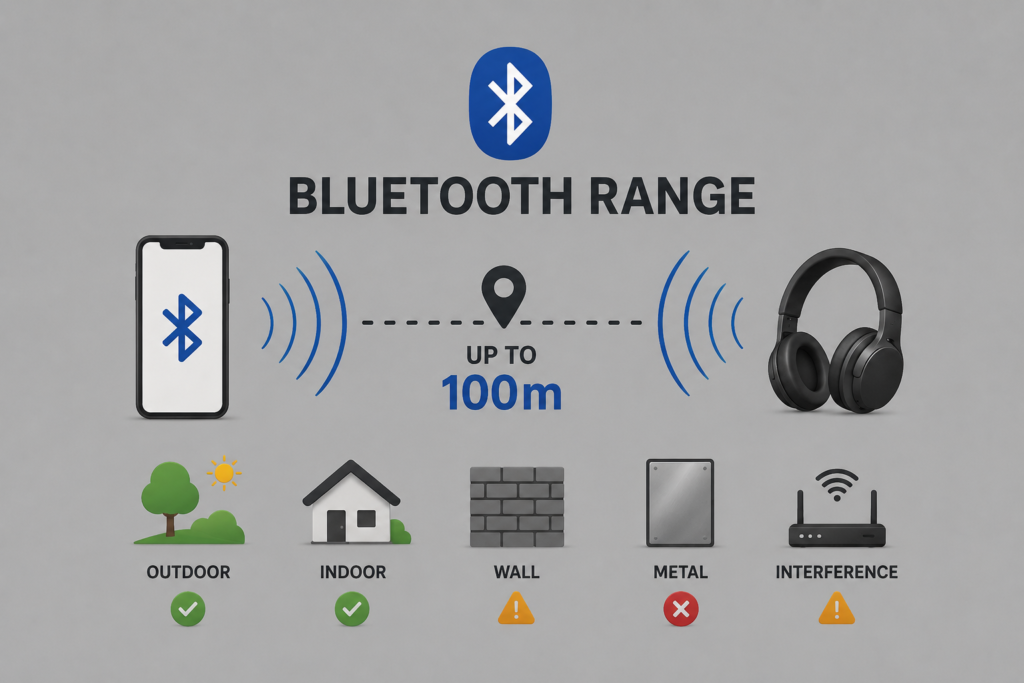
Understanding bluetooth range is extremely important because Bluetooth performance depends heavily on distance, signal strength, physical barriers, and wireless interference. Many people assume Bluetooth only works across a few feet, but modern Bluetooth technology can actually reach surprisingly long distances under the right conditions.
Today, Bluetooth powers smartphones, wireless headphones, speakers, gaming systems, smartwatches, smart homes, and billions of connected devices worldwide. However, the wireless range varies greatly depending on device class, Bluetooth version, transmission power, and environmental factors.
The topic of bluetooth range became even more important after Bluetooth 5.0 introduced major range extension improvements. Modern Bluetooth systems can sometimes operate across hundreds of meters outdoors.
This complete guide explains bluetooth range, Bluetooth Class 1 vs Class 2 systems, signal degradation, indoor vs outdoor performance, physical barriers, long-range Bluetooth, and how modern wireless communication systems achieve greater connectivity distance.
What Is Bluetooth Range? (1994 – Today)
The simplest definition of bluetooth range is:
The maximum distance over which Bluetooth devices can communicate wirelessly while maintaining a stable connection.
Bluetooth devices use radio waves in the 2.4 GHz frequency band to exchange data.
However, wireless signals weaken as distance increases. This process is called signal drop-off or path loss.
Bluetooth range depends on many factors, including:
- Bluetooth version
- Transmission power
- Device class
- Antenna gain
- Physical barriers
- Wireless interference
- Environmental conditions
Modern Bluetooth systems improved wireless range dramatically compared to early Bluetooth generations.
If you are new to Bluetooth technology, learning what is bluetooth helps explain how Bluetooth communication works overall.
Early Bluetooth Range Limitations (1999 – 2005)
Early Bluetooth systems had very limited range.
Bluetooth 1.0 devices often supported only about 10 meters under normal indoor conditions.
Several factors limited early Bluetooth performance:
- Weak transmission power
- Limited antenna quality
- Poor signal management
- Interference issues
Wireless communication technology was still developing during this period.
The first generations mainly focused on replacing cables for nearby devices such as:
- Headphones
- Keyboards
- Mobile accessories
Long-distance wireless communication was not the main priority at the time.
Bluetooth Device Classes Explained
Understanding bluetooth range requires understanding Bluetooth device classes.
Bluetooth devices are divided into different power classes.
Bluetooth Class 1
Bluetooth Class 1 devices use higher transmission power.
Typical range:
- Up to 100 meters or more
Common uses:
- Industrial systems
- Professional equipment
- Long-range communication devices
Bluetooth Class 2
Bluetooth Class 2 devices use lower transmission power.
Typical range:
- Around 10 meters
Common uses:
- Smartphones
- Earbuds
- Wireless accessories
Bluetooth Class 3
Bluetooth Class 3 devices use very low power.
Typical range:
- Around 1 meter
These are less common today.
The comparison between Bluetooth Class 1 vs Class 2 shows how transmission power affects wireless coverage area significantly.
Indoor vs Outdoor Bluetooth Range
One of the biggest factors affecting bluetooth range is the environment.
Outdoor Bluetooth Range
Outdoor wireless communication performs much better because there are fewer obstacles blocking signal propagation.
Modern long-range Bluetooth systems can sometimes exceed:
- 100 meters
- 200 meters
- Even 300+ meters under ideal conditions
Indoor Bluetooth Range
Indoor environments reduce signal strength because of:
- Walls
- Furniture
- Metal objects
- Electronic interference
Indoor Bluetooth range is usually much shorter than outdoor range.
This difference between outdoor vs indoor range is extremely important in real-world use.
Signal Obstacles and Physical Barriers
Physical barriers greatly affect bluetooth range.
Bluetooth radio waves weaken when passing through objects.
Common signal obstacles include:
- Concrete walls
- Metal surfaces
- Glass
- Water
- Large furniture
Interference from walls is one of the biggest reasons Bluetooth connections weaken indoors.
Signal degradation increases as more obstacles block the wireless signal path.
The thicker the barrier, the greater the signal loss.
How Bluetooth Signal Strength Works
Bluetooth communication depends heavily on signal strength.
Stronger signals produce:
- Better connection stability
- Greater wireless range
- Faster communication
- Lower latency
Weaker signals produce:
- Connection drops
- Audio interruptions
- Slow data transfer
- Pairing problems
Signal strength weakens naturally with distance because of wave propagation principles.
This gradual weakening is called path loss.
Modern Bluetooth systems use smart technologies to reduce signal degradation and maintain stable communication.
Bluetooth Versions and Range Improvements
The evolution of bluetooth versions dramatically improved wireless distance capabilities.
Bluetooth 1.x and 2.x
- Limited wireless range
- Higher interference problems
- Lower efficiency
Bluetooth 4.0
- Introduced Bluetooth Low Energy
- Improved energy efficiency
- Better wireless management
Bluetooth 5.0
Bluetooth 5.0 introduced one of the largest Bluetooth range improvements ever.
Benefits included:
- Up to four times greater range
- Improved signal stability
- Better wireless efficiency
Bluetooth 5.3 and 5.4
Modern Bluetooth systems further improved:
- Signal reliability
- Power efficiency
- Wireless optimization
- Environmental adaptation
If you want deeper comparisons, exploring bluetooth 5.0 vs 5.3 vs 5.4 explains the latest improvements in Bluetooth technology.
Bluetooth Classic vs BLE Range
The comparison between bluetooth classic vs ble also affects wireless range performance.
Bluetooth Classic
Bluetooth Classic focuses on:
- Continuous communication
- Audio streaming
- Real-time wireless connections
Bluetooth Low Energy (BLE)
BLE focuses on:
- Low power consumption
- Smart sensors
- Long battery life
- Efficient signal transmission
Modern BLE systems often achieve surprisingly strong long-range Bluetooth performance because of efficient signal management.
BLE became extremely important for IoT systems and smart devices.
Long Range Bluetooth Technology
Modern long-range Bluetooth technology improved dramatically after Bluetooth 5.0.
Several innovations helped increase coverage area:
- Better antenna gain
- Improved transmission power management
- Smarter channel selection
- Enhanced signal processing
Long-range Bluetooth is now used in:
- Smart homes
- Industrial automation
- Warehouses
- Smart agriculture
- Asset tracking systems
This expansion transformed Bluetooth from a simple cable replacement technology into a powerful wireless communication platform.
Environmental Factors Affecting Bluetooth Range
Environmental factors strongly affect bluetooth range.
Common factors include:
- Weather conditions
- Crowded wireless environments
- Nearby WiFi routers
- Electronic interference
- Building materials
- Human bodies
Water absorbs Bluetooth radio waves strongly, which is why human bodies sometimes weaken wireless performance.
Environmental conditions greatly influence real-world Bluetooth behavior.
Bluetooth Range for Common Devices
Different devices support different wireless distances.
Wireless Earbuds
Typical range:
- 10 to 30 meters
Smartwatches
Typical range:
- 10 to 50 meters
Bluetooth Speakers
Typical range:
- 10 to 100 meters depending on class
Industrial Bluetooth Systems
Typical range:
- 100 to 300 meters or more
Modern Bluetooth systems continue expanding communication distance capabilities every year.
How to Improve Bluetooth Range
Many users want better wireless performance.
Tips to Improve Bluetooth Range
- Keep devices closer together
- Remove physical barriers
- Avoid crowded wireless environments
- Update device firmware
- Use newer Bluetooth versions
- Reduce interference sources
Modern devices with newer Bluetooth chips usually provide stronger RF performance and better signal management.
Positioning also matters greatly.
Devices communicate more effectively when there is a clear line of sight.
Bluetooth vs WiFi Range
Many users compare bluetooth vs wifi vs nfc to understand wireless communication differences.
Bluetooth
- Short to medium-range communication
- Low power usage
- Device connectivity
WiFi
- Longer range networking
- Internet access
- Higher bandwidth
NFC
- Extremely short-range communication
- Contactless interactions
Bluetooth offers an excellent balance between power efficiency and wireless coverage for portable devices.
Bluetooth Security and Distance
Wireless distance also affects bluetooth security.
Longer communication ranges may slightly increase exposure to unauthorized connection attempts.
Modern Bluetooth security systems reduce these risks using:
- Encryption
- Authentication
- Secure pairing protocols
Security systems improved dramatically in newer Bluetooth generations.
Bluetooth today is much safer than earlier versions from the late 1990s.
Pairing Distance and Connection Stability
Bluetooth pairing works best when devices remain close together during setup.
If you are learning how to pair bluetooth devices, keeping devices nearby improves connection success rates significantly.
After pairing, many modern Bluetooth systems can maintain stable communication across much larger distances.
Pairing quality often affects long-term wireless stability.
Bluetooth Audio and Signal Quality
Bluetooth range also affects wireless audio quality.
Weak signals may cause:
- Audio delays
- Music interruptions
- Connection drops
- Lower sound quality
Modern bluetooth audio codecs help improve audio performance and maintain stable streaming even at longer distances.
Newer Bluetooth versions handle wireless audio far better than early systems.
The Future of Bluetooth Range
The future of bluetooth looks extremely promising.
Future Bluetooth systems will likely improve:
- Long-range communication
- Wireless stability
- Smart signal adaptation
- Energy efficiency
- IoT networking
Engineers continue developing smarter wireless systems capable of operating across larger areas while using less power.
The growth of wireless ecosystems also connects closely with the future of software engineering, where intelligent communication networks are becoming increasingly important.
Bluetooth will likely continue expanding its wireless capabilities for many years.
Why Bluetooth Range Matters So Much
Bluetooth range affects almost every wireless experience.
Strong Bluetooth range improves:
- Audio quality
- Device reliability
- Smart home communication
- Gaming accessories
- Wireless convenience
Poor wireless range creates frustrating user experiences.
That is why Bluetooth engineers continuously improve RF performance, transmission efficiency, and wireless stability.
Today, Bluetooth provides far greater communication distances than most people realize.
Frequently Asked Questions (FAQs)
What is the normal Bluetooth range?
Most consumer Bluetooth devices support around 10 meters, while modern long-range systems may exceed 100 meters.
Does Bluetooth work through walls?
Yes, but walls weaken Bluetooth signals and reduce wireless range.
Which Bluetooth version has the best range?
Bluetooth 5.x versions provide the strongest wireless range and stability improvements.
Why does Bluetooth range decrease indoors?
Indoor environments contain physical barriers and electronic interference that weaken signal strength.
What affects Bluetooth signal strength?
Signal strength depends on distance, transmission power, obstacles, wireless interference, and device quality.
Can Bluetooth reach 100 meters?
Yes. Bluetooth Class 1 devices and Bluetooth 5.x systems can sometimes reach or exceed 100 meters outdoors.
Conclusion
Understanding bluetooth range helps explain why Bluetooth performance changes across different environments and devices.
Bluetooth range depends on transmission power, antenna gain, signal obstacles, environmental factors, Bluetooth versions, and wireless communication design. Modern Bluetooth systems greatly improved coverage area, signal stability, and long-range communication compared to early generations.
Technologies such as Bluetooth 5.x, Bluetooth Low Energy, and advanced signal management transformed Bluetooth into a highly capable wireless platform for smart homes, wearable devices, industrial systems, and everyday consumer electronics.
As Bluetooth technology continues evolving, wireless range and communication reliability will continue improving for the connected world of the future.