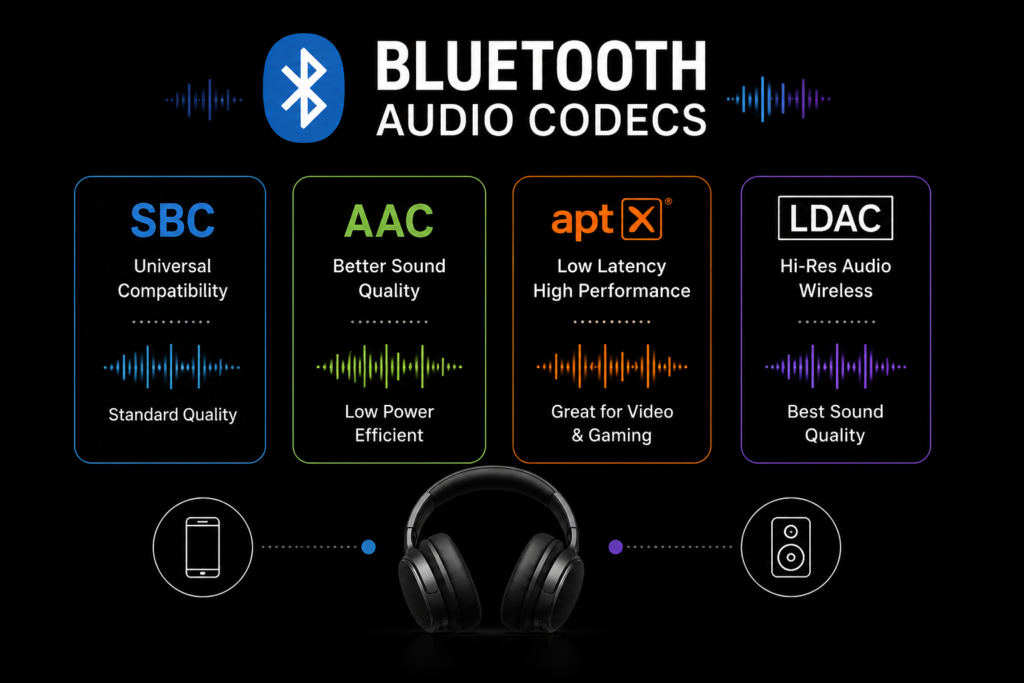
Understanding bluetooth audio codecs is extremely important if you care about wireless sound quality. Modern Bluetooth headphones, earbuds, speakers, smartphones, and audio systems all rely on codecs to transmit music wirelessly. These codecs affect audio fidelity, latency, compression quality, and the overall listener experience.
Many people buy expensive wireless headphones without realizing that the Bluetooth codec can dramatically change how music sounds. Some codecs prioritize compatibility and battery efficiency, while others focus on high-resolution audio and lower Bluetooth latency.
The topic of bluetooth audio codecs became even more important as wireless audio replaced wired listening for millions of people worldwide. Technologies like SBC, AAC, aptX, aptX HD, and Sony LDAC compete to deliver better wireless sound with minimal audio compression.
This complete guide explains bluetooth audio codecs, bitrate comparison, latency differences, sound engineering concepts, and how codecs influence wireless listening quality.
What Are Bluetooth Audio Codecs? (1999 – Today)
Before comparing bluetooth audio codecs, it is important to understand what a codec actually is.
A Bluetooth audio codec is a technology that compresses and decompresses digital audio for wireless transmission.
Because Bluetooth bandwidth is limited, audio files must be compressed before traveling wirelessly between devices.
The codec handles:
- Audio compression
- Wireless sound transmission
- Data compression efficiency
- Audio synchronization
- Sound quality management
When you stream music from a phone to wireless headphones, the codec determines how the sound is processed.
Different codecs produce different results involving:
- Audio fidelity
- Streaming quality
- Bluetooth latency
- Battery usage
- Compatibility
Modern codecs continue improving wireless audio performance every year.
Why Bluetooth Audio Codecs Matter
The importance of bluetooth audio codecs comes from their direct impact on sound quality.
A poor codec may create:
- Audio lag
- Reduced detail
- Weak bass
- Distortion
- Lower clarity
A high-quality codec may provide:
- Better wireless sound
- Higher-resolution audio
- Lower latency
- Improved listener experience
- Better synchronization for video and gaming
Codecs became increasingly important as wireless headphones replaced wired audio systems.
If you enjoy wireless listening, choosing the correct codec can dramatically improve performance.
How Bluetooth Audio Works
Understanding bluetooth audio codecs becomes easier when you understand how Bluetooth audio works overall.
Bluetooth audio communication usually relies on the A2DP profile.
A2DP stands for Advanced Audio Distribution Profile.
The process works like this:
- Audio file plays on source device
- Codec compresses audio data
- Bluetooth transmits the compressed signal
- Headphones decode the signal
- Digital-to-analog conversion produces sound
The codec controls how efficiently audio travels between devices.
If you want deeper wireless communication details, learning how bluetooth works explains the technology behind Bluetooth transmission systems.
SBC Codec Explained
SBC is the default Bluetooth codec.
SBC stands for Subband Coding.
Every Bluetooth audio device supports SBC because it is required by the Bluetooth standard.
Advantages of SBC
- Universal compatibility
- Stable performance
- Low processing demands
- Good battery efficiency
Disadvantages of SBC
- Lower sound quality compared to advanced codecs
- Higher compression
- More noticeable audio artifacts
- Moderate Bluetooth latency
SBC works well for casual listening, but audiophiles often prefer more advanced codecs.
Despite its limitations, SBC remains extremely important because of its wide compatibility.
AAC Codec Explained
AAC stands for Advanced Audio Coding.
AAC became popular largely because of Apple AAC support across iPhones, iPads, and AirPods.
AAC generally provides better sound quality than SBC at similar bitrates.
Advantages of AAC
- Better audio fidelity
- Improved compression efficiency
- Good listener experience
- Excellent support on Apple devices
Disadvantages of AAC
- Performance varies across Android devices
- Higher processing requirements
- Latency can vary
AAC is especially effective inside Apple ecosystems because Apple optimizes hardware and software together.
Many music streaming services also use AAC for compressed audio delivery.
aptX Codec Explained
aptX is a Bluetooth codec developed by Qualcomm.
It became famous for improving wireless sound quality and reducing audio lag.
Advantages of aptX
- Lower Bluetooth latency
- Better audio quality than SBC
- Improved synchronization for video and gaming
- More efficient compression
Disadvantages of aptX
- Requires compatible hardware
- Not universally supported
- Limited support on Apple devices
aptX became extremely popular among Android smartphones and wireless headphones.
Gamers especially appreciate aptX because lower audio lag improves real-time synchronization.
aptX HD Explained
aptX HD is an upgraded version of aptX focused on high-resolution audio.
It supports higher bitrates and improved sound engineering performance.
Advantages of aptX HD
- Better dynamic range
- Higher-resolution wireless sound
- Improved audio detail
- Enhanced sound quality
Disadvantages of aptX HD
- Higher bandwidth requirements
- Requires compatible devices
- Still compressed audio
The comparison between aptX HD vs LDAC became one of the biggest debates in wireless audio technology.
Both codecs aim to deliver premium wireless listening experiences.
Sony LDAC Explained
Sony LDAC is one of the most advanced Bluetooth audio codecs available today.
Sony LDAC supports very high bitrates for wireless audio transmission.
Advantages of LDAC
- Excellent high-resolution audio support
- Better wireless sound detail
- Superior bitrate capabilities
- Outstanding audio fidelity
Disadvantages of LDAC
- Higher battery consumption
- Connection stability may vary
- Requires compatible hardware
Sony LDAC can transmit up to 990 kbps under ideal conditions.
This makes LDAC one of the closest technologies to lossless Bluetooth audio currently available.
Audiophiles often consider LDAC the best wireless codec for sound quality.
Bitrate Comparison Between Codecs
Bitrate comparison is one of the most important topics in bluetooth audio codecs.
Bitrate measures how much audio data transfers every second.
Typical Codec Bitrates
- SBC: Around 328 kbps
- AAC: Around 250 kbps
- aptX: Around 352 kbps
- aptX HD: Around 576 kbps
- LDAC: Up to 990 kbps
Higher bitrates generally allow better audio fidelity, although optimization also matters greatly.
Better codecs preserve more musical detail during wireless transmission.
Bluetooth Latency Explained
Bluetooth latency refers to delay between audio transmission and playback.
Latency matters especially for:
- Gaming
- Movies
- Video calls
- Music production
Lower Latency Codecs
- aptX Low Latency
- aptX Adaptive
Higher Latency Systems
- Some SBC implementations
- Poorly optimized AAC systems
Low latency improves synchronization between sound and visuals.
Modern codecs continue improving audio timing performance.
Audio Compression and Sound Quality
All Bluetooth audio systems use audio compression because wireless bandwidth remains limited.
Compression removes some audio information to reduce file size.
The goal is balancing:
- Sound quality
- Transmission efficiency
- Battery life
- Wireless stability
Better codecs preserve more musical detail while minimizing compression artifacts.
Advanced sound engineering techniques improved wireless sound dramatically over the past decade.
Bluetooth Headphones and Codec Support
Bluetooth headphones codecs greatly affect listening performance.
Some headphones support only SBC and AAC.
Premium models may support:
- aptX
- aptX HD
- LDAC
- aptX Adaptive
If you want better wireless listening, exploring best bluetooth headphones helps identify models with strong codec support.
Codec compatibility between phone and headphones is extremely important.
If both devices do not support the same codec, Bluetooth falls back to lower-quality options.
Bluetooth Versions and Audio Improvements
Modern bluetooth versions improved wireless audio performance significantly.
Bluetooth 5.x introduced:
- Better bandwidth efficiency
- Improved wireless stability
- Lower power consumption
- Better audio synchronization
Newer Bluetooth systems support more advanced codec performance and improved wireless sound quality.
The evolution of Bluetooth standards helped wireless audio become more competitive with wired systems.
Bluetooth Range and Audio Stability
Wireless distance also affects codec performance.
Weak signals may reduce sound quality and create interruptions.
If you want deeper distance information, learning about bluetooth range explains how signal strength affects wireless communication.
Stable wireless connections improve:
- Streaming quality
- Audio consistency
- Synchronization
- Overall listener experience
Modern Bluetooth systems manage wireless audio much better than earlier generations.
Bluetooth Classic vs BLE Audio
The comparison between bluetooth classic vs ble also affects audio communication.
Bluetooth Classic
- Main system for wireless audio
- Stable continuous communication
- Better support for streaming music
BLE Audio
- Newer low-power audio system
- Better battery efficiency
- Future wireless audio potential
BLE Audio may become increasingly important in future wireless sound ecosystems.
Which Codec Is Best?
The best codec depends on the user’s priorities.
Best for Compatibility
- SBC
Best for Apple Devices
- AAC
Best for Gaming and Low Latency
- aptX
Best for High Resolution Audio
- LDAC
Each codec balances performance, battery usage, compatibility, and wireless stability differently.
Lossless Bluetooth Audio Future
The dream of true lossless Bluetooth audio continues driving innovation.
Current Bluetooth systems still use some level of compression.
However, newer wireless technologies continue reducing audio quality loss significantly.
Future improvements may eventually make wireless audio nearly indistinguishable from wired systems.
Bluetooth vs WiFi Audio
Many users compare bluetooth vs wifi vs nfc regarding audio systems.
Bluetooth
- Portable audio
- Wireless headphones
- Low power communication
WiFi
- Higher bandwidth
- Multi-room streaming
- Larger audio systems
NFC
- Pairing assistance only
- Not designed for audio streaming
Bluetooth remains the most practical wireless audio technology for portable devices.
The Future of Bluetooth Audio Technology
The future of bluetooth audio looks extremely exciting.
Future wireless systems will likely improve:
- Lossless wireless audio
- Lower latency
- Better synchronization
- AI-based sound optimization
- Smarter compression systems
The growth of advanced wireless ecosystems also connects closely with the future of software engineering, where intelligent audio systems and wireless optimization continue evolving rapidly.
Bluetooth audio quality will continue improving dramatically in coming years.
Why Bluetooth Audio Codecs Matter Today
Wireless audio has become the global standard for everyday listening.
Bluetooth codecs determine:
- Music quality
- Audio synchronization
- Gaming performance
- Battery efficiency
- Wireless listening satisfaction
Choosing the correct codec can completely change the listening experience.
Modern wireless audio systems are far more advanced than most people realize.
Important FAQs
What are Bluetooth audio codecs?
Bluetooth audio codecs compress and decompress wireless audio signals for Bluetooth transmission.
Which Bluetooth codec has the best sound quality?
Sony LDAC generally offers the best high-resolution wireless sound quality among major codecs.
Is AAC better than SBC?
Yes. AAC usually provides better sound quality and compression efficiency than SBC.
What is aptX used for?
aptX improves wireless sound quality and reduces Bluetooth latency for gaming and video synchronization.
Can Bluetooth audio be lossless?
Current Bluetooth systems still use compression, but newer technologies continue approaching near-lossless quality.
Why do codecs affect Bluetooth headphones?
Codecs control audio compression, latency, synchronization, and sound fidelity during wireless transmission.
Conclusion
Understanding bluetooth audio codecs is essential for anyone who cares about wireless sound quality and modern listening experiences.
Codecs such as SBC, AAC, aptX, aptX HD, and Sony LDAC all approach wireless audio differently. Some prioritize compatibility and battery efficiency, while others focus on high-resolution audio, lower Bluetooth latency, and better audio fidelity.
The evolution of Bluetooth technology transformed wireless sound from a convenience feature into a premium listening platform capable of impressive audio performance.
As Bluetooth audio continues improving, wireless listening will become even more powerful, immersive, and competitive with traditional wired systems.