Understanding how bluetooth works may sound complicated at first, but the technology is actually based on a simple wireless communication system. Every day, billions of people use Bluetooth in smartphones, wireless earbuds, speakers, laptops, gaming devices, cars, and smartwatches without realizing what happens behind the scenes.
Bluetooth technology allows devices to communicate without cables by using short-wavelength radio waves. It creates fast and secure wireless connections between nearby electronic devices. Whether you stream music, connect a keyboard, transfer files, or use wireless headphones, Bluetooth handles everything automatically within seconds.
The reason people want to understand how bluetooth works is because Bluetooth has become one of the most important wireless technologies in modern life. It powers communication between devices using radio frequency systems, signal transmission methods, and smart connection protocols.
This article explains how bluetooth works in simple words, including Bluetooth signal transmission, pairing systems, frequency hopping, piconets, scatternets, wireless communication methods, and how devices connect safely.
What Is Bluetooth? (1994 – Today)
Before learning how bluetooth works, it is important to understand what Bluetooth actually is.
Bluetooth is a wireless communication technology that allows electronic devices to exchange data over short distances without cables.
It was originally developed in 1994 by Ericsson engineers who wanted a universal wireless system for mobile devices.
If you want a deeper explanation of the technology itself, exploring what is bluetooth can help you understand its full purpose and evolution.
Bluetooth became extremely popular because it solved a major problem:
How can devices communicate wirelessly in a simple, low-power, and affordable way?
Today, Bluetooth exists in billions of devices around the world.
The Basic Idea Behind How Bluetooth Works
The simplest explanation of how bluetooth works is this:
Bluetooth devices send information to each other using radio waves instead of wires.
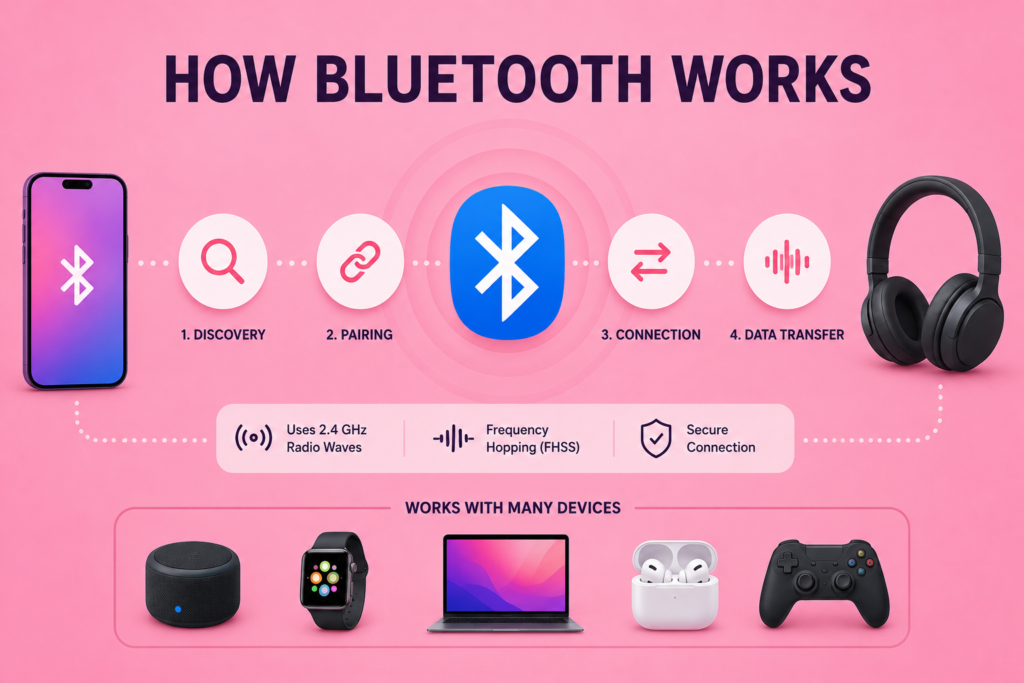
These radio signals travel through the air using the 2.4 GHz ISM band, which is a globally available wireless frequency range.
When two Bluetooth devices communicate, they create a wireless radio link between each other. This allows data packets to move back and forth quickly and securely.
For example:
- Your phone sends audio data to wireless earbuds
- A laptop sends typing information to a Bluetooth keyboard
- A smartwatch sends fitness data to a smartphone
Bluetooth handles all of this automatically using wireless signal technology.
The 2.4 GHz ISM Band Explained
One important part of how bluetooth works is the 2.4 GHz ISM band.
ISM stands for Industrial, Scientific, and Medical.
This radio frequency band is available globally for low-power wireless communication systems. Because it is internationally accepted, Bluetooth devices can work almost anywhere in the world.
The 2.4 GHz ISM band is also used by:
- WiFi routers
- Wireless mice
- Smart home devices
- Baby monitors
- Some cordless phones
Since many devices use the same frequency range, Bluetooth engineers had to create smart ways to avoid signal interference.
That is where Frequency-hopping spread spectrum (FHSS) became extremely important.
Frequency Hopping Spread Spectrum (FHSS)
One of the most important concepts in how bluetooth works is Frequency-hopping spread spectrum (FHSS).
This technology allows Bluetooth devices to rapidly switch between radio channels many times every second.
Instead of staying on one wireless frequency, Bluetooth jumps continuously across different frequencies.
This provides several major benefits:
- Reduces signal interference
- Improves connection stability
- Increases security
- Prevents communication conflicts
For example, if one channel becomes crowded because of WiFi traffic, Bluetooth instantly switches to another channel.
This smart system makes Bluetooth highly reliable even in busy wireless environments.
Bluetooth Signal Transmission Process
The Bluetooth signal transmission process happens extremely quickly.
Here is a simplified explanation of how bluetooth works during communication:
- Device discovery begins
- Devices identify each other
- Connection establishment occurs
- Data packets start transferring
- Frequency hopping maintains stability
Data packets are tiny pieces of digital information sent between devices.
Bluetooth continuously organizes and manages these packets to maintain smooth wireless communication.
This process happens so fast that users usually notice no delay at all.
Device Discovery and Pairing Process
Another important part of how bluetooth works is the pairing process.
Before devices communicate, they must first discover each other.
Bluetooth devices constantly broadcast small identification signals. When another compatible device detects the signal, users can choose to connect.
This pairing process creates a trusted relationship between the devices.
Once paired:
- Devices remember each other
- Future connections become automatic
- Security improves
- Communication becomes faster
If you want practical setup guidance, learning how to pair bluetooth devices can make the connection process even easier.
Modern Bluetooth systems can pair within seconds.
Master Slave Architecture in Bluetooth
Traditional Bluetooth communication used something called master-slave architecture.
In this system:
- One device acts as the master
- Other devices act as slaves
The master device controls communication timing and data coordination.
For example:
- A smartphone may act as the master
- Wireless earbuds may act as slave devices
This structure helped maintain organized communication between connected devices.
Although newer Bluetooth systems use more advanced methods today, master-slave architecture played a major role in early Bluetooth networking.
Bluetooth Piconet and Scatternet Explained
To fully understand how bluetooth works, we also need to discuss Bluetooth piconet and scatternet systems.
Bluetooth Piconet
A Bluetooth piconet is a small wireless network created when devices connect together.
One master device can communicate with multiple slave devices simultaneously.
For example:
- A smartphone connected to earbuds and a smartwatch creates a piconet.
Piconets help Bluetooth manage multiple wireless connections efficiently.
Scatternet
A scatternet forms when multiple piconets connect together.
This creates larger wireless communication structures involving many devices.
Scatternets are more advanced and less common for everyday users, but they demonstrate how flexible Bluetooth networking can become.
Point to Point Communication
Bluetooth mainly uses point-to-point communication systems.
This means data travels directly between connected devices instead of passing through a central internet server.
For example:
- Phone directly to speaker
- Laptop directly to keyboard
- Watch directly to smartphone
This direct communication method helps reduce delays and improve efficiency.
Bluetooth essentially creates a mini local area network (LAN) between nearby devices.
Bluetooth Range and Signal Strength
An important factor in how bluetooth works is communication distance.
Bluetooth range depends on:
- Device power
- Obstacles
- Signal interference
- Bluetooth version
Older Bluetooth systems had limited range, while newer versions provide much stronger coverage.
If you want deeper technical details, exploring bluetooth range can explain how modern Bluetooth versions achieve greater distances.
Bluetooth signals can pass through walls and objects, although barriers may weaken signal quality.
Bluetooth Versions and Technological Improvements (1999 – Today)
The evolution of Bluetooth technology greatly improved performance over time.
Newer bluetooth versions introduced:
- Faster transfer speeds
- Better energy efficiency
- Improved security
- Stronger signal reliability
- Longer range
Bluetooth 4.0 introduced Bluetooth Low Energy, also called BLE.
Bluetooth 5.0 significantly improved range and bandwidth capabilities.
Modern versions support advanced smart devices, gaming accessories, audio systems, and wearable technologies.
Each generation made Bluetooth more stable and efficient.
Bluetooth Classic vs BLE
Understanding bluetooth classic vs ble helps explain how modern Bluetooth systems operate.
Bluetooth Classic
Bluetooth Classic is optimized for:
- Audio streaming
- Continuous communication
- Wireless speakers
- Headphones
Bluetooth Low Energy (BLE)
BLE focuses on:
- Low power consumption
- Smartwatches
- Health devices
- Fitness trackers
- IoT systems
BLE allows devices to run for months or years on small batteries.
This innovation helped Bluetooth enter the smart device revolution.
How Bluetooth Avoids Signal Interference
Because many wireless technologies use the same radio frequencies, signal interference can become a problem.
Bluetooth solves this issue using:
- Frequency hopping
- Error correction systems
- Smart packet switching
- Adaptive bandwidth management
These systems allow Bluetooth to maintain stable wireless signal performance even in crowded environments.
Modern Bluetooth systems are extremely advanced at managing wireless traffic.
Bluetooth Security and Safe Connections
Many users worry about wireless safety.
Modern bluetooth security systems use encryption, authentication, and secure pairing protocols to protect data.
Bluetooth devices exchange security keys during pairing to prevent unauthorized access.
Security systems continue improving with every new Bluetooth generation.
Although no wireless technology is completely perfect, Bluetooth today is far safer than early versions from the late 1990s.
Bluetooth vs WiFi vs NFC
Many users compare bluetooth vs wifi vs nfc to understand their differences.
Bluetooth focuses on:
- Short-range communication
- Low energy use
- Device-to-device connections
WiFi focuses on:
- Internet access
- High-speed networking
- Larger bandwidth
NFC focuses on:
- Extremely short-range communication
- Contactless payments
- Fast tap-based connections
Each technology serves different purposes within wireless ecosystems.
The Future of Bluetooth Technology
The future of bluetooth looks incredibly exciting.
Modern Bluetooth systems continue improving in:
- Audio quality
- Connection speed
- Energy efficiency
- Smart device synchronization
- Security systems
Future technologies such as augmented reality, robotics, wearable computing, and smart cities will depend heavily on Bluetooth communication.
The rapid growth of connected devices also connects closely with the future of software engineering, where intelligent wireless ecosystems are becoming increasingly important.
Bluetooth will likely remain one of the most important wireless communication standards for decades.
Why Bluetooth Became So Successful
The reason Bluetooth became globally successful is simple:
It made wireless communication easy.
Consumers loved the convenience of connecting devices without cables.
Manufacturers loved Bluetooth because it was:
- Affordable
- Reliable
- Low power
- Internationally standardized
- Easy to integrate
Today, billions of Bluetooth devices operate worldwide every day.
Very few wireless technologies have achieved such universal adoption.
Frequently Asked Questions (FAQs)
How bluetooth works in simple words?
Bluetooth works by using radio waves to send data wirelessly between nearby devices without cables.
What frequency does Bluetooth use?
Bluetooth uses the 2.4 GHz ISM radio frequency band for wireless communication.
What is Frequency-hopping spread spectrum?
Frequency-hopping spread spectrum allows Bluetooth to rapidly switch radio channels to avoid interference and improve reliability.
What is a Bluetooth piconet?
A Bluetooth piconet is a small wireless network formed when multiple Bluetooth devices connect together.
Is Bluetooth safe to use?
Yes. Modern Bluetooth systems use encryption and authentication methods to improve wireless security.
What is the difference between Bluetooth Classic and BLE?
Bluetooth Classic is designed for continuous communication like audio streaming, while BLE focuses on low-power smart devices.
Conclusion
Understanding how bluetooth works becomes much easier when viewed as a smart wireless communication system using radio waves instead of cables.
Bluetooth devices communicate through short-wavelength radio waves, frequency hopping, data packets, and secure wireless networking methods. Technologies such as Frequency-hopping spread spectrum (FHSS), Bluetooth piconet systems, scatternets, and master-slave architecture helped Bluetooth become one of the world’s most important wireless standards.
From smartphones and headphones to smart homes and wearable devices, Bluetooth powers billions of wireless connections every day.
Its simplicity, reliability, and low-power design transformed modern technology forever, and its future continues looking brighter than ever.