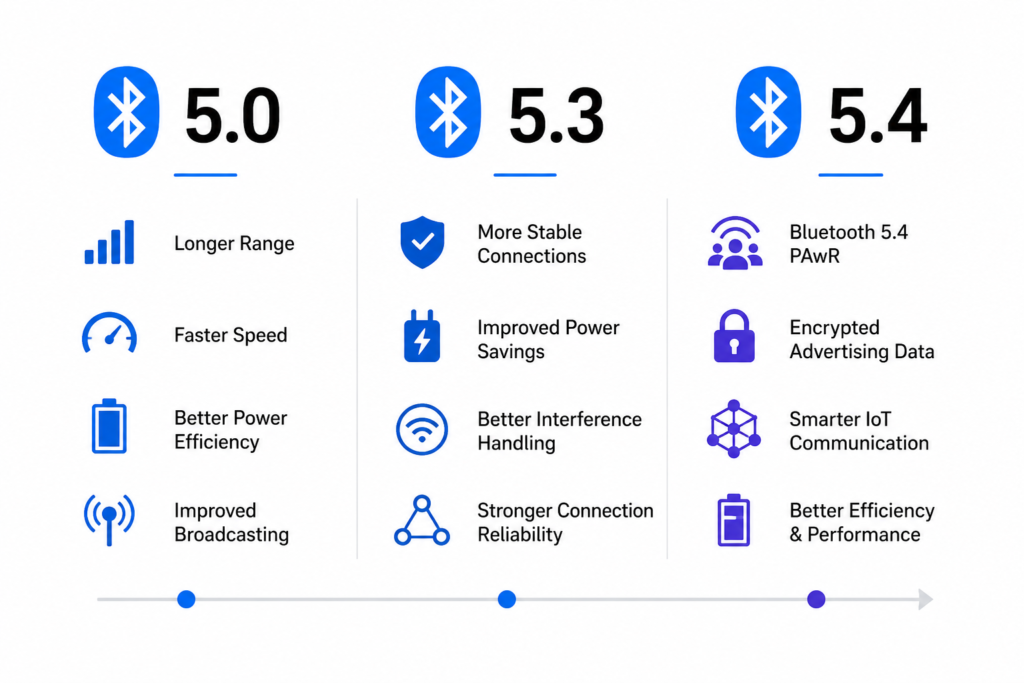
Understanding bluetooth 5.0 vs 5.3 vs 5.4 is extremely important because modern wireless devices continue evolving rapidly. Smartphones, earbuds, smartwatches, gaming accessories, smart homes, and IoT systems now rely heavily on advanced Bluetooth technologies for wireless communication.
Bluetooth 5.0 introduced major improvements involving speed, wireless range, and power efficiency. Later updates like Bluetooth 5.3 and Bluetooth 5.4 focused on improving connection reliability, protocol efficiency, encryption systems, and smart device communication.
Many consumers wonder whether upgrading to newer Bluetooth versions is actually worth the cost. The answer depends on how you use your wireless devices and which features matter most to you.
This complete guide explains bluetooth 5.0 vs 5.3 vs 5.4, including feature breakdowns, security improvements, hardware compatibility, wireless performance, Bluetooth 5.4 PAwR technology, power savings, and whether the latest Bluetooth tech truly offers meaningful advantages.
The Evolution of Bluetooth Technology (2016 – 2024)
Before comparing bluetooth 5.0 vs 5.3 vs 5.4, it helps to understand how Bluetooth technology evolved.
Bluetooth 5.0 launched in 2016 and represented one of the biggest Bluetooth upgrades ever released.
The technology introduced:
- Longer wireless range
- Faster data transfer
- Better energy efficiency
- Improved broadcast communication
Bluetooth later evolved into versions 5.1, 5.2, 5.3, and finally 5.4.
Each release introduced incremental updates focused on improving modern wireless ecosystems.
If you want broader historical background, exploring bluetooth history explains how Bluetooth became a global wireless standard.
Modern Bluetooth systems are far more advanced than earlier generations.
What Is Bluetooth 5.0?
Bluetooth 5.0 represented a major leap in wireless communication technology.
Compared to Bluetooth 4.2, Bluetooth 5.0 delivered:
- Four times greater range
- Twice the speed
- Larger broadcast capacity
- Better energy efficiency
Bluetooth 5.0 transformed:
- Smart homes
- Wearable devices
- Wireless audio
- IoT systems
The release made Bluetooth much more practical for larger wireless ecosystems.
Bluetooth 5.0 quickly became the foundation for modern wireless devices worldwide.
Key Features of Bluetooth 5.0
The importance of bluetooth 5.0 vs 5.3 vs 5.4 starts with understanding Bluetooth 5.0’s innovations.
Longer Wireless Range
Bluetooth 5.0 dramatically improved communication distance.
If you want deeper technical details, learning about bluetooth range explains how Bluetooth distance improved over time.
Faster Speed
Bluetooth 5.0 doubled wireless transfer speed compared to earlier versions.
Better Broadcast Messaging
Devices could now send larger amounts of wireless advertising data more efficiently.
Improved Power Efficiency
Battery-powered devices benefited from lower energy usage and longer battery life.
Bluetooth 5.0 laid the groundwork for future wireless innovation.
What Is Bluetooth 5.3?
Bluetooth 5.3 launched in 2021.
Instead of introducing huge new features, Bluetooth 5.3 focused on optimization and stability improvements.
Bluetooth 5.3 stability became one of its biggest advantages.
This version improved:
- Connection reliability
- Wireless efficiency
- Power savings
- Interference management
- Channel selection
Bluetooth 5.3 focused heavily on creating smoother and more stable wireless experiences.
Many users noticed fewer connection interruptions and better battery performance.
Key Improvements in Bluetooth 5.3
Several important upgrades shaped Bluetooth 5.3.
Better Connection Reliability
Bluetooth 5.3 improved connection robustness and wireless stability.
This reduced:
- Audio dropouts
- Random disconnects
- Wireless interference problems
Improved Power Savings
Bluetooth 5.3 optimized communication timing to reduce unnecessary battery usage.
This especially benefited:
- Smartwatches
- Earbuds
- Fitness trackers
- Smart home sensors
Better Channel Classification
Devices became better at avoiding crowded wireless frequencies automatically.
This improved overall wireless performance significantly.
Bluetooth 5.3 mainly refined existing systems rather than completely redesigning Bluetooth technology.
What Is Bluetooth 5.4?
Bluetooth 5.4 launched in 2023 and focused strongly on IoT systems and large-scale wireless communication.
Bluetooth 5.4 introduced several advanced technologies including:
- Bluetooth 5.4 PAwR
- Encrypted Advertising Data
- Better device synchronization
- Smarter wireless communication systems
Bluetooth 5.4 targeted modern smart ecosystems involving many connected devices simultaneously.
This version became especially important for industrial and retail technology applications.
Bluetooth 5.4 PAwR Explained
One of the biggest innovations in bluetooth 5.0 vs 5.3 vs 5.4 is Bluetooth 5.4 PAwR.
PAwR stands for Periodic Advertising with Responses.
This technology allows:
- Large-scale synchronized communication
- Better IoT networking
- Smarter wireless device coordination
PAwR improves communication between many low-power devices simultaneously.
This is extremely useful for:
- Smart homes
- Industrial systems
- Smart lighting
- Retail technology
- Electronic shelf labels (ESL)
Bluetooth 5.4 PAwR represents a major step toward future wireless automation systems.
Encrypted Advertising Data
Bluetooth 5.4 also introduced Encrypted Advertising Data.
This improves bluetooth security significantly.
Encrypted advertising protects wireless broadcasts from unauthorized interception.
Benefits include:
- Better privacy
- Improved data security
- Safer IoT communication
- Stronger authentication systems
Security improvements became increasingly important as Bluetooth expanded into healthcare, automation, and financial systems.
Bluetooth 5.0 vs 5.3 Comparison
The comparison between Bluetooth 5.0 and 5.3 focuses mainly on refinement.
Bluetooth 5.0
Strengths:
- Major range improvement
- Faster transfer speeds
- Better broadcast communication
Bluetooth 5.3
Strengths:
- Better connection stability
- Improved efficiency
- Lower power consumption
- Smarter interference handling
Bluetooth 5.3 feels smoother and more refined during everyday use.
Users often notice better wireless consistency rather than dramatic feature changes.
Bluetooth 5.3 vs 5.4 Comparison
Bluetooth 5.4 focused more heavily on advanced IoT systems and wireless automation.
Bluetooth 5.3
- Excellent stability
- Efficient communication
- Consumer device optimization
Bluetooth 5.4
- Smarter large-scale networking
- Better encrypted advertising
- Advanced wireless synchronization
- PAwR support
Bluetooth 5.4 especially benefits industrial and connected ecosystem applications.
For average users, the differences may feel smaller than the jump from Bluetooth 4.x to 5.0.
Wireless Audio Improvements
Modern bluetooth audio codecs perform much better thanks to newer Bluetooth versions.
Bluetooth 5.x systems improved:
- Audio synchronization
- Connection reliability
- Wireless stability
- Battery efficiency
Premium wireless headphones now deliver much smoother listening experiences.
If you want premium audio products, exploring best bluetooth headphones helps identify models supporting newer Bluetooth systems.
Modern Bluetooth audio feels far more reliable than earlier generations.
Bluetooth Classic vs BLE in Modern Versions
The comparison between bluetooth classic vs ble also matters when discussing newer Bluetooth standards.
Bluetooth Classic
- Continuous audio streaming
- Traditional wireless communication
BLE
- Low power communication
- Smart devices
- IoT ecosystems
- Better battery efficiency
Bluetooth 5.3 and 5.4 especially improved BLE performance significantly.
BLE became central to modern smart technology.
Pairing and User Experience Improvements
Newer Bluetooth systems improved pairing experiences dramatically.
If you are learning how to pair bluetooth devices, modern Bluetooth versions make wireless setup much easier and faster.
Newer versions improve:
- Device discovery
- Reconnection speed
- Stability
- Pairing reliability
These small improvements greatly enhance everyday usability.
Hardware Compatibility Concerns
Hardware compatibility is important in bluetooth 5.0 vs 5.3 vs 5.4 discussions.
Newer Bluetooth features require:
- Compatible chips
- Updated firmware
- Modern operating systems
Older devices may still connect through backward compatibility, but advanced features might not work fully.
Compatibility remains one of Bluetooth’s greatest strengths overall.
Is Bluetooth 5.4 Worth Upgrading To?
The answer depends on your needs.
Upgrade to Bluetooth 5.4 If You Want:
- Latest IoT features
- Better encrypted communication
- Advanced smart ecosystems
- Long-term future compatibility
Bluetooth 5.0 Is Still Excellent For:
- Wireless audio
- Smartphones
- Gaming accessories
- Everyday consumer electronics
Most casual users may not notice dramatic differences immediately.
However, future smart ecosystems will increasingly benefit from Bluetooth 5.4 capabilities.
Bluetooth vs WiFi Communication
Many users compare bluetooth vs wifi vs nfc when evaluating wireless technologies.
Bluetooth
- Low power communication
- Personal device connectivity
- Portable accessories
WiFi
- Internet networking
- High bandwidth communication
NFC
- Contactless interactions
- Secure short-range communication
Bluetooth continues balancing power efficiency and wireless convenience extremely well.
Security Improvements Across Versions
Security became increasingly important in newer Bluetooth systems.
Bluetooth 5.3 and 5.4 improved:
- Encryption systems
- Authentication protocols
- Wireless privacy
- Device protection
Modern Bluetooth security is significantly stronger than older generations.
Wireless safety continues improving with every update.
The Future of Bluetooth Technology
The future of bluetooth looks extremely promising.
Future Bluetooth systems will likely improve:
- AI-powered wireless optimization
- Smart automation
- Lossless audio communication
- Industrial IoT systems
- Wireless synchronization
The rapid growth of connected ecosystems also connects closely with the future of software engineering, where intelligent wireless communication continues becoming more important.
Bluetooth technology will likely remain essential for decades.
Should You Upgrade?
For most people, Bluetooth 5.0 already provides excellent performance.
However:
- Bluetooth 5.3 improves stability and efficiency
- Bluetooth 5.4 improves IoT communication and wireless intelligence
The value of upgrading depends on your device ecosystem and future needs.
Technology enthusiasts and smart home users may benefit most from newer Bluetooth generations.
Frequently Asked Questions (FAQs)
What is the difference between Bluetooth 5.0, 5.3, and 5.4?
Bluetooth 5.0 improved speed and range, Bluetooth 5.3 improved stability and efficiency, and Bluetooth 5.4 introduced smarter IoT networking features.
Is Bluetooth 5.4 better than 5.0?
Yes. Bluetooth 5.4 includes newer security, synchronization, and wireless networking improvements.
What is Bluetooth 5.4 PAwR?
PAwR stands for Periodic Advertising with Responses, a system designed for smarter large-scale IoT communication.
Should I upgrade from Bluetooth 5.0?
If you use smart home systems or want improved stability and future compatibility, upgrading may be worthwhile.
Is Bluetooth 5.3 more stable?
Yes. Bluetooth 5.3 focuses heavily on connection reliability and reduced interference.
Are Bluetooth versions backward compatible?
Yes. Most Bluetooth versions support backward compatibility with older devices.
Conclusion
Understanding bluetooth 5.0 vs 5.3 vs 5.4 helps users decide whether upgrading to newer wireless technology is truly worthwhile.
Bluetooth 5.0 introduced revolutionary improvements involving speed, range, and energy efficiency. Bluetooth 5.3 refined stability, power savings, and connection reliability. Bluetooth 5.4 expanded Bluetooth into smarter IoT ecosystems with advanced technologies such as PAwR and Encrypted Advertising Data.
For casual users, Bluetooth 5.0 already remains highly capable. However, Bluetooth 5.3 and 5.4 provide smoother wireless experiences, stronger security, and better future readiness for smart ecosystems.
As wireless communication continues evolving, newer Bluetooth versions will play an increasingly important role in connected technology and intelligent digital infrastructure.