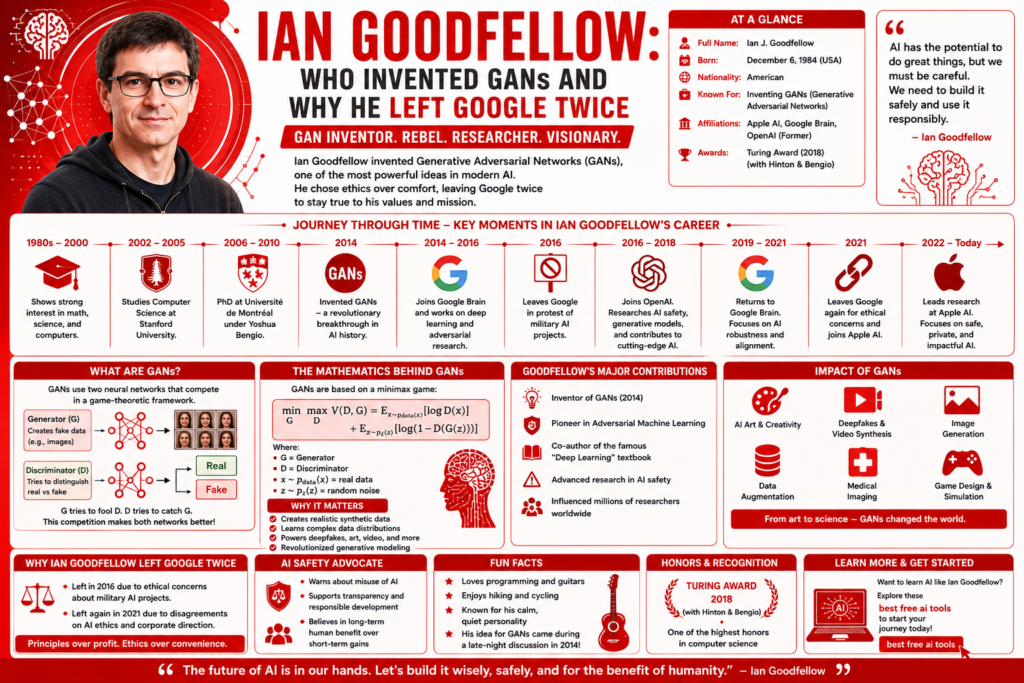
Ian goodfellow biography is one of the most fascinating stories in modern artificial intelligence because Ian Goodfellow invented one of the most revolutionary AI architectures ever created: Generative Adversarial Networks, commonly called GANs. His invention completely transformed generative AI, image synthesis, deepfake technology, artistic AI, and modern machine learning research.
Unlike many scientific breakthroughs that emerge slowly over years, GANs reportedly came to Goodfellow during a late-night discussion with friends in 2014. That single idea eventually changed artificial intelligence forever.
Today, the influence of ian goodfellow biography extends across:
- AI image generation
- Video synthesis
- Deepfake systems
- Computer vision
- Artistic AI
- Generative modeling
Goodfellow also became famous for his career moves between Google, OpenAI, and Apple, as well as his outspoken concerns regarding AI ethics and corporate direction.
His story represents one of the most important chapters in modern AI history.
Early Life of Ian Goodfellow (1980 – 2000)
The story of ian goodfellow biography began in the United States, where Ian Goodfellow developed strong interests in:
- Mathematics
- Science
- Computers
- Problem solving
- Machine intelligence
From an early age, he enjoyed understanding complex systems and exploring computational ideas.
Unlike many researchers who entered AI from traditional engineering backgrounds, Goodfellow became fascinated specifically by learning systems and neural computation.
This curiosity eventually shaped his entire scientific career.
Education and Academic Foundations
The ian goodfellow biography journey expanded when Goodfellow studied computer science at Stanford University.
At Stanford, he focused heavily on:
- Machine learning
- Neural networks
- Representation learning
- Probabilistic modeling
He later pursued graduate research at the University of Montreal under Yoshua Bengio.
Researchers discussing yoshua bengio biography often identify Bengio as one of Goodfellow’s most important mentors.
Montreal became one of the world’s leading AI research centers during this period.
Goodfellow entered AI research at exactly the right time.
Neural Networks Before GANs
To understand the importance of ian goodfellow biography, we must examine the state of AI before GANs appeared.
Deep learning was already growing rapidly because of:
- GPU acceleration
- Large datasets
- Better optimization
- Deep neural architectures
Researchers discussing history of deep learning often describe the early 2010s as the beginning of modern AI expansion.
However, generative modeling remained extremely difficult.
Most neural systems focused mainly on:
- Classification
- Prediction
- Recognition tasks
Generating realistic new content remained a huge challenge.
The Birth of GANs (2014)
The defining breakthrough in ian goodfellow biography arrived in 2014 when Goodfellow invented Generative Adversarial Networks.
The idea reportedly emerged during a discussion about generative models.
Goodfellow realized two neural networks could compete against each other.
The architecture included:
- Generator
- Discriminator
The generator creates fake samples.
The discriminator attempts to detect whether samples are real or fake.
The objective function became:
This adversarial process allowed systems to generate astonishingly realistic outputs.
The invention transformed AI forever.
Why GANs Were Revolutionary
The rise of GANs became one of the biggest moments in the ian goodfellow biography story.
GANs introduced several revolutionary ideas:
- Adversarial learning
- Realistic image generation
- Generative competition
- Unsupervised representation learning
Unlike earlier models, GANs produced outputs that looked surprisingly realistic.
Applications rapidly expanded into:
- Faces
- Art
- Video
- Audio
- Scientific simulation
Researchers discussing history of gans often identify Goodfellow’s 2014 paper as one of the most important AI publications ever written.
Generator vs Discriminator
The core innovation in the ian goodfellow biography story involved neural competition.
Generator
The generator attempts to create realistic fake data.
Discriminator
The discriminator tries to distinguish real samples from fake ones.
As both networks improve simultaneously, generated outputs become increasingly realistic.
This adversarial machine learning process became one of AI’s most powerful concepts.
Deep Learning and GAN Growth
The success of GANs accelerated rapidly during the deep learning boom.
Researchers discussing history of ai often describe GANs as one of the technologies that pushed AI into mainstream public awareness.
GAN applications expanded into:
- Artistic AI
- Deepfakes
- Image restoration
- Data augmentation
- Video synthesis
The impact of ian goodfellow biography suddenly became global.
Google Brain and Industry Research
The ian goodfellow biography journey expanded further when Goodfellow joined Google Brain.
Google Brain became one of the world’s leading deep learning research groups.
At Google, Goodfellow worked on:
- Adversarial machine learning
- Neural robustness
- AI security
- Deep learning systems
He became widely respected for both theoretical and practical AI contributions.
Adversarial Examples and AI Security
One major chapter in ian goodfellow biography involved adversarial examples.
Goodfellow discovered neural networks could be fooled through tiny input changes.
For example:
- Slight pixel modifications
- Hidden perturbations
- Invisible visual changes
These alterations could completely fool neural systems.
This research revealed major weaknesses in deep learning security.
Adversarial machine learning became an entirely new research field.
The Deep Learning Textbook
Another major contribution in ian goodfellow biography involved education.
Goodfellow co-authored the famous Deep Learning textbook alongside Yoshua Bengio and Aaron Courville.
The book became one of the most influential educational resources in AI history.
Researchers worldwide used it to learn:
- Neural networks
- Optimization
- Deep architectures
- Machine learning theory
The textbook helped train an entire generation of AI researchers.
OpenAI and AI Research
The ian goodfellow biography story continued when he joined OpenAI.
At OpenAI, Goodfellow focused heavily on:
- AI safety
- Research innovation
- Generative systems
- Advanced machine learning
OpenAI became one of the most influential AI organizations globally.
Researchers discussing deepmind vs openai often compare OpenAI’s aggressive innovation style with DeepMind’s research-focused approach.
Goodfellow contributed significantly to OpenAI’s early technical direction.
Why Ian Goodfellow Left Google Twice
One of the most discussed parts of ian goodfellow biography involves his career changes.
Goodfellow worked at Google multiple times but also left more than once.
Reports suggest his decisions involved:
- Ethical concerns
- Corporate disagreements
- AI deployment issues
- Research independence
One major moment occurred when Goodfellow reportedly resigned in protest over Google’s contract work involving military AI projects.
This decision highlighted his strong ethical principles.
His career choices became symbolic of growing debates surrounding AI ethics and corporate responsibility.
Apple AI and Industry Leadership
The ian goodfellow biography journey later expanded into Apple AI research.
At Apple, Goodfellow contributed to:
- Machine learning systems
- Privacy-focused AI
- Security research
- Consumer AI products
Apple’s approach to AI often emphasized privacy and on-device intelligence.
Goodfellow’s expertise fit naturally into these goals.
GANs and Artistic AI
One of the biggest cultural impacts in ian goodfellow biography involved artistic AI.
GANs transformed:
- Digital art
- Animation
- Image generation
- Style transfer
- Visual creativity
Researchers discussing generative neural networks often identify GANs as one of the most important foundations of modern generative AI.
GANs enabled machines to create surprisingly realistic artistic outputs.
This completely changed public perception of AI creativity.
Deepfakes and Ethical Concerns
The rise of GANs also created controversy.
The ian goodfellow biography story became connected to deepfake technology.
GAN-generated media raised concerns involving:
- Misinformation
- Fake videos
- Identity manipulation
- Political deception
Goodfellow frequently discussed responsible AI development and ethical deployment.
His work demonstrated both the power and risks of generative AI.
GANs vs Transformers
Modern AI research increasingly compares GANs with transformers.
Researchers discussing transformer neural networks often describe transformers as dominant in language AI.
However, GANs remain highly influential in:
- Image synthesis
- Artistic generation
- Video creation
- Scientific simulation
Both architectures continue shaping AI development today.
Scientific Leadership and Influence
The impact of ian goodfellow biography extends far beyond GAN invention alone.
Goodfellow influenced:
- AI education
- Security research
- Generative modeling
- Industry leadership
- Ethical discussions
His research papers became some of the most cited works in modern AI.
He remains one of the most respected scientists in machine learning today.
AI Safety and Future Concerns
The modern ian goodfellow biography increasingly includes discussions about AI safety.
Goodfellow has warned about:
- Adversarial vulnerabilities
- Unsafe AI deployment
- Misuse of generative systems
These concerns became especially important during the rise of large generative models and synthetic media.
His research helped expose weaknesses that researchers continue addressing today.
The Lasting Legacy of Ian Goodfellow
The story of ian goodfellow biography represents one of the most important journeys in artificial intelligence history.
From GAN invention to adversarial learning and AI ethics, Goodfellow helped reshape modern machine learning completely.
The combination of:
- Generative Adversarial Networks
- AI security research
- Educational leadership
- Ethical advocacy
- Scientific innovation
created one of the strongest legacies in modern AI research.
Today, many of the world’s best free ai tools rely directly or indirectly on technologies inspired by GANs and Goodfellow’s research.
His influence continues shaping the future of artificial intelligence worldwide.
Ian Goodfellow and the Future of AI
The future direction of ian goodfellow biography continues evolving rapidly.
Researchers continue building upon:
- Adversarial learning
- Generative modeling
- Robust AI systems
- Secure machine learning
GANs may eventually power:
- Scientific simulation
- Medical imaging
- Creative AI systems
- Robotics
Goodfellow’s innovations remain foundational to modern AI progress.
FAQs About Ian Goodfellow
Who is Ian Goodfellow?
Ian Goodfellow is an American AI researcher best known for inventing Generative Adversarial Networks (GANs).
What are GANs?
GANs are neural architectures involving competing generator and discriminator networks for realistic content generation.
Why are GANs important?
GANs transformed image generation, artistic AI, deepfakes, and modern generative modeling.
Why did Ian Goodfellow leave Google?
Reports suggest he left partly because of ethical concerns involving military AI contracts and research direction.
Did Ian Goodfellow work at OpenAI?
Yes. Ian Goodfellow worked at OpenAI and contributed to advanced AI research.
What is adversarial machine learning?
Adversarial machine learning studies how AI systems can be manipulated or fooled through specially crafted inputs.
Conclusion
The story of ian goodfellow biography represents one of the most important scientific journeys in modern artificial intelligence. Through GAN invention, adversarial machine learning, and ethical AI advocacy, Ian Goodfellow transformed generative AI forever.
His work became deeply connected to history of gans, history of deep learning, generative neural networks, deepmind vs openai, and yoshua bengio biography research.
Today, GANs continue influencing image synthesis, AI creativity, security research, and generative machine learning worldwide.
As artificial intelligence evolves further, Ian Goodfellow’s innovations will remain foundational to the future of intelligent generative systems.