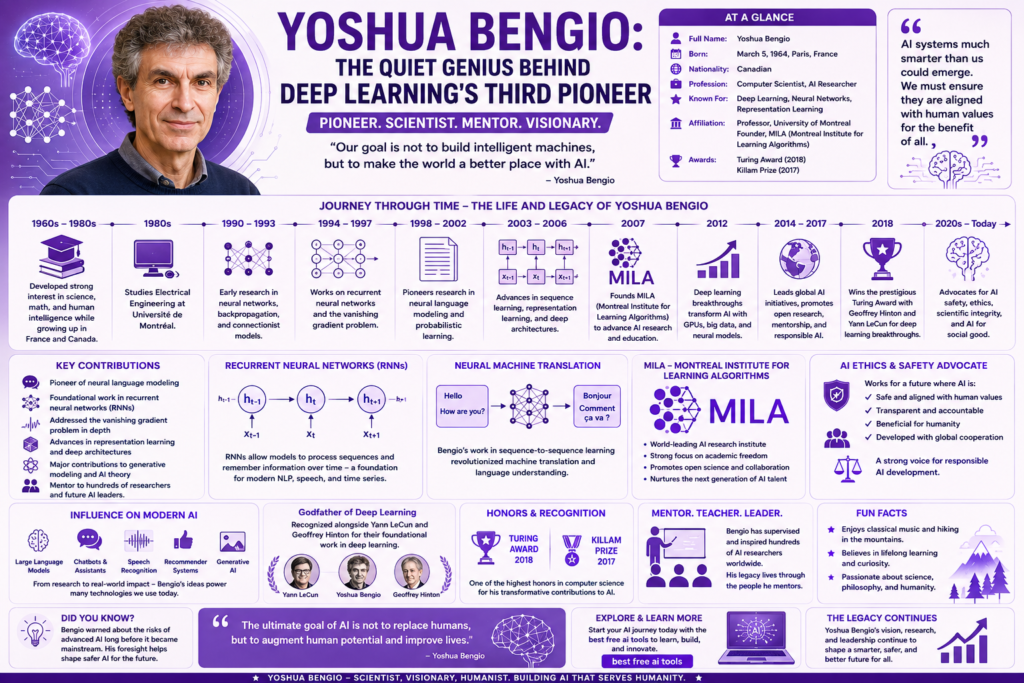
Yoshua bengio biography is one of the most inspiring stories in artificial intelligence because Yoshua Bengio helped transform neural networks from an unpopular academic idea into one of the most powerful technologies in human history. While many people know Geoffrey Hinton and Yann LeCun, Bengio became the quiet scientific force who pushed deep learning forward through research, mentorship, and long-term vision.
At a time when many scientists doubted neural networks, Bengio continued studying machine learning, recurrent networks, language modeling, and generative AI. His work later influenced modern systems including ChatGPT, neural machine translation, transformers, and large language models.
Today, the impact of yoshua bengio biography can be seen across:
- AI research labs
- Language models
- Medical AI
- Robotics
- Speech recognition
- Generative systems
His scientific contributions helped shape modern artificial intelligence forever.
Early Life of Yoshua Bengio (1960 – 1980)
The story of yoshua bengio biography began in Paris, France, where Yoshua Bengio was born in 1964.
His family later moved to Canada, where Bengio developed strong interests in:
- Mathematics
- Science
- Engineering
- Human intelligence
- Cognitive systems
From an early age, he became fascinated by how humans learn and reason.
Unlike many researchers who focused purely on computation, Bengio became deeply interested in understanding intelligence itself.
This curiosity later guided his entire scientific career.
Education and Academic Foundations
The yoshua bengio biography journey expanded when Bengio studied electrical engineering and computer science.
He later joined McGill University and eventually pursued advanced research in artificial intelligence and machine learning.
During this period, AI research remained highly divided.
Researchers discussing history of ai often describe the 1980s as a time of uncertainty for neural networks.
Many scientists believed symbolic AI would dominate the future.
However, Bengio strongly believed learning-based systems could achieve more flexible intelligence.
This belief became central to his future work.
Neural Networks Before Deep Learning
To understand the importance of yoshua bengio biography, we must examine the state of neural networks before the deep learning revolution.
Early neural systems began with the famous mcculloch and pitts neural network model in 1943.
Later, perceptrons introduced learning-based computation.
However, neural networks eventually faced harsh criticism during the AI winters.
The famous perceptron controversy caused many researchers to abandon neural systems entirely.
Funding collapsed.
Neural research became unpopular.
Despite this environment, Bengio continued believing in neural learning systems.
Backpropagation and Learning Systems
One important chapter in yoshua bengio biography involved neural optimization and backpropagation.
Researchers discussing history of backpropagation often identify Bengio as one of the scientists who expanded neural learning research during difficult years.
Backpropagation trains neural systems by minimizing prediction errors:
Where:
- = weight
- = learning rate
- = error function
This learning process became essential for deep neural systems.
Bengio recognized its importance early.
Recurrent Networks and Sequential Learning
The yoshua bengio biography story became closely connected to recurrent neural networks.
Researchers discussing history of rnn often recognize Bengio’s contributions to sequential learning research.
RNNs process information over time using hidden states:ht=f(Whht−1+Wxxt)
These systems became important for:
- Language modeling
- Speech recognition
- Translation
- Sequential prediction
Bengio studied how neural systems could learn long-term dependencies in sequences.
This research later influenced language AI dramatically.
The Vanishing Gradient Problem
One major challenge in the yoshua bengio biography journey involved the famous vanishing gradient problem.
Bengio and his collaborators studied why recurrent networks struggled with long-term memory.
As gradients passed backward through time, they became extremely small.
This made long-range learning very difficult.
The problem slowed progress in:
- Translation systems
- Sequence learning
- Language understanding
Bengio’s research helped scientists understand these limitations mathematically.
This later inspired improved architectures such as LSTMs and transformers.
Montreal AI and MILA
One of the biggest milestones in yoshua bengio biography came through the creation of Montreal AI research.
Bengio became a professor at the University of Montreal and later founded MILA:
Montreal Institute for Learning Algorithms.
MILA eventually became one of the world’s leading AI research centers.
The institute attracted:
- Researchers
- Students
- Engineers
- AI startups
Montreal became one of the most important global AI hubs.
Bengio’s mentorship influenced an entire generation of AI scientists.
Deep Learning Revival (2006 – 2012)
The modern yoshua bengio biography became deeply connected to the deep learning revival.
Researchers discussing history of deep learning often describe Bengio, Geoffrey Hinton, and Yann LeCun as the “Godfathers of Deep Learning.”
Several breakthroughs enabled the revival:
- GPU acceleration
- Large datasets
- Better hardware
- Improved optimization
Researchers discussing gpu history in ai frequently highlight GPUs as essential for training deep neural systems.
Deep learning suddenly achieved extraordinary results in:
- Vision
- Speech
- Language processing
Bengio’s decades of persistence finally received worldwide recognition.
Neural Language Modeling
One of the most important achievements in yoshua bengio biography involved neural language modeling.
Traditional language systems relied heavily on statistical probability tables.
Bengio introduced neural approaches capable of learning distributed word representations automatically.
These systems improved:
- Word prediction
- Translation
- Semantic understanding
- Contextual learning
This research later influenced:
- Word embeddings
- Transformers
- Large language models
Modern NLP owes enormous debt to Bengio’s early work.
Generative Modeling and Representation Learning
The yoshua bengio biography story also became connected to generative modeling.
Researchers discussing generative neural networks often recognize Bengio’s contributions to representation learning and probabilistic AI systems.
Bengio studied how machines could learn meaningful internal representations from data automatically.
This research improved:
- Generative AI
- Unsupervised learning
- Latent representations
- Deep architectures
These ideas later became central to modern AI systems.
AI Ethics and Social Responsibility
Another important part of yoshua bengio biography involves scientific ethics and AI safety.
Unlike many researchers focused purely on commercial progress, Bengio frequently discusses:
- AI risks
- Ethical deployment
- Social impact
- Human-centered AI
He strongly advocates for:
- Safe AI systems
- Open scientific research
- Responsible innovation
His influence extends beyond technical research into public AI policy discussions.
Turing Award and Global Recognition
The achievements in yoshua bengio biography eventually earned worldwide recognition.
In 2018, Bengio received the Turing Award alongside Geoffrey Hinton and Yann LeCun.
The award recognized their groundbreaking contributions to:
- Deep learning
- Neural networks
- Artificial intelligence
This honor confirmed Bengio’s role as one of the most important scientists in modern AI history.
Neural Machine Translation and Language AI
The yoshua bengio biography journey became especially influential in neural machine translation.
Researchers discussing sequence to sequence models often connect Bengio’s work with the rise of modern language systems.
Neural translation systems replaced traditional phrase-based approaches.
These systems improved:
- Context understanding
- Semantic representation
- Language fluency
- Real-time translation
Modern translation systems now rely heavily on deep neural architectures.
Transformers and Modern AI
The rise of transformers became another major chapter in yoshua bengio biography.
Researchers discussing transformer neural networks often recognize Bengio’s earlier sequence learning research as foundational for transformer development.
Transformers later revolutionized:
- Language generation
- Chatbots
- Reasoning systems
- Multi-modal AI
Although Bengio did not invent transformers directly, his work strongly influenced the scientific environment that made them possible.
Bengio and AI for Social Good
One unique aspect of yoshua bengio biography is Bengio’s commitment to AI for social good.
He frequently discusses how AI should help humanity through:
- Healthcare improvements
- Climate modeling
- Education
- Scientific discovery
Researchers discussing history of neural networks in medicine often recognize deep learning systems influenced by Bengio’s research.
His scientific philosophy emphasizes human benefit rather than pure technological competition.
Academic Independence and Open Research
The yoshua bengio biography story also highlights academic independence.
Bengio strongly supports:
- Open science
- Public collaboration
- Research transparency
- Global scientific cooperation
Even as AI became increasingly commercialized, Bengio continued emphasizing academic values and long-term scientific progress.
This approach earned enormous respect within the research community.
AI Safety and Future Risks
In recent years, yoshua bengio biography increasingly focuses on AI safety concerns.
Bengio warns that advanced AI systems may create:
- Misinformation risks
- Autonomous decision dangers
- Social instability
- Concentrated technological power
He advocates carefully managed AI development.
These discussions became especially important during the rise of generative AI systems.
The Lasting Legacy of Yoshua Bengio
The story of yoshua bengio biography represents one of the most important journeys in modern artificial intelligence.
From recurrent networks and language modeling to AI ethics and generative learning, Bengio helped transform neural networks into world-changing technologies.
The combination of:
- Research leadership
- Deep learning advocacy
- Language AI innovation
- Ethical AI discussions
- Scientific mentorship
created one of the strongest academic legacies in AI history.
Today, many of the world’s best free ai tools indirectly rely on breakthroughs influenced by Bengio’s research.
His impact continues shaping the future of artificial intelligence globally.
Yoshua Bengio and the Future of AI
The future direction of yoshua bengio biography continues evolving rapidly.
Bengio now focuses heavily on:
- Safe AI systems
- Scientific reasoning models
- Human-centered AI
- Future intelligence architectures
He believes AI should remain aligned with human values and public benefit.
His vision continues influencing researchers worldwide.
FAQs About Yoshua Bengio
Who is Yoshua Bengio?
Yoshua Bengio is a Canadian computer scientist and one of the pioneers of deep learning research.
Why is Yoshua Bengio famous?
He helped advance deep learning, recurrent neural networks, language modeling, and AI research ethics.
What is MILA?
MILA stands for Montreal Institute for Learning Algorithms, one of the world’s leading AI research institutes founded by Bengio.
Did Yoshua Bengio win the Turing Award?
Yes. Yoshua Bengio won the 2018 Turing Award alongside Geoffrey Hinton and Yann LeCun.
What fields did Bengio influence?
Bengio influenced language modeling, generative AI, neural translation, deep learning, and AI safety research.
Why is Yoshua Bengio important in AI history?
He helped transform neural networks into practical and scalable systems used in modern artificial intelligence worldwide.
Conclusion
The story of yoshua bengio biography represents one of the most important scientific journeys in artificial intelligence history. Through recurrent networks, language modeling, deep learning advocacy, and ethical AI leadership, Yoshua Bengio helped shape modern machine intelligence.
His work became deeply connected to history of deep learning, history of rnn, sequence to sequence models, transformer neural networks, and yann lecun biography research.
Today, Bengio’s influence continues driving advances in generative AI, neural translation, AI safety, and scientific machine learning worldwide.
As artificial intelligence evolves further, Yoshua Bengio’s contributions will remain foundational to the future of intelligent systems.