History of transformer neural networks represents one of the greatest revolutions in artificial intelligence. Before transformers appeared, neural networks struggled with long-term memory, slow training, and limited context understanding. Systems such as recurrent neural networks and LSTMs achieved important breakthroughs, but they still faced major computational bottlenecks.
Everything changed in 2017.
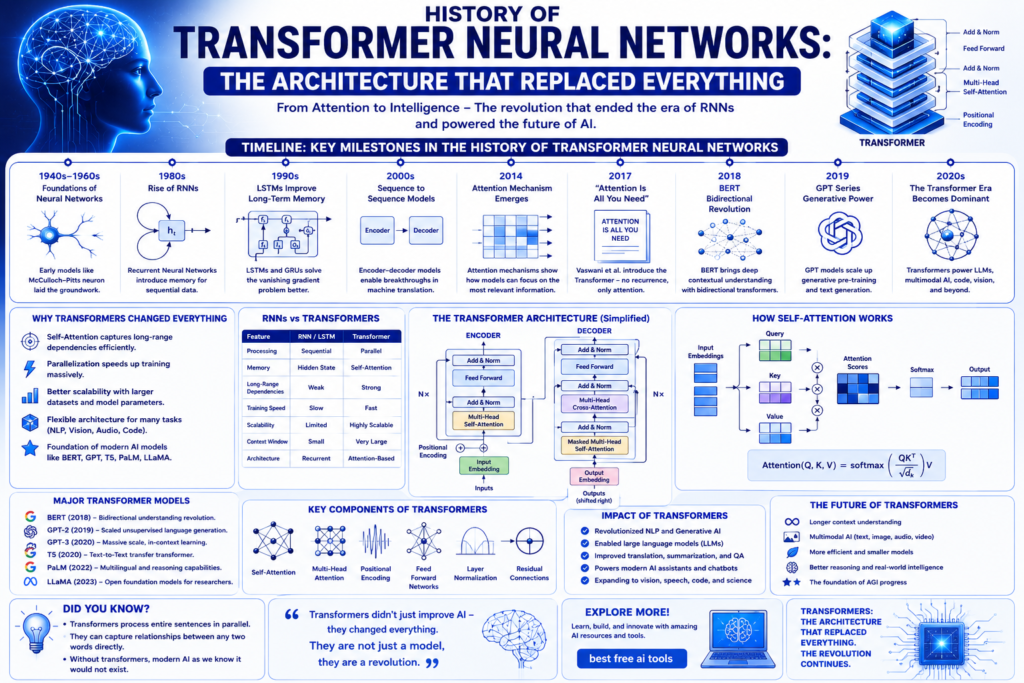
Google researchers introduced the transformer architecture through the famous paper Attention Is All You Need. This breakthrough replaced sequential processing with self-attention mechanisms capable of understanding relationships between words simultaneously.
The rise of history of transformer neural networks completely transformed language modeling, generative pre-training, speech AI, computer vision, robotics, and large language models such as GPT and BERT.
Today, transformers power some of the most advanced AI systems ever created.
Their influence now extends across nearly every branch of artificial intelligence.
Early Neural Networks Before Transformers (1940 – 1990)
To understand the history of transformer neural networks, we first need to examine earlier neural architectures.
The journey began in 1943 with the famous mcculloch and pitts neural network model.
This early computational neuron introduced the idea that artificial systems could imitate biological neurons mathematically.
Over the following decades, researchers developed:
- Perceptrons
- Multilayer networks
- Backpropagation
- Convolutional networks
- Recurrent neural networks
These systems gradually improved machine learning performance across many tasks.
However, language remained one of AI’s greatest challenges.
Human language contains:
- Long-range dependencies
- Contextual meaning
- Sequential relationships
- Dynamic structure
Traditional neural systems struggled to process this complexity efficiently.
The Rise of Recurrent Neural Networks (1980 – 2010)
The modern history of transformer neural networks became deeply connected to recurrent neural network research.
Researchers studying history of rnn developed systems capable of processing sequential information step by step.
RNNs became useful for:
- Language modeling
- Translation
- Speech recognition
- Sequence prediction
The hidden state update looked like:
This allowed neural systems to remember previous inputs over time.
However, RNNs suffered from serious limitations.
The Vanishing Gradient Problem
One major obstacle in the history of transformer neural networks involved the famous vanishing gradient problem.
As sequences became longer, gradients shrank during backpropagation.
This made long-term memory learning extremely difficult.
RNN systems struggled with:
- Long documents
- Large context windows
- Complex dependencies
- Multi-sentence reasoning
Training also remained slow because RNNs processed sequences sequentially rather than in parallel.
These limitations motivated researchers to search for better architectures.
LSTMs Improved Sequential Learning
The history of transformer neural networks evolved further through Long Short-Term Memory systems.
Researchers discussing history of lstm often identify LSTMs as major improvements over traditional RNNs.
LSTMs introduced gating mechanisms:
These gates improved long-term memory handling.
LSTMs became highly successful for:
- Translation
- Speech recognition
- Sequence modeling
- Audio processing
Despite their improvements, LSTMs still processed data sequentially.
This limited scalability and training speed.
Sequence-to-Sequence Models and Translation
The rise of encoder-decoder architectures became another major chapter in the history of transformer neural networks.
Researchers discussing sequence to sequence models introduced systems capable of mapping one sequence into another.
For example:
- English → French translation
- Speech → Text transcription
- Text summarization
Sequence models used:
- Encoder
- Decoder
The encoder compressed information into hidden vectors.
The decoder generated outputs sequentially.
Although powerful, these systems struggled with long sequences because information bottlenecks remained severe.
Researchers needed something better.
Attention Mechanisms Changed Everything
One of the greatest breakthroughs in the history of transformer neural networks arrived through attention mechanisms.
Instead of compressing entire sequences into one hidden state, attention allowed models to focus dynamically on relevant words.
Attention scores are calculated using:
Where:
- = Queries
- = Keys
- = Values
This mechanism dramatically improved contextual understanding.
Models could now learn relationships between distant words efficiently.
Attention became the foundation of transformers.
Attention Is All You Need (2017)
The defining moment in the history of transformer neural networks occurred in 2017.
Google researchers led by Ashish Vaswani published the revolutionary paper:
Attention Is All You Need
This paper introduced the transformer architecture.
The researchers proposed eliminating recurrence entirely.
Instead, transformers relied completely on:
- Self-attention
- Parallelization
- Positional encoding
- Multi-head attention
This breakthrough transformed AI forever.
Self-Attention Explained
Self-attention became the heart of the history of transformer neural networks.
Each word in a sentence could attend to every other word simultaneously.
For example:
Sentence:
“The animal didn’t cross the road because it was tired.”
Self-attention helps the model understand that “it” refers to “animal.”
This contextual understanding dramatically improved language modeling.
Unlike RNNs, transformers processed entire sequences in parallel.
This enabled massive scalability improvements.
Multi-Head Attention and Context Windows
Transformers introduced multi-head attention mechanisms.
Instead of one attention calculation, the model used multiple attention heads simultaneously.
Each head learned different relationships such as:
- Grammar
- Semantics
- Context
- Syntax
The multi-head formula became:
This allowed transformers to capture extremely rich language structures.
Large context windows became possible for the first time.
Positional Encoding Solved Sequence Order
One challenge in the history of transformer neural networks involved preserving word order.
Because transformers process sequences in parallel, they needed positional information.
Researchers introduced positional encoding:
This allowed transformers to understand sequential structure without recurrence.
The Death of RNNs
The rise of transformers dramatically changed AI research.
Researchers discussing rnn vs lstm vs transformer often describe transformers as the architecture that largely replaced sequential neural systems.
Transformers outperformed RNNs and LSTMs across many tasks:
- Translation
- Text generation
- Summarization
- Speech processing
- Coding assistance
Advantages included:
- Faster training
- Better scalability
- Larger context handling
- Improved accuracy
The transformer revolution accelerated rapidly.
BERT and Bidirectional Understanding
One major milestone in the history of transformer neural networks arrived through BERT.
Developed by Google in 2018, BERT introduced bidirectional transformer understanding.
BERT learned context from both directions simultaneously.
This improved:
- Search engines
- Question answering
- NLP understanding
- Contextual semantics
BERT became one of the most influential NLP milestones in AI history.
GPT and Generative Pre-Training
The history of transformer neural networks expanded even further through GPT models.
OpenAI introduced Generative Pre-Trained Transformers capable of generating coherent language at enormous scale.
GPT systems used:
- Large datasets
- Transformer decoders
- Self-supervised learning
- Massive model parameters
These models demonstrated astonishing abilities including:
- Writing
- Coding
- Reasoning
- Translation
- Conversation
The rise of GPT transformed public awareness of artificial intelligence.
Transformers Beyond Language
Although transformers began in NLP, the history of transformer neural networks soon expanded into many other fields.
Applications now include:
- Computer vision
- Robotics
- Protein folding
- Audio generation
- Autonomous driving
Researchers discussing self driving cars and ai increasingly explore transformer architectures for sensor fusion and navigation systems.
Transformers became universal AI architectures.
Transformers and Generative AI
The modern explosion of generative AI became deeply connected to transformers.
Researchers studying generative neural networks often identify transformers as the foundation of modern generative systems.
Transformers now power:
- Chatbots
- Image generation
- Video synthesis
- AI coding assistants
- Multi-modal systems
The architecture became one of the most important innovations in modern computing history.
DeepMind, OpenAI, and the Transformer Race
The competition between major AI labs accelerated transformer development dramatically.
Researchers discussing deepmind vs openai often compare their transformer strategies.
OpenAI focused heavily on:
- GPT systems
- Generative AI
- Multi-modal reasoning
DeepMind explored:
- AlphaFold
- Large reasoning models
- Scientific AI
Together, these organizations pushed transformers into the center of modern AI.
Hardware and the Transformer Explosion
The history of transformer neural networks also depended heavily on hardware improvements.
Researchers discussing gpu history in ai often recognize GPUs as essential for transformer scaling.
Transformer models require enormous computational power because of:
- Large parameter counts
- Attention computations
- Massive datasets
Modern AI training now uses:
- GPUs
- TPUs
- Distributed computing clusters
Hardware innovation became inseparable from transformer growth.
Challenges Facing Transformers
Despite their success, transformers face important challenges.
These include:
- High energy costs
- Massive hardware requirements
- Hallucinations
- Bias
- Training expense
Researchers continue improving:
- Sparse transformers
- Efficient attention
- Long-context systems
- Smaller language models
The transformer revolution still continues evolving rapidly.
Transformers and the Future of AI
The future of history of transformer neural networks looks incredibly exciting.
Researchers are now exploring:
- Artificial General Intelligence
- Real-time multi-modal AI
- Autonomous agents
- Scientific reasoning systems
- Brain-inspired transformer hybrids
Many of today’s best free ai tools rely directly on transformer architectures for writing, coding, image generation, and conversation.
Transformers may eventually become one of the most influential inventions in computer science history.
The Lasting Legacy of Transformers
The history of transformer neural networks represents one of the greatest architectural revolutions in artificial intelligence.
By replacing recurrence with self-attention and parallel processing, transformers solved many of the biggest limitations facing earlier neural systems.
The combination of:
- Self-attention
- Multi-head attention
- Encoder-decoder architectures
- Parallelization
- Large-scale training
created the foundation of modern AI systems.
Transformers transformed language understanding, generative AI, scientific research, and machine reasoning forever.
FAQs About Transformer Neural Networks
What are transformer neural networks?
Transformer neural networks are AI architectures based on self-attention mechanisms for processing sequences efficiently.
Why are transformers important?
Transformers dramatically improved language understanding, scalability, and generative AI performance.
What is self-attention?
Self-attention allows models to understand relationships between words across entire sequences simultaneously.
Who invented transformers?
Google researchers led by Ashish Vaswani introduced transformers in the 2017 paper Attention Is All You Need.
Why did transformers replace RNNs?
Transformers process sequences in parallel, handle longer contexts, and train much faster than RNNs.
What AI systems use transformers today?
GPT, BERT, ChatGPT, image generators, translation systems, and many modern AI tools rely on transformers.
Conclusion
The story of history of transformer neural networks represents one of the greatest breakthroughs in artificial intelligence history. From the limitations of RNNs and LSTMs to the revolutionary self-attention architecture introduced in Attention Is All You Need, transformers completely transformed machine learning.
The rise of transformers became deeply connected to history of deep learning, rnn vs lstm vs transformer, sequence to sequence models, generative neural networks, and gpu history in ai research.
Today, transformers power large language models, generative AI, scientific discovery systems, and modern conversational AI worldwide.
As artificial intelligence continues evolving, transformer neural networks will remain one of the defining technologies shaping the future of intelligent machines.