Sexual selection theory is one of the most fascinating ideas ever developed in evolutionary biology. Introduced by Charles Darwin, this theory explains why many animals evolved extraordinary beauty, colorful feathers, antlers, songs, dances, and unusual courtship behaviors. While Darwin’s theory of natural selection explained survival, sexual selection theory explained attraction, mating success, and reproductive competition.
Before Darwin introduced sexual selection theory, scientists struggled to understand why certain animals possessed traits that seemed harmful to survival. For example, peacock feathers are large, heavy, and highly visible to predators. Yet peacocks continued evolving even more elaborate plumage over time.
Darwin realized some traits evolve not because they improve survival, but because they improve reproductive success. Animals with attractive features or competitive advantages are more likely to find mates and pass their genes to future generations.
Today, sexual selection theory remains essential in evolutionary biology, animal behavior science, genetics, psychology, and ecology. Scientists use sexual selection theory to study mate preference, courtship displays, reproductive strategies, and species evolution across the animal kingdom.
This article explores the history, mathematics, evidence, and scientific importance of sexual selection theory.
Darwin’s Second Great Evolutionary Idea (1859 – 1871)
After publishing on the origin of species, Darwin continued studying evolution and animal behavior.
Although natural selection explained adaptation and survival, Darwin realized another force influenced evolution.
Many organisms possessed traits that seemed difficult to explain through survival alone:
- Peacock tails
- Deer antlers
- Bird songs
- Bright plumage
- Courtship dances
Darwin introduced sexual selection theory to explain these features.
He formally expanded the concept in his 1871 book The Descent of Man, and Selection in Relation to Sex.
Darwin argued that reproductive competition shapes evolution just as strongly as environmental survival.
What Is Sexual Selection Theory?
Sexual selection theory explains how traits evolve because they improve mating success rather than direct survival.
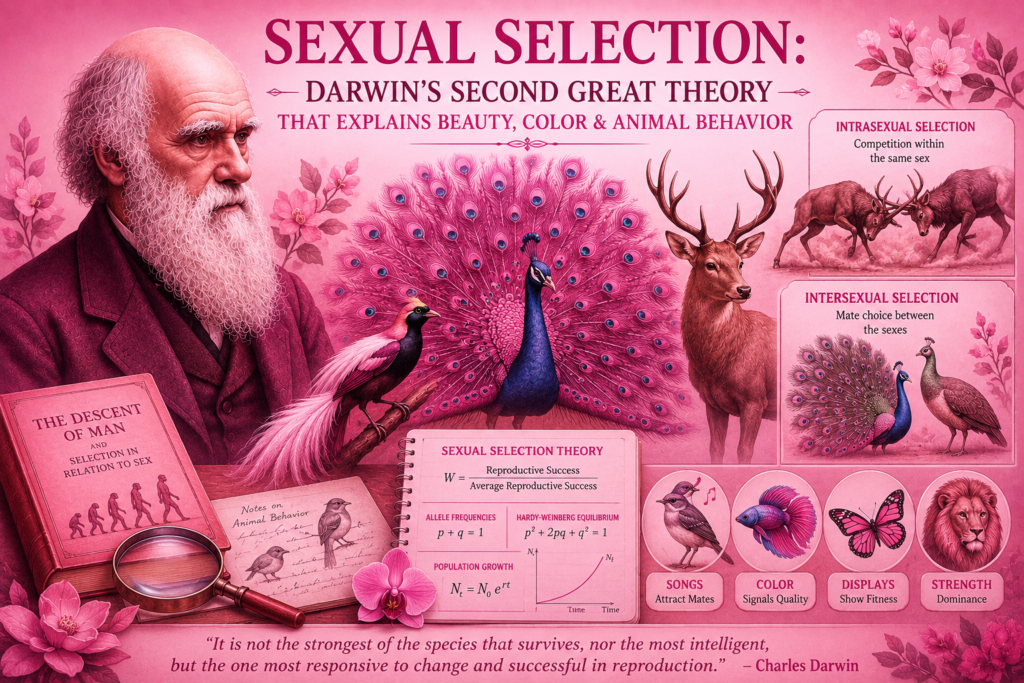
According to Darwin, animals compete for reproductive opportunities in two major ways:
Intrasexual Selection
This involves competition within the same sex.
Examples include:
- Male deer fighting with antlers
- Elephant seals battling for territory
- Dominance competitions among birds
Stronger or more dominant individuals often gain greater access to mates.
Intersexual Selection
This involves mate choice between sexes.
Examples include:
- Female peacocks selecting colorful males
- Birds choosing mates based on songs
- Females preferring elaborate courtship displays
These preferences influence which traits become common over generations.
Sexual selection theory therefore explains beauty, display, and attraction in nature.
Peacock Feathers and Evolutionary Beauty
The peacock became one of Darwin’s most famous examples of sexual selection theory.
Male peacocks possess:
- Bright colorful feathers
- Large tail displays
- Eye shaped feather patterns
These ornaments require energy and may attract predators.
Darwin realized such traits survive because females prefer males with impressive displays.
Over generations, mate preference strengthens these traits.
The process creates evolutionary aesthetics where beauty itself becomes biologically important.
The peacock remains one of the clearest examples of sexual selection theory in action.
Sexual Selection Versus Natural Selection
Sexual selection theory differs slightly from the theory of natural selection.
Natural selection focuses on:
- Survival
- Adaptation
- Environmental fitness
- Predator avoidance
Sexual selection theory focuses on:
- Mating success
- Attraction
- Courtship behavior
- Reproductive competition
Sometimes the two forces work together, while other times they conflict.
For example:
- Bright feathers may attract mates
- Bright feathers may also attract predators
Evolution balances survival and reproductive success simultaneously.
Mathematical Understanding of Sexual Selection
Modern evolutionary biology uses mathematics to study sexual selection theory.
Fitness can be represented mathematically as:
Where:
- = evolutionary fitness
Allele frequencies in mating populations follow:
Where:
- = frequency of one allele
- = frequency of another allele
The Hardy-Weinberg equilibrium equation helps study mating patterns:
Population growth can also be modeled mathematically:
Sexual selection models often analyze mate preference probabilities and reproductive success rates.
These mathematical principles help scientists study evolution, courtship, and mate competition.
Animal Courtship Behavior Across Nature
Sexual selection theory explains many remarkable animal behaviors.
Birds of Paradise
Male birds perform elaborate dances and display colorful plumage to attract females.
Deer Antlers
Male deer use antlers for combat and dominance competition.
Frogs and Mating Calls
Male frogs produce loud calls attracting females during breeding seasons.
Fireflies
Bioluminescent flashing patterns help identify mates.
Bowerbirds
Male bowerbirds construct decorative structures filled with colorful objects.
These examples reveal how sexual selection theory shapes animal behavior and evolutionary ornamentation.
Sexual Dimorphism and Evolution
Sexual selection theory also explains sexual dimorphism, where males and females appear different.
Examples include:
- Male lions with manes
- Male peacocks with giant tails
- Male deer with antlers
- Brightly colored male fish
These differences emerge because males and females experience different reproductive pressures.
In many species, males compete more intensely for mates while females choose among potential partners.
This creates distinct evolutionary pathways.
Darwin and Animal Behavior Studies
Darwin spent years studying behavior, emotion, and reproduction in animals.
His later work connected closely with topics explored in expression of emotions darwin.
Darwin believed emotional displays, gestures, and communication evolved through biological processes.
He studied:
- Bird courtship
- Human facial expressions
- Animal communication
- Mate preference
These studies helped expand evolutionary biology beyond simple survival mechanisms.
Survival of the Fittest and Reproduction
Sexual selection theory also connects closely with survival of the fittest.
In evolutionary biology, “fitness” means reproductive success rather than physical strength alone.
An organism succeeds evolutionarily if it passes genes to future generations.
Sometimes attractiveness becomes more important than survival efficiency.
For example:
- Colorful birds may reproduce more despite greater predation risk
- Large antlers may reduce mobility but improve mating success
Sexual selection therefore shapes evolution through reproduction rather than survival alone.
Darwin to DNA Evolution
Modern genetics strongly supports sexual selection theory.
Research connecting darwin to DNA evolution has revealed how genes influence:
- Plumage coloration
- Hormonal behavior
- Mate preference
- Ornament development
- Reproductive success
DNA sequencing shows that sexual selection rapidly changes gene frequencies within populations.
Scientists now study genetic mechanisms behind attraction and courtship behavior using molecular biology.
Human Evolution and Sexual Selection
Darwin also applied sexual selection theory to humans.
He believed human traits evolved partly through mate preference and reproductive competition.
Possible examples include:
- Facial symmetry
- Voice characteristics
- Hair patterns
- Social behavior
- Artistic display
Modern evolutionary psychology continues exploring these ideas today.
Although human behavior is complex, many scientists believe sexual selection contributed significantly to human evolution.
Sexual Selection in Modern Biology
Sexual selection theory remains one of the most active fields in modern evolutionary science.
Researchers study:
- Mate preference theory
- Behavioral ecology
- Genetic inheritance
- Reproductive strategies biology
- Courtship communication
- Evolutionary psychology
Modern technology allows scientists to track genetic changes caused by mating behavior across generations.
Sexual selection theory continues explaining some of nature’s most beautiful and unusual traits.
Misunderstanding Sexual Selection Theory
Some people mistakenly believe sexual selection only involves physical beauty.
In reality, many factors influence reproductive success:
- Intelligence
- Dominance
- Song quality
- Territory control
- Cooperation
- Resource gathering
Sexual selection theory studies all traits affecting mating success and evolutionary inheritance.
Darwin’s theory therefore extends far beyond appearance alone.
Why Sexual Selection Theory Still Matters Today
Sexual selection theory remains scientifically important because it explains behaviors and traits natural selection alone cannot fully explain.
The theory helps scientists understand:
- Animal courtship behavior
- Evolutionary aesthetics
- Species divergence
- Mate preference
- Reproductive adaptation
- Behavioral evolution
Without sexual selection theory, many biological mysteries involving beauty, display, and reproduction would remain unexplained.
FAQs About Sexual Selection Theory
What is sexual selection theory?
Sexual selection theory explains how traits evolve because they improve mating success and reproduction.
Who created sexual selection theory?
Charles Darwin introduced sexual selection theory in the nineteenth century.
What is the difference between natural selection and sexual selection?
Natural selection focuses on survival, while sexual selection focuses on mating success.
Why do peacocks have large colorful feathers?
Peacock feathers evolved because females preferred males with impressive displays.
What is sexual dimorphism?
Sexual dimorphism refers to physical differences between males and females of the same species.
Is sexual selection theory accepted today?
Yes. Modern evolutionary biology strongly supports sexual selection through genetics, behavior studies, and ecology.
Conclusion
Sexual selection theory became Darwin’s second great contribution to evolutionary science after natural selection. The theory explained why beauty, color, songs, displays, and courtship behaviors evolved across the animal kingdom.
From peacock feathers to antlers and bird songs, sexual selection theory revealed that reproductive success shapes evolution just as powerfully as environmental survival. Modern genetics and behavioral science continue confirming Darwin’s extraordinary insights into attraction, mate choice, and animal behavior.
The scientific importance of sexual selection theory stands beside the discoveries of many great thinkers whose ideas transformed civilization, including those explored in how ancient greek scientists changed modern science.