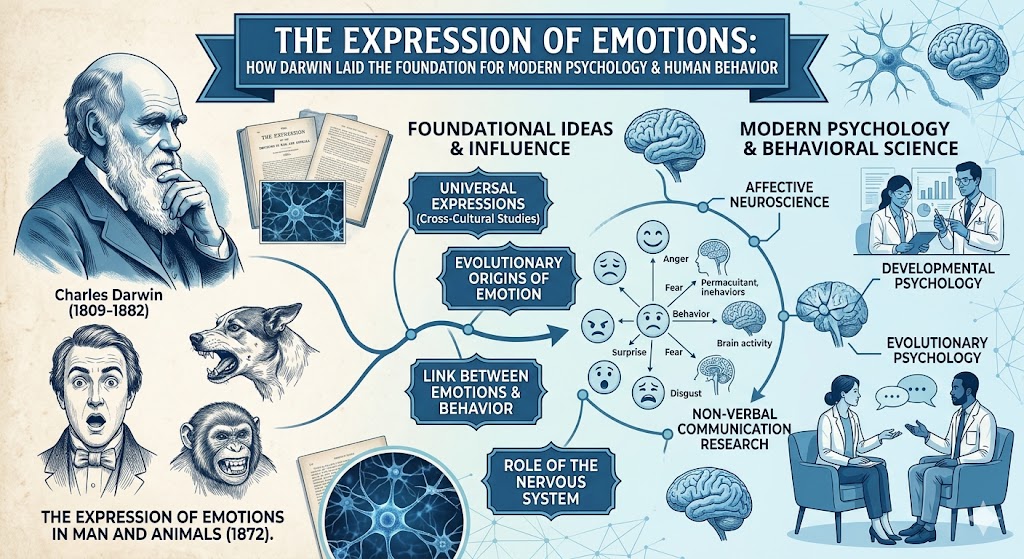
Expression of emotions darwin became one of the most revolutionary scientific studies in the history of psychology and human behavior. While Charles Darwin is most famous for evolution and natural selection, his groundbreaking work on emotional expression transformed humanity’s understanding of facial expressions, nonverbal communication, and the biological basis of emotion.
Darwin believed emotions were not random human experiences. Instead, he argued emotional expressions evolved gradually over millions of years and were deeply connected to survival, communication, and social interaction. Through careful observations of humans and animals, Darwin demonstrated that many emotional expressions are universal across cultures and species.
The discoveries connected to expression of emotions darwin helped establish the foundations of modern psychology, behavioral science, neuroscience, and evolutionary psychology.
Today, expression of emotions darwin remains one of the most influential scientific works on human behavior ever written. Scientists continue studying facial expressions, body language, microexpressions, and emotional responses using principles first introduced by Darwin.
This article explores Darwin’s emotional research, the mathematics of emotional analysis, universal expressions, evolutionary psychology, and how expression of emotions darwin changed modern science forever.
Darwin’s Interest in Human Emotion (1860 – 1872)
After publishing on the origin of species, Darwin became increasingly interested in behavior and emotional communication.
Darwin asked important scientific questions:
- Why do humans smile?
- Why do people blush?
- Why do animals show fear or aggression?
- Are emotions universal?
- Did emotional expressions evolve?
Most scientists during the nineteenth century believed emotions were purely cultural or spiritual experiences.
Darwin challenged this idea.
He argued emotional expressions developed through biological evolution and adaptation.
This revolutionary idea later became central to psychology and behavioral science.
The Expression of the Emotions in Man and Animals (1872)
In 1872, Darwin published his famous book:
The Expression of the Emotions in Man and Animals
The book became one of the earliest scientific studies of emotional behavior.
Darwin examined:
- Facial muscles
- Body movements
- Animal gestures
- Blushing
- Crying
- Fear responses
- Aggression signals
Expression of emotions darwin argued humans and animals share emotional behaviors because they share evolutionary ancestry.
This concept strongly supported descent with modification and evolutionary continuity.
Universal Human Emotions
One of Darwin’s most important discoveries involved universal emotional expressions.
Darwin believed certain emotions appear similarly across all human cultures.
These included:
- Happiness
- Fear
- Anger
- Sadness
- Surprise
- Disgust
Darwin observed similar facial reactions in people from different countries and societies.
This suggested emotions are biologically inherited rather than entirely learned culturally.
Modern psychology strongly supports this conclusion.
Researchers today continue studying cross cultural emotional expressions first explored in expression of emotions darwin.
Facial Muscles and Emotional Communication
Darwin carefully studied how facial muscles create emotional expressions.
He analyzed:
- Smiling muscles
- Frowning movements
- Eye widening
- Sneering
- Blushing reactions
Darwin believed these expressions evolved because they improved communication and survival.
For example:
- Fear expressions warn others about danger
- Anger displays discourage threats
- Sadness encourages social support
Expression of emotions darwin demonstrated that facial expressions serve important evolutionary functions.
Animals and Emotional Expression
Darwin also studied emotional behavior in animals.
He observed:
- Dogs showing excitement
- Primates expressing fear
- Cats displaying aggression
- Horses reacting nervously
Darwin realized emotional behaviors often resemble human expressions.
This similarity supported evolutionary continuity between humans and animals.
The research strengthened Darwin’s broader evolutionary framework connected to the tree of life theory.
Mathematical Analysis of Emotional Behavior
Modern psychology and neuroscience use mathematics to study emotional patterns connected to expression of emotions darwin.
Behavioral probability can be represented mathematically:
Where:
- = probability of a specific emotional expression
Population studies often use statistical averages:
Where:
- μ = mean response rate
- = individual observations
- = total participants
Correlation analysis in psychology uses:
These mathematical tools help scientists study emotional patterns, facial recognition, and psychological behavior scientifically.
Blushing and Unique Human Emotions
Darwin became especially fascinated by blushing.
He considered blushing one of the most uniquely human emotional responses.
Darwin believed blushing evolved through social awareness and self consciousness.
Blushing involves:
- Increased blood flow
- Facial redness
- Nervous system activation
- Emotional sensitivity
Expression of emotions darwin described blushing as one of the most human psychological reactions in nature.
Modern neuroscience still studies this phenomenon today.
Nonverbal Communication and Body Language
Darwin’s work strongly influenced modern studies of body language and nonverbal communication.
He realized communication occurs through:
- Facial expressions
- Posture
- Gestures
- Eye movement
- Voice tone
Many emotional signals operate unconsciously.
Expression of emotions darwin helped establish the scientific study of behavioral communication long before modern psychology existed.
Emotional Expressions and Survival
Darwin connected emotional behavior with the theory of natural selection.
He believed emotional expressions evolved because they improved survival and social cooperation.
Examples include:
- Fear responses increasing alertness
- Anger displays discouraging rivals
- Affection strengthening family bonds
- Disgust preventing contamination
Emotional communication became biologically valuable for social species.
Expression of emotions darwin therefore linked psychology directly with evolution.
Survival of the Fittest and Emotional Adaptation
Expression of emotions darwin also connected closely with survival of the fittest.
Organisms possessing effective emotional communication often gained survival advantages.
For example:
- Parents recognizing infant distress improve offspring survival
- Social groups cooperating emotionally increase protection
- Warning signals reduce danger exposure
Darwin realized emotions are adaptive biological systems rather than random experiences.
Evolutionary Psychology Roots
Modern evolutionary psychology traces many ideas directly back to expression of emotions darwin.
Evolutionary psychologists study:
- Human behavior
- Emotional adaptation
- Mate selection
- Social cooperation
- Fear responses
- Cognitive evolution
Darwin’s emotional theories became foundational for understanding human psychology through evolution.
Modern behavioral science still depends heavily on Darwin’s original insights.
Expression of Emotions Darwin and Modern Neuroscience
Modern neuroscience strongly supports many conclusions from expression of emotions darwin.
Brain imaging studies reveal emotional systems involving:
- Amygdala activation
- Hormonal responses
- Facial muscle coordination
- Nervous system reactions
Scientists now understand emotions involve both biology and cognition.
Darwin’s work anticipated many discoveries later confirmed by neuroscience.
Darwin to DNA Evolution and Human Behavior
Research involving darwin to DNA evolution has revealed genetic influences on emotional behavior.
Scientists now study genes connected to:
- Anxiety responses
- Aggression
- Empathy
- Social bonding
- Emotional regulation
Genetics and neuroscience continue supporting Darwin’s idea that emotional expressions evolved biologically.
Modern DNA research confirms many emotional behaviors have evolutionary origins.
Emotional Expression Across Cultures
One major strength of expression of emotions darwin was Darwin’s global perspective.
He compared emotional expressions across many cultures and populations.
Modern cross cultural studies continue showing humans share remarkably similar emotional reactions worldwide.
This supports Darwin’s argument that emotional expressions are universal evolutionary traits rather than purely cultural inventions.
Expression of Emotions Darwin and Modern Psychology
Expression of emotions darwin became foundational for many branches of psychology including:
- Behavioral psychology
- Social psychology
- Cognitive science
- Evolutionary psychology
- Neuroscience
- Communication studies
Darwin helped transform emotional behavior into a scientific subject rather than purely philosophical speculation.
His work remains one of the greatest contributions to psychology in history.
Why Expression of Emotions Darwin Still Matters Today
Expression of emotions darwin remains scientifically important because it revealed the biological and evolutionary foundations of human emotion.
The research continues influencing:
- Psychology
- Neuroscience
- Artificial intelligence
- Behavioral science
- Communication studies
- Evolutionary biology
Modern emotion recognition systems, facial analysis technology, and behavioral science still rely on principles first explored by Darwin.
FAQs About Expression of Emotions Darwin
What is expression of emotions darwin?
It refers to Darwin’s scientific study of emotional expressions in humans and animals.
Why was Darwin’s emotion research important?
It helped establish modern psychology and evolutionary explanations for emotions.
Did Darwin believe emotions evolved?
Yes. Darwin argued emotional expressions evolved gradually through natural selection.
What emotions did Darwin study?
Darwin studied fear, anger, happiness, sadness, surprise, disgust, and other emotional reactions.
Why did Darwin study facial expressions?
He believed facial expressions revealed biological and evolutionary patterns in communication.
Is Darwin’s emotional theory accepted today?
Yes. Modern psychology and neuroscience strongly support many of Darwin’s conclusions.
Conclusion
Expression of emotions darwin completely transformed scientific understanding of psychology, behavior, and emotional communication. Charles Darwin demonstrated that emotions are not random cultural inventions but deeply rooted biological systems shaped through evolution.
From facial expressions and blushing to animal gestures and nonverbal communication, Darwin’s emotional research laid the foundation for modern psychology and neuroscience. Today, scientists continue building upon the remarkable discoveries Darwin first introduced nearly 150 years ago.
The scientific importance of expression of emotions darwin stands beside the achievements of many great thinkers whose discoveries reshaped civilization, including those explored in how ancient greek scientists changed modern science.