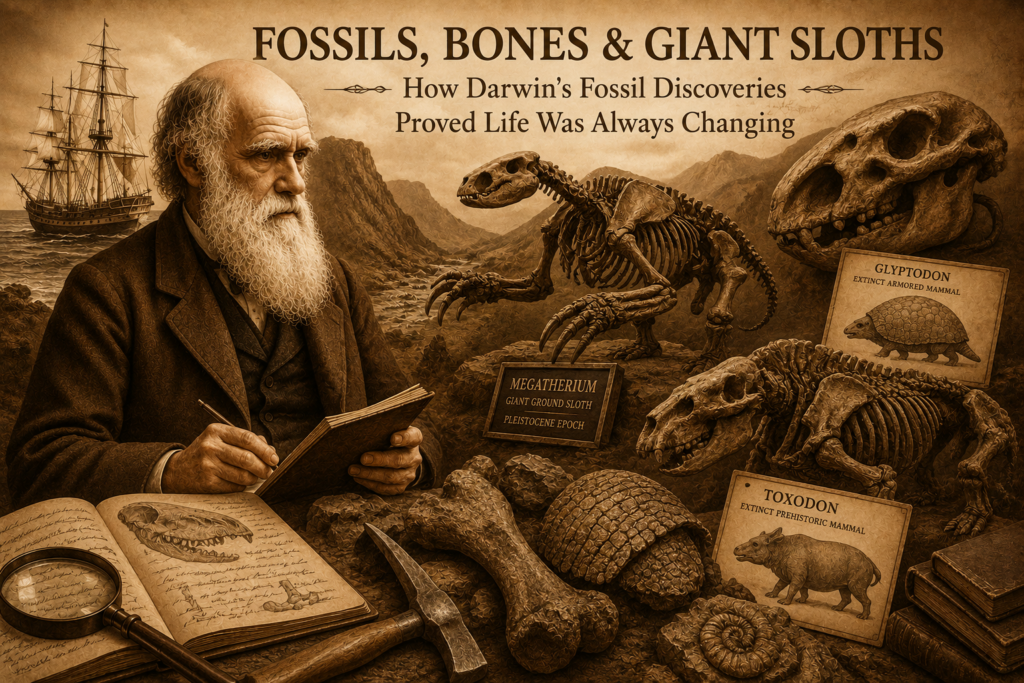
Darwin fossil discoveries played a massive role in changing science forever. During the nineteenth century, most people believed species were fixed and never changed. Fossils were mysterious objects that many scientists struggled to explain. However, Charles Darwin’s discoveries of giant bones, extinct mammals, and ancient skeletal remains helped prove that life on Earth had changed dramatically across geological time.
While traveling during the HMS beagle voyage, Charles Darwin uncovered fossils unlike anything seen before. Giant sloths, armored mammals, and strange extinct creatures revealed an ancient world very different from the modern one. Even more surprising, many fossils resembled living animals still found in South America.
These observations became one of the strongest clues supporting evolution and common ancestry. Darwin realized extinct organisms and modern species might be connected through gradual biological change.
Today, darwin fossil discoveries remain central to paleontology, geology, and evolutionary biology. Fossils continue providing some of the strongest evidence that life on Earth evolved over millions of years.
This article explores Darwin’s fossil discoveries, the science of fossilization, the role of giant sloths and extinct mammals, and how fossils helped transform modern biology forever.
Fossils Before Darwin (1700 – 1830)
Before Darwin, fossils confused scientists and religious thinkers alike.
Many questions remained unanswered:
- Why did fossil species disappear?
- Why did fossils resemble living organisms?
- Why were giant bones buried underground?
- How old were fossils?
Some people believed fossils were remnants from biblical floods, while others thought extinct species still survived somewhere undiscovered.
The science of paleontology was still developing during the early nineteenth century.
Geologists such as Charles Lyell argued Earth was extremely old and shaped by slow geological processes. This idea later became essential to Darwin’s thinking.
Fossils slowly began revealing that life on Earth had changed dramatically across immense spans of time.
The HMS Beagle Voyage and Fossil Exploration (1831 – 1836)
Darwin’s fossil discoveries began during the famous HMS beagle voyage.
The voyage took Darwin across South America, where he explored cliffs, riverbanks, rock layers, and sediment deposits filled with ancient fossils.
Darwin discovered:
- Giant mammal bones
- Fossilized armor plates
- Ancient skulls
- Extinct marine organisms
- Geological strata containing preserved remains
The discoveries fascinated him because many fossils resembled living South American species.
Darwin realized extinct organisms might share relationships with modern animals.
This insight later became central to evolution and descent with modification.
Giant Sloths and Megatherium Fossils
One of Darwin’s most important fossil discoveries involved giant sloths called Megatherium.
Megatherium was an enormous prehistoric mammal related to modern tree sloths.
The creature possessed:
- Massive claws
- Thick bones
- Huge skeletal structures
- Powerful limbs
Darwin discovered fossilized Megatherium remains in Argentina.
The giant sloth fossils shocked scientists because they revealed extinct creatures far larger than modern relatives.
Darwin noticed similarities between giant sloths and living South American sloths.
This suggested ancient and modern organisms might share common ancestry.
The Megatherium fossils became one of the strongest clues supporting evolutionary change.
Glyptodon and Giant Armored Mammals
Another famous fossil discovered by Darwin belonged to Glyptodon, an extinct armored mammal resembling a giant armadillo.
The animal possessed:
- Thick protective armor
- Large body size
- Heavy skeletal structures
Again, Darwin noticed similarities between extinct Glyptodon fossils and living armadillos found in South America.
These observations raised important scientific questions:
- Why did extinct and living animals resemble one another?
- Why were fossils found near modern relatives?
- Could species gradually change over time?
Darwin increasingly suspected that species evolved rather than remaining fixed forever.
Toxodon and Strange Ancient Mammals
Darwin also discovered fossils belonging to Toxodon, one of the strangest prehistoric mammals ever found.
Toxodon possessed features resembling:
- Rodents
- Rhinoceroses
- Hippos
The bizarre combination confused scientists for decades.
The fossil record revealed a prehistoric world filled with extinct creatures unlike anything alive today.
Darwin’s fossil discoveries demonstrated that extinction and biological change were natural parts of Earth’s history.
Geological Strata and Fossilization
Darwin’s work also helped connect fossils with geological time.
Fossils are preserved in sedimentary rock layers called strata.
Over time:
- Organisms die
- Sediment covers remains
- Minerals replace organic material
- Fossils form through geological processes
Older fossils usually appear deeper within rock layers.
This helped scientists understand Earth’s long history.
Darwin realized geological change and biological evolution likely occurred gradually over millions of years.
Mathematical Understanding of Fossil Populations
Modern evolutionary biology uses mathematics to study population changes and extinction patterns.
Population growth can be modeled mathematically:
Where:
- = population size at time t
- = original population
- = growth rate
Genetic variation within populations follows allele frequency equations:
Where:
- = frequency of one allele
- = frequency of another allele
The Hardy-Weinberg equilibrium equation studies genetic stability:
Evolutionary fitness is often represented mathematically:
These principles help scientists understand extinction, adaptation, and species divergence over geological time.
Fossils and the Theory of Evolution
Darwin’s fossils became major evidence supporting the theory of natural selection.
The fossil record revealed several important patterns:
- Ancient organisms differed from modern species
- Extinct species resembled living relatives
- Organisms changed gradually over time
- Extinction occurred repeatedly
These observations supported evolutionary change and adaptation.
Darwin realized species were not permanent. Instead, they evolved through inherited variation and environmental pressure.
Fossils provided physical evidence that life on Earth had always been changing.
Fossils and the Tree of Life Theory
Darwin’s fossil discoveries also supported the tree of life theory.
According to this concept:
- Species share common ancestry
- Evolution produces branching lineages
- New species emerge gradually
- Extinct species represent earlier branches
Fossils helped scientists reconstruct evolutionary relationships between organisms.
For example:
- Ancient whales evolved from land mammals
- Birds evolved from dinosaurs
- Modern horses evolved from smaller ancestors
The fossil record became one of the strongest demonstrations of common descent.
Darwin and Wallace: Shared Evolutionary Thinking
Another scientist connected to evolutionary theory was Alfred Russel Wallace.
The collaboration between darwin and wallace helped strengthen scientific acceptance of evolution.
Although Wallace focused more on living organisms and geography, both scientists recognized the importance of adaptation and species change.
Together, their work transformed biology forever.
Fossils, Extinction, and Survival
Darwin’s discoveries also revealed that extinction is a natural process.
Throughout Earth’s history:
- Species appeared
- Species adapted
- Species disappeared
- New species evolved
Environmental change, climate shifts, competition, and ecological pressure shaped survival across geological time.
This understanding connected closely with survival of the fittest in evolutionary biology.
The fossil record showed that no species survives forever.
Modern Fossil Science and DNA
Modern paleontology continues supporting Darwin’s ideas.
New discoveries constantly reveal transitional species connecting ancient and modern organisms.
Research involving genetics and darwin to DNA evolution has strengthened fossil evidence even further.
Scientists now combine:
- Fossils
- DNA sequencing
- Comparative anatomy
- Embryology
- Geological dating
These fields work together to reconstruct evolutionary history with remarkable detail.
Why Darwin’s Fossil Discoveries Still Matter Today
Darwin fossil discoveries remain scientifically important because they provide direct evidence for evolution and extinction.
Fossils help scientists understand:
- Ancient ecosystems
- Climate change
- Evolutionary transitions
- Species adaptation
- Biodiversity history
Without fossils, evolutionary biology would lack physical evidence connecting ancient and modern life.
Darwin’s discoveries transformed paleontology into one of the most powerful sciences studying Earth’s biological history.
FAQs About Darwin Fossil Discoveries
What fossils did Darwin discover?
Darwin discovered fossils of giant sloths, Glyptodon, Toxodon, and other extinct South American mammals.
Why were Darwin’s fossil discoveries important?
They showed extinct animals resembled modern species, supporting evolutionary change and common ancestry.
What was Megatherium?
Megatherium was a giant prehistoric sloth related to modern tree sloths.
How do fossils support evolution?
Fossils reveal gradual biological changes and transitional forms across geological time.
Did Darwin discover dinosaurs?
No. Darwin mainly discovered extinct mammal fossils in South America.
Why is the fossil record important?
The fossil record provides physical evidence showing life on Earth changed over millions of years.
Conclusion
Darwin fossil discoveries completely changed humanity’s understanding of life, extinction, and evolution. The giant sloths, armored mammals, and fossilized bones Darwin uncovered during the HMS Beagle voyage revealed that Earth once contained creatures vastly different from modern life.
These fossils provided powerful evidence that species were not fixed forever but changed gradually through time. Modern paleontology, geology, and genetics continue confirming the evolutionary patterns Darwin first recognized nearly two centuries ago.
The scientific importance of Darwin’s fossil discoveries stands beside the achievements of many great thinkers whose ideas transformed civilization, including those explored in how ancient greek scientists changed modern science.