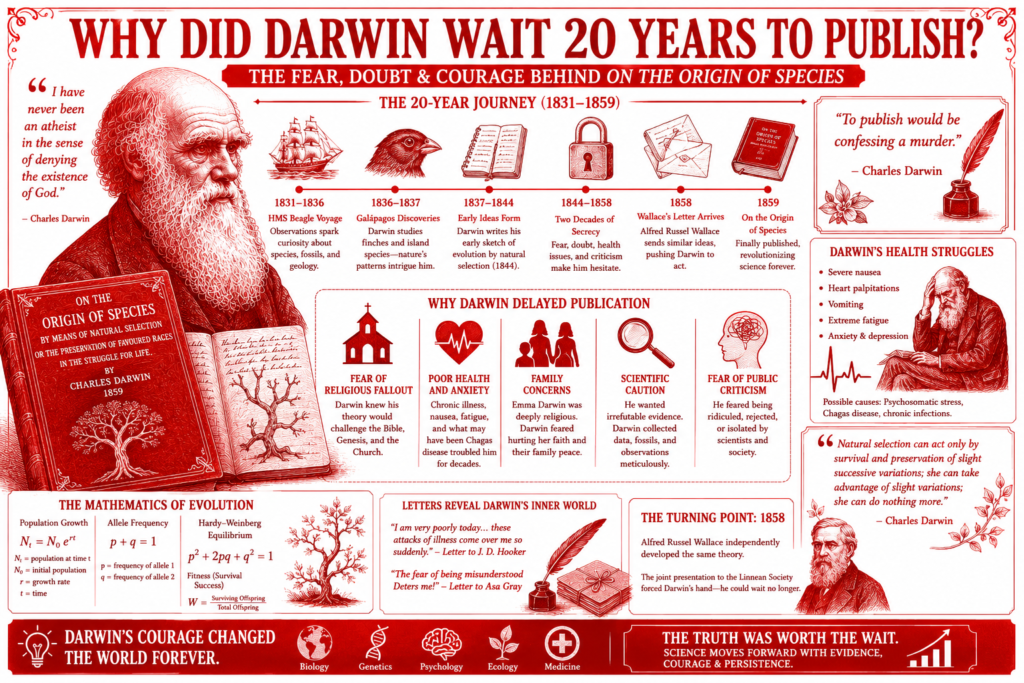
why darwin delayed publication remains one of the most fascinating questions in scientific history. Charles Darwin developed the foundations of evolutionary theory during the 1830s, yet he waited nearly twenty years before publishing On the Origin of Species in 1859. During those decades, Darwin secretly refined his ideas while struggling with fear, illness, religious concerns, and the possible consequences of challenging society’s beliefs.
The delay behind Darwin’s publication was not simple procrastination. Darwin understood his theory would shake science, religion, and human identity. His ideas suggested species evolved gradually through natural selection rather than appearing through separate acts of divine creation. In Victorian society, these conclusions were explosive.
The story behind why darwin delayed publication reveals a deeply human side of scientific discovery. Darwin was not only a brilliant scientist but also a cautious thinker, anxious husband, devoted father, and emotionally conflicted intellectual.
Today, historians continue studying why darwin delayed publication because the story illustrates how revolutionary ideas often face fear, resistance, and personal doubt before changing the world forever.
This article explores Darwin’s hesitation, health struggles, religious fears, scientific caution, mathematical foundations of evolution, and the dramatic events that finally pushed Darwin to publish his revolutionary theory.
The HMS Beagle Voyage Changes Everything (1831 – 1836)
The origins of why darwin delayed publication began during the famous HMS beagle voyage.
While traveling across South America and the Pacific Ocean, Charles Darwin collected observations that challenged traditional views about life.
Darwin studied:
- Fossils
- Geological strata
- Island species
- Animal variation
- Biodiversity patterns
The discoveries involving darwin finches and the Galápagos Islands especially influenced his thinking.
Darwin slowly realized species might change gradually over time through adaptation and environmental pressure.
However, he also understood these conclusions contradicted dominant religious beliefs.
Darwin Secretly Develops Evolutionary Theory (1837 – 1844)
After returning to England, Darwin privately began developing evolutionary ideas.
He filled notebooks with revolutionary concepts including:
- Common ancestry
- Species transformation
- Natural selection
- Adaptation
- Competition for survival
By 1844, Darwin had already written a substantial essay outlining evolutionary theory.
Yet he refused to publish it publicly.
The question of why darwin delayed publication became increasingly connected to fear of social and religious backlash.
Darwin knew his theory would challenge traditional theology and Victorian society.
Fear of Religious Fallout
One major reason why darwin delayed publication involved religion.
Victorian England remained deeply religious during the nineteenth century.
Many people believed:
- Species were fixed creations
- Humans were specially created
- Earth was designed intentionally by God
Darwin’s theory threatened these assumptions.
Evolution through natural selection implied:
- Species evolved naturally
- Humans shared ancestry with animals
- Life changed gradually over immense time
Darwin feared religious outrage and public controversy.
The later debate involving darwin vs church confirmed many of his concerns.
Emma Darwin and Family Concerns
Darwin’s wife Emma Darwin played an important role in why darwin delayed publication.
Emma was deeply religious and worried Darwin’s ideas could damage both faith and morality.
She feared evolutionary theory might separate them spiritually after death.
Darwin deeply respected Emma and cared about her emotional wellbeing.
Their family dynamic added emotional complexity to Darwin’s scientific decisions.
Although Emma supported Darwin personally, religious concerns remained a source of tension within the household.
Darwin’s Health Problems and Anxiety
Another major factor behind why darwin delayed publication involved Darwin’s chronic illness.
For decades, Darwin suffered symptoms including:
- Nausea
- Fatigue
- Heart palpitations
- Vomiting
- Anxiety
- Weakness
Historians still debate the exact cause.
Possible explanations include:
- Chagas disease
- Psychosomatic illness
- Stress related conditions
- Chronic infections
Darwin’s health problems often limited his productivity and increased his emotional caution.
His illnesses intensified during periods of scientific pressure and controversy.
Scientific Caution and Evidence Gathering
Darwin was also extraordinarily cautious scientifically.
One major reason why darwin delayed publication was his desire for overwhelming evidence.
Darwin spent decades collecting data involving:
- Fossils
- Breeding experiments
- Comparative anatomy
- Embryology
- Geology
- Plant biology
He wanted his theory to withstand criticism from scientists and clergy alike.
Darwin feared publishing too early without sufficient evidence.
This scientific caution eventually strengthened On the Origin of Species enormously.
The Theory of Natural Selection
At the center of why darwin delayed publication was Darwin’s revolutionary mechanism of evolution called the theory of natural selection.
Darwin realized:
- Organisms produce more offspring than survive
- Individuals vary naturally
- Some traits improve survival and reproduction
- Advantageous traits spread over generations
This process gradually changes populations over time.
Darwin understood these ideas directly challenged traditional creation beliefs.
Mathematical Foundations of Evolution
Modern biology uses mathematics to describe principles connected to Darwin’s evolutionary ideas.
Population growth can be modeled mathematically:
Where:
- = population size at time t
- = initial population
- = growth rate
Allele frequencies follow:
Where:
- = frequency of one allele
- = frequency of another allele
The Hardy-Weinberg equation models inheritance:
Evolutionary fitness can be represented as:
These mathematical principles later provided strong support for Darwinian evolution.
Darwin’s Fear of Public Reaction
Why darwin delayed publication also involved fear of public humiliation and criticism.
Darwin understood his ideas could:
- Damage his reputation
- Offend religious institutions
- Create political controversy
- Shock Victorian society
The scientific world during the nineteenth century could be ruthless toward controversial thinkers.
Darwin worried about becoming isolated or ridiculed.
He privately described his theory as “like confessing a murder.”
Darwin and Wallace (1858)
Everything changed dramatically in 1858.
Alfred Russel Wallace independently developed a theory remarkably similar to Darwin’s natural selection.
The collaboration between darwin and wallace forced Darwin into action.
Wallace sent Darwin a manuscript explaining evolutionary principles almost identical to Darwin’s unpublished ideas.
Darwin suddenly feared losing scientific priority after twenty years of private work.
This event became the turning point ending Darwin’s long hesitation.
The Publication of On the Origin of Species (1859)
In 1859, Darwin finally published on the origin of species.
The book sold out immediately and transformed science forever.
Darwin presented evidence involving:
- Fossils
- Animal breeding
- Geography
- Comparative anatomy
- Species variation
The publication triggered enormous debate across science, religion, and society.
The controversy surrounding why darwin delayed publication suddenly became reality.
Survival of the Fittest and Public Misunderstanding
The phrase survival of the fittest later became strongly associated with Darwinian evolution.
However, many people misunderstood evolutionary fitness.
Darwin did not mean only physical strength.
In biology, fitness refers to reproductive success and adaptation.
Public misunderstanding created additional controversy surrounding evolutionary theory.
These misconceptions increased Darwin’s concerns about publication.
Darwin’s Emotional Burden
The story behind why darwin delayed publication reveals Darwin’s emotional complexity.
Darwin experienced:
- Fear
- Doubt
- Anxiety
- Intellectual isolation
- Scientific caution
- Moral conflict
Despite these struggles, Darwin continued refining his ideas patiently and methodically.
His emotional burden demonstrates that major scientific discoveries often involve intense personal challenges.
Darwin to DNA Evolution
Modern genetics strongly supports Darwin’s evolutionary framework.
Research involving darwin to DNA evolution revealed the molecular mechanisms behind heredity and adaptation.
DNA evidence now confirms:
- Common ancestry
- Mutation
- Natural selection
- Evolutionary divergence
Modern biology validates many of Darwin’s original ideas with extraordinary precision.
The decades Darwin spent gathering evidence ultimately proved worthwhile.
Why Darwin Delayed Publication and Scientific Courage
Today, historians view why darwin delayed publication as a combination of:
- Scientific caution
- Religious concern
- Personal anxiety
- Health problems
- Fear of controversy
- Desire for evidence
Darwin’s eventual decision to publish required enormous courage.
His work permanently transformed humanity’s understanding of life on Earth.
Why This Story Still Matters Today
The story behind why darwin delayed publication remains important because it reveals the human side of science.
Scientific progress often involves:
- Fear of criticism
- Emotional struggle
- Intellectual risk
- Social opposition
Darwin’s experience demonstrates that revolutionary discoveries rarely emerge easily.
His courage eventually changed biology, medicine, genetics, psychology, and modern scientific thought forever.
About Why Darwin Delayed Publication
Why did Darwin wait so long to publish evolution?
Darwin feared religious backlash, public criticism, and wanted stronger scientific evidence.
How long did Darwin delay publication?
Darwin delayed publishing his theory for about twenty years.
Was Darwin afraid of the church?
Yes. Darwin worried his theory would create conflict with religious beliefs and institutions.
Did Darwin’s health affect his work?
Yes. Chronic illness and anxiety strongly influenced Darwin’s productivity and emotional state.
Who forced Darwin to publish?
Alfred Russel Wallace’s similar evolutionary theory pushed Darwin to publish sooner.
Was Darwin confident in his theory?
Darwin believed strongly in evolution but remained cautious and careful scientifically.
Conclusion
Why darwin delayed publication became one of the most fascinating stories in scientific history because it revealed the emotional, intellectual, and social struggles behind revolutionary ideas. Charles Darwin spent twenty years balancing fear, scientific caution, illness, and religious controversy before finally publishing one of the most important books ever written.
Despite enormous pressure and uncertainty, Darwin’s courage transformed humanity’s understanding of life, evolution, and nature forever. Modern genetics, fossils, and biology continue confirming the extraordinary insights Darwin finally shared with the world in 1859.
The historical importance of Darwin’s struggle stands beside the achievements of many great thinkers whose discoveries reshaped civilization, including those explored in how ancient greek scientists changed modern science.