Java vs javascript explained is one of the most searched topics in programming because millions of beginners mistakenly think Java and JavaScript are the same language. Their names sound extremely similar, but in reality they are completely different technologies built for different purposes.
Java is a powerful programming language mainly used for enterprise software, Android development, and backend systems. JavaScript is the dominant scripting language of the web and powers interactive websites, browser applications, and modern front end frameworks.
The confusion became common during the internet boom of the 1990s when both languages gained massive popularity at nearly the same time.
In this detailed guide, you will learn the complete difference between Java and JavaScript, how each language works, where they are used, why their names became connected, and which language you should learn today for the future of software engineering.
The Origins of Java and JavaScript (1991 – 1995)
To understand java vs javascript explained, you first need to understand their history.
Java was created at Sun Microsystems by James Gosling and the Green Team in 1991. The language originally started as Oak programming language before later becoming Java.
The project focused on portability, security, and enterprise software systems.
If you want to understand the full background, you should explore java history: 1991 to today because Java evolved into one of the most important enterprise technologies ever created.
JavaScript appeared later in 1995.
It was developed by Brendan Eich at Netscape in only a few weeks. Netscape wanted a lightweight scripting language for web browsers.
At first, JavaScript was called Mocha, then LiveScript, before finally becoming JavaScript.
The naming decision was mostly a marketing strategy because Java was already extremely popular during that period.
This is one reason why beginners still become confused today.
Why Their Names Sound Similar
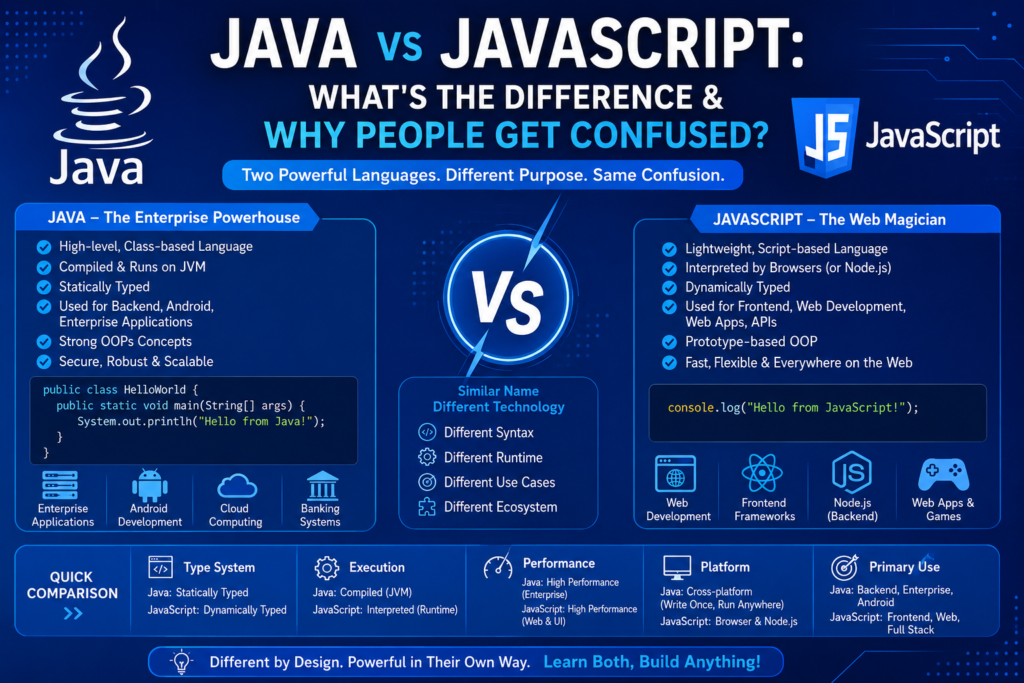
One major reason java vs javascript explained remains popular is the naming confusion.
JavaScript was intentionally named to benefit from Java’s growing popularity.
However, the two languages have entirely separate architectures.
Java is:
- Compiled
- Statically typed
- Class based
- Enterprise focused
JavaScript is:
- Dynamically typed
- Script based
- Browser focused originally
- Interpreted at runtime
Despite sharing the word Java, the technologies evolved independently.
The story also connects with why java is named java, which involves coffee culture and Sun Microsystems branding history.
What Is Java?
Java is a general purpose programming language designed for reliability and platform independence.
Its biggest philosophy became:
Write Once Run Anywhere.
Java applications compile into bytecode and run inside the Java Virtual Machine.
Example Java Code:
public class Hello {
    public static void main(String[] args) {
        System.out.println("Hello from Java!");
    }
}
Java uses strong OOP class architecture principles.
Developers commonly use Java for:
- Enterprise software
- Android applications
- Banking systems
- Cloud platforms
- Backend development
- Scientific systems
Java became highly respected because of security, scalability, and performance stability.
What Is JavaScript?
JavaScript started primarily as a browser scripting engine language.
It allowed websites to become interactive.
Example JavaScript Code:
console.log("Hello from JavaScript!");Unlike Java, JavaScript originally focused on client-side execution inside web browsers.
Modern JavaScript now also supports server-side Node js development.
JavaScript powers:
- Interactive websites
- Front end frameworks
- Full stack development
- Mobile apps
- Browser games
- APIs
Today, JavaScript is considered essential for modern web development.
Java vs JavaScript Syntax Comparison
Another reason people search for java vs javascript explained is because the syntax sometimes appears similar.
Example Java Variable:
int age = 25;
String name = "Ali";
Example JavaScript Variable:
let age = 25;
let name = "Ali";
Although they look somewhat alike, the underlying systems differ significantly.
Java uses statically typed vs dynamically typed architecture differences.
Java requires strict data type declarations.
JavaScript allows flexible variable types during runtime.
Compilation vs Interpretation
One of the biggest Java and JavaScript differences explained involves execution methods.
Java
Java uses compilation.
Process:
Source Code → Bytecode → JVMJavaScript
JavaScript originally relied on runtime interpretation inside browsers.
Modern engines now use advanced optimizations through ECMAScript standards and Just In Time compilation systems.
This architectural difference affects speed, portability, and application design.
Front End vs Back End Languages
Java and JavaScript often compete in discussions involving front-end vs back-end languages.
Java
Mostly backend focused.
Common uses:
- APIs
- Enterprise servers
- Android systems
- Cloud infrastructure
JavaScript
Originally frontend focused.
Now also supports backend development using Node js.
Common uses:
- React
- Vue
- Angular
- Express js
- Full stack web apps
Modern companies often combine both languages together.
Java Memory Management Systems
Java uses automatic garbage collection.
This means developers do not manually control memory allocation.
Example:
String text = "Java Memory";Java automatically manages unused memory later.
JavaScript also uses garbage collection systems, but the browser environment controls much of the process.
Both languages simplified programming compared to older systems like C++.
Java File Extensions
Source file extensions are another important distinction.
Java files:
.javaJavaScript files:
.jsThis small difference still causes confusion among beginners downloading source code online.
Enterprise Computing vs Web Development
Java became famous because of enterprise computing systems.
Large corporations trusted Java for:
- Banking
- Insurance software
- Government systems
- Large databases
- Financial applications
JavaScript became dominant in web development.
Modern websites rely heavily on JavaScript for:
- Animations
- Forms
- Interactive interfaces
- Dynamic content
This comparison of web development languages remains one of the biggest differences between both technologies.
The Rise of Node js (2009 – Today)
For many years, JavaScript remained mostly browser focused.
Everything changed after Node js appeared.
Node js allowed JavaScript to run outside browsers.
This transformed JavaScript into a full stack development language.
Developers could now build both frontend and backend applications using JavaScript.
This major change intensified discussions around tech stack choosing Java vs JS.
Java for Android Development
Java became highly important in mobile development after Android launched.
Millions of developers entered programming through java for android development tutorials and projects.
Java dominated Android application development for many years before Kotlin became increasingly popular.
Despite newer alternatives, Java still powers countless Android systems globally.
JavaScript in Modern Web Apps
JavaScript dominates modern web technology.
Popular frameworks include:
- React
- Vue
- Angular
- Next js
JavaScript became central to:
- Social media platforms
- E commerce websites
- Streaming services
- Browser applications
Without JavaScript, the modern internet would look completely different.
Performance Comparison
Another important part of java vs javascript explained involves performance.
Java Performance
Java usually performs better for:
- Large enterprise systems
- High concurrency applications
- Banking systems
- Massive backend servers
Java benefits from optimized JVM performance.
JavaScript Performance
JavaScript performs extremely well for:
- Browser interaction
- Dynamic interfaces
- Fast web rendering
- Lightweight scripting
Modern browser engines improved JavaScript dramatically.
Learning Difficulty Comparison
Beginners often ask:
Should I learn Java or JavaScript?
The answer depends on career goals.
Learn Java If You Want:
- Enterprise development
- Android apps
- Backend engineering
- Cloud systems
Many beginners first start learning java today because of its strong career opportunities.
Learn JavaScript If You Want:
- Web development
- Front end design
- Full stack apps
- Interactive websites
Both languages offer excellent career potential.
Java’s Strong Object Oriented System
Java strongly emphasizes object oriented programming.
Example:
class Car {
    String brand;

    void display() {
        System.out.println(brand);
    }
}
Developers frequently search for java oop concepts explained because OOP remains central to Java architecture.
JavaScript also supports OOP concepts, but its model evolved differently through prototypes and modern classes.
Java Framework Ecosystem
Java built one of the world’s largest enterprise ecosystems.
Popular frameworks include:
- Spring Boot
- Hibernate
- Jakarta EE
Developers researching best java frameworks compared quickly realize how massive the Java enterprise ecosystem has become.
JavaScript also has huge ecosystems through npm libraries and frontend frameworks.
Why People Still Get Confused
Even today, people confuse Java and JavaScript because:
- The names are similar
- Both involve coding
- Both became popular during the internet boom
- Both use somewhat similar syntax styles
However, the technologies remain fundamentally different.
The confusion became one of the biggest examples of programming language nomenclature issues in software history.
Java and the Future of Technology
Both Java and JavaScript continue evolving rapidly.
Java focuses heavily on:
- Enterprise computing
- Cloud systems
- AI infrastructure
- Scalability
JavaScript focuses heavily on:
- Modern web applications
- Full stack development
- Browser technologies
- Interactive user interfaces
Together, both languages shape the future of software engineering in powerful ways.
Which Language Is Better?
There is no universal winner.
The better choice depends on project goals.
Choose Java For:
- Enterprise software
- Banking systems
- Android development
- Scalable backend systems
Choose JavaScript For:
- Websites
- Interactive UI
- Frontend apps
- Full stack development
Many professional developers eventually learn both languages.
Advanced Java Features
Modern Java includes powerful systems such as:
- Concurrency tools
- Streams API
- Lambda expressions
- Virtual threads
Developers exploring advanced java concepts guide topics often discover how advanced Java has become in enterprise computing.
The Lasting Legacy of Both Languages
Java and JavaScript both changed technology forever.
Java revolutionized enterprise software and platform portability.
JavaScript revolutionized web interactivity and browser applications.
Despite the confusion around their names, both languages became pillars of modern computing.
Their influence continues growing across cloud systems, AI platforms, mobile apps, and internet infrastructure.
Frequently Asked Questions (FAQs)
Is JavaScript based on Java?
No. JavaScript was developed independently and is not based on Java.
Why are Java and JavaScript confused?
Their names are very similar, and both became popular during the 1990s internet boom.
Which language is easier to learn?
JavaScript is usually easier for beginners in web development, while Java provides stronger structure for software engineering learning.
Can JavaScript replace Java?
Not completely. Both languages serve different purposes and dominate different industries.
Is Java still useful today?
Yes. Java remains one of the world’s most important enterprise programming languages.
Should I learn Java or JavaScript first?
Choose Java for enterprise systems and Android. Choose JavaScript for web development and frontend technologies.
Conclusion
The full story of java vs javascript explained reveals that these two technologies are entirely different despite their similar names. Java focuses on enterprise computing, scalability, and backend systems, while JavaScript dominates modern web interactivity and browser based applications.
The confusion mainly started because JavaScript adopted its name during Java’s rise to popularity in the 1990s. However, both languages evolved into powerful technologies with unique strengths and massive developer communities.
Today, Java and JavaScript remain among the world’s most important programming languages. Whether you want to build enterprise software, Android apps, websites, or full stack platforms, both technologies continue shaping the future of modern computing.