The history of word embeddings is one of the most important and underappreciated chapters in the story of artificial intelligence. Before machines could generate essays, answer questions, or translate languages fluently, they first needed to understand something far more basic: what words mean and how they relate to each other.
The history of word embeddings traces the journey from simple, rigid word representations to the rich, powerful vector models that now sit at the heart of every modern language AI system. It is a story of brilliant ideas, unexpected breakthroughs, and one paper from 2013 that genuinely changed everything.
Why Representing Words Was So Hard
Before we explore the history of word embeddings in depth, it helps to understand the core problem they were solving. Computers do not understand language the way humans do. They work with numbers. So the first challenge in natural language processing was always: how do you turn a word into a number that actually captures its meaning?
The earliest answer was one-hot encoding. Each word in the vocabulary got its own position in a giant vector, and that position was marked with a 1 while everything else was a 0. This was clean and simple but had a fatal flaw: every word was equally different from every other word. “King” was no closer to “queen” than it was to “banana.” There was no meaning embedded in the representation at all, just identity.
Bag of Words and TF-IDF: Early Attempts (1950 – 1990)
The Bag of Words model was an early improvement in the history of word embeddings. Instead of encoding individual words, it encoded documents as collections of word counts. This allowed simple text classification and information retrieval to work reasonably well. If a document had many occurrences of the word “medicine,” it was probably about health.
TF-IDF refined this by giving higher weight to words that were common in a document but rare across the full collection. A word like “the” appears everywhere and tells you nothing useful. A word like “photosynthesis” appearing frequently in a document is genuinely informative about its topic.
These methods were useful tools in their time, but they still treated words as completely independent symbols. They captured nothing about semantic similarity, about the fact that “happy” and “joyful” mean nearly the same thing, or that “bank” can mean both a financial institution and a river’s edge depending on context. The n-gram models of this era tried to capture short sequences but still could not model true meaning.
The Distributional Hypothesis: The Big Idea (1957)
A crucial intellectual foundation for the history of word embeddings came from linguistics rather than computer science. In 1957, British linguist J.R. Firth wrote what became one of the most quoted sentences in computational linguistics: “You shall know a word by the company it keeps.” This idea, known as the Distributional Hypothesis, proposed that words with similar meanings tend to appear in similar contexts.
This was a profound insight. It meant you could learn the meaning of a word not by defining it, but by observing where and how it was used across large amounts of text. “Dog” and “cat” both appear near words like “pet,” “feed,” “fur,” and “walk.” Their shared contexts reveal their relationship far more naturally than any hand-coded dictionary could.
Latent Dirichlet Allocation and Latent Semantic Analysis, developed in the late 1980s, were early computational attempts to apply this idea. LSA used dimensionality reduction on large word-document matrices to find hidden semantic relationships between words. It worked surprisingly well for its time but was slow and memory-hungry, and it still could not capture the richness of true word meaning.
Neural Language Models: The Bridge to Modern Embeddings (2003)
The true history of word embeddings as we know them today began in 2003 with Yoshua Bengio and his colleagues. Their paper “A Neural Probabilistic Language Model” proposed learning word representations as a side effect of training a neural network to predict the next word in a sentence.
The key insight was powerful: if you trained a neural network on language prediction, the internal representations it developed for each word would naturally capture semantic meaning. Words used in similar ways would develop similar internal representations. This was distributional semantics implemented through gradient descent and backpropagation in NLP rather than matrix algebra.
These early neural word representations were far richer than anything one-hot encoding or LSA could produce. They were dense rather than sparse, meaning they packed real information into every dimension of the vector rather than leaving most of it empty. The shift from sparse vs dense vectors was a decisive moment in the history of word embeddings.
Word2Vec: The Breakthrough That Changed Everything (2013)
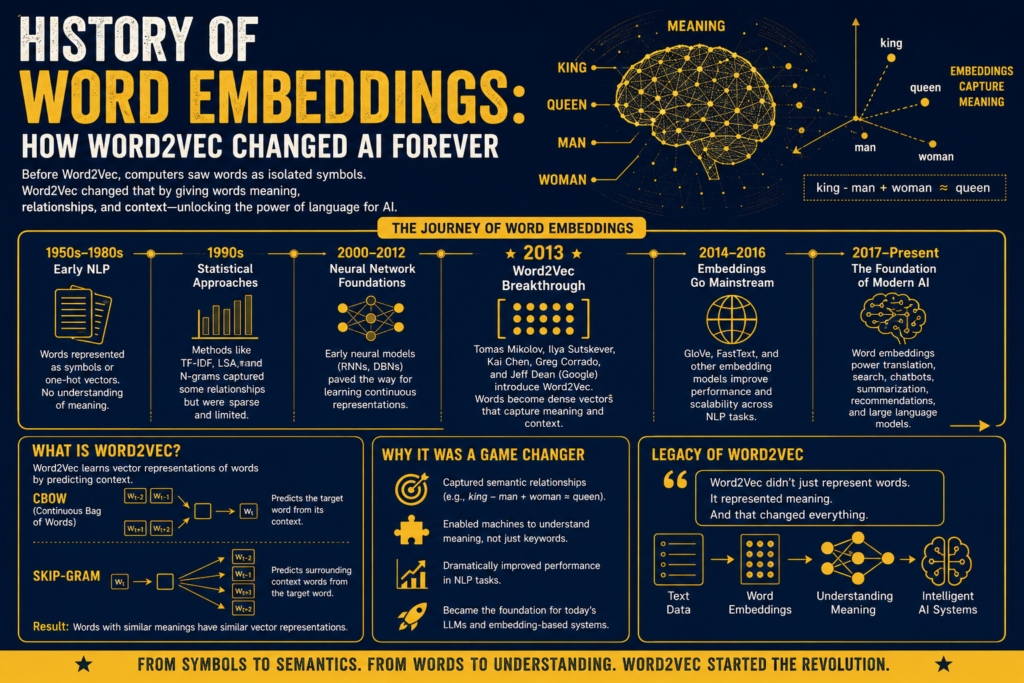
If there is one moment that defines the history of word embeddings, it is 2013 and the publication of Word2Vec by Tomas Mikolov and colleagues at Google. Word2Vec was not the first neural word embedding method, but it was by far the most efficient and impactful model ever released up to that point.
Word2Vec came in two architectures: Skip-gram and CBOW, which stands for Continuous Bag of Words. The Skip-gram model trained a neural network to predict the context words surrounding a given word. CBOW did the reverse, predicting a word from its surrounding context. Both methods produced dense vector representations that captured remarkable semantic and syntactic relationships.
The results were almost poetic. You could perform vector arithmetic on words: the vector for “king” minus “man” plus “woman” came remarkably close to the vector for “queen.” Words related by analogy clustered together naturally in the vector space. Semantic similarity could be measured cleanly using cosine similarity, a simple mathematical operation.
What is word2vec in plain terms? It is a shallow two-layer neural network trained on massive text data to produce word vectors where geometric relationships reflect real-world semantic relationships. Its simplicity and training speed made it instantly popular across every field dealing with text data.
To understand how these embeddings fit into the bigger picture of modern AI language systems, exploring the **[recurrent neural networks history](https://example.com)** shows exactly how researchers built on Word2Vec’s foundation to create increasingly powerful sequential models.
GloVe: Combining Global and Local Context (2014)
Word2Vec was revolutionary, but it had a limitation worth noting. It learned from local context windows, looking only at the words immediately surrounding each target word. It did not directly use global co-occurrence statistics across the entire training corpus.
In 2014, researchers at Stanford introduced GloVe, which stands for Global Vectors for Word Representation. GloVe combined the efficiency of Word2Vec with the global statistical information from earlier methods like LSA. It built a word-word co-occurrence matrix from the entire training corpus and then trained on that matrix to produce vector representations.
GloVe performed comparably to Word2Vec on most benchmarks and offered some interpretability advantages. Understanding the history of word embeddings through the GloVe era is largely about refinement, about making dense vector representations more stable, more generalizable, and more useful across a wider range of tasks.
FastText and Subword Representations (2016)
One problem with both Word2Vec and GloVe was that they treated each word as a single atomic unit. If a word was not in the training vocabulary, the model had no representation for it at all. This was particularly problematic for languages with rich morphology, where words change form through prefixes and suffixes constantly.
In 2016, Facebook AI Research introduced FastText, which addressed this by representing words as bags of character n-grams. Instead of learning a single vector for “running” as a whole word, FastText learned vectors for its character substrings and then combined them. This allowed FastText to handle rare and unseen words by building their representations from familiar character sequences it had already learned.
FastText was especially powerful for languages like German, Finnish, and Turkish, where word forms vary enormously. It was also more robust to typos and informal text, a practical advantage for real-world applications.
ELMo: Context Finally Enters Embeddings (2018)
Word2Vec, GloVe, and FastText all shared one fundamental limitation in the history of word embeddings. They produced a single static vector for each word, completely regardless of context. But words are deeply contextual. The word “bank” in “river bank” means something entirely different from “bank” in “bank account.” A static vector simply could not capture this crucial difference.
In 2018, researchers at the Allen Institute introduced ELMo, Embeddings from Language Models. ELMo was a breakthrough in contextualized embeddings. Rather than assigning each word a fixed vector, ELMo generated different representations for each word based on the full sentence it appeared in. The word “bank” would get one vector in a finance context and a completely different one near water.
ELMo used deep bidirectional LSTM networks trained on a language modelling objective. This was a genuinely major leap forward in the history of word embeddings and set the stage for the transformer revolution that followed almost immediately afterward.
BERT and the Transformer Revolution (2018 – 2019)
The biggest shift in the entire history of word embeddings came when the transformer architecture replaced recurrent networks. In 2018, Google released BERT, Bidirectional Encoder Representations from Transformers. BERT produced deeply contextual embeddings by processing entire sequences in parallel using self-attention rather than sequentially through LSTMs.
BERT was pre-trained on masked language modelling and next sentence prediction. These tasks forced BERT to develop rich, contextual representations of every word in relation to its full surrounding context simultaneously. The embeddings BERT produced were dramatically more powerful than anything that came before them.
The what is bert model question is best answered this way: BERT is a transformer-based model that reads text in both directions at once, producing a contextual embedding for every word that reflects its full meaning in that specific sentence. It became the gold standard for virtually every NLP task almost overnight.
Alongside BERT, understanding how these models connect to each other is captured well in the bert vs gpt vs t5 comparison, which shows the different design philosophies that emerged from the same transformer foundation.
From Embeddings to Large Language Models
The history of word embeddings does not end with BERT. It transforms into the story of large language models, where embeddings are not just inputs but are generated and refined throughout every single layer of the transformer. Modern LLMs like GPT-4 and Claude produce contextual representations at every layer, creating what researchers call a latent space of meaning that is extraordinarily rich and dense.
The pre-training and fine-tuning approach that BERT pioneered became the template for every major language model that followed. Pre-training on massive text corpora gives models their broad language understanding. Fine-tuning adapts that understanding to specific tasks with far less data.
Today, the best embeddings capture not just word meaning but sentence meaning, paragraph meaning, and even the tone and style of entire documents. Sentence transformers and universal sentence encoders extend the core ideas pioneered in the history of word embeddings into dimensions the original 2013 Word2Vec paper could barely have imagined.
If you want to see what tools are built on top of all these advances today, exploring the future of large language models gives a compelling picture of where embedding technology and language AI are heading next.
Why the History of Word Embeddings Still Matters Today
Understanding the history of word embeddings is not just an academic exercise for researchers. It explains why modern AI systems are so powerful and where their real weaknesses come from. Embeddings are why AI can understand that two questions mean the same thing even when they use completely different words. They are why search engines find relevant results even when your query does not exactly match any document in the index.
They also explain some important AI limitations. Embeddings trained on biased text data will encode those biases directly into the vector space, making AI systems prone to unfair or inaccurate outputs in ways that are difficult to detect and fix. Understanding where embeddings come from is essential to building better and fairer AI systems.
If you want to put this knowledge to practical use right away, checking out the best free ai tools 2026 shows you exactly which modern tools are powered by the embedding technology this history created, and how accessible they have become for everyday users.
The history of wordembeddings is ultimately the history of teaching machines to understand meaning, and that project is still very much ongoing.
Frequently Asked Questions (FAQs)
What is the history of word embeddings in simple terms?
It is the story of how researchers developed ways to represent word meaning as mathematical vectors, starting from simple one-hot encoding and evolving through Word2Vec, GloVe, ELMo, and BERT into the rich contextual representations powering AI today.
Why was Word2Vec such a big deal in the history of word embeddings?
Word2Vec was fast, scalable, and produced vectors that captured real semantic relationships through simple arithmetic. It made dense word representations practical for large-scale applications for the very first time.
What is the difference between static and contextual embeddings?
Static embeddings like Word2Vec give each word a single fixed vector regardless of usage. Contextual embeddings like ELMo and BERT produce different vectors for the same word depending on the sentence it appears in.
How do word embeddings relate to modern LLMs?
Word embeddings are the foundation on which LLMs are built. Modern language models use transformer-based contextual embeddings throughout every layer to represent meaning at every single stage of processing.
Are word embeddings still used today?
Yes. While modern LLMs generate their own rich internal representations, traditional embeddings like GloVe and FastText are still widely used in lower-resource settings and for tasks where speed and simplicity matter more than maximum accuracy.
Conclusion
The history of word embeddings is a journey from raw symbols to rich meaning, from ones and zeros to vectors that can almost think. Starting with the Distributional Hypothesis and moving through LSA, Word2Vec, GloVe, FastText, ELMo, and BERT, every step made AI a little more capable of understanding the thing that makes us human: language. The ideas born in this history now power every chatbot, search engine, and AI writing tool on the planet. And the story is still being written, one embedding at a time.