Introduction
The debate around chatgpt vs google search is not just a technology comparison. It is a genuine turning point in how humanity accesses information. For more than two decades, Google Search was so dominant that its name became a verb. When people wanted to know something, they Googled it. Then in November 2022, ChatGPT arrived and asked a quiet but disruptive question: what if instead of returning a list of links, an AI simply answered your question directly?
The chatgpt vs google search conversation quickly moved from tech blogs into boardrooms, classrooms, and government offices. Google declared an internal code red. Billions of dollars shifted in the stock market. Educators debated whether students would ever learn to read sources again. And ordinary users around the world found themselves comparing two profoundly different ways of interacting with information online.
This article explores the chatgpt vs google search rivalry in depth, covering how each system works, where each excels, where each falls short, and what the competition between them means for the future of search, knowledge, and the internet itself.
How Google Search Works: The Crawl, Index, and Rank Model (1998 – 2022)
To understand chatgpt vs google search properly, you need to understand what Google Search actually is under the hood. Google is not a database of answers. It is a system for finding, organizing, and ranking existing pages on the web. The process relies on three core functions: web crawling infrastructure that continuously discovers new and updated pages across the internet, indexing that stores and organizes the content of those pages in a massive searchable database, and ranking algorithms that determine which pages are most relevant and authoritative for any given query.
When you type a question into Google, you are not asking Google to generate an answer. You are asking Google to find web pages that already contain information relevant to your question and to rank them in order of likely usefulness. The search engine results page you see is a curated list of links to content that already exists, written by humans, published on websites, and crawled by Google’s bots.
This model has extraordinary strengths. It is transparent in the sense that you can click through to the original source and evaluate its credibility yourself. It is comprehensive because Google has indexed hundreds of billions of web pages. It is fast, typically returning results in under a second. And it is continuously updated as new content is published and crawled. Knowledge graph integration, which allows Google to display structured factual summaries directly on the results page for certain queries, has added a layer of direct answering on top of the link-based model.
The limitations of this model are equally real. It requires users to do their own synthesis, clicking through multiple links, evaluating sources, and assembling answers from fragments. Zero-click searches, where Google attempts to answer the query directly with a featured snippet, help with simple factual questions but struggle with complex, nuanced, or multi-part queries. And the search engine results page has become increasingly cluttered with advertisements, SEO-optimized content designed to rank rather than inform, and low-quality pages that game algorithmic indexing systems.
How ChatGPT Works: Generation Instead of Retrieval
The chatgpt vs google search comparison becomes immediately interesting when you understand that ChatGPT operates on a fundamentally different principle. ChatGPT does not retrieve existing web pages. It generates responses from scratch using a large language model that has absorbed patterns from massive amounts of text during pre-training. When you ask ChatGPT a question, it is not searching a database. It is generating a response token by token, drawing on the knowledge encoded in its billions of parameters during training.
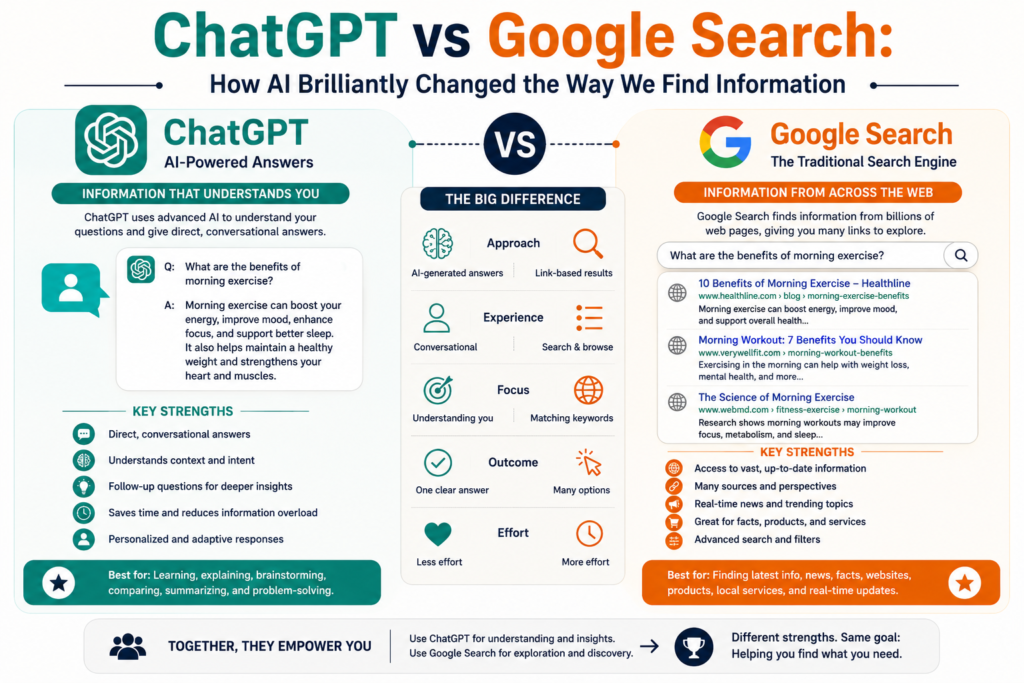
This is the core of the chatgpt vs google search distinction: information retrieval versus text generation. Google retrieves. ChatGPT generates. That difference has profound implications for what each system does well and where each one fails.
The chatgpt history shows how ChatGPT was built on GPT-3.5 and later GPT-4, using reinforcement learning from human feedback to align responses with what users actually find helpful. The result is a system that can engage in conversational information retrieval, understanding the context of a conversation, answering follow-up questions, and synthesizing complex answers in natural language without requiring the user to click through multiple sources.
For questions that require synthesis, explanation, or step-by-step reasoning, ChatGPT’s generative approach often produces dramatically more useful responses than a list of links. Ask ChatGPT to explain quantum entanglement to a twelve-year-old, or to compare three programming frameworks, or to write a cover letter for a specific job, and the conversational AI approach has clear advantages. No amount of clever search engine optimization produces an interface that can engage with that kind of nuanced, context-specific request.
The Critical Difference: Real-Time Data and Source Transparency
One of the most important dimensions of chatgpt vs google search is the question of real-time data access. Google Search is continuously updated as its web crawling infrastructure discovers new content. If a major news story breaks this morning, Google will typically surface relevant articles within hours. This makes Google genuinely useful for current events, breaking news, stock prices, sports scores, and any other information that changes rapidly.
ChatGPT, in its base form, has a training data cutoff. The model’s knowledge is frozen at the point its training data was collected. If you ask about events that happened after the cutoff, ChatGPT either does not know or, more dangerously, may generate a plausible-sounding response based on patterns from before the cutoff that does not accurately reflect current reality. OpenAI has addressed this limitation by building web search capabilities into ChatGPT for paid subscribers, allowing the model to retrieve current information before generating responses. But in its core design, ChatGPT is not a real-time information system.
Source citation transparency is another significant point of difference in the chatgpt vs google search debate. When Google returns results, it shows you where the information comes from. You can evaluate the credibility of each source, check publication dates, and make informed judgments about reliability. ChatGPT, by contrast, generates responses without always clearly attributing specific claims to specific sources. The model synthesizes information from its training data and presents it as a unified response. This makes it harder to fact-check, harder to verify, and easier to accept incorrect information that sounds authoritative because it is presented as confident prose rather than a link you would naturally approach with some skepticism.
This connects directly to the ai hallucination history problem. ChatGPT and other large language models can generate factually incorrect information with the same confident tone they use when generating correct information. In chatgpt vs google search, hallucination is one of ChatGPT’s most significant weaknesses. Google, because it is surfacing existing documents rather than generating new text, does not hallucinate in the same way, though it can certainly surface inaccurate content that already exists on the web.
Google Fights Back: Bard, Gemini, and AI Overviews (2023 – 2024)
The chatgpt vs google search rivalry did not leave Google passive. The google bard gemini history shows how Google responded to ChatGPT’s launch with urgency and ambition. Google announced Bard in February 2023, built on its LaMDA language model, and positioned it as a conversational AI capable of supplementing Search with generative answers. The launch was bumpy, with a widely circulated demonstration error that temporarily wiped billions of dollars from Alphabet’s market value overnight.
Google subsequently replaced Bard with Gemini, a more capable multimodal model, and began integrating AI-generated answers directly into Search through a feature called AI Overviews. This move represented Google’s attempt to close the gap in the chatgpt vs google search debate by bringing conversational AI generation directly into the search experience while retaining the link-based model underneath.
The integration of AI Overviews into Google Search raised new questions and new controversies. Users and publishers noted that AI-generated summaries at the top of search results reduced traffic to the underlying websites, threatening the content ecosystem that Google’s search index depends on. There were also high-profile errors in AI Overview outputs, with the feature generating factually incorrect or absurd answers that spread rapidly on social media. The chatgpt vs google search dynamic had, paradoxically, pushed Google toward adopting some of ChatGPT’s strengths while also importing some of its weaknesses.
Accuracy, Trust, and the Fact-Checking Problem
In the chatgpt vs google search accuracy comparison, the picture is nuanced and depends heavily on the type of query. For straightforward factual questions with clear answers, Google’s model of surfacing authoritative sources tends to be more reliable because the answer is grounded in a specific document you can inspect. For complex, synthesized, or nuanced questions, ChatGPT’s ability to integrate information and explain reasoning can produce more useful responses, provided the underlying information in its training data is accurate.
Fact-checking mechanisms differ fundamentally between the two approaches. With Google, the user bears primary responsibility for evaluating source quality. Semantic search technology has improved Google’s ability to understand the meaning behind queries rather than just matching keywords, making it better at surfacing genuinely relevant content. But the user still needs to click, read, and judge.
With ChatGPT, the model bears more of the synthesis burden but does so without always making its reasoning or sources visible. This shifts trust in ways that can be problematic. Studies have found that people tend to rate AI-generated text as more credible than equivalent human-written text, even when the AI text contains errors. The confidence and fluency of ChatGPT’s outputs can make it harder to maintain healthy skepticism compared to encountering a list of links where source evaluation is more naturally prompted.
The user intent understanding in chatgpt vs google search also differs significantly. Google is highly optimized for navigational and informational queries where the user wants to find a specific page or a quick fact. ChatGPT is better optimized for exploratory, conversational, and generative tasks where the user wants help thinking through something rather than simply finding an existing answer. These different strengths mean the two systems are often better understood as complementary than as direct substitutes, despite their competitive positioning.
The Business Model Collision and What It Means for the Web
The chatgpt vs google search rivalry is not just about user experience. It is a collision of two fundamentally different business models with enormous implications for how the internet functions.
Google’s business is built on advertising. The search engine results page is the most valuable piece of real estate in digital advertising, and Google’s dominance in search has made it one of the most profitable companies in human history. Every time a user performs a search and clicks an ad, Google generates revenue. Every time a user gets an answer from ChatGPT without visiting a website, that revenue model is potentially disrupted.
This dynamic creates a genuine tension in the chatgpt vs google search competition. If conversational AI reduces the number of searches people perform on Google, or reduces the click-through rates that make search advertising valuable, the economic model that funds much of the open web is threatened. Publishers who create the content that both Google indexes and ChatGPT trains on face a paradox: the AI systems that consume their content may also divert the traffic that makes producing that content economically viable.
For deeper context on how these developments fit into the broader trajectory of AI and information technology, the llm timeline traces the full arc from early language models to the current generation of systems reshaping how people find and use information.
Who Wins the chatgpt vs google search Debate?
Chatgpt vs google search does not have a simple winner because the two systems are genuinely better at different things. If you want to know what happened in the news today, who won last night’s game, or what the current price of a stock is, Google Search is the right tool. If you want to understand a complex concept, write a draft of something, brainstorm ideas, or get a synthesized explanation of a nuanced topic, ChatGPT is often more useful.
The future of AI in search will likely see continued convergence, with search engines incorporating more generative AI and AI assistants gaining better access to real-time information. The most capable future information retrieval systems may combine the best of both approaches: the currency and source transparency of algorithmic indexing with the synthesis and conversational capability of generative AI.
The openai history and the history of Google both show organizations that are remarkably good at adapting to competitive pressure. Neither will cede this space without a serious fight, and the competition between them will almost certainly produce better tools for users than either would have developed alone.
Frequently Asked Questions (FAQs)
What is the main difference between ChatGPT and Google Search?
Google Search retrieves existing web pages and ranks them by relevance, while ChatGPT generates new text responses from patterns learned during training. Google shows you where information comes from. ChatGPT synthesizes a response without always clearly citing sources. Google is better for current events and source verification. ChatGPT is better for explanation, synthesis, and conversational interaction.
Can ChatGPT access real-time information like Google?
In its base form, ChatGPT has a training data cutoff and cannot access information about events after that date. However, OpenAI has added web search functionality to ChatGPT for paid subscribers, allowing the model to retrieve current information before generating responses. Google Search, by contrast, is continuously updated and is inherently designed for real-time information retrieval.
Is ChatGPT more accurate than Google Search?
Accuracy depends on the type of query. Google is generally more reliable for factual questions because it surfaces authoritative sources you can verify directly. ChatGPT can be more useful for synthesized or complex answers, but it is prone to hallucination, generating confident but incorrect responses. Neither system is always accurate, and both require critical evaluation by the user.
Will ChatGPT replace Google Search?
Most experts believe ChatGPT will not fully replace Google Search but will change how people use it and push Google to evolve significantly. The two systems serve different user needs, and the competition between them is driving rapid innovation on both sides. Google is integrating generative AI into its search products, while ChatGPT is gaining real-time information access. The future of search will likely borrow from both approaches.
How does ChatGPT affect website traffic and the broader web?
ChatGPT and AI-generated answers can reduce the number of clicks that reach individual websites, particularly for informational queries where the AI’s synthesized answer removes the need to visit a source. This threatens the content ecosystem that both Google’s index and AI training datasets depend on. Publishers, journalists, and content creators are grappling with how to sustain content production in an environment where AI systems may provide answers without directing traffic to the original sources.
Conclusion
The chatgpt vs google search rivalry has already changed the internet in ways that are still unfolding. It has pushed Google to integrate AI faster than it planned. It has given hundreds of millions of people a new way to interact with information. It has raised urgent questions about accuracy, source transparency, hallucination, and the economics of the open web. And it has made clear that the way people find information online is in the middle of its most significant transformation since Google itself arrived in 1998.
Neither chatgpt vs google search produces a clear and permanent winner. What the competition produces is something more valuable: rapid innovation, new user capabilities, and a genuine rethinking of what it means to search for knowledge in an age of generative AI. The outcome of this rivalry will shape how billions of people learn, decide, and understand the world for decades to come.