Introduction
The grok ai history is one of the most unconventional stories in the modern artificial intelligence industry. It begins with the world’s most unpredictable technology entrepreneur, runs through a public feud with the organization he helped found, and arrives at a family of AI models that have carved out a genuinely distinctive niche in the increasingly crowded consumer AI chatbot ecosystem. Grok is not just another ChatGPT competitor. It is a product built from a specific ideological position about what AI should be, how it should behave, and what its relationship to truth and free expression ought to look like.
Understanding the grok ai history means understanding Elon Musk’s complicated relationship with OpenAI, the founding of xAI as an independent research venture, the technical choices the team made in developing successive model generations, and the ways in which real-time access to X data gave Grok a capability that no other major AI assistant could match. The grok ai history is a story about rivalry, ideology, engineering ambition, and the question of what happens when one of the most powerful figures in technology decides the AI systems others are building are not good enough.
The Falling Out: From OpenAI Co-Founder to Rival (2015 – 2023)
The grok ai history begins with a departure. Elon Musk was one of the co-founders of OpenAI in December 2015, contributing significant early funding and bringing enormous public visibility to the organization’s mission. His involvement was framed as a commitment to ensuring that artificial general intelligence would be developed safely and for the benefit of humanity rather than for the profit of any single company.
The openai history records Musk’s departure from OpenAI’s board in 2018, officially attributed to potential conflicts of interest with Tesla’s AI development work. But the relationship between Musk and OpenAI continued to deteriorate publicly in subsequent years. When OpenAI created its capped-profit subsidiary in 2019 and accepted billions in Microsoft investment, Musk became one of the organization’s most vocal critics, arguing that it had abandoned its original nonprofit mission and become exactly the kind of closed, commercially driven AI company it had been founded to counterbalance.
Musk’s criticism of OpenAI intensified after ChatGPT’s release, where he took issue not just with the commercial structure but with what he described as the political and ideological biases in the model’s outputs. He coined the term TruthGPT as the concept for what he believed AI should be: a model committed to maximum truth-seeking rather than to the kind of careful, politically calibrated responses that he argued characterized ChatGPT and similar systems. This TruthGPT original concept became the philosophical foundation on which the grok ai history would be built.
In 2023, Musk filed a lawsuit against OpenAI and its leadership, alleging that the organization had breached its founding mission and its contractual obligations to him as an early donor. The lawsuit added legal dimension to what had been a public feud and made clear that Musk’s criticism of OpenAI was not rhetorical posturing but a genuine strategic rivalry with a new organization he was building as a direct alternative.
The Founding of xAI: An Independent Research Venture (July 2023)
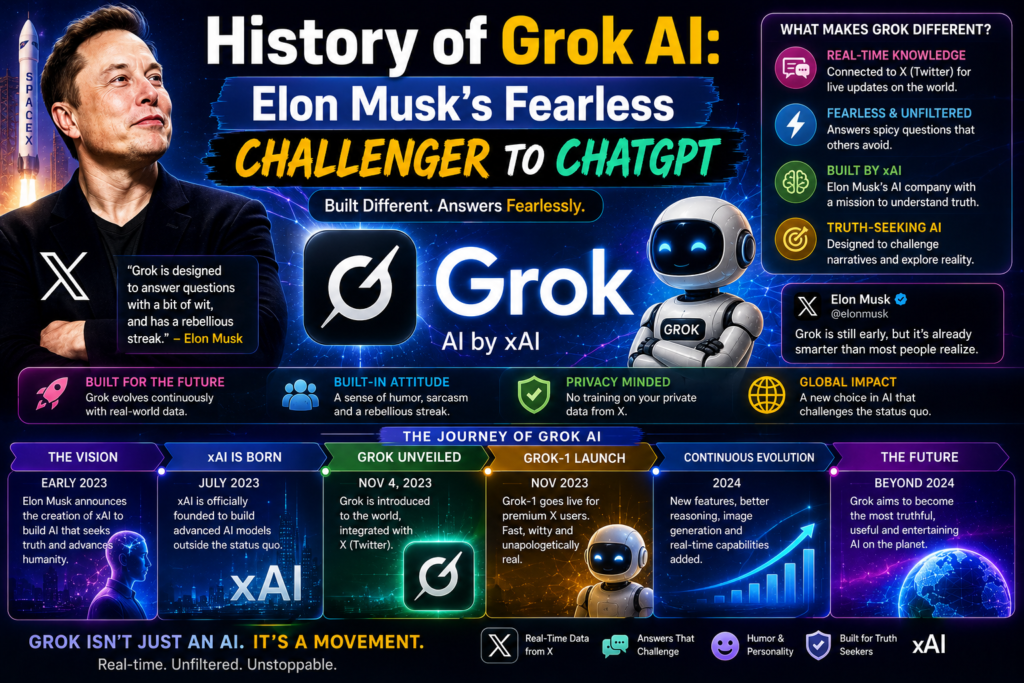
The grok ai history took its decisive step forward in July 2023 when Musk officially announced the founding of xAI, a new AI research company explicitly positioned as an independent research venture competing with OpenAI, Google, and Anthropic. The founding team included researchers who had previously worked at DeepMind, OpenAI, Google Brain, and other leading AI laboratories, with Musk serving as the chief executive and providing the primary financial backing.
The xAI founding by Elon Musk was announced with a stated mission to understand the true nature of the universe, a characteristically grand framing that reflected Musk’s tendency to position his ventures within the largest possible conceptual frameworks. More practically, xAI was founded to develop AI systems that prioritized intellectual curiosity, a commitment to truthfulness, and a rebellion against political correctness in AI outputs, specifically the kind of careful content moderation and prompt moderation controversy avoidance that characterized the alignment choices of ChatGPT and Claude.
The naming of the AI model Grok came from the science fiction novel Stranger in a Strange Land by Robert Heinlein, where “grok” means to understand something so thoroughly and intuitively that the knower becomes part of what is known. The Stranger in a Strange Land naming choice was a deliberate signal about what Musk wanted Grok to be: not a careful, hedged assistant but a model that engaged fully with ideas, including uncomfortable or controversial ones, in pursuit of genuine understanding.
xAI’s early development was conducted with substantial compute resources. The Memphis supercomputer cluster known as Colossus, which xAI built in collaboration with partners in Memphis, Tennessee, became one of the key infrastructure stories in the grok ai history. The Colossus cluster was assembled with extraordinary speed, with xAI reportedly bringing tens of thousands of Nvidia H100 GPUs online in a matter of months, reflecting both the ambition of the project and Musk’s ability to mobilize resources at a pace that most organizations could not match.
Grok-1: The First Model and the X Integration (November 2023)
The grok ai history reached its first public milestone in November 2023 when xAI launched Grok as a feature for X Premium subscribers. The product was available initially to a limited group through the X Premium subscriber rollout before expanding more broadly. This distribution strategy was immediately distinctive: instead of launching as a standalone product or through a separate application, Grok was embedded directly within X, the social media platform that Musk had acquired in 2022.
This integration gave Grok a capability that no other major consumer AI chatbot ecosystem participant could replicate: real-time access to X data. While ChatGPT and Claude operated from training data with fixed cutoffs, Grok could access the full stream of posts, discussions, and breaking information on X as it happened. For questions about current events, trending topics, breaking news, and public reactions to ongoing developments, Grok had a structural informational advantage over every closed-API competitor.
The personality that xAI gave Grok was deliberately different from the measured, careful tone of ChatGPT and Claude. Grok was designed to be witty, willing to engage with edgy or provocative questions, and explicitly more willing to discuss topics that other AI systems typically declined. This rebellion against political correctness was a core product positioning choice, intended to appeal to users who felt that mainstream AI assistants were overly cautious and ideologically constrained.
The in-context learning performance of Grok-1 was competitive but not immediately at the frontier established by GPT-4 and Claude 3. The model showed strong autoregressive prediction capabilities and demonstrated the distinct personality that xAI had designed into it, but benchmark comparisons with the leading closed models placed it in a competitive second tier rather than at the top of capability rankings. The prompt moderation controversy that surrounded some of Grok’s outputs in early months reflected the genuine tension between Musk’s vision of an uncensored AI and the practical reality that some outputs created problems that required addressing.
Grok-1 Open Source: A Bold Strategic Move (March 2024)
One of the most consequential decisions in the grok ai history came in March 2024 when xAI released the Grok-1 model weights under an Apache 2.0 open-source license. The Grok-1 open source Apache license release made the 314-billion-parameter mixture of experts model freely available for anyone to download, modify, and deploy commercially, following the precedent that Mistral AI had set with its own Apache-licensed releases.
The decision to open-source Grok-1 was striking given that xAI had invested significantly in training it, and it placed xAI explicitly in the open-weights camp alongside Meta and Mistral at a moment when OpenAI and Google were keeping their frontier models closed. The release generated enormous attention in the developer community and was downloaded millions of times in the days following its announcement.
The scale of Grok-1 was notably large for an open-weights model: 314 billion total parameters in a mixture of experts architecture, with approximately 86 billion parameters active for any given token. This made it one of the largest open-source language models ever released at the time, and it demonstrated that xAI was training at a scale that required serious compute infrastructure. The synthetic text generation capabilities of the open-sourced model allowed the developer community to immediately begin experimenting with fine-tuning and adaptation.
Grok 1.5 and Multimodal Expansion (April 2024)
The grok ai history continued its rapid development with the release of Grok 1.5 in April 2024. This version represented a significant upgrade in reasoning capability and introduced multimodal image understanding, allowing Grok to process and reason about images alongside text for the first time. The Grok 1.5 vision and reasoning improvements were visible across a range of benchmarks, with the model showing particularly strong performance on mathematical and spatial reasoning tasks that benefited from the ability to process visual information.
The software engineering benchmarks on which Grok 1.5 was evaluated showed meaningful improvement over Grok-1, with the model demonstrating more reliable code generation and debugging capabilities. High-fidelity prompt engineering techniques applied during development of Grok 1.5 produced a model that was more reliably helpful on technical tasks while maintaining the distinctive personality that xAI had established as Grok’s brand identity.
The multimodal expansion also connected the grok ai history to the broader multimodal ai history trend that was reshaping every major AI product in 2024. The ability to process images became a baseline expectation for competitive AI assistants, and xAI’s implementation in Grok 1.5 put the product on par with GPT-4V and Claude 3’s vision capabilities for a broad range of visual reasoning tasks.
Grok-2 and Grok Build: Coding and Agentic Capabilities (2024)
The grok ai history expanded further in 2024 with the release of Grok-2 and the introduction of Grok Build, a coding agent capability designed to help developers write, debug, and iterate on code more effectively. The Grok Build coding agent represented xAI’s entry into the rapidly growing market for AI-powered software development tools, competing directly with GitHub Copilot, Claude’s coding capabilities, and GPT-4’s use in development workflows.
Grok Build’s approach to agentic coding tasks reflected xAI’s broader philosophy of building AI that engaged directly with problems rather than hedging. The agent could write functional code across multiple programming languages, identify and fix bugs in existing code, and work iteratively on software engineering tasks with a directness that reflected the model’s trained personality. Software engineering benchmarks showed Grok-2 performing competitively with the leading models on standard coding evaluations.
The consumer AI chatbot ecosystem that surrounded Grok through this period was growing with each successive release. X Premium subscribers gained progressively more powerful versions of Grok as their subscription benefit, and xAI was working toward making more capabilities available to a broader user base beyond the premium subscription tier.
Grok-3 and the Memphis Colossus Infrastructure (2025)
The grok ai history entered its most technically ambitious phase with Grok-3, trained on the full Memphis supercomputer cluster that xAI had built in Tennessee. The Colossus cluster, which reached approximately 200,000 Nvidia H100 GPUs at its peak, represented one of the most powerful single training clusters assembled for any AI project, reflecting xAI’s determination to compete at the absolute frontier of compute scale.
Grok-3 showed benchmark performance competitive with the leading frontier models from OpenAI and Anthropic, with particular strength on reasoning, mathematics, and science benchmarks. The model also demonstrated significantly improved multimodal image understanding relative to its predecessors, handling complex visual reasoning tasks with greater accuracy and nuance.
The real-time access to X data that had distinguished Grok from its inception remained a core differentiator for Grok-3. As the information environment of 2025 moved faster than ever, the ability to draw on real-time posts, discussions, and breaking news from one of the world’s largest social media platforms gave Grok a factual currency advantage that training-data-dependent models could not match for time-sensitive queries.
The ai arms race companies dynamic that the grok ai history illustrates is one of the defining features of the current AI era. Every major technology company and well-funded startup is now competing to build frontier models, and the competitive pressure this creates is accelerating capability development faster than any single organization could achieve independently.
The llm timeline places the grok ai history as one of the fastest progressions from zero to frontier capability in the industry, reflecting both the resource advantages that Musk brought to xAI and the technical talent the organization recruited from leading AI laboratories.
The future of AI will be shaped in part by whether xAI’s distinctive positioning, uncensored, witty, real-time, and ideologically differentiated, proves to be a durable competitive advantage or whether the mainstream AI assistant market converges on similar product characteristics regardless of the philosophical starting points of the organizations building them.
The chatgpt history and the grok ai history together represent two of the most watched rivalries in AI, driven as much by the personal relationship between Musk and OpenAI’s leadership as by pure technical competition. That personal dimension has given the grok ai history a dramatic quality that most AI product stories lack.
FAQs
What is Grok AI and who made it?
Grok is an AI assistant developed by xAI, the AI company founded by Elon Musk in July 2023. It is designed to be more direct, witty, and less constrained by content moderation than mainstream AI assistants like ChatGPT and Claude. Grok is integrated into the X platform and is available to X Premium subscribers, with successively more capable versions released through 2024 and 2025.
Why did Elon Musk start xAI after being involved with OpenAI?
Musk co-founded OpenAI in 2015 but departed from its board in 2018. His relationship with OpenAI deteriorated significantly after the organization created its capped-profit subsidiary and accepted major Microsoft investment, which Musk argued betrayed the original nonprofit mission. He became increasingly critical of ChatGPT’s political moderation and alignment choices, and founded xAI in 2023 as an explicitly competing organization building AI according to different philosophical principles.
What makes Grok different from ChatGPT and Claude?
Grok differs from ChatGPT and Claude in several important ways. It is integrated directly into X and has real-time access to posts and discussions on the platform, giving it current information that training-data-limited models lack. Its personality is deliberately more direct and willing to engage with controversial topics. It has been released in open-source form under an Apache license, unlike the closed weights of ChatGPT. And it is backed by xAI’s compute infrastructure at a scale that enables competitive frontier model training.
What is the Colossus supercomputer and why does it matter for Grok?
Colossus is the supercomputer cluster that xAI built in Memphis, Tennessee for training Grok models. At its peak it comprised approximately 200,000 Nvidia H100 GPUs, making it one of the most powerful training clusters ever assembled for an AI project. Grok-3 was trained on this infrastructure, enabling xAI to compete with the compute scale available to OpenAI, Google, and Anthropic in producing frontier-capable models.
Is Grok available outside of X Premium?
Grok has been primarily distributed through X Premium subscriptions since its November 2023 launch, though xAI has progressively expanded access and developed standalone application options. The open-source release of Grok-1 under an Apache license made that model version freely available for anyone to download and deploy independently, though the more capable Grok-2 and Grok-3 models remain available through X and xAI’s API.
Conclusion
The grok ai history is unlike any other story in the AI industry because it is driven as much by personality and ideology as by pure technical ambition. Elon Musk’s complicated history with OpenAI, his conviction that mainstream AI was becoming ideologically captured, his access to resources that could fund frontier compute infrastructure, and his willingness to take controversial positions produced an AI product with a genuinely distinctive identity and a genuinely distinctive technical architecture.
Grok ai history has moved from concept to frontier competitor in approximately two years, a pace that reflects the extraordinary resources xAI has been able to deploy. Real-time X data integration, open-source model releases, the Colossus supercomputer cluster, and a personality that deliberately contrasts with the careful tone of mainstream AI assistants have all contributed to giving Grok a position in the AI landscape that is not easily replicated by competitors.
Whether Grok’s distinctive positioning translates into durable market share, whether xAI’s ideological differentiation proves to be a lasting advantage or a niche appeal, and whether the technical trajectory of successive Grok generations can maintain pace with the resources being deployed by Google, OpenAI, and Anthropic are all questions that the continuing grok ai history will answer. What is already clear is that Elon Musk’s entry into AI has made the competitive landscape more dramatic, more unpredictable, and more interesting than it would have been without him.