Introduction
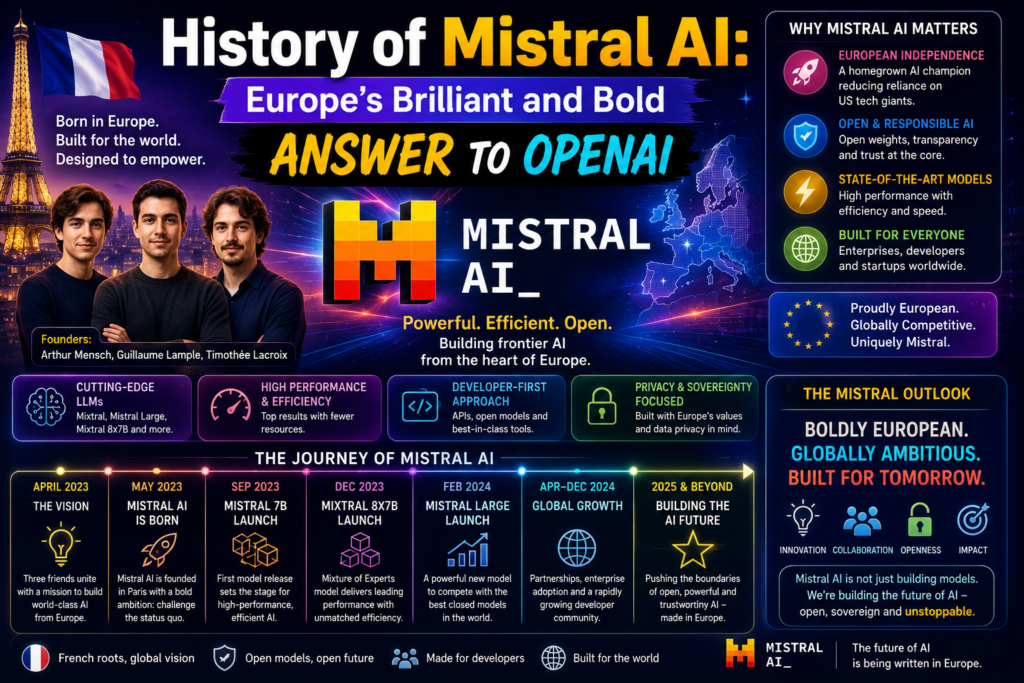
The mistral ai history is the story of a startup that moved faster, thought more boldly, and disrupted more assumptions than almost anyone expected from a company less than two years old. When three researchers founded Mistral AI in Paris in April 2023, the conventional wisdom was that frontier AI was a game only the largest, best-funded American and Chinese organizations could play. Within months, Mistral had released a model that outperformed every other open-source model of its size, raised funding at a valuation that made it Europe’s most valuable AI startup, and established itself as a genuine alternative to OpenAI for developers and enterprises worldwide.
The mistral ai history is therefore not just the story of impressive benchmark results. It is the story of how a Paris-based AI startup challenged the assumption that you needed billions of dollars and thousands of GPUs to compete at the frontier. It is the story of how European talent, a pragmatic approach to open-source release, and a fierce commitment to efficiency over raw scale produced results that caught the entire AI industry off guard. And it is the story of how Europe found its voice in the global AI race through a company that refused to play by the rules everyone else had accepted.
Understanding the mistral ai history means understanding both the technical achievements and the strategic decisions that shaped every major moment in the company’s rapid ascent.
The Founding Team: Former Meta and DeepMind Researchers (April 2023)
The mistral ai history begins with three researchers who had spent years at the organizations that had defined modern AI research. Arthur Mensch, who became Mistral’s CEO, had worked as a research scientist at DeepMind, where he contributed to work on large-scale language model training. Timothée Lacroix and Guillaume Lample had both been senior researchers at Meta AI, where they had been directly involved in the development of the LLaMA model family.
The decision to leave two of the world’s most prestigious AI research positions to found a startup in Paris was driven by a specific conviction: that the dominant paradigm of massive-scale, closed, proprietary AI development was not the only viable path to frontier capability. The former Meta and DeepMind researchers believed that architectural efficiency, careful engineering, and a commitment to open weight release could produce results competitive with the best closed models at dramatically lower cost.
This founding thesis was informed directly by the work they had done at their previous employers. Lample and Lacroix had seen firsthand through the LLaMA development how much could be achieved with carefully designed models trained on well-curated data using compute-optimal approaches. Mensch’s DeepMind experience had given him exposure to the efficiency-focused research culture that had produced Chinchilla, the influential paper that challenged the AI field to rethink how it balanced model size and training data.
The venture capital seed rounds that followed the founding were extraordinary in their speed and size. Mistral AI raised 105 million euros in a seed round within weeks of its founding, before releasing any product or demonstrating any model publicly. The investment reflected confidence in the founding team’s pedigree rather than any product evidence, and it gave Mistral the resources to move immediately into training serious models without the bootstrap constraints that typically limit early-stage startups.
Mistral 7B: The Release That Proved the Point (September 2023)
The mistral ai history reached its first major public milestone in September 2023 when Mistral released Mistral 7B, a seven-billion-parameter language model available under an Apache license with no use restrictions. The model’s benchmark performance was immediately striking: it outperformed Meta’s LLaMA 2 13B on most evaluations despite having roughly half as many parameters, and it matched or exceeded LLaMA 2 70B on many code-focused benchmarks while using a fraction of the compute required for inference.
The Mistral 7B Apache license was a deliberate and significant choice. The Apache 2.0 license is one of the most permissive open-source licenses available, allowing commercial use, modification, and redistribution with essentially no restrictions. This was more permissive than the LLaMA 2 license that Meta had released, which included restrictions for very large organizations. By releasing under Apache, Mistral made Mistral 7B genuinely free for any use by anyone, a statement about their open-source philosophy that resonated strongly with the developer community.
The technical choices that made Mistral 7B so efficient were specific and deliberate. The model used sliding window attention, a modification of the standard transformer attention mechanism that limited each token’s attention to a local window of preceding tokens rather than the full context, dramatically reducing the memory requirements and computational cost of attention at long sequence lengths. This made Mistral 7B particularly efficient at inference time, enabling deployment on hardware that would struggle with comparable-performance models from other providers.
The compact neural network efficiency that Mistral 7B demonstrated became the defining characteristic of the mistral ai history through its early phase. The message was clear: you did not need to build the largest model to build the best model for a given compute budget. Weight fine-tuning optimization on top of Mistral 7B also proved exceptionally productive, with the community quickly producing instruction-tuned and domain-specific variants that performed remarkably well for their size.
Mixtral 8x7B: The Sparse MoE Breakthrough (December 2023)
The mistral ai history took its most technically ambitious step in December 2023 with the release of Mixtral 8x7B, a sparse Mixture of Experts model that represented a fundamental architectural departure from the dense transformer design of Mistral 7B. Where Mistral 7B processed every token through all of its parameters, Mixtral 8x7B used a Sparse Mixture of Experts, or SMoE, design with eight expert subnetworks and a routing mechanism that selected two experts for each token at each layer.
The Mixtral 8x7B sparse MoE architecture meant the model had approximately 46.7 billion total parameters but only used around 12.9 billion parameters for any given token during inference. This made it roughly as computationally expensive to run as a model with 13 billion active parameters, while having access to the representational capacity of a much larger model through the specialized expert networks. The result was a model that performed comparably to LLaMA 2 70B and GPT-3.5 on many benchmarks while requiring significantly less compute to serve at scale.
The high-margin API revenue implications of this architecture were immediately obvious to the developer community. A model that achieved GPT-3.5-level performance at a fraction of the inference cost could be offered at dramatically lower prices than comparable closed API models, which is exactly what Mistral did when it launched its API platform. The economics of the mistral ai history were shaped in part by this architectural advantage: efficient models that were cheap to serve enabled pricing that undercut American competitors and attracted price-sensitive enterprise customers.
Mistral also released Mixtral 8x7B under an Apache license, continuing its commitment to open-weight, permissive release. The model was immediately downloaded millions of times from Hugging Face and became one of the most widely adopted open-weight models in the community, second only to the LLaMA family in terms of fine-tuning activity and derivative model development.
The fine tuning in ai ecosystem that formed around Mixtral 8x7B was particularly active in multilingual contexts. The model’s multilingual translation capability, which was strong relative to its compute cost, made it popular for European enterprise applications where handling multiple languages within a single deployment was a practical necessity.
Series B Funding and the European AI Champion Narrative (2024)
The mistral ai history in early 2024 was defined by extraordinary financial momentum that reflected how seriously the market had taken the company’s technical achievements. Mistral raised a Series B funding round of 600 million euros in June 2024 at a valuation of approximately six billion euros, making it the most valuable AI startup in Europe and one of the most valuable AI companies in the world behind only OpenAI and Anthropic.
The Series B funding valuation came alongside a strategic partnership announcement that reshaped perceptions of Mistral’s position in the competitive landscape. Mistral announced a partnership with Microsoft, which would make Mistral’s models available on Microsoft Azure as first-party offerings. The Microsoft Azure partnership was both a commercial distribution deal and a strategic validation. For a Paris-based AI startup to secure Microsoft as a distribution partner put it on the same level as OpenAI in terms of cloud market access, and it gave Mistral immediate access to Microsoft’s vast enterprise customer base.
The European sovereign AI champion narrative that had been developing around Mistral AI became more prominent in this period. European governments, business leaders, and technology policy advocates increasingly pointed to Mistral as evidence that Europe could compete at the frontier of AI without simply importing American or Chinese technology. The European AI Act compliance considerations that European enterprises faced when choosing AI vendors created an additional reason to consider Mistral as a preferred partner, since its European headquarters and European regulatory context made compliance conversations more straightforward than with American providers.
The mistral ai history during this period also intersected with active debates in European technology policy about data sovereignty, AI regulation, and the strategic importance of maintaining European capability at the AI frontier. Mistral’s founders actively participated in these debates, advocating for a pragmatic approach to AI regulation that protected citizens without preventing European companies from competing globally.
Le Chat: Taking on ChatGPT Directly (2024)
The mistral ai history took a major product turn in early 2024 with the launch of Le Chat, Mistral’s direct-to-consumer AI assistant. The name, which means “the cat” in French, was characteristically playful for a company that had often taken a more understated approach to its public communications than American competitors. Le Chat was positioned as Mistral’s answer to ChatGPT, offering a conversational interface powered by Mistral’s models with a clean, fast user experience.
The Le Chat assistant launch represented a strategic expansion from Mistral’s original API-first, developer-focused approach into the consumer and enterprise market that ChatGPT and Claude had made mainstream. The product was available in multiple languages, reflecting Mistral’s multilingual translation capability and its European user base that spanned French, German, Spanish, Italian, and other major languages.
Le Chat was offered in both free and paid tiers, with the paid tier providing access to Mistral’s most capable models and priority inference. The hardware-agnostic deployment philosophy that Mistral had applied to its API was reflected in Le Chat’s architecture, which was designed to run efficiently across different infrastructure configurations without being locked into specific cloud providers.
Mistral Large 3 and the Enterprise Push (2024 – 2025)
The mistral ai history through late 2024 and into 2025 was characterized by a consistent pattern of releasing capable models across the full capability spectrum, from compact models suitable for on-device deployment to large frontier models competing directly with GPT-4 and Claude 3.
Mistral Large 3, the most capable tier of the Mistral enterprise model lineup, demonstrated performance on par with the leading models from OpenAI and Anthropic on most standard benchmarks. The model was available through Mistral’s API with context window expansion to 128k tokens, matching the extended context capabilities that had become standard among frontier model providers. For enterprise customers requiring both high capability and the compliance and sovereignty advantages of a European AI provider, Mistral Large 3 enterprise model represented a compelling option.
The context window expansion to 128k tokens addressed one of the practical limitations that had previously made Mistral’s larger models less suitable for certain enterprise use cases involving very long documents, large codebases, or extended conversation histories. With this limitation removed, Mistral could compete across the full range of enterprise AI applications that previously would have required customers to use American providers.
The llm timeline places the mistral ai history as one of the fastest progressions from founding to frontier capability in the history of AI development. In approximately eighteen months from founding to the release of Mistral Large 3, the company went from a founding announcement to a genuine contender at every tier of the AI model market.
Mistral’s Place in the Global AI Landscape
The mistral ai history sits within a broader competitive context that includes the deepseek ai history of aggressive efficiency-focused development from China, the meta llama history of open-weight model release from a major American platform company, and the closed frontier model development from OpenAI, Google, and Anthropic.
Mistral’s position within this landscape is distinctive. It is neither purely open nor purely closed, releasing some models freely while keeping others as commercial API products. It is neither purely research-focused nor purely product-focused, maintaining a genuine research agenda while building commercial products on top of that research. And it is neither purely European in its ambitions nor purely global, serving as a symbol of European AI capability while competing directly in the global market.
The ai arms race companies dynamic that has defined AI development since ChatGPT’s launch has benefited Mistral in important ways. Every escalation in the capability competition creates more market for efficient alternatives at lower price points, which is precisely where Mistral’s architectural advantages are most valuable.
The future of AI will see Mistral continuing to navigate the tension between its open-source identity and its commercial ambitions, between its European roots and its global market, and between its efficiency-first philosophy and the pressure to match the raw capability of frontier models that have been trained with far greater resources.
Frequently Asked Questions (FAQs)
When was Mistral AI founded and who are its founders?
Mistral AI was founded in April 2023 in Paris by Arthur Mensch, Timothée Lacroix, and Guillaume Lample. Arthur Mensch, who serves as CEO, previously worked as a research scientist at DeepMind. Timothée Lacroix and Guillaume Lample were senior researchers at Meta AI, where they were directly involved in developing the LLaMA model family. The company raised 105 million euros in a seed round within weeks of founding.
What made Mistral 7B significant when it was released?
Mistral 7B was released in September 2023 and immediately established itself as the strongest open-source model at the seven-billion-parameter scale. It outperformed Meta’s LLaMA 2 13B on most benchmarks despite having half as many parameters, and matched LLaMA 2 70B on many coding tasks. Released under an Apache 2.0 license with no commercial restrictions, it became one of the most widely adopted models in the open-source AI community.
What is Mixtral 8x7B and what is a Sparse Mixture of Experts model?
Mixtral 8x7B is a language model that uses a Sparse Mixture of Experts architecture, which divides the model into eight specialized subnetworks called experts and routes each token through only two of these experts at each layer during processing. This allows the model to have 46.7 billion total parameters while only using approximately 12.9 billion active parameters per token, achieving GPT-3.5-level performance at dramatically lower inference cost. It was released under an Apache license in December 2023.
What is Le Chat and how does it compare to ChatGPT?
Le Chat is Mistral’s conversational AI assistant, launched in early 2024 as a direct competitor to ChatGPT. The name means “the cat” in French. It offers a free tier and paid tiers with access to Mistral’s most capable models, supports multiple European languages, and is available through both web and mobile interfaces. It differs from ChatGPT primarily in its multilingual focus and its European regulatory context, which makes it attractive to enterprise customers with European data sovereignty requirements.
Is Mistral AI truly open-source?
Mistral AI follows a mixed model approach. Its smaller and mid-sized models, including Mistral 7B and Mixtral 8x7B, have been released under permissive Apache 2.0 licenses that allow commercial use with virtually no restrictions. Its larger, most capable models, like Mistral Large, are available as commercial API products rather than open weights. This hybrid approach allows Mistral to maintain an open-source identity and community while generating the commercial revenue needed to fund ongoing frontier research.
Conclusion
The mistral ai history is a story about what becomes possible when genuinely talented researchers apply an efficiency-first philosophy in an industry that has been competing primarily on spending. From a 105-million-euro seed round before releasing a single model to a six-billion-euro valuation supported by partnerships with Microsoft and a user base spanning dozens of countries, Mistral AI has traveled one of the most extraordinary trajectories in the history of AI startups.
The mistral ai history has demonstrated that open-source AI and commercial success are not in opposition, that European AI talent can compete at the global frontier, and that architectural innovation can achieve what brute-force scale alone cannot. Every major milestone in the mistral ai history has reinforced these points: Mistral 7B proving that smaller models could outperform larger ones with the right design, Mixtral 8x7B proving that sparse architectures could match dense models at lower cost, and Mistral Large proving that a Paris-based startup could build frontier models genuinely competitive with the best the world has to offer.
The deepest lesson of the mistral ai history may be the simplest: the organizations that win in AI are not necessarily the ones that spend the most, but the ones that think most clearly about what efficiency, openness, and genuine capability require. Mistral has thought clearly, moved fast, and built something extraordinary. The rest of the story is still being written.