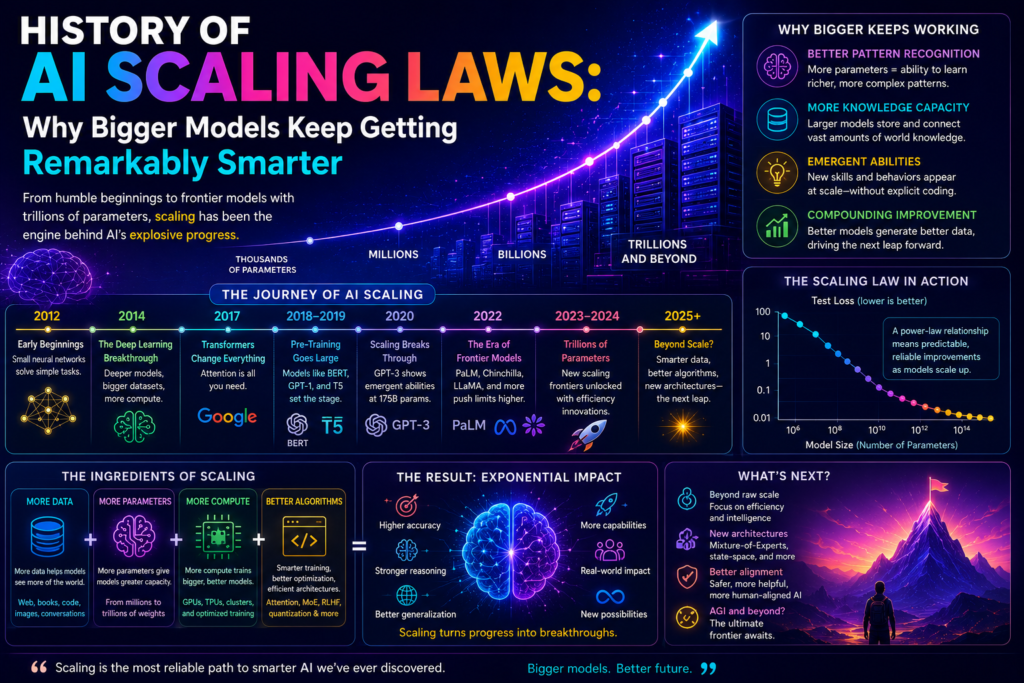
Introduction
The ai scaling laws are among the most consequential empirical discoveries in the history of modern machine learning. They describe something that, once noticed, seems almost too good to be true: the performance of neural networks improves in smooth, predictable, mathematically describable ways as you increase model size, training data, and computational resources. There is no obvious ceiling in sight, no point at which the improvements suddenly stop. You invest more, you get more, with a reliability that has held across many orders of magnitude of scale.
Understanding the ai scaling laws means understanding the single most important empirical fact driving the enormous investment in large language models today. It explains why organizations are spending billions of dollars training models with hundreds of billions of parameters. It explains why the amount of compute used to train frontier AI models has increased by a factor of roughly ten every year. And it explains why the AI industry has restructured itself around the imperative of scale in ways that would have seemed irrational before researchers understood these laws and began to trust them.
The ai scaling laws are not just an academic curiosity. They are the strategic foundation of the most competitive and consequential technology race of our era.
The Early Intuitions: Scale Has Always Mattered (1990 – 2010)
The ai scaling laws did not arrive as a complete theory. They accumulated gradually from observations that practitioners had been making for decades. Researchers in machine learning had long known that bigger training datasets generally produced better models, that deeper networks often outperformed shallower ones when the training data was sufficient, and that more computational power enabled experiments that smaller budgets could not.
But these were intuitions rather than laws. There was no precise quantitative relationship, no formula that would let you predict exactly how much a model would improve if you doubled its size or tripled its training data. The relationship between scale and performance was understood to be positive but not yet understood to be systematic in the way that physical laws are systematic.
The large language models history from this period shows machine learning research proceeding with limited scale as both a constraint and an assumed ceiling. Researchers built models that were as large as their hardware could support and assumed that there were diminishing returns somewhere just above the sizes they could train. This assumption turned out to be wrong in ways that the empirical discovery of ai scaling laws would make clear.
Neural network performance on benchmark tasks improved with dataset size and model size throughout the 2000s, but the improvements were often inconsistent and hard to predict. Some architectures scaled better than others. Some tasks showed clear gains from larger models while others seemed to plateau. Without a unified theoretical framework, researchers could not reliably extrapolate from what worked at small scale to what would work at large scale.
The Deep Learning Revolution and the First Scaling Signals (2012 – 2017)
The deep learning revolution that began with AlexNet in 2012 produced the first clear signals that scale in neural networks was doing something systematic. AlexNet was larger and deeper than previous convolutional networks, and its dramatic performance improvement on ImageNet demonstrated that the relationship between model capacity and task performance was steeper than the field had assumed.
Over the following years, researchers observed consistently that deeper and wider networks performed better, that more training data produced better generalization, and that models that had seemed too large to train efficiently became tractable as GPU hardware improved. The pattern was accumulating even before anyone had articulated it as a formal law.
The transformer architecture history from 2017 was itself a product of these scaling signals. Researchers at Google who designed the transformer were motivated in part by the observation that the self-attention mechanism would scale more efficiently on GPU hardware than recurrent architectures, because it could be parallelized across the full sequence length. This made it practical to train larger models on more data, which was expected to produce better results based on the accumulated evidence.
The language model scaling that began with GPT-1 in 2018 was the first sustained attempt to systematically push the boundaries of model size in natural language processing. GPT-1 had 117 million parameters. GPT-2 in 2019 had 1.5 billion. These experiments were not yet guided by formal ai scaling laws, but they were motivated by the intuition that larger models trained on more data would perform better.
The OpenAI Scaling Laws Paper: Making It Rigorous (2020)
The ai scaling laws became a formalized empirical science in January 2020 when Jared Kaplan, Sam McCandlish, and colleagues at OpenAI published “Scaling Laws for Neural Language Models.” This paper was not a theoretical derivation but an empirical study of massive scope, systematically varying model size, dataset size, and compute budget across many orders of magnitude and carefully measuring how performance changed with each factor.
The key findings were extraordinary in their clarity and their implications. The paper found that model performance, measured as loss on a held-out test set, followed precise power laws with respect to each of the three scaling factors. Double the number of model parameters, and loss improves by a predictable amount. Double the size of the training dataset, and loss improves by a predictable amount. Double the compute budget while optimizing the allocation between model size and training length, and loss improves by a predictable amount.
These were not approximate relationships or trends that held loosely under certain conditions. They were tight power law relationships that held consistently across five or more orders of magnitude of scale, from tiny models with thousands of parameters to models with billions of parameters. The ai scaling laws, as articulated in this paper, had the feel of physical constants: reliable, quantitative, and apparently fundamental.
The model size scaling and compute scaling AI relationships described in the paper gave practitioners something they had never had before: a reliable roadmap for what investments would produce what results. If you wanted a model that was twenty percent better, you could calculate approximately how many more parameters, how much more data, and how much more training compute that would require. The uncertainty about whether scale was worth pursuing was replaced by quantitative confidence in the rate of return.
Chinchilla: Revising the Laws for Optimal Training (2022)
The ai scaling laws story took an important new turn in 2022 when researchers at DeepMind published the Chinchilla paper, formally titled “Training Compute-Optimal Large Language Models.” This paper argued that the original OpenAI scaling laws had led the field to train models that were systematically too large relative to the amount of data they were trained on.
The original laws had suggested that as compute budgets grew, the optimal strategy was to spend most of the budget on making the model larger. Chinchilla challenged this by studying the joint optimization of model size and training tokens simultaneously. The result was striking: for a given compute budget, training a smaller model on significantly more data often produced better final performance than training a larger model on less data.
The Chinchilla model, with roughly 70 billion parameters trained on 1.4 trillion tokens, matched or exceeded the performance of GPT-3 at 175 billion parameters despite being much smaller, precisely because it had been trained on roughly four times as much data. This demonstrated that training datasets and model parameter scaling needed to be considered jointly rather than independently, and that the field had been leaving significant performance on the table by undertraining large models.
The Chinchilla findings reshaped how researchers approached large model training. LLaMA from Meta was explicitly designed around Chinchilla-optimal training recipes, training smaller models for longer on more carefully curated data. The ai scaling laws had been refined from their original form into a more complete picture of how to allocate a given compute budget optimally across model size and training data volume.
What Scaling Laws Mean Strategically: The Trillion-Dollar Implication
The strategic implications of the ai scaling laws cannot be overstated. Once researchers trusted that performance would improve predictably with scale, the question became entirely about resource allocation rather than about whether scale was worth pursuing. Organizations that could invest more would get more capable models. The technology race became a race for compute infrastructure scaling, for training datasets, and for the engineering expertise to train and serve models at extreme scale.
This logic explains the enormous capital investment that has flowed into AI since GPT-3 demonstrated the ai scaling laws in their most visible and publicly compelling form. GPT-3’s capabilities emerged not from a fundamentally new algorithm or architectural breakthrough but from applying known techniques at a scale that had not been attempted before. The message was clear: scale works, and organizations that could scale would win.
The gpt-3 history shows how this realization landed in the broader technology industry. GPT-3 was not just impressive for what it could do. It was impressive as a proof of concept for the ai scaling laws applied at scale. Every major technology company that observed GPT-3’s capabilities understood the same thing simultaneously: this was what you got when you invested enough compute, and more investment would produce more capability. The AI arms race that followed was a direct consequence.
The openai history from this period shows an organization restructuring itself around the imperative of scale, raising billions of dollars in new funding, building dedicated training infrastructure, and partnering with Microsoft specifically to access the cloud compute resources that frontier training required.
The Compute Frontier: Training Infrastructure at Extreme Scale
The ai scaling laws have driven a remarkable transformation in AI training infrastructure. When the original scaling laws paper was published in 2020, the largest models being trained had hundreds of billions of parameters. By 2023, trillion-parameter model training was being seriously attempted. By 2024, training clusters with tens of thousands of specialized AI accelerators were considered standard for frontier model development.
The algorithm performance improvements enabled by scale have been accompanied by, and in some ways enabled by, hardware developments that have kept pace with demand. Nvidia’s GPU roadmap has delivered roughly ten times the AI training throughput every two to three years across successive generations, and Google’s Tensor Processing Units have provided competitive alternatives optimized for the specific computational patterns of transformer training.
The training infrastructure required to take advantage of the ai scaling laws has itself become a major area of engineering innovation. Distributed training across thousands of accelerators requires sophisticated parallelism strategies, custom interconnect hardware, and careful software engineering to avoid communication bottlenecks that would waste the theoretical compute capacity of the hardware. Model optimization techniques including mixed precision training, gradient checkpointing, and flash attention have each contributed to making large model training more efficient within fixed hardware budgets.
Machine learning research into the ai scaling laws has also explored whether the laws hold for different architectural choices and different task types. The evidence so far suggests that the power law relationships are remarkably robust across different transformer variants, different data types including text, images, audio, and code, and different training objectives. This robustness has reinforced confidence in the laws as fundamental properties of neural network training rather than artifacts of specific architectural choices.
Emergent Capabilities: What Scaling Laws Cannot Fully Predict
One of the most fascinating and consequential aspects of the ai scaling laws is the phenomenon of emergent capabilities: capabilities that appear suddenly as models cross certain scale thresholds, that were not present in smaller models and that could not be easily predicted from extrapolating the smooth performance curves.
GPT-3’s few-shot learning capability was one of the first widely noticed examples of emergence. Smaller models showed limited ability to learn from in-context examples. As model size crossed certain thresholds, this capability appeared dramatically. Similar patterns have been observed for chain-of-thought reasoning, arithmetic, and various commonsense inference tasks.
The emergence phenomenon complicates the simple picture painted by the ai scaling laws. The laws describe smooth, predictable improvement in aggregate loss metrics. But the practical capabilities that matter to users can appear discontinuously, with sudden capability jumps that are not obvious from the smooth loss curves. This makes it difficult to fully predict what a model trained at a given scale will be able to do, even when the loss at that scale is precisely predictable.
This uncertainty about emergence has fueled both excitement and concern about continued scaling. On one hand, unknown capabilities emerging at larger scales may produce genuinely beneficial AI advances that cannot be anticipated. On the other hand, the unpredictability of what new capabilities will emerge makes it harder to anticipate and prepare for potential risks.
AI Scaling Laws and the Future of Foundation Models
AI scaling laws continue to be studied intensively as the field pushes toward ever larger scales and explores whether the smooth power law relationships that have characterized training from small to large models will continue to hold as the most ambitious training runs approach limits of available data and compute.
Questions about data scaling deserve particular attention. The smooth relationships between training data volume and model performance assume an effectively unlimited supply of high-quality training data. As models have been trained on larger and larger fractions of the available internet text, questions about whether the internet can continue to supply training data at the rate that the ai scaling laws seem to demand have become increasingly pressing. Synthetic data generation, using AI to create training data for AI, has emerged as a potential response, though its ultimate scalability remains an open research question.
The pre training in ai article covers the full context of how pre-training scale has driven the development of modern foundation models, showing how the ai scaling laws have shaped training decisions at every generation of model development.
FAQs
What are AI scaling laws and who discovered them?
AI scaling laws are empirical relationships that describe how the performance of neural language models improves predictably as you increase model size, training data volume, and computational resources. They were formally articulated in a January 2020 paper by Jared Kaplan, Sam McCandlish, and colleagues at OpenAI titled “Scaling Laws for Neural Language Models.” The paper demonstrated that performance follows precise power law relationships with each scaling factor across many orders of magnitude.
Why do larger AI models tend to perform better?
Larger models have more parameters, which means more capacity to represent complex patterns in language. When trained on sufficient data, this additional capacity translates into better language understanding and generation across a wide range of tasks. The ai scaling laws quantify this relationship: doubling model parameters produces a predictable improvement in loss that has held consistently across scales from millions to hundreds of billions of parameters.
What did the Chinchilla paper change about how we understand scaling laws?
The Chinchilla paper, published by DeepMind in 2022, demonstrated that the optimal training strategy for a given compute budget required balancing model size and training data volume more carefully than the original scaling laws had suggested. Specifically, models should be trained on roughly twenty tokens of data per parameter for compute-optimal performance. This led to the realization that many large models had been significantly undertrained on too little data for their size, and shifted the field toward training smaller models on more data.
Do AI scaling laws have any limits?
The precise limits of ai scaling laws are not yet fully understood. The smooth power law relationships have held across many orders of magnitude without obvious plateaus, but there are theoretical reasons to expect limits eventually, particularly from finite data availability. Questions about whether the internet contains enough high-quality text to sustain continued scaling, and whether synthetic data can supplement natural data effectively, are among the most important open questions in scaling law research.
What are emergent capabilities in AI scaling?
Emergent capabilities are abilities that appear in AI models as they cross certain scale thresholds but are not present in smaller models and cannot be easily predicted by extrapolating smooth performance curves. Examples include few-shot learning in GPT-3, chain-of-thought reasoning in larger models, and certain commonsense inference capabilities. Emergent capabilities complicate the simple picture of smooth predictable improvement, suggesting that some practical capabilities arrive discontinuously even when aggregate loss improves smoothly.
Conclusion
The ai scaling laws represent one of the most important empirical discoveries in the history of machine learning. By revealing that neural network performance improves predictably and consistently with scale, they transformed AI from a field of individual algorithm breakthroughs into something closer to a predictable engineering discipline where investment translates reliably into capability improvement.
The ai scaling laws have been refined, challenged, and extended since their original formulation. The Chinchilla paper showed that data and model size must be scaled together. Research into emergent capabilities showed that smooth loss improvements can accompany discontinuous practical capability gains. And ongoing work on the limits of scaling continues to probe whether the smooth power law relationships will hold as the field approaches the frontiers of available data and compute.
But none of this refinement has diminished the central insight: scale works in AI in a way that it does not in most other technological domains. More compute, more data, and more parameters reliably produce more capable models, and this relationship has driven the most consequential technological competition of our era. Every major AI product and every major AI investment of the past five years is built on the foundation that the ai scaling laws provided.
The future of AI will be shaped by how these laws evolve as the field approaches the limits of current approaches, and by what new scaling frontiers researchers discover as they push beyond the regimes where the current laws have been verified.