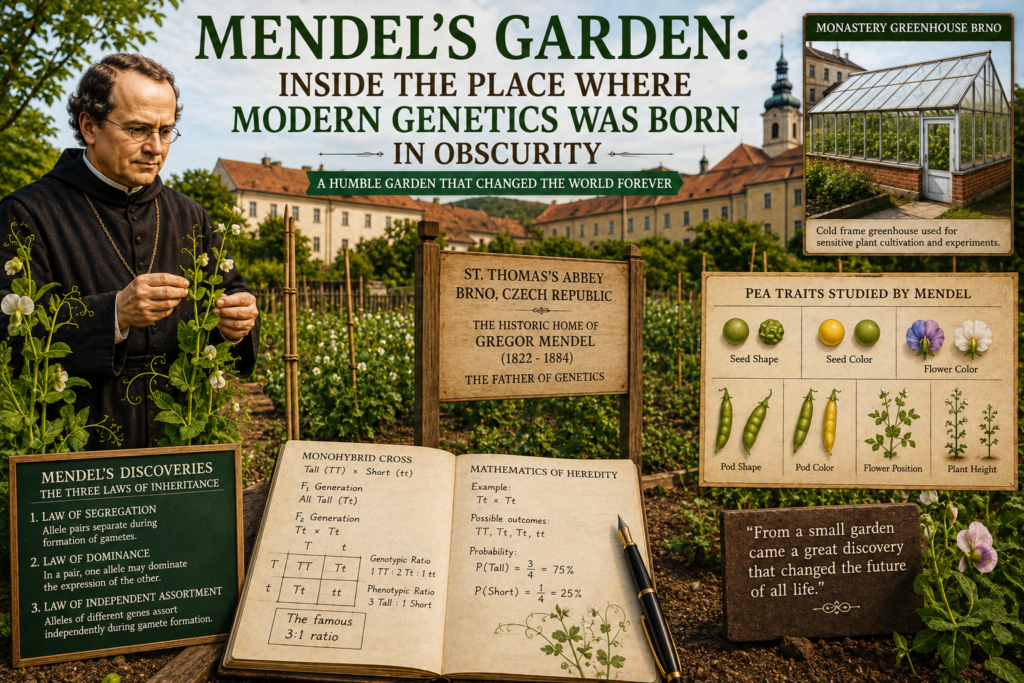
The story of mendel’s garden is one of the most fascinating chapters in scientific history. Hidden within a monastery in Brno, a quiet garden became the birthplace of modern genetics. While the scientific world focused on grand discoveries made in famous universities and laboratories, a humble friar carefully cultivated pea plants and unknowingly laid the foundation for an entirely new branch of science.
Today, millions of students learn about genes, DNA, chromosomes, and inheritance. Yet few realize that these revolutionary concepts can be traced back to a small garden that once occupied a modest corner of a monastery. The history of mendel’s garden reminds us that world changing discoveries often emerge from humble beginnings rather than prestigious institutions.
This remarkable location remains one of the most important historical scientific locations in biology. It is widely recognized as the birthplace of modern genetics and a symbol of how curiosity, patience, and careful observation can transform human knowledge.
The Historical Setting of Mendel’s Garden (1843 – 1856)
The famous mendel’s garden was located within the grounds of St. Thomas’s Abbey in Brno, now part of the Czech Republic. During the nineteenth century, the monastery served as an intellectual center where education, agriculture, philosophy, and science were encouraged.
Unlike many religious institutions of the era, the monastery actively supported scientific inquiry. The monks studied mathematics, natural history, agriculture, and meteorology. This environment provided the ideal conditions for experimentation.
The Gregor Mendel garden site was not a vast agricultural field. Instead, it was a relatively modest experimental area designed for careful scientific work. What made the site extraordinary was not its size but the precision of the research conducted there.
Many historians now regard the location as one of the most significant landmark locations in biology because it was truly where genetics began.
The Physical Layout of Mendel’s Garden
Understanding mendel’s garden requires examining the physical environment itself.
The garden contained:
- Cultivation beds for experimental plants
- A monastery greenhouse Brno researchers used for controlled studies
- Areas for weather observation
- Small botanical collections
- Agricultural test plots
The physical dimensions of the experimental area were relatively modest. However, every section served a specific purpose.
The cultivation beds were carefully organized to prevent accidental pollination. Soil conditions were monitored to ensure healthy plant growth. The surrounding microclimate created favorable conditions for pea cultivation.
Nearby stood a Cold frame greenhouse that protected sensitive plants from adverse weather conditions.
Together, these elements created an operational workspace perfectly suited for scientific research.
Why the Garden Was Ideal for Genetics Research
One reason mendel’s garden became so important was its unique combination of natural and controlled conditions.
Several factors contributed:
- Suitable soil conditions
- Favorable microclimate
- Access to greenhouse facilities
- Quiet working environment
- Ability to isolate plant varieties
These conditions allowed Mendel to conduct experiments with remarkable accuracy.
Today, scientists recognize the garden as an example of how micro-environments for scientific breakthroughs can influence the course of human history.
The site demonstrates that scientific revolutions do not always require massive laboratories. Sometimes they begin in a simple botanical sanctuary.
The Arrival of Gregor Mendel (1843 – 1851)
When Gregor Mendel entered the Augustinian monastery, he was not yet a famous scientist. He was a young friar seeking education and stability.
His intellectual abilities quickly became apparent.
The monastery encouraged him to pursue studies in:
- Mathematics
- Physics
- Botany
- Agriculture
Later, he attended the University of Vienna, where he learned advanced scientific methods and statistical analysis.
When he returned to Brno, he brought with him a unique combination of biological curiosity and mathematical thinking.
That combination would transform mendel’s garden into the geographical cradle of genetics.
Why Mendel Chose Pea Plants
One of the most important questions in genetics history is why mendel chose peas.
Pea plants offered several advantages:
- Easy cultivation
- Fast reproduction
- Distinct visible traits
- Natural self pollination
- Controlled cross pollination
Mendel selected traits such as:
- Plant height
- Flower color
- Seed color
- Seed shape
- Pod shape
These characteristics made it possible to track inheritance patterns over multiple generations.
Inside mendel’s garden, thousands of pea plants were grown and observed with extraordinary care.
The Famous Pea Plant Experiments (1856 – 1863)
The heart of the story lies in the legendary mendel pea plant experiments.
Mendel spent approximately eight years crossing different pea varieties and recording the outcomes.
He examined more than 28,000 plants.
For example:
Tall Plant = TT
Short Plant = tt
Cross:
TT × tt
First Generation:
All offspring = Tt
Result:
100% Tall
This outcome suggested that one trait could dominate another.
Mendel repeated these experiments thousands of times to verify his observations.
The consistency of the results convinced him that inheritance followed predictable rules.
Mathematics in Mendel’s Garden
One revolutionary aspect of mendel’s garden research was the use of mathematics.
Most nineteenth century biologists relied on descriptive observations.
Mendel counted, measured, and calculated.
Consider the second generation cross:
Tt × Tt
Possible outcomes:
TT, Tt, Tt, tt
Genotypic Ratio:
1 : 2 : 1
Phenotypic Ratio:
3 : 1
Probability calculations:
P(Tall) = 3/4 = 75%
P(Short) = 1/4 = 25%
This famous pattern became known as the mendel 3 to 1 ratio.
The mathematical precision displayed in mendel’s garden was unprecedented in biology.
Many historians describe this achievement as the beginning of the mathematics of heredity.
Discovering the Rules of Inheritance
Through years of experimentation, Mendel discovered that traits are inherited through predictable mechanisms.
His observations eventually led to the development of modern genetic theory.
Although the term gene did not yet exist, Mendel correctly inferred that hereditary factors were being transmitted from parents to offspring.
The discoveries made within mendel’s garden would later become the foundation for modern genetics, genomics, and molecular biology.
A Garden Hidden from the World
One remarkable aspect of mendel’s garden is that almost nobody recognized its importance at the time.
Mendel presented his findings in 1865 and published them in 1866.
The scientific community largely ignored his work.
This remains one of the greatest examples of small-scale scientific revolutions occurring in isolation.
The physical site of genetic discovery remained largely unknown to the wider scientific world for decades.
Why Science Ignored Mendel
Many historians continue to ask why science ignored mendel.
Several explanations exist:
- Scientists favored blending inheritance theories.
- Statistical methods were poorly understood.
- The paper was published locally.
- Biology had not yet embraced quantitative analysis.
As a result, the extraordinary discoveries made in mendel’s garden received little attention.
Only decades later would scientists recognize their significance.
Gregor Mendel Predicted Modern Genetics
The statement that Gregor Mendel predicted modern genetics is supported by remarkable evidence.
Mendel never saw DNA.
He never observed chromosomes.
He knew nothing about molecular biology.
Yet he correctly identified fundamental inheritance patterns that modern genetics later confirmed.
His conclusions accurately predicted:
- Gene segregation
- Hereditary transmission
- Dominance relationships
- Independent inheritance
This achievement remains one of the most astonishing examples of scientific foresight in history.
Preservation of Mendel’s Workspace
Today, mendel’s garden is carefully protected through historic preservation efforts.
Visitors can explore:
- Reconstructed cultivation beds
- Historic monastery grounds
- Botanical displays
- Educational exhibits
- Preserved greenhouse structures
The preservation of Mendel’s workspace allows modern visitors to appreciate the environment in which genetics was born.
The site has become a major destination for Brno Czech Republic historical tourism.
Scientists, students, and history enthusiasts travel from around the world to visit the location.
Visiting Mendel’s Garden Today
For those interested in visiting Mendel’s garden, the experience offers a unique connection to scientific history.
Walking through the historic monastery grounds provides insight into the daily environment that shaped Mendel’s work.
Visitors can observe:
- Local flora
- Experimental garden layouts
- Historical botany gardens
- Monastery architecture
- Educational exhibits
The site continues to inspire new generations of scientists.
Few places better demonstrate how humble beginnings can lead to discoveries that transform the world.
From Mendel to DNA
The journey from mendel to DNA represents one of the greatest scientific success stories ever recorded.
Mendel discovered inheritance patterns.
Scientists later discovered chromosomes.
Eventually researchers identified DNA as the molecule responsible for genetic information.
Every major advance in genetics traces its roots back to the discoveries made within mendel’s garden.
Modern fields influenced by Mendel include:
- Genetic engineering
- Genomics
- Biotechnology
- Personalized medicine
- Agricultural genetics
Without his work, these fields might have developed much later.
The Lasting Legacy of Mendel’s Garden
Today, mendel’s garden stands as a symbol of scientific perseverance and intellectual curiosity.
The garden demonstrates that transformative discoveries do not require enormous budgets or advanced technology.
Instead, they require:
- Careful observation
- Logical reasoning
- Mathematical analysis
- Persistence
- Creativity
The birthplace of modern genetics remains one of humanity’s greatest scientific landmarks.
Its legacy continues to influence biology, medicine, agriculture, and countless areas of scientific research.
FAQs
Where is Mendel’s Garden located?
Mendel’s Garden is located at St. Thomas’s Abbey in Brno, Czech Republic, where Gregor Mendel conducted his famous pea plant experiments.
Why is Mendel’s Garden important?
It is considered the birthplace of modern genetics because Mendel discovered the fundamental principles of heredity there.
How many plants did Mendel study?
Mendel analyzed approximately 28,000 pea plants during his experiments.
Can people visit Mendel’s Garden today?
Yes. The site is preserved and open to visitors interested in genetics and scientific history.
Why did Mendel use mathematics in his experiments?
Mathematics allowed him to identify inheritance patterns and calculate probability ratios accurately.
How did Mendel’s work influence modern genetics?
His discoveries became the foundation for gene theory, DNA research, genomics, and modern biotechnology.
Conclusion
The story of mendel’s garden is a powerful reminder that some of humanity’s greatest discoveries begin in the most unexpected places. Hidden within a monastery, this modest garden became the birthplace of modern genetics and the foundation of our understanding of heredity.
Through patience, observation, and mathematical precision, Mendel transformed a small experimental pea patch into one of the most important scientific sites in history. Today, the preserved garden stands as a lasting tribute to curiosity, determination, and the extraordinary power of careful scientific inquiry. From a quiet corner of Brno emerged ideas that forever changed biology and ultimately shaped our understanding of life itself.