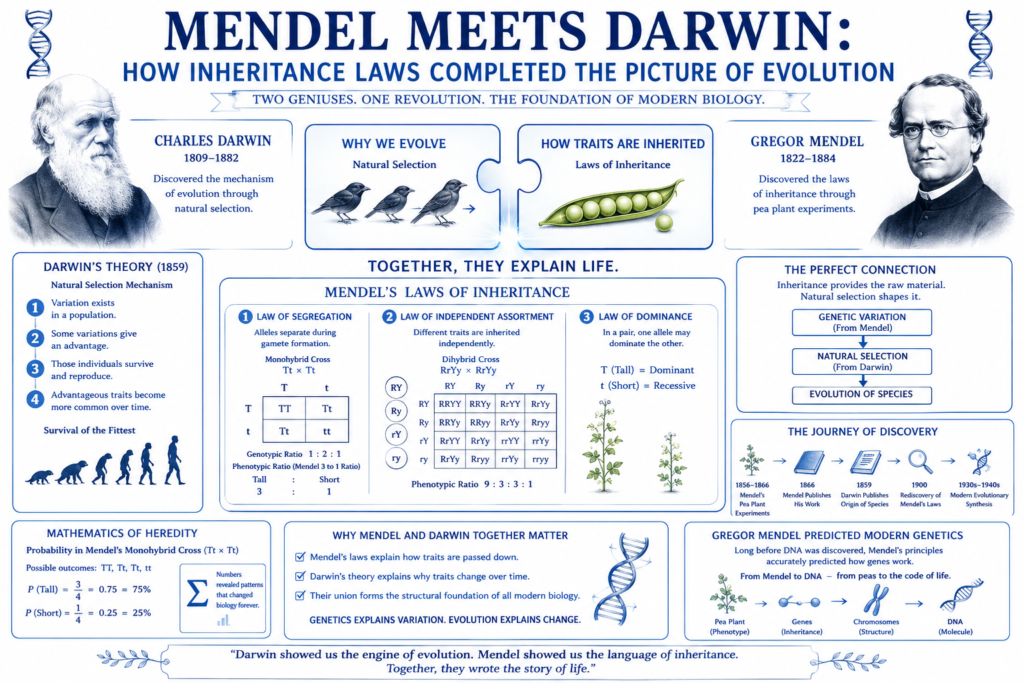
The story of mendel and darwin represents one of the most important intellectual connections in the history of science. Charles Darwin explained how species evolve through natural selection, while Gregor Mendel uncovered the rules governing inheritance. Individually, their discoveries transformed biology. Together, they created the foundation of modern evolutionary science.
The fascinating aspect of mendel and darwin is that neither scientist fully understood how perfectly their ideas complemented one another. Darwin explained why organisms change over time, but he struggled to explain how traits were reliably passed from one generation to the next. Mendel solved that mystery through meticulous experiments with pea plants.
Today, modern biology recognizes the relationship between mendel and darwin as one of the greatest scientific partnerships never realized during their lifetimes. Their combined work eventually produced the modern evolutionary synthesis and transformed our understanding of life itself.
The Scientific World Before Mendel and Darwin (1800 – 1850)
Before the discoveries of mendel and darwin, scientists had only limited explanations for biological diversity.
Many believed species were fixed and unchanging.
Others proposed inheritance theories based on vague assumptions. One common idea was blending inheritance, which suggested offspring inherited an average mixture of parental traits.
For example:
Tall Parent + Short Parent = Medium Height Offspring
According to blending inheritance, variation should gradually disappear over generations.
This posed a serious problem for evolution because natural selection requires variation to persist.
The future connection between mendel and darwin would ultimately solve this puzzle.
Darwin’s Revolutionary Theory (1859)
In 1859, Charles Darwin published On the Origin of Species.
Darwin proposed that species evolve through natural selection.
The natural selection mechanism operates through three essential principles:
- Variation exists among individuals.
- Some traits improve survival and reproduction.
- Beneficial traits become more common over time.
This process became known as survival of the fittest.
Darwin’s theory explained adaptation, biodiversity, and the evolution of species.
However, Darwin faced a major challenge.
He could not explain precisely how inheritance worked.
This unresolved issue became known as the Darwinian evolution genetics puzzle.
Darwin’s Inheritance Problem
One reason the relationship between mendel and darwin became so important is that Darwin lacked a reliable inheritance mechanism.
If blending inheritance were true, advantageous traits would gradually disappear.
Consider:
Parent A trait value = 10
Parent B trait value = 0
Offspring average:
(10 + 0) ÷ 2 = 5
Next generation:
(5 + 0) ÷ 2 = 2.5
Eventually:
5 → 2.5 → 1.25 → 0.625
The beneficial trait would fade away.
Natural selection would struggle to preserve useful characteristics.
Darwin recognized this problem but lacked a solution.
The answer would come from Mendel’s work.
Gregor Mendel’s Experiments (1856 – 1866)
While Darwin developed evolutionary theory, Gregor Mendel was conducting research in a monastery garden.
His famous pea plant studies revealed patterns of inheritance that contradicted blending inheritance.
The groundbreaking mendel pea plant experiments demonstrated that hereditary factors remain distinct rather than blending together.
For example:
Tall Plant (TT) × Short Plant (tt)
First Generation:
TT × tt
Result:
All offspring = Tt
100% Tall
The hereditary factors remained intact.
This concept became known as particulate inheritance.
The discovery was revolutionary.
The Mathematics Behind Mendel’s Discovery
One reason Mendel’s work was so powerful was its mathematical precision.
Consider a simple genetic cross:
Tt × Tt
Possible offspring:
TT, Tt, Tt, tt
Genotypic Ratio:
1 : 2 : 1
Phenotypic Ratio:
3 : 1
Probability:
P(Tall) = 3/4 = 75%
P(Short) = 1/4 = 25%
This famous mendel 3 to 1 ratio demonstrated that hereditary traits are passed through predictable mechanisms.
These results became the foundation of the mathematics of heredity.
Unlike Darwin’s broader observations, Mendel provided numerical evidence.
How Mendel Solved Darwin’s Biggest Problem
The relationship between mendel and darwin became transformative because Mendel solved the inheritance problem.
Under particulate inheritance:
Genes remain intact across generations.
Instead of blending:
T remains T
t remains t
Traits can disappear and later reappear.
This explained how variation survives over long periods.
Natural selection could now act on stable hereditary units.
The missing link in evolutionary theory had finally been discovered.
The Law of Segregation and Evolution
One of the most important concepts connecting mendel and darwin is the law of segregation.
Mendel discovered that hereditary factors separate during reproduction.
Example:
Tt → T + t
Each parent contributes one factor.
This process preserves genetic diversity.
Without segregation, variation would quickly disappear.
The law of segregation therefore provided a structural foundation of adaptation and evolutionary change.
The Law of Independent Assortment and Diversity
Another key contribution was the law of independent assortment.
Different hereditary factors are inherited independently.
Example:
RrYy
Possible gametes:
RY, Ry, rY, ry
This principle dramatically increases genetic combinations.
Mathematically:
2² = 4 combinations
For three gene pairs:
2³ = 8 combinations
For ten gene pairs:
2¹⁰ = 1024 combinations
This enormous genetic variation evolutionary engine supplies natural selection with the raw material required for evolution.
Why Darwin Never Fully Understood Mendel
One of history’s greatest scientific ironies involves mendel and darwin.
Mendel published his findings in 1866.
Darwin lived until 1882.
However, there is no convincing evidence that Darwin appreciated the significance of Mendel’s research.
Several factors contributed:
- Limited distribution of Mendel’s paper
- Scientific communication barriers
- Complexity of Mendel’s mathematics
- Focus on different research fields
As a result, the complete synthesis never occurred during their lifetimes.
Why Science Ignored Mendel
The story of why science ignored mendel also affected Darwinian evolution.
Had Mendel’s discoveries been widely accepted immediately, evolutionary biology might have advanced decades earlier.
Instead, genetics and evolution developed separately.
This delayed the unification of biological theory.
Scientists would spend decades trying to reconcile inheritance with evolution before recognizing Mendel’s contribution.
Rediscovery and the Birth of Modern Genetics (1900 – 1920)
Around 1900, scientists rediscovered Mendel’s work.
Researchers quickly realized that his inheritance principles explained how traits persist across generations.
The connection between mendel and darwin became increasingly obvious.
Mendel explained inheritance.
Darwin explained selection.
Together, they explained evolution.
This realization marked a turning point in the history of evolutionary thought.
Population Genetics Foundations (1920 – 1940)
The next major breakthrough came through populational genetics foundations.
Scientists such as:
- Ronald Fisher
- J.B.S. Haldane
- Sewall Wright
combined Mendelian genetics with evolutionary theory.
They developed mathematical models showing how gene pool frequency changes through time.
One simplified example:
Initial frequency:
A = 0.40
a = 0.60
After selection:
A = 0.55
a = 0.45
Over generations, advantageous genes become more common.
This mathematical framework validated Darwin’s theory using Mendel’s inheritance laws.
The Modern Evolutionary Synthesis (1930 – 1950)
The modern evolutionary synthesis unified genetics and evolution into a single scientific framework.
The synthesis demonstrated:
- Evolution occurs through changes in gene frequencies.
- Natural selection acts on genetic variation.
- Mutations create new variation.
- Inheritance preserves useful traits.
The modern synthesis architects successfully integrated the discoveries of mendel and darwin.
This achievement became one of biology’s greatest intellectual accomplishments.
Random Mutations and Evolutionary Adaptation
Modern genetics introduced another crucial concept.
Random mutations create new genetic variants.
Natural selection then evaluates those variants.
For example:
Mutation Rate = 1 × 10⁻⁶
Population Size = 1,000,000
Expected Mutations:
1,000,000 × 1 × 10⁻⁶ = 1
New variation continuously enters populations.
This process drives evolutionary adaptation and long term biological change.
The combined framework of mendel and darwin explains how evolution proceeds generation after generation.
Microevolution and Macroevolution
The synthesis of mendel and darwin also clarified the relationship between microevolution and macroevolution molecular mechanics.
Microevolution involves small changes in gene frequencies.
Example:
Gene A frequency:
0.40 → 0.45 → 0.50 → 0.55
Over many generations, these small changes accumulate.
Eventually, major evolutionary transformations emerge.
Thus, large scale evolution can arise from countless small genetic changes.
Genetic Drift and Evolution
Evolution is not driven solely by natural selection.
Genetic drift also influences populations.
Suppose:
Gene A frequency = 50%
Gene a frequency = 50%
Random events may alter frequencies:
A = 60%
a = 40%
This process contributes to evolutionary outcomes alongside selection.
Modern evolutionary biology incorporates both mechanisms.
The framework created through mendel and darwin allows scientists to understand these complex interactions.
Gregor Mendel Predicted Modern Genetics
It is fair to say that Gregor Mendel predicted modern genetics.
Although he never observed DNA or chromosomes, his inheritance laws accurately described how hereditary information behaves.
His discoveries anticipated:
- Genetics
- Genomics
- Molecular biology
- Biotechnology
The remarkable accuracy of his conclusions continues to impress scientists today.
From Mendel to DNA
The journey from mendel to DNA illustrates the extraordinary success of modern biology.
Mendel identified inheritance patterns.
Scientists later discovered chromosomes.
Eventually DNA was identified as the molecule carrying genetic information.
Every major genetic breakthrough rests upon foundations established by Mendel and integrated into Darwinian evolution.
The Lasting Legacy of Mendel and Darwin
Today, mendel and darwin are inseparable in biological science.
Darwin explained why evolution occurs.
Mendel explained how inheritance works.
Together, they solved the continuous variation riddle solved by modern genetics.
Their combined discoveries created the synthesis of biology core theories and transformed our understanding of life.
Without either scientist, modern biology would be incomplete.
FAQs
How are Mendel and Darwin connected?
Darwin explained natural selection, while Mendel explained inheritance. Together they provide the foundation of evolutionary biology.
Why did Darwin need Mendel’s discoveries?
Darwin lacked a mechanism explaining how traits were passed from parents to offspring.
What is particulate inheritance?
Particulate inheritance is the idea that hereditary factors remain distinct rather than blending together.
What is the modern evolutionary synthesis?
It is the unification of Darwin’s evolution theory with Mendelian genetics.
Did Mendel and Darwin ever meet?
There is no evidence that Mendel and Darwin ever met or collaborated.
Why is their combined work important?
Together they explain both the origin of variation and the mechanism of evolutionary change.
Conclusion
The story of mendel and darwin represents one of the most powerful intellectual achievements in scientific history. Darwin revealed the mechanism of natural selection, while Mendel uncovered the rules governing inheritance. Individually, their discoveries transformed biology. Together, they completed the picture of evolution and established the foundation of modern genetics.
Their combined legacy continues to guide research in genetics, medicine, biotechnology, and evolutionary biology. The partnership they never knew they had ultimately became one of the most influential scientific connections ever formed, proving that great ideas often achieve their full power only when united with other groundbreaking discoveries.