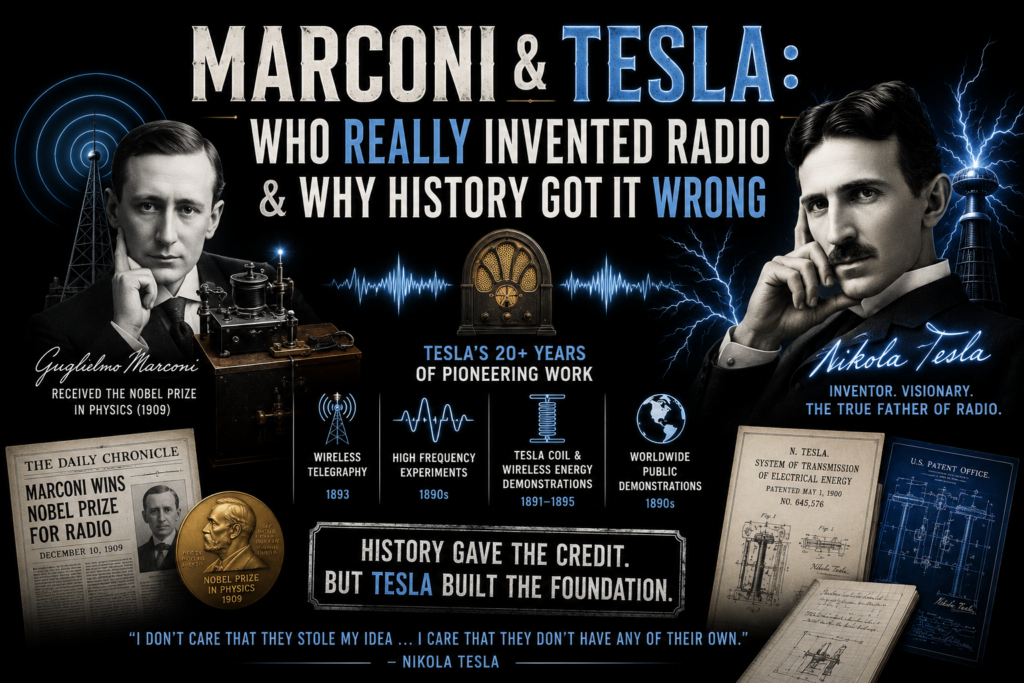
The debate surrounding marconi and tesla radio invention remains one of the most controversial topics in the history of science and technology. For decades, many textbooks credited Guglielmo Marconi as the inventor of radio. His successful wireless transmissions and international fame helped establish that narrative across much of the world.
However, the full story is far more complicated. Long before Marconi achieved global recognition, Nikola Tesla had already developed critical radio technologies, secured patents, demonstrated wireless communication systems, and proposed methods that became essential to modern radio transmission.
The controversy over marconi and tesla radio invention involves patents, legal battles, scientific discoveries, and a landmark Supreme Court ruling that reshaped historical understanding. To understand who truly invented radio, it is necessary to examine the evidence, the technology, and the legal decisions that followed.
The Scientific Foundations of Radio (1860 – 1890)
Before the marconi and tesla radio invention controversy emerged, scientists had already established the theoretical foundations of electromagnetic communication.
Important contributors included:
- James Clerk Maxwell
- Heinrich Hertz
- Oliver Lodge
- Nikola Tesla
- Guglielmo Marconi
Maxwell’s equations demonstrated that electromagnetic waves could travel through space.
One of Maxwell’s key equations is:
c = 1 / √(μ₀ε₀)
Where:
- c = Speed of light
- μ₀ = Magnetic permeability
- ε₀ = Electric permittivity
This equation proved that light and radio waves belong to the same electromagnetic family.
These discoveries laid the groundwork for future wireless communication systems.
Nikola Tesla’s Early Wireless Experiments (1891 – 1895)
Years before Marconi became famous, Nikola Tesla visionary inventor was conducting extensive wireless experiments.
Tesla believed information and energy could both be transmitted without wires.
His research involved:
- Radio frequency generation
- Resonance
- Signal transmission
- Circuit tuning
- Wireless communication
Many of these investigations relied on principles associated with tesla coil explained technologies.
Tesla’s lectures during the early 1890s demonstrated wireless lamps and signal transmission concepts that impressed engineers worldwide.
These experiments represent important evidence in the marconi and tesla radio invention debate.
Tesla’s Radio Patents
Tesla secured several patents covering wireless communication systems before Marconi’s most famous achievements.
Among the most significant were patents involving:
- Transmission apparatus
- Wireless signaling
- Resonant circuits
- Frequency tuning systems
Many of these inventions appear within collections of nikola tesla patents that continue to be studied today.
Tesla’s work established several principles that later became essential to practical radio systems.
The existence of these patents would eventually play a major role in legal proceedings.
The Importance of the Four Tuned Circuit Patent
One of Tesla’s most important contributions was the four-tuned circuit patent.
The design used:
- Tuned transmitter circuits
- Tuned receiver circuits
- Frequency selection
- Wave syntony
This arrangement improved signal reliability and reduced interference.
Modern radio communication continues to depend on similar tuning principles.
Many historians regard the four-tuned circuit patent as one of the strongest pieces of evidence supporting Tesla’s role in the marconi and tesla radio invention story.
Guglielmo Marconi’s Rise (1895 – 1901)
Guglielmo Marconi focused on transforming wireless communication into a practical commercial system.
His efforts attracted investors and government support.
Marconi developed equipment capable of sending messages over increasingly long distances.
His work involved:
- Spark gap apparatus
- Long-wave radio signals
- Transmission towers
- Wireless telegraphy patents
Marconi’s success brought radio technology to public attention and established him as a global figure.
As a result, many people began associating radio exclusively with Marconi.
The Transatlantic Wireless Signal (1901)
A major milestone occurred in 1901 when Marconi claimed to receive a transatlantic wireless signal across the Atlantic Ocean.
This achievement generated worldwide headlines.
The accomplishment appeared to prove that wireless communication could operate over enormous distances.
The event dramatically strengthened Marconi’s reputation and became a key factor in the public perception of the marconi and tesla radio invention question.
Although historians continue debating aspects of the experiment, its impact on public opinion was undeniable.
Spark Gap Apparatus and Early Radio Technology
Early radio systems relied heavily on spark gap apparatus designs.
These systems produced bursts of electromagnetic energy that could transmit coded messages.
The basic resonant frequency equation is:
f = 1 / (2π√LC)
Where:
- f = Frequency
- L = Inductance
- C = Capacitance
This relationship remains fundamental to radio engineering.
Tesla understood resonance deeply and incorporated these principles into his wireless research long before radio became commercially widespread.
Patent Office Reversal and Growing Controversy
The patent history surrounding marconi and tesla radio invention became increasingly complicated.
Initially, Tesla held important patents related to wireless communication.
However, in 1904, the United States Patent Office approved Marconi’s radio patent application after previously rejecting similar claims.
This patent office reversal created intense controversy.
Some researchers argued that financial and political influences contributed to the decision.
Others maintained that Marconi deserved recognition for successfully commercializing wireless communication.
The debate continues among historians today.
Wireless Telegraphy Patents and Legal Battles
As radio technology became more valuable, patent disputes intensified.
Numerous lawsuits emerged involving:
- Wireless telegraphy patents
- Proprietary designs
- Communication monopoly claims
- Priority debate issues
The growing radio industry generated enormous profits, making legal ownership increasingly important.
These disputes eventually contributed to a major patent infringement lawsuit involving competing inventors and corporations.
Tesla’s Remote Control Demonstration (1898)
An often overlooked chapter in the marconi and tesla radio invention controversy involves Tesla’s radio controlled boat demonstration.
Using technology related to tesla remote control invention, Tesla showcased a vessel controlled through wireless signals.
The demonstration proved that radio waves could do more than transmit messages.
They could control machines.
This breakthrough represented an early form of telemetry infrastructure and wireless automation.
It further demonstrated Tesla’s advanced understanding of radio communication.
John Stone Stone and Other Contributors
The development of radio involved numerous innovators.
Among them was john stone stone, an engineer who contributed significantly to wireless communication technologies.
Other researchers also advanced circuit tuning, synchronization mechanism systems, and signal processing techniques.
The existence of multiple contributors complicates efforts to identify a single inventor.
Nevertheless, Tesla and Marconi remain the central figures in the historical debate.
Wireless Pioneer Litigation
As commercial radio expanded, wireless pioneer litigation became increasingly common.
Companies fought over:
- Patent rights
- Licensing fees
- Technology ownership
- Market control
These legal battles often centered on the question of priority of invention.
Who invented a technology first?
Who deserved credit?
These questions remain at the heart of the marconi and tesla radio invention controversy.
The Nobel Prize Radio Controversy (1909)
In 1909, Guglielmo Marconi shared the Nobel Prize in Physics for contributions to wireless telegraphy.
This decision generated what many historians call the noble prize radio controversy.
Supporters of Tesla argued that his earlier patents and experiments deserved greater recognition.
Although Tesla never received a Nobel Prize for radio technology, many scholars believe his contributions were foundational.
The controversy remains a subject of discussion among historians and engineers.
The Supreme Court Decision 1943
One of the most significant developments occurred in 1943.
The supreme court decision 1943 invalidated key Marconi patent claims.
The Court recognized that earlier inventions by Tesla and other researchers had anticipated important aspects of Marconi’s work.
This ruling provided substantial legal vindication for Tesla.
The decision did not officially declare Tesla the sole inventor of radio.
However, it significantly altered the legal landscape and strengthened Tesla’s position in the historical record.
For many scholars, this ruling represents one of the strongest arguments in the marconi and tesla radio invention debate.
Why History Initially Favored Marconi
Several factors explain why Marconi received most public credit.
Commercial Success
Marconi built successful companies and communication networks.
Public Visibility
His demonstrations attracted worldwide media attention.
International Recognition
Governments adopted his systems for communication.
Nobel Prize Recognition
The Nobel Prize increased his global reputation.
These factors often overshadowed Tesla’s earlier contributions.
Historical Revisionism and Modern Research
Modern historians have reexamined the evidence surrounding marconi and tesla radio invention.
Research has highlighted:
- Earlier Tesla patents
- Patent priority issues
- Legal precedence
- Technical similarities
- Retroactive credit considerations
This process of historical revisionism has produced a more balanced understanding of radio’s origins.
Rather than viewing radio as the achievement of a single individual, many scholars now recognize the contributions of multiple inventors.
Tesla’s Broader Vision of Wireless Communication
Tesla’s radio research connected closely with tesla wireless power transmission concepts.
He envisioned a world where wireless networks would transmit:
- Messages
- Information
- Navigation signals
- Energy
His ambitious plans eventually contributed to the wardenclyffe tower project, which sought to expand global wireless communication.
Although the project was never completed, it demonstrated the extraordinary scope of Tesla’s vision.
Who Really Invented Radio?
The answer depends on how invention is defined.
If invention means creating essential scientific principles and patented technologies, Tesla possesses a strong claim.
If invention means building commercial systems and achieving public adoption, Marconi played a crucial role.
The evidence suggests that radio emerged through contributions from many pioneers.
However, modern scholarship increasingly acknowledges Tesla’s foundational role in the development of radio technology.
Frequently Asked Questions
Did Tesla invent radio before Marconi?
Tesla developed and patented important wireless communication technologies before many of Marconi’s most famous achievements.
What was the 1943 Supreme Court decision?
The U.S. Supreme Court invalidated key Marconi patent claims and recognized prior inventions by Tesla and others.
Why is Marconi often called the inventor of radio?
Marconi successfully commercialized wireless communication and gained widespread public recognition.
Did Tesla and Marconi work together?
No. They developed competing approaches and became associated with different aspects of radio technology.
Who deserves credit for inventing radio?
Most historians now believe radio resulted from contributions made by several inventors, including Tesla, Marconi, Hertz, Lodge, and others.
Conclusion
The story of marconi and tesla radio invention reveals how technological history is often more complex than popular narratives suggest. While Marconi became internationally famous for commercializing radio communication, Tesla had already developed many of the core principles and patented technologies that made radio possible.
The patent disputes, legal battles, and Supreme Court ruling of 1943 demonstrate that the invention of radio cannot be attributed solely to one individual. Instead, it emerged through the combined efforts of multiple pioneers working at the frontiers of science and engineering.
Today, a growing number of historians recognize Tesla’s contributions as fundamental to radio technology. The debate may never completely disappear, but modern evidence makes one thing clear: Nikola Tesla played a far greater role in the invention of radio than many history books once acknowledged.