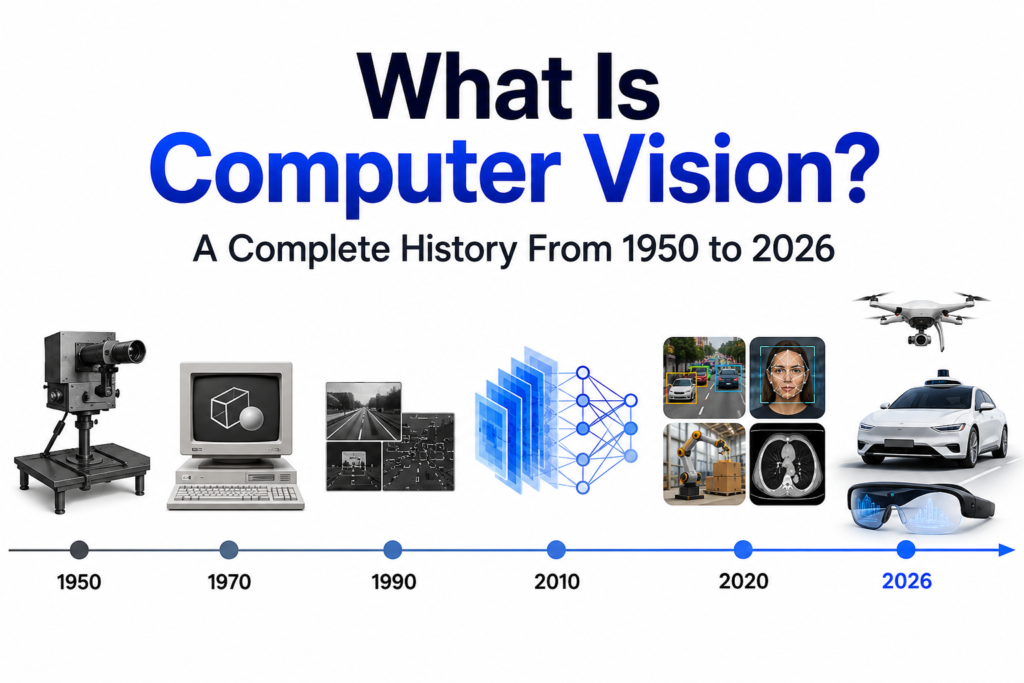
The history of computer vision is one of the most exciting stories in all of science and technology. From humble experiments in the 1950s to systems that can detect tumors, drive cars, and generate photorealistic images, the journey of teaching machines to see has reshaped the modern world. This guide walks you through every major milestone, breakthrough, and turning point in the history of computer vision, from its earliest roots to the powerful systems we rely on today.
What Is Computer Vision?
Computer vision is a branch of artificial intelligence that enables machines to interpret, analyze, and understand visual information from the world, including images, videos, and live camera feeds. Rather than just storing pixels, a computer vision system tries to extract meaning, whether that means identifying a face, reading a license plate, or spotting a crack in a factory part.
The gap between computer vision vs human vision remains significant. Human eyes and brains process visual information instantly, with rich context and zero training data needed. Machines, on the other hand, require vast datasets, powerful processors, and carefully designed algorithms to come close to the same result. Even today, human vision handles edge cases, lighting changes, and ambiguous scenes far better than most automated systems.
The Very Beginning: 1950 – 1960
The earliest seeds of computer vision were planted before the term even existed. In the 1950s, researchers began experimenting with digital image representation and the idea that machines could process visual signals the same way they processed numbers.
Frank Rosenblatt introduced the Perceptron in 1957, an early neural network model that could learn to recognize simple patterns. It was not image recognition in the modern sense, but it proved that machines could learn from data. This idea would quietly sit in the background for decades before reshaping the entire field.
Optical character recognition also took its first steps during this era. Early OCR systems were built to read printed text, a task that seems simple today but required years of engineering to make even partially reliable.
The Birth of a Discipline (1960 – 1970)
The 1960s marked the formal beginning of computer vision as a research discipline. Larry Roberts, often called the father of computer vision, published his 1963 MIT dissertation on machine perception of three-dimensional solids. His work on the block world, simple geometric objects in controlled lighting, laid the groundwork for later research in edge detection and 3D shape reconstruction. Roberts showed that computers could extract structural information from two-dimensional images, a revolutionary idea at the time.
Feature extraction also became a central focus during this period. Researchers realized early on that instead of analyzing every pixel, machines should identify meaningful features like edges, corners, and regions. This insight would guide the field for the next six decades.
The Summer That Changed Everything (1966)
In 1966, Seymour Papert and Marvin Minsky at MIT launched what is now known as the MIT Summer Vision Project. The goal was to solve computer vision over a single summer, assigning it to an undergraduate student as a side project. The team severely underestimated the problem. The project ran far beyond the summer, and many of the challenges they identified are still active research areas today.
The Summer Vision Project is a landmark moment in the history of computer vision because it was the first organized, large-scale attempt to build a complete vision system. Its failure taught researchers how extraordinarily complex visual perception really is.
Pattern Recognition and Image Processing (1970 – 1980)
The 1970s brought serious investment in image processing algorithms and pattern recognition. Researchers developed mathematical tools to filter, enhance, and analyze images systematically. David Marr at MIT proposed a powerful computational theory of vision in the late 1970s that divided visual processing into layers: primal sketch, two-and-a-half-D sketch, and full 3D model. His framework influenced researchers for a generation.
Edge detection became a major focus during this decade. Researchers developed techniques to find boundaries between objects in an image, which is a necessary first step in understanding a scene. The history of edge detection includes important contributions from John Canny, whose Canny edge detector, published in 1986, remains one of the most widely used algorithms in all of image processing.
The history of pattern recognition during this period also saw the use of statistical models to classify objects and signals. Hidden Markov models, originally developed for speech, began to find applications in visual sequence analysis as well.
Neural Networks and Early Learning (1980 – 1990)
The 1980s were a period of slow but meaningful progress. Researchers began connecting neural networks to visual tasks in more sophisticated ways. Kunihiko Fukushima introduced the Neocognitron in 1980, a hierarchical neural network designed specifically for image recognition. The history of the Neocognitron is significant because it directly inspired the convolutional neural networks that power modern computer vision.
Yann LeCun advanced this work throughout the decade and into the early 1990s by developing LeNet, a convolutional neural network that could reliably read handwritten digits. His work on applying backpropagation to image recognition tasks was foundational. The history of image processing in this era shifted from purely rule-based approaches toward data-driven learning.
Image segmentation also matured during the 1980s. Researchers developed algorithms to divide an image into meaningful regions, grouping pixels by color, texture, or intensity, which made it possible to isolate objects from their backgrounds.
The Rise of Computer Vision Tools (1990 – 2000)
The 1990s saw both setbacks and breakthroughs. Funding for AI research had dried up during the so-called AI winter, but computer vision continued making steady progress thanks to practical applications and better hardware.
The history of OpenCV begins in this era. Intel began developing the Open Source Computer Vision Library in 1999, releasing the first version publicly in 2000. OpenCV gave researchers and developers a shared toolkit of image processing algorithms, making it far easier to build and test vision systems. It remains one of the most widely used libraries in the field today.
The history of facial recognition also accelerated in the 1990s. Turk and Pentland published their Eigenfaces approach in 1991, using principal component analysis to represent and compare faces mathematically. This was followed by the Viola-Jones algorithm in 2001, a real-time face detection method that used simple features and a cascade of classifiers to identify faces in images quickly enough for practical use.
Deep Learning Transformed Computer Vision (2000 – 2010)
The early 2000s were a transitional period. Researchers were laying the groundwork for a revolution even if nobody quite realized how close it was. The history of ImageNet begins here. Fei-Fei Li began building the ImageNet dataset in 2006, eventually assembling over 14 million labeled images across more than 20,000 categories. It was the largest visual dataset ever assembled at that time, and it would soon become the proving ground for a generation of algorithms.
Geoffrey Hinton and his colleagues showed that deep neural networks could be trained effectively using improved initialization and activation methods, reviving interest in neural networks that had stalled for years. The connection between deep architectures and visual perception was becoming clearer.
The AlexNet Moment and the Deep Learning Explosion (2010 – 2015)
2012 was the year everything changed. Alex Krizhevsky, Ilya Sutskever, and Geoffrey Hinton entered a model called AlexNet in the ImageNet Large Scale Visual Recognition Challenge. The history of AlexNet is now legendary: it cut the error rate nearly in half compared to the second-place entry, shocking researchers who had spent years improving traditional methods by fractions of a percent.
AlexNet used deep convolutional layers, GPU acceleration, and dropout regularization in ways that demonstrated the raw power of deep learning for visual tasks. Within a year, nearly every serious computer vision researcher had shifted toward neural network approaches.
The history of VGGNet continues the story in 2014, when researchers at Oxford built a deeper, more uniform architecture that proved depth itself was a critical ingredient in visual recognition. That same year, Google introduced GoogLeNet, also known as Inception, which used clever module designs to build very deep networks efficiently.
The history of ResNet, published by Microsoft Research in 2015, pushed this even further. ResNet introduced residual connections that let networks be trained with over 100 layers without the vanishing gradient problem that had previously made deep networks impossible to train. ResNet won ImageNet that year with superhuman accuracy.
Transfer learning in computer vision became one of the most powerful tools to emerge from this era. Because large models trained on ImageNet had learned rich visual features, researchers found they could take these pre-trained networks and fine-tune them on smaller, specialized datasets, getting excellent results without starting from scratch.
Object Detection Evolves (2013 – 2018)
As classification improved, researchers turned their attention to detection. The history of object detection became a rapidly growing subfield, asking not just what is in an image but where it is.
The history of R-CNN began in 2013 when Ross Girshick proposed using region proposals combined with convolutional networks to detect objects in images. The history of Faster R-CNN followed in 2015, dramatically speeding up the process by integrating the proposal network into the main architecture. Anchor boxes in object detection, a concept introduced in this era, allowed networks to efficiently predict boxes of multiple sizes and shapes at each location.
The history of YOLO, standing for You Only Look Once, introduced a completely different philosophy in 2015. Rather than examining regions separately, YOLO treated detection as a single regression problem, predicting all boxes and class labels in one forward pass. This made it dramatically faster than region-based methods, enabling real-time detection on video. The YOLO vs R-CNN vs SSD comparison became a standard topic in computer vision courses and benchmarks, with each architecture offering a different trade-off between speed and accuracy.
Faces, Privacy, and Recognition at Scale (2010 – 2020)
The history of facial recognition took a dramatic leap when deep learning arrived. Facebook introduced DeepFace in 2014, achieving near-human accuracy on face verification benchmarks using a deep convolutional network trained on millions of images. The history of DeepFace marked the point where automated face recognition crossed the threshold of practical reliability.
The history of Apple Face ID begins in 2017 when Apple released the iPhone X, replacing fingerprint recognition with a 3D face scan powered by infrared sensors and neural networks. It was the first mass-market deployment of facial recognition as a security product for hundreds of millions of people.
Facial recognition and privacy became increasingly contentious as the technology spread. Cities, schools, airlines, and law enforcement agencies began adopting the technology, prompting serious debates about consent, bias, and civil liberties that continue today.
Generative Models and AI Image Creation (2014 – 2022)
Computer vision is not only about understanding images. It is also about creating them. Generative adversarial networks, introduced by Ian Goodfellow in 2014, pitted two neural networks against each other to produce images of startling quality.
The history of DALL-E begins in 2021 when OpenAI released a model capable of generating images from text descriptions, combining language understanding with image synthesis in ways that stunned the public. The history of Stable Diffusion in 2022 brought high-quality image generation to consumer hardware, and the history of Midjourney introduced a platform that made artistic AI image generation accessible to millions of non-technical users.
Neural style transfer, developed by Leon Gatys in 2015, showed that networks could separate the content of an image from its artistic style and recombine them, turning a photograph into something that looked painted by Van Gogh or Monet.
The history of deepfakes, which emerged around 2017, showed the darker side of these generative capabilities. Neural networks could place one person’s face onto another’s body in video with disturbing realism, raising urgent questions about misinformation and digital trust.
Computer Vision Enters the Physical World (2015 – 2024)
Self-driving cars and computer vision became deeply intertwined as the automotive industry raced to build autonomous vehicles. Companies like Waymo, Tesla, and Cruise invested billions in sensor fusion systems that combined cameras, lidar, and radar with deep learning models trained on millions of miles of driving data. Computer vision became the eyes of the car, responsible for detecting pedestrians, reading signs, and understanding lane boundaries in real time.
Medical imaging AI transformed radiology and pathology. Systems trained on millions of annotated scans learned to detect lung nodules, diabetic retinopathy, skin cancer, and dozens of other conditions, sometimes outperforming specialists on specific tasks.
Computer vision in manufacturing enabled automated quality control at a scale humans could never match. Cameras inspecting circuit boards, checking weld integrity, or detecting packaging defects could process hundreds of items per minute without fatigue.
The history of augmented reality became tied to computer vision as systems needed to understand and track the physical environment in real time. The history of Google Lens, launched in 2017, brought visual search to smartphones, letting users point their camera at objects, text, plants, or landmarks and receive instant information.
Computer vision in sports has grown into a major industry, with tracking systems analyzing player movement, ball trajectory, and tactical patterns to generate insights for coaches and broadcasters. Drones and computer vision have merged in agriculture, construction, search and rescue, and military applications, with aerial cameras feeding real-time analysis to operators.
Vision Transformers and the Modern Era (2020 – 2026)
The most recent shift in the history of computer vision is the rise of vision transformers. Introduced in 2020, the Vision Transformer (ViT) applied the transformer architecture originally developed for language to image patches, achieving state-of-the-art results on major benchmarks and challenging the long dominance of convolutional networks.
The history of multimodal AI represents the current frontier. Models like GPT-4V, Gemini, and Claude can process both text and images, enabling a wide range of applications from document analysis to visual question answering. Video understanding in AI has advanced rapidly, with models now capable of describing, searching, and summarizing video content at scale.
The history of pose estimation has produced systems that can track human body joints in real time from a single camera, powering fitness apps, animation tools, and physical therapy software. The history of depth estimation has advanced through self-supervised learning, enabling accurate 3D scene understanding from monocular cameras.
Frequently Asked Questions
Who invented computer vision?
There is no single inventor, but Larry Roberts is widely considered one of the founding figures of computer vision due to his 1963 MIT dissertation on machine perception of 3D shapes. Seymour Papert and Marvin Minsky also played foundational roles through the Summer Vision Project in 1966.
What was the first computer vision experiment?
The earliest formal experiments were conducted in the late 1950s and early 1960s using simple geometric shapes in controlled environments. Larry Roberts’s block world experiments at MIT are among the most frequently cited as the true beginning of the discipline.
How did deep learning change computer vision?
The publication of AlexNet in 2012 demonstrated that deep convolutional neural networks trained on large labeled datasets could achieve dramatically better results than traditional feature-based methods. This triggered a widespread shift toward deep learning across the entire field and produced rapid improvements in recognition, detection, and generation.
What is the difference between image processing and computer vision?
Image processing focuses on transforming or enhancing images, such as sharpening, filtering, or adjusting brightness. Computer vision goes further, seeking to extract semantic meaning from images, such as identifying objects, understanding scenes, or tracking motion.
Is computer vision the same as machine vision?
Machine vision typically refers to industrial applications like automated inspection and measurement, while computer vision is the broader academic and research field. The two overlap significantly but differ in context and focus.
Conclusion
From Larry Roberts drawing lines around wooden blocks in 1963 to systems that generate photorealistic images from a text prompt in seconds, the history of computer vision spans more than six decades of relentless ingenuity. Every decade brought a new theoretical foundation, a new algorithm, or a new dataset that pushed the boundaries of what machines could perceive.
Today, computer vision technology is embedded in smartphones, hospitals, factories, farms, sports stadiums, and city streets. It protects borders, reads tumors, catches defects, and unlocks phones. It is one of the most consequential technologies in human history, and the story is far from finished. The coming years will bring even deeper integration of vision with language, reasoning, and action, producing systems that do not just see the world but understand it in ways that were once reserved for human minds alone.