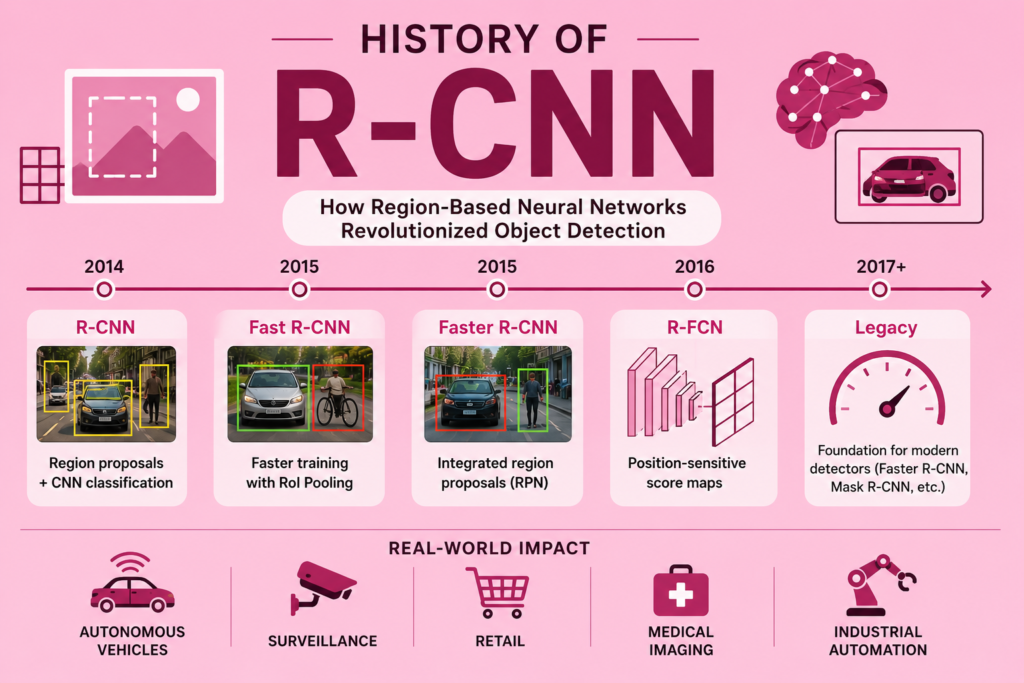
Image classification answers the question of what is in a picture. Object detection answers a harder question: what is in the picture, and exactly where is it. The history of r-cnn marks the moment deep learning finally tackled that harder question convincingly, bringing the same convolutional neural networks that had transformed image classification into the world of locating multiple objects within a single image. This article traces the complete history of R-CNN, from the problems it was designed to solve, through its internal architecture, to its lasting influence on every object detector that followed.
The State of Object Detection Before R-CNN
Before the history of r-cnn began, object detection relied almost entirely on hand-crafted proposal algorithms and traditional machine learning classifiers. Researchers would use techniques to generate candidate regions where objects might be located, then apply features like SIFT or HOG combined with Linear Support Vector Machines to decide whether each region actually contained an object and what type of object it was.
These approaches predated the deep learning transformed computer vision era and suffered from a fundamental limitation: the features used to describe each region were designed by humans, not learned from data. While the history of AlexNet had just demonstrated in 2012 that deep convolutional networks could dramatically outperform hand-crafted features for image classification, applying that same power to object detection, where an image could contain a variable and unknown number of objects of different sizes, was a substantially harder engineering problem.
Ross Girshick and the Birth of R-CNN (2014)
Ross Girshick R-CNN history 2014 begins with a paper titled “Rich feature hierarchies for accurate object detection and semantic segmentation,” published by Ross Girshick along with collaborators at the University of California, Berkeley. This paper introduced R-CNN, short for Regions with CNN features, and represented one of the first successful attempts to bring the power of deep convolutional networks to object detection.
Regions with CNN features development timeline shows that the core insight behind R-CNN was elegantly simple in concept, even though it required careful engineering to implement effectively: generate a large number of candidate regions that might contain objects, then run each region through a convolutional neural network to extract features, and finally use those features to classify what, if anything, was in each region and refine the location of its bounding box.
This approach allowed R-CNN to inherit the powerful representation learning capabilities that had made AlexNet so successful, while still producing the kind of localized, per-object outputs that object detection requires.
How R-CNN Actually Worked
The history of r-cnn is best understood by walking through its three-stage pipeline, which represented one of the earliest examples of a history of two stage object detectors approach in deep learning.
The first stage involved generating region proposals. Rather than examining every possible rectangular region within an image, which would be computationally impossible, R-CNN used an algorithm called selective search. The evolution of selective search region proposals reflects a broader trend in early object detection research: using relatively cheap, traditional image processing techniques to narrow down the search space before applying expensive deep learning computations. Selective search worked by grouping pixels based on color, texture, and other low-level similarities, producing roughly 2,000 candidate regions per image, each representing a Region of Interest (RoI) that might contain an object.
The second stage involved feature extraction. Each of the roughly 2,000 candidate regions was cropped from the original image and resized to a fixed size, producing what researchers called warped image patches. Each warped patch was then passed through a convolutional neural network, originally based on the AlexNet architecture, to produce a feature matrix extraction representing that region in a high-dimensional space that captured its visual content.
The third stage involved classification and localization. The feature vectors extracted from each region were fed into Linear Support Vector Machines, one for each object category the system was trained to recognize, which determined whether the region contained an object of that category. Separately, R-CNN bounding box regression history shows that a regression model was trained to refine the coordinates of each bounding box, adjusting the initial region proposal to more tightly fit the actual object within it.
R-CNN’s Impact on Computer Vision Benchmarks (2014)
Impact of R-CNN on computer vision benchmarks was immediate and significant. On the PASCAL VOC mean average precision benchmark, a standard evaluation dataset for object detection at the time, R-CNN achieved a substantial improvement over previous approaches, demonstrating that the same deep learning principles behind the history of imagenet success could be extended to object detection with similarly dramatic results.
This result represented Early deep learning object localization history in a very real sense. For the first time, a deep learning based system had clearly outperformed traditional hand-engineered approaches not just on classification, but on the more complex task of finding and identifying multiple objects within a single image, complete with accurate bounding boxes around each one.
The success of R-CNN validated the broader thesis that deep learning transformed computer vision was not limited to classification tasks. It opened the door for researchers to apply convolutional neural networks to an enormous range of problems beyond simply labeling an entire image, including the kinds of detection tasks essential for applications like self-driving cars and computer vision, medical imaging ai, and computer vision in manufacturing.
The Problems With R-CNN
Despite its groundbreaking results, R-CNN had serious practical limitations that quickly became apparent as researchers tried to use it in real applications. Multi stage pipeline architecture history reveals that R-CNN’s three separate stages, region proposal, feature extraction, and classification, were trained somewhat independently, making the overall system complex to train and difficult to optimize end to end.
Computational redundancy bottlenecks represented perhaps the most significant problem. Because each of the roughly 2,000 region proposals per image was processed independently through the convolutional neural network, many overlapping regions ended up having their features recomputed multiple times, even though they shared significant portions of the same image content. This redundancy made R-CNN extremely slow, often taking tens of seconds to process a single image, far too slow for any real-time application.
High storage overhead history also affected R-CNN’s practicality. The feature vectors extracted from each region proposal needed to be stored, at least temporarily, during the training process, and with thousands of regions per image across large training datasets, this storage requirement became substantial, adding to the computational and infrastructure burden of working with the system.
The Precursor to Fast and Faster R-CNN
History of SVM classifiers in deep learning networks within R-CNN represents an interesting transitional moment in the broader history of object detection. R-CNN combined a deep neural network for feature extraction with traditional Linear Support Vector Machines for classification, a hybrid approach that reflected the field’s gradual transition from traditional machine learning toward fully end-to-end deep learning systems.
Precursor to fast and faster R-CNN describes how researchers quickly began addressing R-CNN’s limitations. Fast R-CNN, introduced shortly after the original R-CNN, addressed the computational redundancy problem by processing the entire image through the convolutional network just once, then extracting features for each region proposal from this shared feature map using a technique related to spatial pyramid pooling overlap, rather than running each region through the network separately.
The history of Faster R-CNN, which followed soon after, went even further, replacing the selective search algorithm with a learned region proposal network that was itself a small neural network, integrated directly into the overall architecture. This meant the entire system, from region proposal through classification and bounding box refinement, could be trained end to end, dramatically improving both speed and accuracy compared to the original R-CNN.
Anchor boxes in object detection, a concept introduced as part of Faster R-CNN’s region proposal network, allowed the system to predict bounding boxes of multiple predefined shapes and sizes at each location in the feature map, an idea that would later become central to other architectures including the history of yolo.
R-CNN’s Lasting Legacy
Even though R-CNN itself was quickly superseded by faster and more efficient successors, its influence on the history of object detection is impossible to overstate. R-CNN established the basic conceptual framework, generate candidate regions, extract features for each region, classify and refine, that influenced object detection research for years afterward, even as the specific implementation details changed dramatically.
Fine-tuning localization heads, the practice of taking a network pretrained on a large classification dataset like ImageNet and adapting its final layers for the specific task of object localization, became standard practice across the field, directly building on techniques first demonstrated at scale by R-CNN. Transfer learning in computer vision more broadly owes a significant debt to the demonstration that features learned for image classification could be effectively repurposed for object detection.
The YOLO vs R-CNN vs SSD comparison that became a standard framework for understanding object detection tradeoffs exists, in large part, because R-CNN established one end of that spectrum, prioritizing accuracy through a careful, multi-stage process, against which faster, single-pass alternatives like YOLO and the single shot detector were explicitly positioned.
Frequently Asked Questions
Who created R-CNN?
R-CNN was created by Ross Girshick and collaborators at the University of California, Berkeley, with the original paper published in 2014. It was one of the first systems to successfully apply deep convolutional neural networks to the object detection problem, building on the success of architectures like AlexNet in image classification.
What does R-CNN stand for?
R-CNN stands for Regions with CNN features, reflecting its core approach of generating candidate regions within an image and using a convolutional neural network to extract features from each region for classification and bounding box refinement.
Why was R-CNN considered slow?
R-CNN was slow because it processed each of the roughly 2,000 candidate regions per image independently through a convolutional neural network, leading to significant computational redundancy since many regions overlapped and shared image content. This made R-CNN take tens of seconds per image, far too slow for real-time applications.
How did R-CNN influence later object detectors?
R-CNN established the conceptual framework of generating region proposals, extracting features, and classifying regions, which directly influenced Fast R-CNN and Faster R-CNN. These successors addressed R-CNN’s speed limitations while preserving its core insight that deep convolutional features could be used for object localization, not just classification. This framework also influenced the broader history of object detection, including comparisons with single-pass architectures like YOLO and SSD.
What is the difference between R-CNN and Faster R-CNN?
R-CNN used a separate, traditional algorithm called selective search to generate region proposals, and processed each proposal independently through a neural network, making it slow. Faster R-CNN replaced selective search with a learned region proposal network integrated into the overall architecture, and shared computation across the entire image, allowing the whole system to be trained end to end and run significantly faster while maintaining strong accuracy.
Conclusion
The history of r-cnn represents a pivotal moment when deep learning expanded beyond image classification into the more demanding territory of object detection. Ross Girshick’s 2014 architecture proved that convolutional neural networks could not only say what was in an image, but precisely where, achieving results on benchmarks like PASCAL VOC that traditional methods could not match.
Although R-CNN’s slow, multi-stage design was quickly improved upon by Fast R-CNN and Faster R-CNN, its core ideas remain embedded in how researchers think about object detection to this day. Every modern system built on computer vision technology that needs to locate and identify multiple objects within an image, from autonomous vehicles to retail inventory systems, traces part of its conceptual lineage back to the breakthrough that R-CNN represented in 2014.