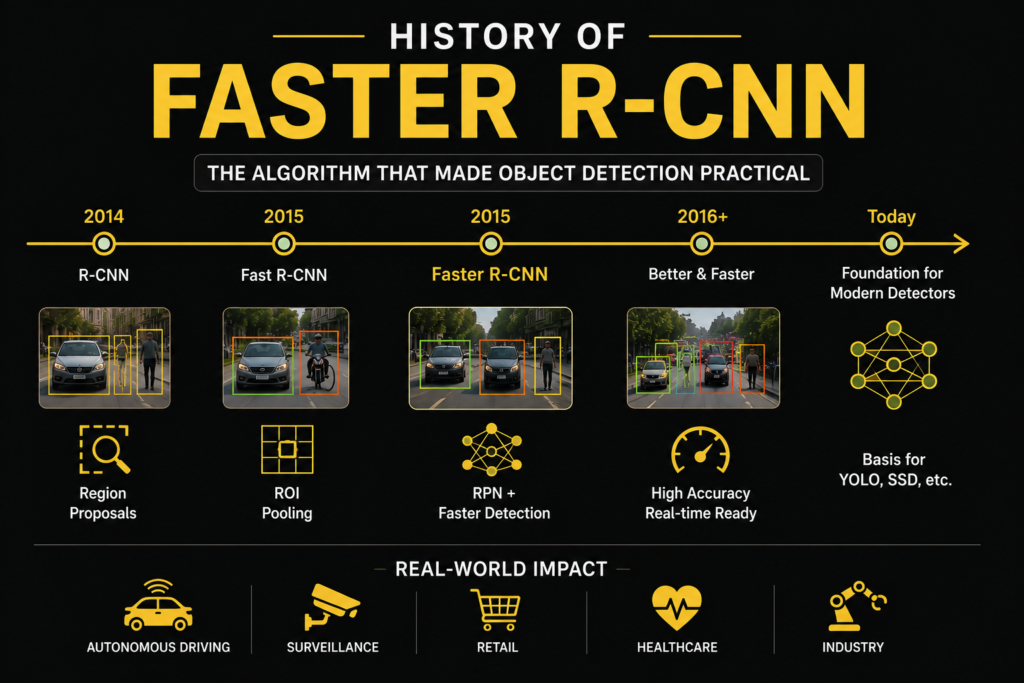
Object detection had a speed problem. The history of r-cnn had proven that deep convolutional networks could outperform traditional methods at finding objects within images, but the original architecture was painfully slow, often taking tens of seconds per image. The history of faster r-cnn is the story of how researchers solved this problem by rethinking one of the most expensive parts of the entire pipeline, transforming object detection from an academic curiosity into something that could actually be deployed in real applications. This article covers that history in full detail, from the architectural innovations involved to the lasting influence Faster R-CNN continues to have on computer vision today.
Setting the Stage: The Limits of Fast R-CNN
By the time the history of faster r-cnn begins, the field had already made significant progress beyond the original R-CNN. Fast R-CNN, an intermediate step, had addressed one major inefficiency by processing the entire image through a convolutional network just once, then extracting features for each candidate region from this shared feature map using RoI Pooling layers, rather than running each region through the network separately.
This was a meaningful improvement, but Fast R-CNN still relied on selective search, a traditional, hand-crafted algorithm running outside the neural network, to generate region proposals in the first place. Faster R-CNN vs Fast R-CNN architectural jump centers on exactly this remaining bottleneck. Selective search was not particularly fast, and because it operated independently from the neural network, it could not benefit from GPU acceleration or be improved through training. Region proposal generation had become the new performance bottleneck, even after the rest of the pipeline had been streamlined.
Shaoqing Ren and the Region Proposal Network (2015)
Shaoqing Ren Faster R-CNN history 2015 begins with a paper titled “Faster R-CNN: Towards Real-Time Object Detection with Region Proposal Networks,” published by Shaoqing Ren, Kaiming He, Ross Girshick, and Jian Sun, representing Microsoft Research Faster R-CNN paper history and continuing the lineage that Girshick had started with the original R-CNN the year before.
The central innovation was the introduction of region proposal networks history, a small neural network that could generate region proposals directly from the same convolutional feature maps already being computed for the main detection task. Rather than running an entirely separate algorithm to find candidate regions, Faster R-CNN integrated proposal generation directly into the neural network architecture itself.
This was the breakthrough of real time deep localization networks in a meaningful sense. By making region proposal generation a learnable, GPU-accelerated component of the network rather than an external, hand-crafted algorithm, Faster R-CNN eliminated the largest remaining bottleneck in the detection pipeline.
How the Region Proposal Network Works
The Region Proposal Network (RPN) is, at its core, a small convolutional network that slides across the shared feature map produced by the main backbone network, originally based on Deep VGG16 backbone integration, the same architecture popularized by the history of VGGNet.
At each position on the feature map, the RPN considers a set of predefined reference boxes called anchors, defined by an anchor parameters grid specifying different scales and aspect ratios. Anchor boxes in object detection, introduced as part of this architecture, allowed the network to predict, for each anchor at each position, whether it likely contains an object and how the anchor’s coordinates should be adjusted to better fit any object present.
This approach reflects a coarse-to-fine localization strategy. The anchors provide a coarse, predefined starting point covering a wide range of possible object shapes and sizes, while the network’s predictions refine these starting points into more precise bounding boxes. Translation invariant windows, meaning the same set of anchor shapes and the same network weights are applied at every position on the feature map, allowed the RPN to detect objects regardless of where they appeared within the image, an important property for generalization.
Learnable region proposals represented a fundamental shift from the hand-crafted proposal algorithms used in earlier detectors. Because the RPN was trained jointly with the rest of the network, it could learn to generate proposals that were specifically useful for the detection task at hand, rather than relying on generic, task-independent region proposals.
Shared Feature Maps: The Key to Speed
Shared convolutional feature maps timeline is central to understanding why Faster R-CNN was so much faster than its predecessors. In the original R-CNN, each of roughly 2,000 region proposals was processed independently through a convolutional network, an enormously redundant computation given how much overlapping image content these regions shared.
Faster R-CNN, building on the shared feature abstraction introduced in Fast R-CNN, computed convolutional features for the entire image just once. Both the region proposal network and the final classification and bounding box regression stages operated on this single shared feature map, rather than recomputing features for each region separately.
This sharing of computation between the proposal generation stage and the final detection stage was the key architectural insight that made Faster R-CNN dramatically faster than its predecessors while maintaining, and in many cases improving, accuracy. The fully convolutional layers used throughout the architecture meant that the entire system, from raw image to final detections, could process images of varying sizes efficiently.
Training Faster R-CNN: Alternating and Joint Approaches
History of alternating training in Faster R-CNN reflects the practical challenges of training a system with two components, the region proposal network and the detection network, that both depend on shared convolutional features but serve somewhat different purposes.
In the original implementation, training proceeded in an alternating fashion: the region proposal network was trained first, then used to generate proposals for training the detection network, then the shared convolutional layers were fine-tuned again with the detection network’s gradients, and the process repeated for several rounds. This alternating approach was complex but allowed both components to be trained effectively despite their interdependence.
Multi-task loss function computation later became standard, allowing the region proposal network and the detection network to be trained jointly in a single, end-to-end process, with a combined loss function that accounted for both the quality of the region proposals and the accuracy of the final classifications and bounding boxes. This joint training approach simplified the overall training process while achieving comparable or better results than the original alternating approach.
Faster R-CNN’s Impact on Object Detection Benchmarks (2015)
The introduction of Faster R-CNN represented a major step in Evolution of end to end two stage detectors, demonstrating that the entire object detection pipeline, from raw image to final bounding boxes and class labels, could be implemented as a single neural network trained largely end to end, with the exception of certain post-processing steps like non-maximum suppression.
On standard object detection benchmarks of the time, Faster R-CNN achieved significant improvements in both speed and accuracy compared to both the original R-CNN and Fast R-CNN. The combination of accuracy and dramatically improved speed, compared to its predecessors, made Faster R-CNN one of the most influential architectures in the history of object detection, and it quickly became a standard baseline against which new object detection methods were compared.
This period also saw Faster R-CNN’s influence extend into related tasks. The history of image segmentation benefited from architectural ideas first demonstrated in Faster R-CNN, particularly the use of RoI Pooling and its successors for extracting features corresponding to specific regions of an image, ideas that were later extended to produce pixel-level segmentation masks rather than just bounding boxes.
Architectural Legacy of Faster R-CNN in AI
Architectural legacy of Faster R-CNN in AI extends well beyond object detection narrowly defined. The core idea of using a shared backbone network to produce feature maps that multiple task-specific heads can then operate on, whether for classification, bounding box regression, or segmentation, became a foundational pattern in computer vision system design.
The YOLO vs R-CNN vs SSD comparison that frames much of how researchers and practitioners think about object detection tradeoffs exists in its current form largely because Faster R-CNN established such a strong baseline for the two-stage approach. Anchor boxes in object detection, introduced as part of the RPN, were subsequently adopted by single-stage detectors including early versions of the history of yolo and the single shot detector, demonstrating how architectural innovations from Faster R-CNN influenced even the competing single-stage approaches it was originally contrasted against.
Transfer learning in computer vision also benefited significantly from Faster R-CNN’s design. Because the architecture relied on a standard backbone network, originally VGG16 but later including architectures from the history of ResNet and other families, pretrained on large datasets like the one behind the history of imagenet, practitioners could adapt Faster R-CNN to new detection tasks by fine-tuning a network that already understood general visual features, significantly reducing the amount of task-specific training data required.
Faster R-CNN in Practical Applications
The practical impact of the history of faster r-cnn extends across numerous industries that rely on computer vision technology for object detection. Medical imaging ai applications have used Faster R-CNN and its derivatives to detect and localize abnormalities within scans, where accuracy is often prioritized over the absolute fastest possible processing speed.
Computer vision in manufacturing applications have similarly benefited from Faster R-CNN’s accuracy advantages, particularly for detecting small or subtle defects where two-stage detectors generally outperform faster single-stage alternatives. While Faster R-CNN itself is not typically fast enough for real-time video applications like those handled by the history of yolo, its descendants and architectural principles continue to inform systems where the speed vs accuracy tradeoff favors accuracy.
Frequently Asked Questions
Who created Faster R-CNN?
Faster R-CNN was created by Shaoqing Ren, Kaiming He, Ross Girshick, and Jian Sun, published in a 2015 paper while several of the authors were at Microsoft Research. It built directly on the earlier R-CNN and Fast R-CNN architectures developed primarily by Ross Girshick.
What is the Region Proposal Network in Faster R-CNN?
The Region Proposal Network, or RPN, is a small neural network integrated into Faster R-CNN that generates candidate object regions directly from the shared convolutional feature map of the input image. It uses a set of predefined anchor boxes at each position on the feature map to predict whether an object is likely present and how the anchor should be adjusted to better fit it.
How is Faster R-CNN different from Fast R-CNN?
Fast R-CNN improved on the original R-CNN by sharing convolutional computation across all region proposals for a given image, but it still relied on selective search, a hand-crafted external algorithm, to generate those proposals. Faster R-CNN replaced selective search with a learned Region Proposal Network integrated directly into the same network, eliminating the remaining major bottleneck and allowing the entire system to be trained end to end.
Is Faster R-CNN still used today?
Yes, particularly in applications where accuracy is more important than processing speed, such as certain medical imaging ai and computer vision in manufacturing tasks. While faster single-stage detectors like the history of yolo and the single shot detector are often preferred for real-time applications, Faster R-CNN and its descendants remain in active use and continue to influence new architectural designs.
Why was Faster R-CNN considered a breakthrough?
Faster R-CNN was considered a breakthrough because it eliminated the last major non-learnable, computationally expensive component of the object detection pipeline, the external region proposal algorithm, by replacing it with a Region Proposal Network trained jointly with the rest of the system. This made the entire pipeline end to end trainable, dramatically improved speed compared to earlier R-CNN variants, and set a new standard for accuracy on object detection benchmarks.
Conclusion
The history of faster r-cnn represents the moment object detection moved from a promising but impractical research result toward something genuinely usable in real applications. By introducing the Region Proposal Network and sharing convolutional features between proposal generation and final detection, Shaoqing Ren and his collaborators eliminated the most significant remaining bottleneck in the pipeline that began with R-CNN.
The architectural ideas introduced in Faster R-CNN, shared backbones, learnable region proposals, and anchor-based predictions, continue to influence object detection research and remain embedded in countless systems built on computer vision technology today. Understanding the history of faster r-cnn is understanding a key turning point where deep learning based object detection became fast enough, and accurate enough, to move from research papers into real-world deployment.