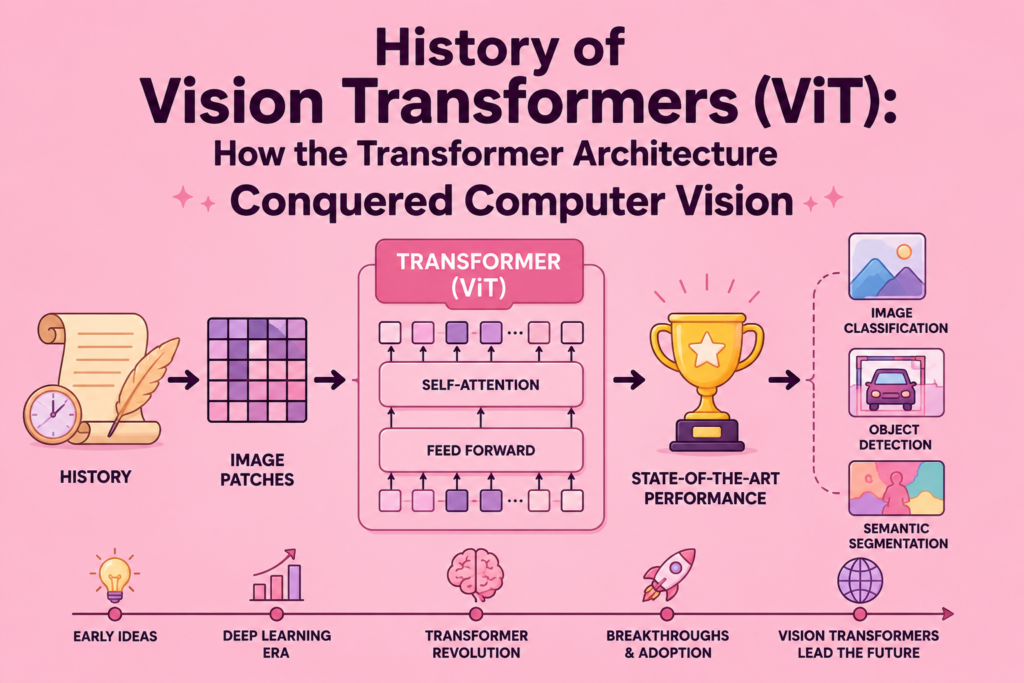
For nearly a decade after the history of AlexNet in 2012, convolutional neural networks dominated computer vision so completely that it became difficult to imagine any alternative architecture displacing them. Then, in 2020, researchers demonstrated that an architecture originally developed for language, the transformer, could be applied directly to images, achieving results that rivaled and eventually surpassed convolutional approaches on major benchmarks. Vision transformers represent one of the most significant architectural shifts in the entire history of computer vision, and this article traces that history from the architecture’s language model origins to its current role alongside, and sometimes in place of, convolutional networks.
What Are Vision Transformers in Computer Vision
What are vision transformers in computer vision is a question best answered by first understanding where transformers came from. The transformer architecture was originally introduced for natural language processing, built around a mechanism called self-attention that allows a model to weigh the importance of different parts of an input relative to each other, regardless of their distance within the input sequence.
For text, this meant a transformer could relate a word at the beginning of a sentence to a word at the end, without the kind of step-by-step processing that earlier architectures required. The question vision transformers research set out to answer was whether this same fundamental mechanism, designed for sequences of words, could be adapted to work with images, which are fundamentally different in structure, two-dimensional grids of pixels rather than one-dimensional sequences of tokens.
History of Self Attention Mechanisms in Vision
History of self attention mechanisms in vision predates the full vision transformer architecture by several years. Researchers had experimented with incorporating attention mechanisms into convolutional architectures, allowing networks to focus on specific regions of an image more heavily than others, long before anyone proposed replacing convolutions with attention entirely.
These early experiments demonstrated that attention mechanisms could improve performance on various computer vision tasks, but they were generally used as additions to convolutional architectures rather than as wholesale replacements. The question of whether attention alone, without any convolutional layers at all, could handle image processing effectively remained open until a specific architectural proposal addressed it directly.
An Image Is Worth 16×16 Words (2020)
An Image is Worth 16×16 Words is the title of the paper that introduced the original vision transformer architecture in 2020, published by researchers at Google. ViT deep learning model architecture explained begins with this paper’s core insight: an image could be divided into a grid of fixed-size patches, for example 16 by 16 pixels each, and each of these patches could be treated similarly to how a transformer treats a word or token in a sentence.
Image patch embeddings represent the first step in this process. Each patch of the image, a small square region of pixels, is flattened into a vector and passed through Linear projection layers, transforming the raw pixel values of each patch into a representation, an embedding, that the transformer architecture can work with, analogous to how word embeddings represent words in language models.
Positional embedding vectors address an important challenge that arises from this patch-based approach. Unlike convolutional networks, which inherently understand spatial relationships because convolutional filters operate on local neighborhoods of pixels, a transformer treating patches as a sequence has no inherent sense of where each patch was located within the original image. Positional embeddings solve this by adding information about each patch’s original position to its embedding, allowing the transformer to take spatial arrangement into account.
How Vision Transformers Process Images
Once an image has been divided into patches and converted into embeddings with positional information, these embeddings are processed by Transformer encoder blocks, the same fundamental building blocks used in transformer-based language models. Each encoder block applies self-attention, allowing every patch embedding to attend to every other patch embedding, weighing their relative importance for the task at hand.
Multi head self attention in vision models extends this further. Rather than computing a single attention pattern, multiple attention heads compute different attention patterns in parallel, potentially capturing different types of relationships between patches, some heads might focus on local relationships between nearby patches, while others might capture relationships between distant patches that nonetheless relate to the same object or scene element.
Global context dependencies represent perhaps the most significant practical difference between vision transformers and convolutional networks. A convolutional layer’s receptive field, the region of the input image that influences a given output, starts small and grows gradually as information passes through successive layers. A self-attention layer, by contrast, can relate any patch to any other patch immediately, regardless of their spatial distance, providing access to global context from the very first layer.
Vision Transformers vs Convolutional Neural Networks
Vision transformers vs convolutional neural networks represents one of the most discussed comparisons in modern computer vision research. Convolutional architectures, including those descended from the history of VGGNet, the history of GoogLeNet, have built-in assumptions about images, that nearby pixels are more related than distant pixels, and that the same features, edges, textures, shapes, are useful regardless of where they appear in an image.
Inductive bias limitations describe how these built-in assumptions, while generally helpful, can also be limiting. Convolutional networks are, in a sense, told in advance how to think about images. Vision transformers, lacking these built-in assumptions, need to learn relevant spatial relationships entirely from data, which generally requires significantly more training data to achieve comparable performance, but may also allow the network to discover relationships that convolutional architectures’ assumptions might not accommodate well.
Training vision transformers on large scale datasets became an important practical consideration as a result. The original ViT paper found that vision transformers underperformed convolutional networks when trained on smaller datasets, but matched or exceeded convolutional performance when trained on sufficiently large datasets, datasets significantly larger than the history of imagenet benchmark that had driven much of the deep learning transformed computer vision progress through the 2010s.
Computational FLOPs scaling also differs between the two architecture families. Self-attention mechanisms have computational requirements that scale differently than convolutions as image resolution increases, an important practical consideration for deploying these architectures, particularly for high-resolution images or video.
Applications of Vision Transformers in Image Analysis
Applications of vision transformers in image analysis expanded rapidly following the original 2020 paper. Vision transformers for object detection benchmarks became an active area of research, with researchers adapting the basic ViT architecture for tasks beyond simple image classification, including the kinds of detection and localization tasks central to the history of object detection more broadly, and segmentation tasks related to the history of image segmentation.
Transfer learning in computer vision, a practice that had become standard following the success of convolutional architectures pretrained on ImageNet, was adapted for vision transformers as well, with large vision transformer models pretrained on massive datasets serving as a foundation for fine-tuning on more specific tasks, similar in spirit to how pretrained convolutional networks had been used previously.
Masked autoencoders (MAE) represent an important training approach developed for vision transformers, drawing inspiration from similar masked prediction approaches used in language model training. By training a model to reconstruct portions of an image that have been deliberately hidden, masked autoencoders provide an effective way to pretrain vision transformers without requiring labeled data, an important consideration given how much data these architectures benefit from.
Hybrid Approaches: The Best of Both Worlds
Future of hybrid CNN vision transformer models reflects an important trend in how the field has responded to the introduction of vision transformers. Rather than vision transformers completely replacing convolutional networks, much research has focused on combining elements of both approaches, using convolutional layers for early processing where their inductive biases about local structure are particularly helpful, while using transformer-based attention mechanisms for later processing where global context becomes more important.
This hybrid approach reflects a broader pattern that has recurred throughout the history of computer vision: rather than each new architectural paradigm completely displacing previous ones, different approaches often find their respective strengths and end up coexisting, sometimes combined within the same overall system, with the specific combination depending on the requirements of a given task.
This pattern connects directly to applications including self-driving cars and computer vision and medical imaging ai, where the specific accuracy, efficiency, and interpretability requirements of different tasks influence whether convolutional, transformer-based, or hybrid architectures are most appropriate.
Vision Transformers and Interpretability
Attention heatmap generation represents one practical benefit that has emerged from the attention mechanisms underlying vision transformers. Because self-attention explicitly computes how much each part of an image attends to other parts, these attention patterns can be visualized, providing some insight into which regions of an image a model is focusing on when making a particular prediction.
This interpretability benefit connects to broader concerns within computer vision technology about understanding why deep learning models make the predictions they do, particularly important in high-stakes applications like medical imaging ai, where understanding which parts of an image influenced a diagnosis can be valuable for building trust in automated systems and for catching potential errors.
Edge AI Deployment of Vision Transformers
Edge AI deployment of vision transformers presents practical challenges related to the computational requirements discussed earlier. While vision transformers have shown impressive results on large-scale benchmarks, deploying these models efficiently on resource-constrained devices, similar to the kinds of constraints discussed in relation to drones and computer vision and other edge computing applications, requires careful consideration of model size, computational requirements, and the specific accuracy versus efficiency tradeoffs appropriate for a given application.
Ongoing research into more efficient vision transformer variants, as well as hybrid architectures that combine the efficiency advantages of convolutional approaches with the global context advantages of attention mechanisms, continues to address these practical deployment considerations.
Frequently Asked Questions
What is a vision transformer?
A vision transformer is a neural network architecture that applies the transformer architecture, originally developed for language processing, to images. It works by dividing an image into fixed-size patches, converting each patch into an embedding, adding positional information, and processing these embeddings using self-attention mechanisms that allow every patch to relate to every other patch.
How do vision transformers differ from convolutional neural networks?
Convolutional neural networks process images using local filters that operate on small neighborhoods of pixels, with built-in assumptions about spatial relationships in images. Vision transformers process images as sequences of patches using self-attention, which provides access to global context from the first layer but requires learning spatial relationships from data rather than having them built in, generally requiring larger training datasets to achieve comparable performance.
Why do vision transformers need so much training data?
Vision transformers lack the built-in assumptions about images, such as the importance of local spatial relationships, that convolutional networks have. This means vision transformers need to learn these relationships entirely from data, which generally requires significantly larger training datasets compared to convolutional networks to achieve comparable performance, though techniques like masked autoencoders have helped address this challenge.
Are vision transformers replacing convolutional neural networks?
Not entirely. While vision transformers have achieved strong results on many benchmarks, much current research focuses on hybrid architectures that combine convolutional layers, particularly useful for early processing where local structure matters, with transformer-based attention mechanisms, useful for later processing where global context becomes important. Different applications may favor convolutional, transformer-based, or hybrid approaches depending on their specific requirements.
What are masked autoencoders and why are they important for vision transformers?
Masked autoencoders are a training approach where a model learns to reconstruct portions of an image that have been deliberately hidden, similar to masked prediction approaches used in training language models. This provides an effective way to pretrain vision transformers without requiring labeled data, helping address the large data requirements of these architectures.
Conclusion
The history of vision transformers represents one of the most significant architectural developments in computer vision since the deep learning transformed computer vision revolution began with AlexNet in 2012. By adapting the transformer architecture, originally developed for language, to work with images divided into patches, researchers demonstrated that self-attention mechanisms could match and, with sufficient data, exceed the performance of convolutional architectures that had dominated the field for nearly a decade.
Rather than completely replacing convolutional networks, vision transformers have become part of a broader, more diverse architectural landscape within computer vision technology, with hybrid approaches combining the strengths of both paradigms increasingly common across applications ranging from object detection to medical imaging. Understanding the history of vision transformers means understanding how an idea from an entirely different domain, language processing, found a powerful new application, reshaping what researchers consider the default architecture for visual tasks.