For centuries, physicists treated mass and energy as entirely separate concepts, governed by two completely independent conservation laws. Matter was matter, solid and measurable. Energy was something else entirely, capable of changing form but never becoming matter itself. Then, in 1905, Albert Einstein proposed something almost unbelievable. The equivalence of mass and energy meant these two seemingly distinct properties were, in fact, the very same thing, expressed through different physical forms.
Understanding the equivalence of mass and energy means grasping one of the most profound unifications in the history of science, a discovery that revealed matter itself as an incredibly concentrated form of energy, waiting to be released under the right physical conditions.
Two Separate Laws Before Einstein
Before diving into the equivalence of mass and energy, it helps to understand the classical worldview it replaced. Nineteenth century physics operated according to two distinct conservation laws. The conservation of mass stated that matter could neither be created nor destroyed, only rearranged through chemical reactions. Separately, the law of conservation of energy stated that energy could change form, from kinetic to potential to thermal, but never simply vanish or appear from nothing.
These two principles worked perfectly well within their respective domains, yet nothing suggested any deeper connection between them. Mass and energy occupied entirely separate categories within classical physics, treated as fundamentally different types of physical quantities.
Einstein’s Radical Proposal (1905)
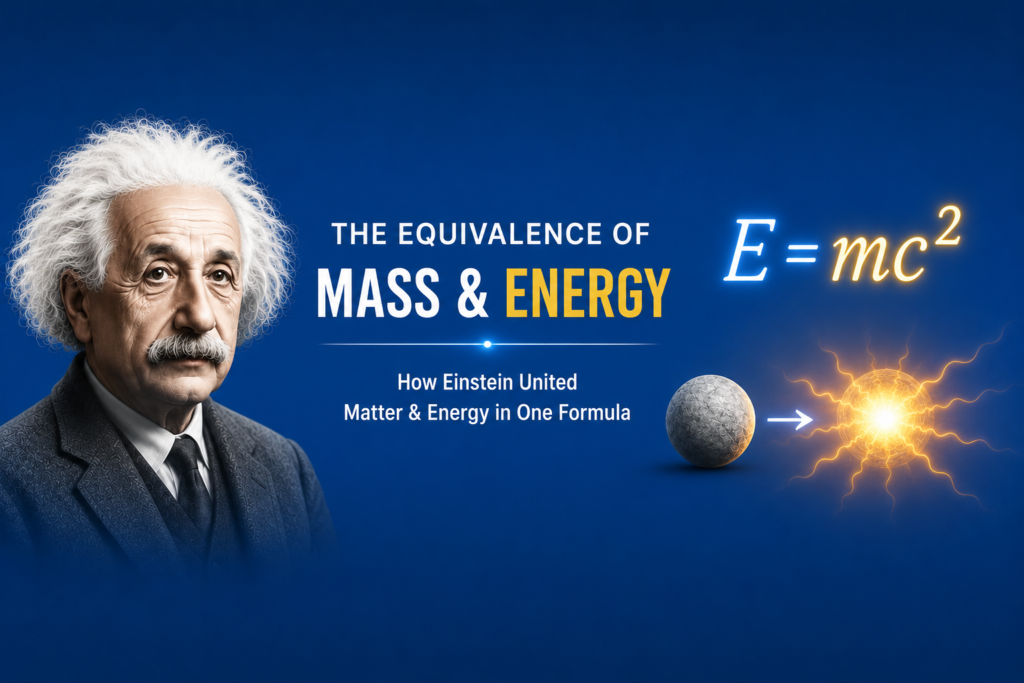
During his remarkable miracle year, alongside groundbreaking papers on special relativity explained and the photoelectric effect, Einstein derived a striking mathematical consequence suggesting that mass and energy were fundamentally interchangeable. This became known as the equivalence of mass and energy, expressed through what remains the most famous equation in scientific history:
E = mc²
Here, E represents energy, m represents mass, and c represents the invariant speed of light, approximately 299,792,458 meters per second. Because c is squared within this equation, the conversion constant c squared becomes an enormous number, revealing that even tiny amounts of mass correspond to absolutely staggering quantities of energy once converted according to this relationship.
What This Formula Actually Means
The equivalence of mass and energy suggests something genuinely radical about the nature of matter itself. According to Einstein’s reasoning, mass represents a form of latent energy in mass, a concentrated, dormant form of energy sitting quietly within every object, waiting for the right physical process to release it. This concept fundamentally challenged the idea that matter and energy belonged to entirely separate categories.
This relationship also required combining the previously separate conservation laws into a single, unified principle now known as conservation of mass-energy law, stating that the total combination of mass and energy within any closed system remains constant, even though mass alone or energy alone might individually increase or decrease during physical processes.
Rest Energy: The Hidden Energy Within Matter
A crucial concept within the equivalence of mass and energy involves rest energy vs kinetic energy considerations. Even a completely stationary object, possessing no kinetic energy whatsoever from motion, still contains enormous rest energy simply due to its mass, calculated directly through E = mc². This rest energy represents the theoretical maximum energy that could be extracted from an object’s mass alone, independent of any additional motion or external energy sources.
This distinction matters significantly when considering invariant mass particle system calculations, since an object’s fundamental rest energy remains constant regardless of the observer’s own motion or reference frame, providing a stable, measurable quantity central to relativistic physics calculations.
Nuclear Reactions: Mass Converting Into Energy
Perhaps the most dramatic demonstration of the equivalence of mass and energy occurs within nuclear reaction mass loss processes. During nuclear fission, heavy atomic nuclei split apart into smaller fragments, and the combined mass of these resulting fragments is measurably less than the original nucleus’s mass. This missing mass has not simply disappeared. It has converted directly into energy according to Einstein’s formula.
This phenomenon relates directly to nuclear binding mass defect calculations, since the energy originally required to hold a nucleus together, called binding energy, corresponds precisely to this measurable mass difference. Understanding this relationship became essential to einstein and nuclear energy applications, from peaceful power generation to more consequential wartime applications developed decades after Einstein’s original theoretical insight.
Fusion Reactions and Stellar Energy
The equivalence of mass and energy also explains thermonuclear energy release occurring continuously within stars, including our own sun. During nuclear fusion, lighter atomic nuclei combine to form heavier elements, and once again, the resulting mass proves slightly less than the combined mass of the original starting materials. This subatomic conversion efficiency, though representing only a tiny fraction of total mass involved, releases tremendous quantities of energy, powering stellar processes that have illuminated our sun for billions of years.
Pair Production: Energy Becoming Matter
Remarkably, the equivalence of mass and energy also works in reverse, demonstrated through pair production photon electron phenomena. Under specific high energy conditions, a sufficiently energetic photon can spontaneously transform into a matter creation threshold event, producing both a particle and its corresponding antiparticle, such as an electron alongside a positron.
This represents energy turned into matter directly, a genuinely stunning confirmation that mass and energy truly represent two expressions of the same underlying physical reality, rather than fundamentally separate categories as classical physics had assumed.
Annihilation: The Complete Reverse Process
The opposite phenomenon, positron electron annihilation, demonstrates the equivalence of mass and energy with equally striking clarity. When a particle collides with its corresponding antiparticle, both particles completely vanish, their entire combined mass converting directly into gamma photon matter creation energy, following mass-energy balance calculations with perfect precision.
This annihilation process represents perhaps the most complete, unambiguous demonstration possible of the equivalence of mass and energy, since absolutely no residual matter remains afterward, only pure energy exactly matching the original particles’ combined mass according to Einstein’s famous formula.
Connecting to Quantum Theory
Interestingly, the equivalence of mass and energy also connects historically to quantum theory through Einstein’s collaborative intellectual relationship with einstein and planck. Just as Planck’s quantum hypothesis revealed that energy exists in discrete photon packets, Einstein’s mass-energy relationship revealed that this same energy could be derived directly from matter itself, uniting two of the most transformative theoretical breakthroughs of the early twentieth century within a shared conceptual framework regarding the fundamental nature of physical reality.
This principle also relates conceptually to wave-particle duality explained, since photons themselves, despite possessing zero rest mass, still carry measurable energy and momentum, demonstrating yet another dimension of how mass and energy interrelate throughout modern physics.
Why This Discovery Still Matters Today
Beyond nuclear applications, the equivalence of mass and energy continues influencing modern physics research, astrophysics, and particle physics experiments conducted at facilities worldwide. This principle stands among the clearest examples of einstein predictions proven through decades of rigorous experimental verification, confirmed repeatedly through particle accelerator experiments and precise astrophysical observations.
The Legacy: Uniting Matter and Energy Forever
The Albert Einstein legacy surrounding the equivalence of mass and energy demonstrates how one theoretical insight, developed purely through mathematical reasoning during his remarkable 1905 miracle year, could eventually reshape humanity’s understanding of energy production, nuclear physics, and the fundamental nature of matter itself throughout the universe.
Frequently Asked Questions
What does the equivalence of mass and energy mean?
The equivalence of mass and energy means that mass and energy are interchangeable properties of matter, expressed through Einstein’s famous equation E equals mc squared.
How is this principle used in nuclear reactions?
Nuclear fission and fusion both convert small amounts of mass into large amounts of energy, directly demonstrating the equivalence of mass and energy in practical applications.
Can energy really turn into matter?
Yes, through pair production, sufficiently energetic photons can spontaneously create matched particle and antiparticle pairs, demonstrating that energy can convert directly into matter.
Why is the speed of light squared in this equation?
The speed of light squared serves as an enormous conversion factor, explaining why even tiny amounts of mass correspond to extremely large amounts of energy.
Is the equivalence of mass and energy still relevant today?
Yes, this principle remains fundamental to nuclear physics, astrophysics, and particle physics research, continuing to explain phenomena from stellar energy production to particle annihilation.
Conclusion
The equivalence of mass and energy stands as one of the most profound unifications in the history of physics, revealing that matter and energy represent two expressions of the same underlying physical reality. Born from Einstein’s theoretical reasoning during his remarkable 1905 miracle year, this discovery eventually reshaped nuclear physics, energy production, and humanity’s fundamental understanding of matter itself. More than a century later, the equivalence of mass and energy continues powering both scientific research and practical technology, standing as one of the most consequential unifications ever achieved in the history of science.