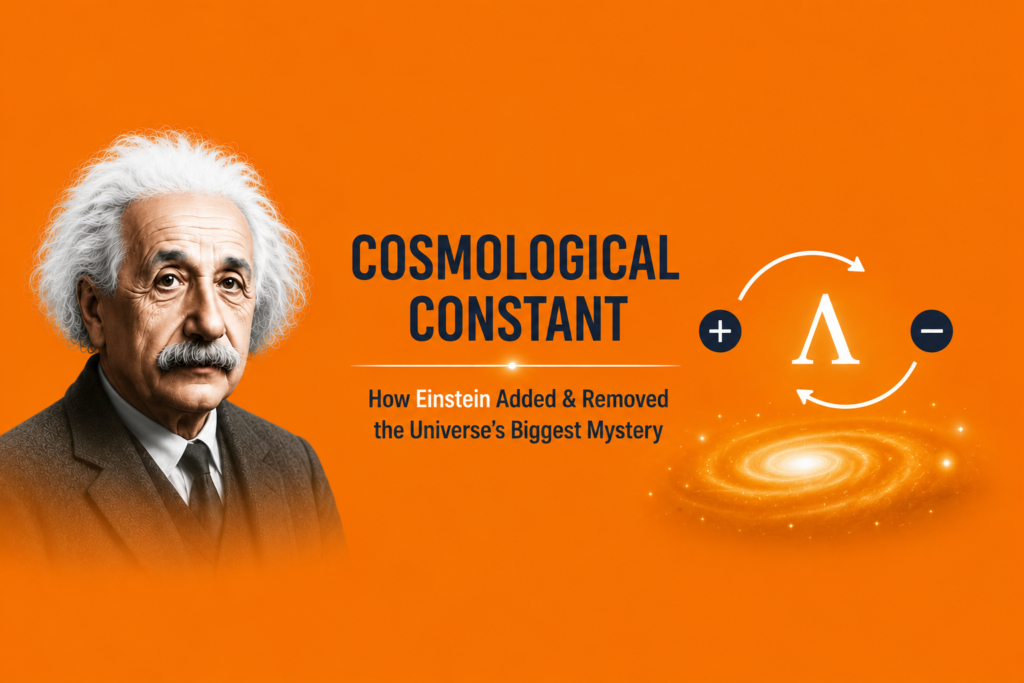
Few scientific stories carry as much irony as the tale of the cosmological constant explained through Einstein’s own shifting judgment. He introduced this mysterious term into his equations to solve one problem, later called it his greatest mistake, and decades after his death, scientists discovered it might represent one of the most important forces shaping the entire universe. This strange, back-and-forth journey reveals just how unpredictable scientific discovery can truly be, even for history’s greatest theoretical mind.
Understanding the cosmological constant explained means following a century long scientific detective story, one that begins with a static universe theory, passes through embarrassment and rejection, and ends with modern cosmology’s most puzzling mystery regarding dark energy.
Building a Universe: Einstein’s Equations Meet Cosmology (1915 – 1917)
Shortly after publishing his complete general relativity explained theory in 1915, Einstein turned his attention toward applying these equations to the universe as a whole. This ambitious project, developed further in 1917, connected directly to Einstein’s revolutionary insight that gravity is curved spacetime, extending this geometric framework to describe the entire cosmos rather than isolated gravitational systems.
However, Einstein encountered an immediate and troubling problem. His original equations predicted that a universe filled with matter should either be expanding or contracting, never remaining perfectly static. This directly contradicted the prevailing scientific assumption of the era, which held that the universe existed as an unchanging, static cosmic model 1917 backdrop, eternal and unchanging throughout all time.
Introducing the Cosmological Constant (1917)
To resolve this contradiction, Einstein introduced an additional term into his field equations, represented by the Greek letter lambda, written as Λ. This became known as the cosmological constant explained through his modified equations, expressed in simplified form as:
G_μν + Λg_μν = 8πG/c⁴ × T_μν
Here, G_μν represents spacetime curvature, Λ represents the newly introduced cosmological constant, g_μν represents the metric tensor describing spacetime geometry, and T_μν represents mass and energy distribution. This additional Lambda Λ symbol relativity term functioned essentially as a repulsive gravitational force, precisely counterbalancing the attractive pull of ordinary matter and gravity, allowing Einstein’s equations to finally predict a stable, unchanging universe matching prevailing scientific assumptions of his time.
Einstein’s Biggest Blunder (1929)
This carefully constructed static universe picture collapsed entirely in 1929, when American astronomer Edwin Hubble made a startling discovery. Through careful observation of distant galaxies, Edwin Hubble 1929 discovery revealed that virtually every galaxy exhibited galactic redshift Doppler shift patterns, indicating they were moving away from Earth, and remarkably, more distant galaxies were receding faster than closer ones.
This groundbreaking observation provided direct evidence that the universe was not static at all, but actually expanding continuously, exactly as Einstein’s original, unmodified equations had predicted before he introduced his cosmological constant fix. Einstein reportedly called his introduction of the cosmological constant his greatest blunder, a rare moment of scientific self-criticism from one of history’s most celebrated physicists.
Why Einstein Abandoned His Own Idea
Following Hubble’s discovery, Einstein quickly abandoned the cosmological constant explained through his earlier static universe attempt, considering it an unnecessary complication that had prevented him from confidently predicting cosmic expansion years before Hubble’s direct observational confirmation. For decades afterward, the cosmological constant became largely forgotten, dismissed as an interesting historical footnote representing one of Einstein’s rare theoretical missteps.
Most physicists throughout the following decades simply set Lambda equal to zero within Einstein’s equations, treating the term as an unnecessary complication rather than a genuine feature of physical reality, a conclusion that seemed thoroughly justified given the expanding vs static cosmos evidence Hubble had provided.
An Unexpected Return: The Accelerating Universe (1998)
Remarkably, the cosmological constant explained through Einstein’s abandoned idea experienced a dramatic scientific resurrection in 1998. Two independent research teams, studying accelerating universe 1998 evidence through careful type Ia supernovae measurements, discovered something genuinely shocking. Not only was the universe expanding, as Hubble had shown decades earlier, but this expansion itself was accelerating over time.
This unexpected acceleration could not be explained through ordinary matter and energy alone. Something else, some mysterious repulsive influence, appeared to be pushing galaxies apart at an ever increasing rate, precisely the kind of behavior Einstein’s long abandoned cosmological constant had originally described.
Dark Energy: Reviving Einstein’s Rejected Idea
Physicists now believe this mysterious acceleration results from what has become known as dark energy cosmological constant, a still poorly understood form of vacuum energy density permeating all of space itself. According to modern calculations, this vacuum energy density rho_vac exhibits precisely the repulsive gravitational properties that Einstein’s original cosmological constant had described, complete with cosmological pressure negative characteristics pushing spacetime apart rather than pulling it together.
This discovery represents one of science’s most remarkable ironies. Einstein’s supposed greatest blunder turned out to describe something genuinely real about the universe, just for entirely different reasons than he originally intended when solving his static universe puzzle back in 1917.
The Lambda-CDM Model: Modern Cosmology’s Framework
Today’s leading cosmological framework, known as the Lambda-CDM cosmological model, incorporates Einstein’s revived cosmological constant explained as an essential component alongside dark matter and ordinary visible matter. This model, built upon foundational friedmann lemaitre robertson walker equations describing cosmic expansion, provides remarkably accurate predictions matching observed cosmic expansion speed and large scale universe structure.
According to current measurements, dark energy, represented mathematically through the cosmological constant, comprises roughly seventy percent of the universe’s total mass energy content, making it the dominant influence determining our cosmos’s ultimate long term fate and continued expansion.
The Cosmological Constant Problem
Despite this remarkable observational success, physicists still face what has become known as the cosmological constant problem, a significant theoretical puzzle involving quantum vacuum fluctuations. When physicists attempt calculating the expected vacuum energy density using established quantum field theory, their theoretical predictions differ from actual observed values by an almost incomprehensibly large factor, representing one of the most significant unresolved discrepancies throughout modern theoretical physics.
This ongoing puzzle connects meaningfully to broader questions regarding einstein and planck‘s combined legacy in establishing quantum theory, since resolving the cosmological constant problem likely requires deeper understanding of how quantum mechanics and gravity ultimately unify together.
Why This Story Still Matters Today
The remarkable journey of the cosmological constant explained, from Einstein’s original static universe fix through his self-declared blunder to its unexpected revival as dark energy, demonstrates the beautifully unpredictable nature of scientific discovery itself. This story stands among the most fascinating examples of einstein predictions proven in an entirely unexpected way, connecting distantly to his earlier theoretical triumphs including mass-energy equivalence and general relativity.
The Legacy: Einstein’s Unexpected Cosmic Contribution
The Albert Einstein legacy surrounding the cosmological constant explained demonstrates how even a scientist’s admitted mistake can eventually reveal genuine, profound truths about the universe. What Einstein once called his greatest blunder now stands as one of modern cosmology’s most essential concepts, continuing to shape ongoing research into dark energy, cosmic expansion, and the ultimate fate of our universe.
Frequently Asked Questions
What is the cosmological constant explained simply?
The cosmological constant is a term Einstein added to his equations to allow for a static universe, later revived to explain the observed acceleration of cosmic expansion, now associated with dark energy.
Why did Einstein call the cosmological constant his biggest blunder?
Einstein regretted introducing the cosmological constant after Hubble’s 1929 discovery proved the universe was expanding, meaning his original equations without the constant had been correct all along.
How does the cosmological constant relate to dark energy?
Modern physicists believe dark energy behaves precisely like Einstein’s cosmological constant, representing a mysterious vacuum energy density causing the universe’s expansion to accelerate.
What discovery proved the universe’s expansion was accelerating?
In 1998, two independent research teams studying distant supernovae discovered that cosmic expansion was accelerating, rather than slowing down as previously expected.
What is the cosmological constant problem in physics?
This refers to a massive discrepancy between theoretical quantum predictions and actual observed values for vacuum energy density, representing one of physics’ most significant unresolved puzzles.
Conclusion
The cosmological constant explained through Einstein’s shifting scientific judgment stands as one of the most remarkable stories in the history of physics, a concept introduced, rejected, and ultimately revived across more than a century of scientific discovery. From solving an outdated static universe puzzle to explaining the modern mystery of cosmic acceleration through dark energy, this single mathematical term demonstrates how scientific ideas can find unexpected new life decades after their original purpose. More than a century after Einstein first wrote it into his equations, the cosmological constant remains one of cosmology’s most important, and most mysterious, concepts.