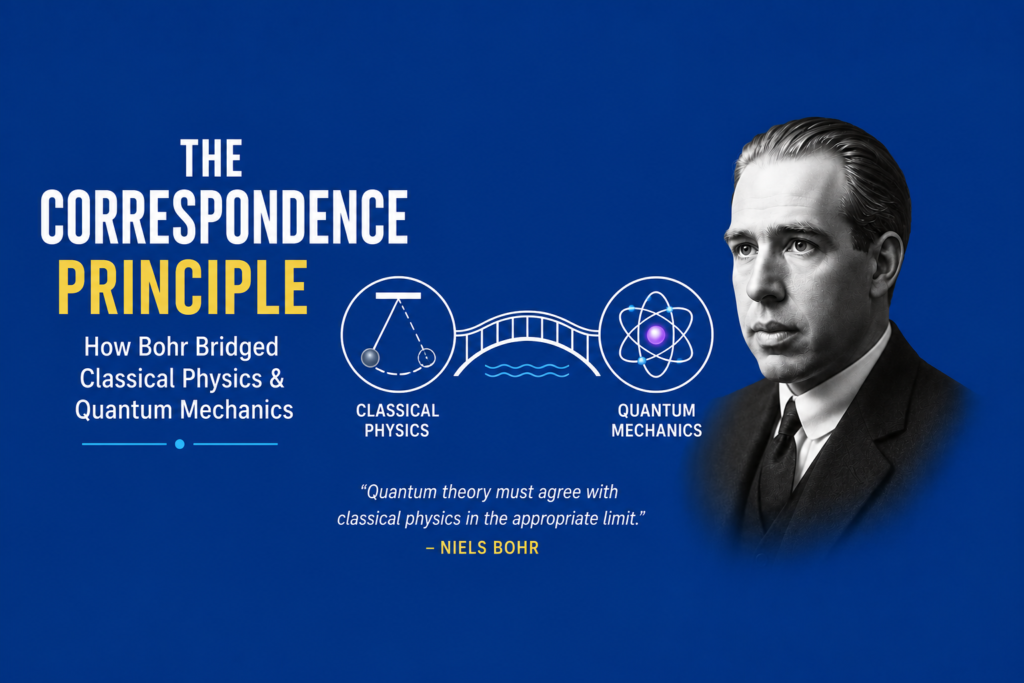
Every revolutionary new theory faces the same essential test. It must explain everything the old theory explained, while also revealing something genuinely new. When Niels Bohr introduced his atomic model in 1913, he faced exactly this challenge. His radical quantum framework needed to somehow connect back to the well-established classical physics that had successfully described the macroscopic world for over two centuries. The correspondence principle became Bohr’s elegant solution, a foundational idea ensuring that quantum mechanics and classical physics remained two consistent descriptions of the same underlying reality, rather than two contradictory, unrelated theories.
Understanding the correspondence principle means grasping one of quantum theory’s most important conceptual safeguards, a guiding rule that helped physicists navigate the transition between two seemingly incompatible worldviews without abandoning either one entirely.
The Problem Quantum Theory Needed to Solve
Before appreciating the correspondence principle, it helps to understand the genuine dilemma facing physicists throughout the early twentieth century. Bohr’s atomic model, describing electron orbits and energy levels as strictly quantized rather than continuous, successfully explained hydrogen’s mysterious spectral lines. Yet this same quantum framework appeared to directly contradict classical electrodynamics, which had accurately described macroscopic electromagnetic phenomena for generations.
This created an uncomfortable situation. If quantum mechanics were genuinely correct, why did classical physics continue working so remarkably well for describing everyday, large-scale phenomena? Physicists needed some theoretical bridge quantum and classical worlds, a way of understanding precisely how and when quantum effects transitioned into familiar classical behavior.
Bohr’s Solution: Introducing the Correspondence Principle (1913 – 1920)
Bohr first hinted at what became the correspondence principle within his original 1913 atomic model papers, though he developed and refined the concept more fully throughout the following years. The core insight stated that quantum mechanical predictions must converge toward classical physics results whenever quantum systems involve very large quantum numbers.
According to this Bohr correspondence principle, as the principal quantum number n describing an electron’s orbital level grows increasingly large, the specific quantum mechanical predictions regarding that electron’s behavior should increasingly resemble, and eventually become indistinguishable from, predictions made using ordinary classical electrodynamics.
Understanding the Classical Limit
Central to the correspondence principle is the concept of the classical limit of quantum mechanics, the specific mathematical regime where quantum effects become negligible and classical descriptions become accurate approximations. This large quantum numbers limit essentially represents the boundary where discrete, quantized behavior smoothly transitions into the continuous, predictable behavior classical physics describes.
Consider Bohr’s frequency condition, expressed through the equation:
ΔE = hf
Here, ΔE represents the energy difference between two electron orbital levels, h represents Planck’s constant, and f represents the resulting photon frequency. For small quantum numbers, corresponding to electrons occupying orbits very close to the nucleus, this energy difference remains relatively large compared to the total energy involved, producing clearly quantum mechanical, discrete behavior.
However, as quantum numbers increase, the relative spacing between adjacent quantized energy levels grows increasingly small compared to the electron’s overall energy. In this high principal quantum number regime, the previously distinct, discrete energy jumps become so closely spaced that they effectively blur together, approximating the smooth, continuous energy changes classical physics predicts.
Mathematical Demonstration: Orbital Frequency Convergence
Bohr demonstrated the correspondence principle mathematically by comparing two different calculations of orbital frequency for an electron within a hydrogen atom. Using purely quantum mechanical reasoning, physicists could calculate the frequency of light emitted when an electron transitions between adjacent orbital levels using Bohr’s frequency condition combined with his energy level formula:
E_n = -13.6 eV / n²
Separately, using purely classical physics reasoning, physicists could calculate the actual orbital frequency of an electron circling the nucleus at a given radius, based simply on classical mechanics governing circular motion under electrostatic attraction.
Remarkably, Bohr proved that for very large values of n, these two independently calculated frequencies, one derived through quantum transition mathematics and the other through classical orbital physics, converge toward identical values. This classical orbits convergence provided compelling mathematical proof that quantum mechanics genuinely contained classical physics as a limiting case, rather than existing as some entirely separate, disconnected theoretical framework.
Why This Principle Mattered So Much
The correspondence principle served several crucial functions within the development of quantum theory. First, it provided physicists with valuable quantum mechanics consistency checks, allowing them to verify whether newly proposed quantum theories or calculations produced sensible results when extended toward classical, macroscopic conditions.
Second, the correspondence principle helped guide theoretical development itself. When physicists throughout the 1920s worked toward developing more complete and sophisticated quantum mechanical frameworks, ensuring their new equations satisfied Bohr’s correspondence requirements became an essential test of any proposed theory’s validity, functioning as a kind of physics unity theory constraint guiding acceptable mathematical development.
Extending Beyond the Hydrogen Atom
While Bohr originally developed the correspondence principle specifically within the context of Bohr’s hydrogen atom solution, the underlying concept extended far beyond this single application. The correspondence principle application proved relevant across numerous areas of emerging quantum theory, including early attempts to understand the quantum harmonic oscillator, where physicists needed to verify that quantum predictions properly converged toward classical oscillator behavior under appropriate limiting conditions.
This harmonic oscillator limit analysis became a standard test throughout quantum mechanics development, ensuring that increasingly sophisticated mathematical frameworks maintained proper continuity with well-established classical mechanics wherever such continuity should reasonably be expected.
The Semi-Classical Bridge
The correspondence principle effectively established what physicists now call semi-classical physics, an intermediate theoretical regime where quantum mechanical principles operate alongside classical approximations, particularly useful for systems involving very large quantum numbers where full quantum mechanical treatment becomes computationally unwieldy or unnecessary.
This semi-classical approximation approach remains genuinely useful throughout modern physics, allowing researchers to apply simplified classical reasoning to certain aspects of quantum systems while reserving full quantum mechanical treatment for situations specifically requiring it, striking a practical balance between mathematical rigor and computational efficiency.
Connecting to Broader Quantum Philosophy
The correspondence principle also connected meaningfully to Bohr’s broader philosophical framework regarding quantum mechanics, including his later development of the complementarity principle and his significant role within the historic Einstein–Bohr debate. While these later contributions addressed different specific questions regarding quantum measurement and interpretation, they shared the same underlying commitment to ensuring quantum mechanics remained a coherent, internally consistent theory properly connected to observable classical reality.
This consistency requirement proved particularly important given ongoing philosophical disagreements captured within Niels Bohr vs Einstein discussions regarding quantum mechanics’ completeness and interpretation. Regardless of these deeper philosophical disputes, both physicists generally accepted that any successful quantum theory needed to satisfy correspondence principle requirements when extended toward classical, macroscopic limits.
Why the Correspondence Principle Still Matters Today
Beyond its historical significance in establishing early quantum theory’s credibility, the correspondence principle continues serving important practical functions throughout modern physics. Researchers developing new theoretical frameworks, whether exploring quantum gravity, advanced quantum field theory, or novel quantum computing algorithms, routinely apply correspondence principle reasoning to verify that their mathematical models properly reduce to established, experimentally verified classical or semi-classical behavior under appropriate limiting conditions.
This ongoing application demonstrates how thoroughly from Bohr model to modern technology developments continue relying upon foundational principles Bohr first established over a century ago, proving that even seemingly abstract theoretical safeguards can provide lasting practical value throughout generations of subsequent scientific development.
Bohr’s Lasting Contribution to Scientific Methodology
Bohr’s quantum contributions regarding the correspondence principle extend beyond pure physics into broader scientific methodology itself, establishing an important precedent for how revolutionary new theories should properly relate to previously established, successful frameworks. Rather than treating quantum mechanics and classical physics as entirely separate, contradictory theories, Bohr’s correspondence principle demonstrated how apparently incompatible descriptions of reality could be reconciled through careful mathematical analysis of appropriate limiting conditions.
Frequently Asked Questions
What is the correspondence principle in simple terms?
The correspondence principle states that quantum mechanical predictions must converge toward classical physics results when systems involve very large quantum numbers, ensuring consistency between these two theoretical frameworks.
Why did Bohr develop the correspondence principle?
Bohr needed to demonstrate that his revolutionary quantum atomic model remained consistent with well-established classical physics, particularly for macroscopic systems where classical descriptions had already proven remarkably successful.
How does the correspondence principle work mathematically?
The principle shows that as quantum numbers increase, the previously distinct energy levels become so closely spaced that quantum predictions effectively converge with classical physics calculations for the same system.
Does the correspondence principle apply only to atomic physics?
No, the correspondence principle extends across numerous areas of quantum theory, including harmonic oscillators and other systems, serving as a general consistency check for quantum mechanical theories.
Why is the correspondence principle still relevant today?
Modern physicists continue applying correspondence principle reasoning when developing new theoretical frameworks, ensuring mathematical models properly reduce to established classical behavior under appropriate limiting conditions.
Conclusion
The correspondence principle stands as one of Niels Bohr’s most conceptually important contributions to quantum theory, providing an essential theoretical bridge connecting revolutionary new quantum mechanics to well-established classical physics. By demonstrating that quantum predictions naturally converge toward classical results under conditions involving large quantum numbers, Bohr ensured that his radical new framework represented a genuine expansion of physical understanding rather than a wholesale rejection of previously validated theories. More than a century later, this elegant principle continues guiding theoretical physics development, standing as permanent proof that even the most revolutionary scientific breakthroughs must ultimately remain connected to the observable reality they seek to explain.