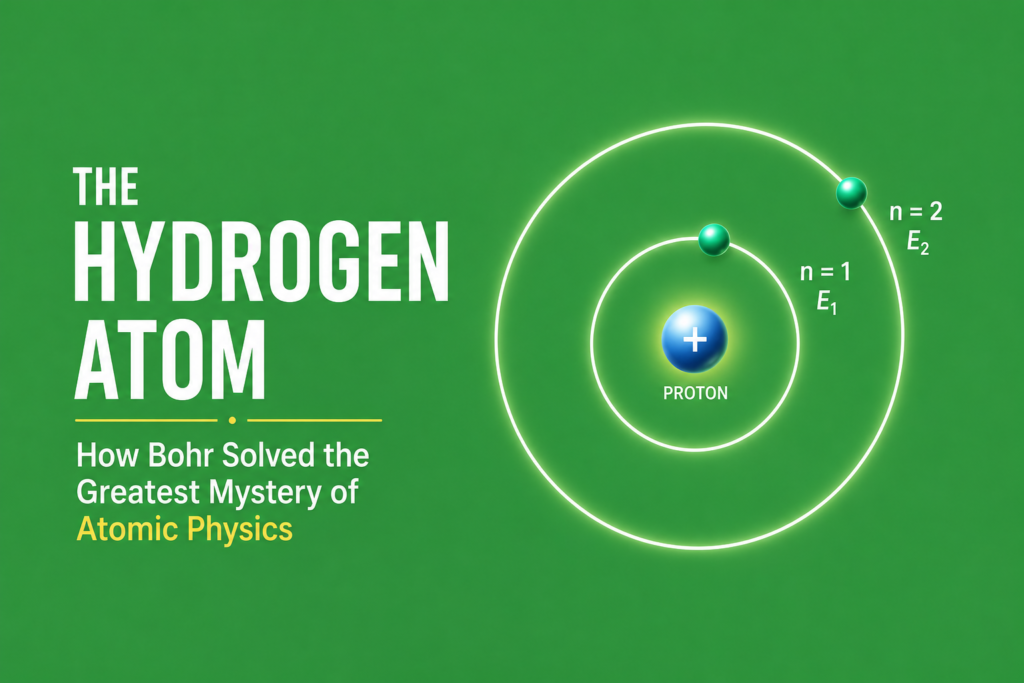
Of all the elements in the universe, none is simpler than the hydrogen atom, a single proton paired with a single orbiting electron. Yet this simplicity concealed one of the most stubborn mysteries in the entire history of physics. For decades, scientists watched energized hydrogen gas glow with light at oddly specific colors, unable to explain why. It took a young Danish physicist named Niels Bohr to finally crack this puzzle in 1913, transforming the humble hydrogen atom into the key that unlocked quantum mechanics itself.
Understanding how the hydrogen atom mystery was solved means tracing one of science’s most satisfying detective stories, a journey from puzzling laboratory observations to a complete, mathematically precise theory explaining exactly why atoms behave the way they do.
The Puzzle of Glowing Gas
Long before Bohr entered the picture, scientists had been fascinated by what happened when they passed electricity through a gas discharge tube filled with hydrogen gas. The gas would glow, emitting a distinctive pinkish light. When physicists passed this light through a prism, rather than seeing a smooth, continuous rainbow, they observed something strange, a series of sharp, isolated bright lines against an otherwise dark background.
This phenomenon, known as the hydrogen spectrum line pattern, represented one of the great unsolved puzzles of atomic spectroscopy. Every element, scientists discovered, produced its own unique pattern of these emission lines, almost like a fingerprint. Yet nobody could explain why atoms would only emit light at these very specific wavelengths rather than across a continuous, unrestricted range, creating a genuine mystery of atomic spectra that persisted for decades.
An Empirical Clue: The Rydberg Formula
Before any theoretical explanation existed, Swedish physicist Johannes Rydberg discovered a mathematical pattern hidden within the confusing collection of hydrogen spectrum wavelength measurements. His empirical Rydberg equation, developed through careful pattern matching rather than theoretical derivation, successfully predicted the wavelengths of hydrogen’s spectral lines with remarkable accuracy, expressed as:
1/λ = R(1/n₁² − 1/n₂²)
Here, λ (lambda) represents wavelength, R represents the Rydberg constant, and n₁ and n₂ represent positive integers, with n₂ always larger than n₁. While this formula worked beautifully for prediction purposes, it remained purely descriptive. Rydberg had found the pattern, but nobody understood why the hydrogen atom should behave according to this particular mathematical relationship at all.
Rutherford’s Nuclear Model and Its Fatal Flaw
The theoretical groundwork necessary for solving this mystery arrived through Ernest Rutherford’s 1911 gold foil scattering experiments, which revealed that atoms contain a dense, positively charged nucleus surrounded by orbiting electrons. This picture of the hydrogen atom seemed reasonable, resembling a miniature solar system with the electron orbiting its nuclear proton much like a planet circles the sun.
However, this model contained a devastating theoretical problem. According to established electromagnetic theory, any charged particle undergoing acceleration, including an electron curving around in orbital motion, should continuously radiate energy away. Classical physics predicted that the hydrogen atom’s electron should spiral inward toward its nucleus almost instantaneously, causing complete atomic collapse within a fraction of a second. Yet hydrogen atoms clearly remained perfectly stable indefinitely, a direct contradiction that classical physics simply could not resolve.
Bohr’s Breakthrough Insight (1913)
In 1913, Niels Bohr proposed a radical solution that would finally explain the hydrogen atom’s stability while simultaneously deriving Rydberg’s mysterious empirical formula from genuine theoretical first principles. Bohr suggested that the single electron within a hydrogen atom could only occupy specific, quantized orbital positions, corresponding to fixed electron orbits and energy levels, rather than any arbitrary continuous distance from the nucleus.
Bohr’s key postulate involved quantization of the electron’s angular momentum, restricting permitted orbits according to the relationship:
L = nh / 2π
Here, L represents angular momentum, n represents the principal energy level, taking only positive integer values, and h represents Planck’s constant. This single, elegant restriction meant that only certain discrete orbital radii were physically permitted within the hydrogen atom, with everything in between strictly forbidden by quantum rules.
Calculating Hydrogen’s Energy Levels
Using this angular momentum quantization principle combined with the balance between electrostatic attraction and orbital motion, Bohr derived a complete formula describing hydrogen energy levels precisely:
E_n = -13.6 eV / n²
Here, E_n represents the total energy associated with the electron occupying quantum level n. This equation revealed that the ground state hydrogen configuration, with n equal to one, possesses an energy of negative 13.6 electron volts, representing the ionization energy of hydrogen required to completely remove the electron from its atom entirely.
As n increases, representing progressively higher energy configurations, the electron’s energy becomes less negative, approaching zero as it moves farther from the nuclear proton, eventually escaping the atom’s influence entirely once sufficient energy has been supplied.
Explaining the Spectral Lines at Last
Bohr’s true triumph came when he demonstrated that electronic transition events between these quantized hydrogen energy levels would produce photons with frequencies matching Rydberg’s empirical formula exactly. This connection relied on Bohr’s frequency condition, expressed as:
ΔE = hf
Here, ΔE represents the energy difference between two hydrogen energy levels, h is Planck’s constant, and f represents the resulting photon frequency. When an electron falls from a higher energy level down to a lower one, it releases a single photon carrying precisely this energy differential, producing monochromatic light emission at one specific wavelength.
By calculating all possible electron transitions between hydrogen’s quantized energy levels, Bohr successfully derived Rydberg’s previously mysterious formula from pure theoretical reasoning, finally revealing the deep physical explanation behind decades of puzzling spectral lines of hydrogen observations.
The Named Spectral Series
Bohr’s theoretical framework elegantly explained several distinct groups of hydrogen spectral lines, each corresponding to electron transitions ending at a particular lower energy level. The Lyman series describes transitions ending at the ground state, n equals one, producing ultraviolet light beyond the visible spectrum lines humans can naturally perceive.
The Balmer series, historically the first discovered and most significant for early spectroscopy, describes transitions ending at the second energy level, n equals two, producing visible light wavelengths that had originally puzzled nineteenth century scientists studying hydrogen’s gas discharge tube emissions. Meanwhile, the Paschen series describes transitions ending at the third energy level, n equals three, producing infrared radiation invisible to the naked eye but readily detectable using appropriate optical spectroscopy instruments.
Calculating the Rydberg Constant Theoretically
Perhaps most remarkably, Bohr’s theoretical framework allowed physicists to calculate the Rydberg constant calculation directly from fundamental physical constants, including Planck’s constant, electron mass, and elementary charge, rather than simply measuring it empirically through experimental observation alone. This theoretical derivation matched the previously measured experimental value with extraordinary precision, providing overwhelming confirmation that Bohr’s quantized hydrogen atom model accurately described genuine physical reality rather than merely offering a convenient mathematical coincidence.
Beyond Emission: The Absorption Spectrum
The same underlying quantum principles governing hydrogen’s emission behavior also explained its absorption spectrum properties. When appropriate frequencies of light pass through cool hydrogen gas, electrons absorb photons carrying precisely the correct energy needed to jump between quantized energy levels, removing those specific wavelengths from the transmitted light and creating dark absorption lines exactly matching the bright emission lines observed under different experimental conditions.
Why the Single Electron Atom Mattered So Much
The hydrogen atom’s simplicity, containing merely a single proton and single orbiting electron, made it the perfect testing ground for Bohr’s revolutionary quantum theory. Because hydrogen represents the simplest possible single electron atom system, Bohr could derive exact, precise mathematical predictions without the additional complications introduced by multiple interacting electrons found in heavier elements.
This simplicity meant that successfully explaining the hydrogen atom provided compelling, essentially undeniable proof that quantum principles genuinely governed atomic behavior, establishing crucial theoretical credibility that would soon extend throughout the broader field of quantum mechanics.
The Correspondence Principle and Theoretical Consistency
As quantum theory matured beyond his original hydrogen atom calculations, Bohr introduced his correspondence principle, ensuring that quantum mechanical predictions regarding electron behavior would align properly with classical physics results under conditions involving very large quantum numbers. This principle helped confirm that Bohr’s revolutionary new framework represented a genuine expansion of physical understanding rather than a wholesale rejection of previously validated classical theories.
From Hydrogen to Broader Quantum Legacy
Bohr’s success explaining the hydrogen atom launched his broader Bohr’s quantum contributions throughout the following decades, eventually including his development of the complementarity principle and his significant participation in the historic Niels Bohr vs Einstein debates regarding quantum mechanics’ fundamental philosophical interpretation. These later theoretical achievements, developed largely within Bohr’s own influential research institute, remained deeply connected conceptually to the original quantized hydrogen atom insight that first established his scientific reputation.
Why This Discovery Still Matters Today
Understanding how Bohr solved the hydrogen atom mystery remains foundational to modern atomic spectroscopy, astrophysics, and chemistry education worldwide. Astronomers continue using hydrogen’s characteristic spectral lines to identify the composition and movement of distant stars and galaxies, directly applying principles Bohr first established over a century ago while studying this simplest possible atomic system.
Frequently Asked Questions
Why was the hydrogen atom so important to solve?
The hydrogen atom’s simplicity, containing only one electron, allowed Bohr to derive precise mathematical predictions without the complications of multiple electron interactions, making it the perfect test case for quantum theory.
What mystery did Bohr’s hydrogen atom model solve?
Bohr’s model explained why hydrogen gas emits light only at specific, discrete wavelengths rather than a continuous spectrum, by showing that electrons occupy quantized energy levels.
What are the Lyman, Balmer, and Paschen series?
These are groups of hydrogen spectral lines corresponding to electron transitions ending at different energy levels, producing ultraviolet, visible, and infrared light respectively.
How did Bohr calculate the Rydberg constant theoretically?
Bohr derived the Rydberg constant directly from fundamental physical constants like Planck’s constant and electron mass, matching the previously measured experimental value with remarkable precision.
Why does hydrogen only emit light at specific wavelengths?
Because electrons can only occupy specific quantized energy levels, transitions between these levels release photons with precisely defined energies, corresponding to specific wavelengths of light.
Conclusion
The hydrogen atom mystery, unsolved for decades despite mounting experimental evidence, finally yielded to Niels Bohr’s revolutionary 1913 quantum theory, transforming a simple observation about glowing gas into one of the most important theoretical breakthroughs in scientific history. By successfully deriving Rydberg’s previously mysterious empirical formula from genuine quantum principles, Bohr proved that atoms operate according to strict, quantized rules rather than smooth classical behavior. More than a century later, the hydrogen atom remains an essential teaching tool and continues informing astrophysics research, standing as permanent proof that even the simplest elements in the universe can conceal the deepest scientific mysteries.