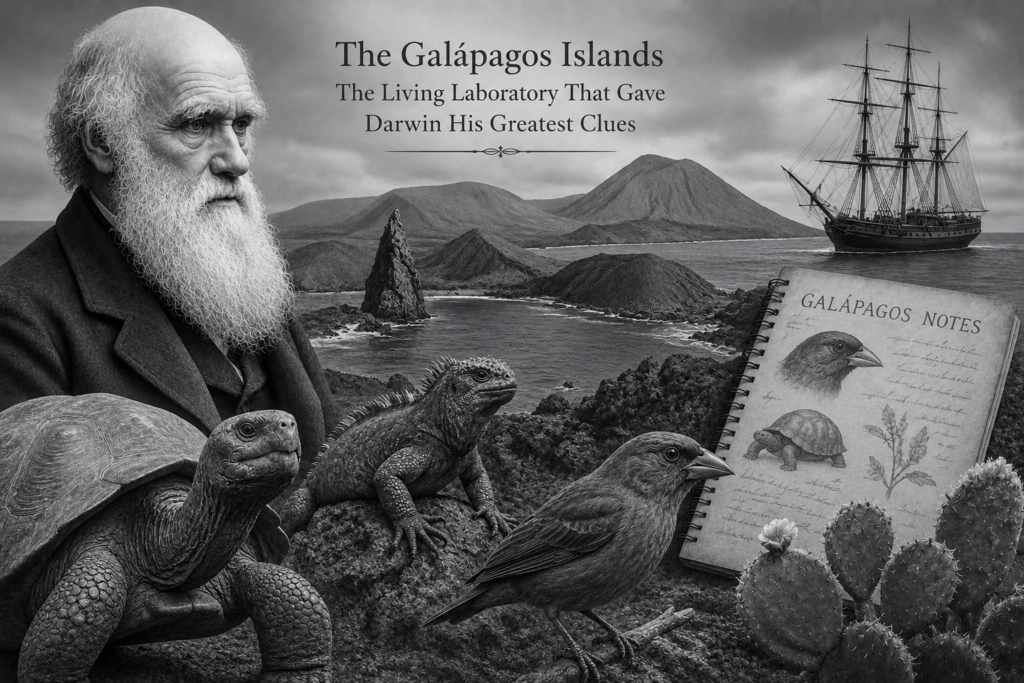
Galapagos islands and darwin remain one of the most important connections in scientific history. These isolated volcanic islands in the Pacific Ocean became the natural laboratory that helped transform Charles Darwin’s understanding of life on Earth. The strange animals, unusual plants, and unique ecosystems Darwin encountered there eventually inspired ideas that changed biology forever.
When Charles Darwin arrived at the Galápagos Islands during the HMS beagle voyage, he discovered species unlike anything he had seen before. Giant tortoises, marine iguanas, unusual birds, and isolated ecosystems revealed patterns that challenged traditional beliefs about nature and creation.
The Galápagos Islands helped Darwin recognize that species change gradually over time through adaptation and environmental pressure. These observations later became central to evolutionary theory and modern biology.
Today, the Galápagos remain one of the world’s most famous biodiversity hotspots and continue serving as a living laboratory for evolutionary science, ecology, and conservation biology.
This article explores the history, wildlife, scientific importance, and evolutionary discoveries connected to galapagos islands and darwin.
Discovery and Geography of the Galápagos Islands
The Galápagos Islands are located in the Pacific Ocean approximately 900 kilometers west of Ecuador.
The archipelago consists of volcanic islands formed by tectonic activity and lava eruptions over millions of years.
The islands are famous for:
- Volcanic landscapes
- Isolated ecosystems
- Unique wildlife
- Endemic species
- Ecological diversity
Because the islands formed in isolation, species evolved separately from mainland organisms.
This geographic isolation became essential to understanding adaptation and biodiversity.
The HMS Beagle Voyage Arrives (1835)
The most important moment in Galápagos scientific history occurred in September 1835 when Darwin arrived aboard the HMS Beagle.
The expedition was commanded by Captain Robert FitzRoy and focused on mapping coastlines and collecting scientific observations.
Darwin explored several islands including:
- San Cristóbal
- Isabela
- Santiago
- Floreana
The strange wildlife fascinated him immediately.
Unlike Europe or South America, the islands contained species found nowhere else on Earth.
These discoveries profoundly shaped Darwin’s scientific thinking.
Giant Tortoises and Island Differences
One of Darwin’s earliest observations involved the Galápagos giant tortoises.
Different islands contained tortoises with different shell shapes and body structures.
Some tortoises possessed:
- Dome shaped shells
- Saddle shaped shells
- Longer necks
- Different feeding adaptations
Local residents could reportedly identify which island a tortoise came from simply by examining its shell.
Darwin realized environmental conditions influenced adaptation and survival.
These observations later supported the theory of natural selection.
Marine Iguanas and Extraordinary Adaptation
The Galápagos marine iguanas shocked Darwin because they were the world’s only sea swimming lizards.
These reptiles evolved special adaptations including:
- Flattened tails for swimming
- Salt glands for removing seawater salt
- Strong claws for gripping rocks
- Dark skin for heat absorption
Marine iguanas feed underwater on algae and seaweed.
Their existence demonstrated how isolation and environmental pressure shape unique evolutionary adaptations.
The islands contained countless examples of species adjusting to local habitats.
Darwin Finches and Evolutionary Clues
The most famous discoveries connected to galapagos islands and darwin involved the birds later called darwin finches.
Darwin collected several finch species but initially failed to recognize their importance.
Later analysis revealed:
- Different islands contained different finch species
- Beak shapes varied dramatically
- Feeding behaviors differed
- All finches likely shared common ancestry
Some finches cracked seeds while others ate insects or cactus flowers.
These differences strongly suggested adaptation through environmental pressure.
Darwin eventually realized species could diverge gradually from common ancestors.
This insight became one of the foundations of evolutionary biology.
Isolation and Speciation
The Galápagos Islands provided ideal conditions for speciation because of geographic isolation.
Isolation limits gene flow between populations.
Over time:
- Mutations accumulate
- Populations diverge genetically
- Adaptations increase survival
- New species emerge
This process explains why the Galápagos contain so many endemic species.
Modern evolutionary biology still uses the islands as a classic example of island biogeography and adaptive radiation.
Mathematical Understanding of Evolutionary Change
Modern biology uses mathematics to explain adaptation and evolutionary dynamics observed in the Galápagos.
Population growth can be modeled mathematically:
Where:
- = population size at time t
- = initial population
- = growth rate
Population genetics uses allele frequency equations:
Where:
- = frequency of one allele
- = frequency of another allele
The Hardy-Weinberg equation studies genetic variation:
Fitness in natural selection can also be represented mathematically:
These principles help scientists analyze biodiversity and adaptation in Galápagos species.
Volcanic Island Evolution and Ecosystems
The Galápagos Islands continue changing because of volcanic activity.
New islands form while older islands slowly erode over geological time.
This creates constantly changing habitats and ecosystems.
Species must continuously adapt to:
- Climate conditions
- Food availability
- Droughts
- Predators
- Competition
Environmental pressure drives natural selection within island populations.
These ecological processes remain central to modern evolutionary research.
From Galápagos to On the Origin of Species
The observations connected to galapagos islands and darwin later influenced Darwin’s famous book on the origin of species.
Darwin eventually realized:
- Species evolve gradually
- Organisms share common ancestry
- Adaptation improves survival
- Environmental pressure shapes evolution
The Galápagos became one of the strongest pieces of evidence supporting evolutionary theory.
Without these islands, Darwin might never have developed his revolutionary scientific ideas.
The Tree of Life and Common Ancestry
The Galápagos Islands also helped support the tree of life theory.
Darwin realized related species could branch into new forms over time.
According to this evolutionary model:
- Species share ancient ancestors
- Evolution produces branching diversity
- Adaptation creates new species
- Biodiversity expands gradually
Modern genetics strongly supports this concept.
DNA sequencing reveals that Galápagos species remain closely related to mainland ancestors while showing unique evolutionary changes.
Modern Scientific Research in the Galápagos
Scientists continue studying the Galápagos Islands today.
Modern research focuses on:
- Evolutionary biology
- Ecology
- Climate adaptation
- Conservation science
- Population genetics
- Biodiversity preservation
One famous long term project involved Peter and Rosemary Grant studying finches on Daphne Major Island.
Their research directly observed natural selection changing bird beak sizes during drought conditions.
The Galápagos remain one of the greatest natural laboratories on Earth.
Darwin to DNA Evolution
Modern genetics has strongly confirmed Darwin’s observations.
Research involving darwin to DNA evolution revealed how genes influence adaptation and species divergence.
DNA analysis shows:
- Galápagos species share common ancestry
- Mutations create variation
- Natural selection changes gene frequencies
- Isolation encourages speciation
Modern molecular biology continues supporting Darwin’s original insights from the islands.
Conservation and Biodiversity Protection
The Galápagos Islands now face environmental challenges including:
- Tourism pressure
- Invasive species
- Climate change
- Pollution
Conservation programs work to protect the islands’ unique ecosystems and biodiversity.
The Galápagos National Park and international conservation organizations help preserve:
- Giant tortoises
- Marine iguanas
- Native birds
- Fragile habitats
Protecting the islands remains scientifically important because they provide unmatched insight into evolution and ecology.
Why the Galápagos Islands Still Matter Today
The scientific importance of galapagos islands and darwin continues today because the islands visually demonstrate evolution in action.
The islands help scientists understand:
- Adaptive radiation
- Environmental pressure
- Speciation
- Biodiversity
- Natural selection
- Ecosystem adaptation
Few places on Earth provide such clear evidence for evolutionary biology.
The Galápagos remain one of humanity’s greatest natural scientific treasures.
FAQs About the Galápagos Islands and Darwin
Why are the Galápagos Islands famous?
The islands are famous for unique wildlife and their role in inspiring Darwin’s theory of evolution.
What did Darwin discover in the Galápagos?
Darwin observed species variation, adaptation, and environmental differences that later influenced evolutionary theory.
What animals are unique to the Galápagos Islands?
Famous species include giant tortoises, marine iguanas, and Darwin’s finches.
Why are the islands called a living laboratory?
Scientists can observe evolution, adaptation, and ecological processes directly in the islands’ isolated ecosystems.
How did the Galápagos influence Darwin?
The islands showed Darwin how species adapt differently to environments over time.
Are the Galápagos Islands protected today?
Yes. Large portions of the islands are protected through conservation programs and national park regulations.
Conclusion
The connection between galapagos islands and darwin completely transformed science and humanity’s understanding of life on Earth. The isolated volcanic islands revealed how adaptation, biodiversity, and environmental pressure shape species through evolution.
From giant tortoises to Darwin’s finches, the Galápagos provided the clues that helped Darwin develop one of the greatest scientific theories in history. Modern genetics, ecology, and evolutionary biology continue confirming the extraordinary insights first inspired by these remarkable islands.
The scientific legacy of the Galápagos Islands stands beside the discoveries of many great thinkers whose ideas reshaped civilization, including those explored in how ancient greek scientists changed modern science.