History of dropout became one of the most important stories in modern artificial intelligence because a surprisingly simple idea solved one of deep learning’s biggest problems. As neural networks became deeper and more powerful, researchers faced a dangerous challenge called overfitting. Networks memorized training data too perfectly and failed to generalize to real-world tasks.
The solution arrived through dropout, a training technique that randomly disables neurons during learning. This small innovation dramatically improved neural network accuracy, robustness, and performance.
Today, dropout is widely used across deep learning systems including image recognition, speech recognition neural networks, language processing, and generative AI. What looked like a simple trick eventually became one of the defining innovations of the deep learning revival.
The rise of dropout also played an important role in the modern AI birth that followed Geoffrey Hinton’s neural network reboot.
Early Neural Networks and Overfitting Problems (1950 – 1990)
To understand the history of dropout, we first need to explore the early evolution of neural networks.
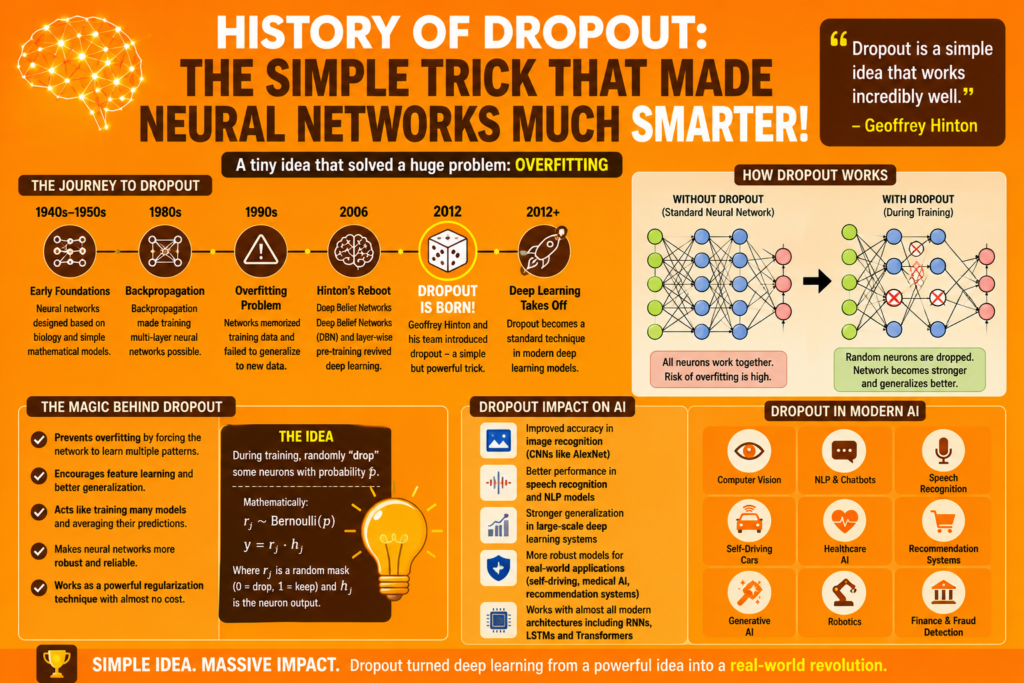
During the 1940s and 1950s, scientists developed artificial neuron models inspired by the biological brain. The famous mcculloch and pitts neural network became one of the earliest mathematical foundations of AI research.
Later, Frank Rosenblatt introduced the perceptron, which encouraged optimism about machine intelligence. However, early neural systems were very limited and could not solve complex tasks effectively.
As neural networks grew deeper during the 1980s, researchers discovered major learning problems. Networks often memorized training examples instead of learning generalized patterns.
This issue became known as overfitting.
For example:
- A network might recognize training images perfectly
- But fail completely on new unseen images
This problem slowed the growth of deep neural systems for many years.
Researchers tried many solutions including:
- Smaller networks
- Regularization methods
- Weight penalties
- Better feature learning
- Data augmentation
Despite these efforts, overfitting remained a huge challenge.
Geoffrey Hinton and the Deep Learning Revival (2006)
The modern history of dropout cannot be separated from Geoffrey Hinton’s deep learning revolution.
In 2006, Geoffrey Hinton and his collaborators introduced Deep Belief Networks and layer-wise unsupervised pre-training. This breakthrough restarted global interest in neural AI.
The famous Science 2006 paper demonstrated that deep neural networks could finally train effectively.
Researchers discussing history of deep learning often describe this period as the beginning of modern AI birth.
Deep Belief Networks used Restricted Boltzmann Machines and layer-wise pre-training to stabilize learning in deep architectures.
However, even after Hinton’s reboot, overfitting remained a major issue.
As neural network depth increased, models became more powerful but also more likely to memorize data.
The AI community needed a better regularization method.
Why Overfitting Was Dangerous
Overfitting became especially problematic as computational power improved.
Larger datasets and GPUs allowed researchers to build huge neural networks with millions of parameters.
While these models achieved high training accuracy, they often performed poorly on real-world tasks.
This happened because the network relied too heavily on specific neuron combinations.
The system failed to develop generalized feature learning.
Researchers studying history of alexnet later discovered that overfitting was one of the biggest obstacles facing large-scale computer vision systems.
Without solving overfitting, deep learning could never scale successfully.
The Birth of Dropout (2012)
The major breakthrough arrived in 2012 when Geoffrey Hinton and his students introduced dropout.
The idea was surprisingly simple:
During training, randomly “drop” some neurons from the network.
This means:
- Certain neurons temporarily become inactive
- Their outputs are ignored
- Different subnetworks form during each training step
Instead of depending on fixed neuron pathways, the network learns distributed representations.
This dramatically improved generalization.
The probability equation for dropout can be written as:
Where:
- = whether neuron j remains active
- = probability of keeping the neuron
The output becomes:
This simple method transformed neural learning.
Why Dropout Worked So Well
Dropout forced neural networks to become more adaptable.
Instead of memorizing exact training patterns, networks learned robust feature representations.
Researchers compared dropout to biological evolution because neurons could no longer rely on specific neighboring neurons.
Every training iteration created slightly different architectures.
This process produced several benefits:
- Reduced overfitting
- Better generalization
- Stronger feature learning
- Improved weight initialization stability
- Increased robustness
- Better dimensionality reduction
Dropout also behaved like training many neural networks simultaneously and averaging their predictions.
This ensemble-like effect greatly improved performance.
The Connection Between Dropout and Deep Learning Growth
The history of dropout became deeply connected to the rapid expansion of deep learning after 2012.
Around the same time, AlexNet shocked the AI world by dominating the ImageNet competition.
AlexNet used dropout heavily to prevent overfitting.
Researchers studying history of cnn frequently mention dropout as one of the critical technologies behind deep convolutional network success.
Without dropout, massive neural architectures may have struggled to generalize effectively.
The combination of:
- GPU acceleration
- Large datasets
- ReLU activation
- Backpropagation
- Dropout regularization
created the perfect environment for modern deep learning systems.
Dropout and Neural Network Depth
As networks became deeper, dropout became even more valuable.
Very deep architectures contain enormous numbers of parameters.
Without regularization, these models easily memorize datasets.
Dropout encouraged networks to learn more meaningful semantic patterns instead of memorizing details.
This was especially important in:
- Computer vision
- NLP models
- Speech recognition
- Recommendation systems
- Generative neural networks
Researchers working on transformer neural networks later adapted dropout techniques into attention systems and modern language models.
Even today, dropout remains important in large-scale AI systems.
Mathematical Understanding of Dropout
Dropout can also be interpreted mathematically as noise injection during training.
Suppose a neural activation is:
With dropout applied:
Where:
- = random binary mask
- = weights
- = input vector
This random masking prevents co-adaptation among neurons.
Instead of relying on exact neuron interactions, the network develops distributed learning strategies.
This greatly improves robustness during testing.
Geoffrey Hinton’s Influence on Dropout
Geoffrey Hinton’s influence on dropout research was enormous.
Researchers studying geoffrey hinton biography often describe dropout as one of his most elegant contributions to AI.
Hinton believed many neural learning problems could be solved using biologically inspired principles.
Dropout reflected this philosophy by making networks more flexible and resilient.
The method quickly became standard practice in deep learning research worldwide.
Soon, dropout appeared in:
- CNN architectures
- RNN systems
- LSTM networks
- Sequence models
- Transformer systems
Its simplicity made it easy to implement across many architectures.
Dropout Beyond Computer Vision
Although dropout became famous in image recognition, its influence expanded far beyond computer vision.
Today, dropout helps improve:
- Speech recognition neural networks
- Machine translation
- Chatbots
- Reinforcement learning systems
- Medical AI
- Financial prediction systems
- Autonomous driving
Modern AI systems handling self driving cars and ai tasks often use dropout-inspired regularization techniques for safety and reliability.
Dropout also improved uncertainty estimation in neural predictions.
This became important for healthcare and autonomous systems where prediction confidence matters greatly.
The Relationship Between Dropout and Modern AI
The growth of dropout reflects the broader evolution of artificial intelligence itself.
Researchers exploring history of ai often view dropout as one of the practical breakthroughs that transformed deep learning from an academic experiment into a global technology revolution.
Dropout helped neural networks become:
- More scalable
- More reliable
- More accurate
- More commercially useful
Without strong regularization methods, many modern AI achievements may not have been possible.
Dropout in Today’s AI Systems
Even though modern architectures continue evolving, dropout still remains widely used.
Many of today’s best free ai tools depend on dropout or similar regularization methods behind the scenes.
Modern AI frameworks such as TensorFlow and PyTorch include dropout as a standard layer.
Researchers also continue developing advanced alternatives inspired by dropout concepts, including:
- DropConnect
- Spatial Dropout
- Variational Dropout
- Stochastic Depth
These innovations continue improving neural network depth and stability.
The Lasting Legacy of Dropout
The history of dropout proves that even simple ideas can create massive technological revolutions.
Unlike many complicated AI breakthroughs, dropout succeeded because of elegance and practicality.
It solved one of deep learning’s most dangerous weaknesses using randomness and simplicity.
Today, dropout remains one of the foundational techniques in modern deep learning.
Its influence continues shaping future neural architectures and generative AI systems worldwide.
FAQs About Dropout
What is dropout in neural networks?
Dropout is a regularization technique where random neurons are temporarily disabled during training to reduce overfitting.
Who invented dropout?
Dropout was introduced by Geoffrey Hinton and his research team around 2012.
Why is dropout important?
Dropout improves generalization and prevents neural networks from memorizing training data.
How does dropout reduce overfitting?
It forces the network to learn distributed features instead of relying on fixed neuron pathways.
Is dropout still used today?
Yes. Dropout remains widely used in CNNs, transformers, NLP models, and generative AI systems.
Does dropout work with transformers?
Yes. Modern transformer neural networks frequently use dropout during training for regularization.
Conclusion
The story of history of dropout demonstrates how a small innovation can transform an entire technological field. During the rapid growth of deep learning, neural networks faced serious overfitting problems that threatened their scalability and real-world usefulness.
Geoffrey Hinton and his collaborators solved this issue with dropout, a surprisingly simple regularization method that made networks more flexible, robust, and intelligent.
The success of dropout became deeply connected to history of deep learning, history of cnn, history of alexnet, transformer neural networks, and history of ai research.
Today, dropout continues powering advanced AI systems across medicine, robotics, speech recognition, and generative technologies.
As artificial intelligence evolves toward even deeper architectures, dropout’s elegant idea will remain one of the most influential breakthroughs in neural network history.