History of relu became one of the most important stories in artificial intelligence because this simple mathematical function helped solve one of deep learning’s greatest challenges. Before ReLU transformed neural networks, researchers struggled with slow training, saturation problems, poor model convergence, and unstable deep architectures.
The Rectified Linear Unit, commonly called ReLU, changed everything.
This non-linear activation function improved gradient flow, increased training speed, and helped deep neural networks become practical for real-world AI systems. ReLU became one of the key technologies behind computer vision breakthroughs, speech recognition neural networks, transformer systems, and modern generative AI.
Although ReLU looks mathematically simple, its impact on deep learning was revolutionary. Many researchers now consider it one of the turning points in the modern AI birth.
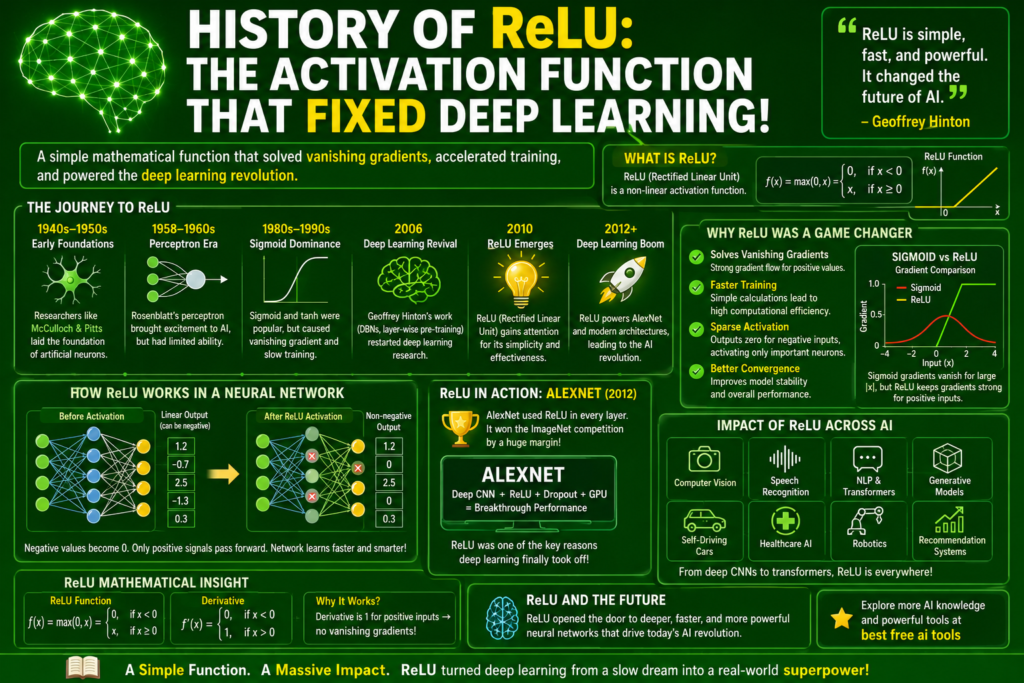
Early Neural Networks Before ReLU (1940 – 1980)
To understand the history of relu, we first need to explore the early foundations of neural networks.
In 1943, Warren McCulloch and Walter Pitts introduced one of the earliest artificial neuron models. Their research became a critical milestone in neural computation.
The famous mcculloch and pitts neural network concept showed how biological neurons could inspire machine intelligence.
During the 1950s and 1960s, Frank Rosenblatt developed the perceptron, which used simple activation rules to classify data.
However, early neural systems remained limited because they could not handle highly complex learning tasks.
Researchers later introduced activation functions such as sigmoid and tanh to improve non-linear learning capabilities.
These functions allowed neural networks to learn more complicated decision boundaries.
But they also introduced serious optimization problems.
The Problem with Sigmoid Functions
Before ReLU became popular, sigmoid activation dominated deep learning research.
The sigmoid function looked like this:
This mathematical function converted inputs into values between 0 and 1.
Sigmoid activation worked reasonably well for shallow networks, but deeper architectures faced major issues.
The biggest problem was saturation.
When input values became very large or very small, gradients approached zero.
This caused slow learning and unstable optimization.
Researchers studying vanishing gradient problem discovered that gradients weakened dramatically as they moved backward through deep layers.
As a result:
- Deep networks learned very slowly
- Earlier layers stopped updating properly
- Model convergence became extremely difficult
This challenge slowed neural network research for many years.
Geoffrey Hinton and the Deep Learning Revival (2006)
The modern history of relu became deeply connected to Geoffrey Hinton’s deep learning revival.
In 2006, Hinton and his team introduced Deep Belief Networks and layer-wise pre-training methods that restarted interest in deep neural architectures.
Researchers discussing history of deep learning often describe this moment as the rebirth of modern AI.
The famous Science 2006 paper demonstrated that deep neural systems could finally train successfully.
However, even after this breakthrough, activation functions still limited training efficiency.
Deep networks remained difficult to optimize because sigmoid activations caused weak gradient flow.
The AI community needed a better solution.
The Rise of Rectified Linear Units
The Rectified Linear Unit existed conceptually in earlier mathematical discussions, but it gained major attention around 2010.
Researchers discovered that ReLU solved many optimization problems affecting deep networks.
The ReLU function is extremely simple:
This means:
- Negative values become 0
- Positive values remain unchanged
Unlike sigmoid functions, ReLU does not saturate for positive values.
This improved gradient flow dramatically.
Neural networks could now train faster and deeper than ever before.
Why ReLU Changed Deep Learning Forever
The history of relu became revolutionary because of several major advantages.
Faster Training Speed
ReLU calculations are computationally efficient.
The function requires only a simple threshold operation.
This allowed GPUs to train deep networks much faster.
Researchers studying gpu history in ai recognized that ReLU and GPU acceleration together created the perfect environment for deep learning growth.
Better Gradient Flow
ReLU prevented gradients from shrinking excessively during backpropagation.
This solved many vanishing gradient issues affecting deep architectures.
Sparse Activation
Because negative values become zero, many neurons remain inactive during training.
This sparse activation improved feature learning and reduced unnecessary computation.
Improved Model Convergence
Networks using ReLU achieved better optimization stability and faster convergence.
These benefits transformed deep learning performance across many fields.
AlexNet and the ReLU Revolution (2012)
The real explosion of ReLU popularity happened in 2012 with AlexNet.
AlexNet was developed by Alex Krizhevsky, Ilya Sutskever, and Geoffrey Hinton.
The network won the ImageNet competition with dramatically higher accuracy than previous systems.
Researchers studying history of alexnet often identify ReLU as one of the biggest reasons behind its success.
AlexNet trained much faster than earlier CNNs because ReLU accelerated optimization.
The model also combined:
- GPU acceleration
- Dropout regularization
- Deep convolutional layers
- Large-scale datasets
This breakthrough proved that deep neural networks could dominate computer vision tasks.
The AI industry changed permanently after AlexNet.
ReLU and Computer Vision Growth
The success of ReLU transformed the field of computer vision.
Researchers exploring history of cnn research quickly adopted ReLU across convolutional architectures.
ReLU improved:
- Image classification
- Object detection
- Facial recognition
- Video analysis
- Medical imaging
Deep CNN systems became much more practical and scalable.
This led to rapid advancements in autonomous driving, healthcare AI, and robotics.
Today, many self driving cars and ai systems rely heavily on ReLU-based architectures.
Mathematical Understanding of ReLU
The simplicity of ReLU became one of its greatest strengths.
Mathematically:
The derivative becomes:
Because gradients remain strong for positive values, optimization becomes much easier.
This stable gradient flow improved deep network optimization significantly.
Researchers also discovered that ReLU mimics aspects of biological neural firing because neurons activate only when signals exceed certain thresholds.
Variants of ReLU
As deep learning evolved, researchers developed many ReLU variations.
These included:
- Leaky ReLU
- Parametric ReLU
- ELU
- SELU
These variants attempted to solve minor weaknesses such as “dead neurons,” where some ReLU units stop activating completely.
Despite newer alternatives, standard ReLU remains one of the most widely used activation functions in AI.
ReLU and Modern AI Systems
The influence of ReLU extends far beyond computer vision.
Today, ReLU powers:
- NLP models
- Transformer architectures
- Recommendation systems
- Speech recognition neural networks
- Generative neural networks
- Reinforcement learning systems
Researchers discussing transformer neural networks often acknowledge ReLU’s role in enabling efficient deep optimization.
Even though transformers use advanced attention mechanisms, activation functions remain essential inside feedforward layers.
ReLU and the Deep Learning Explosion
The rise of ReLU directly contributed to the global deep learning explosion.
Researchers exploring history of ai often describe ReLU as one of the practical innovations that made large-scale AI commercially viable.
Without strong activation functions, deep networks may never have scaled effectively.
ReLU improved:
- Algorithmic performance
- Computational efficiency
- Neural network depth
- Training reliability
- Feature extraction
Its simplicity made implementation easy across nearly every deep learning framework.
Geoffrey Hinton’s Influence on ReLU Adoption
Although Geoffrey Hinton did not invent ReLU directly, his research played a huge role in popularizing deep neural systems that benefited from ReLU optimization.
Researchers discussing godfathers of deep learning frequently connect Hinton’s work to the broader success of ReLU-based architectures.
The combination of:
- Backpropagation
- Deep architectures
- GPU computing
- ReLU activation
- Dropout regularization
created the modern AI revolution.
Without these combined innovations, today’s neural systems would look very different.
ReLU in Today’s AI Tools
Modern AI frameworks such as TensorFlow, PyTorch, and Keras use ReLU extensively.
Many of today’s best free ai tools rely on ReLU-based architectures for language generation, image recognition, and recommendation systems.
Even advanced generative AI models still depend on activation functions inspired by ReLU principles.
Its impact continues influencing nearly every major neural application.
The Legacy of ReLU
The history of relu proves that simple mathematical ideas can transform entire industries.
ReLU solved critical deep learning problems that limited neural progress for decades.
Its ability to improve gradient flow, increase training speed, and support deeper architectures changed AI forever.
Today, ReLU remains one of the foundational building blocks of modern neural systems.
As artificial intelligence continues evolving, the influence of ReLU will remain deeply connected to the future of machine learning.
FAQs About ReLU
What is ReLU in deep learning?
ReLU stands for Rectified Linear Unit, a non-linear activation function widely used in neural networks.
Why is ReLU important?
ReLU improves gradient flow, speeds up training, and helps deep neural networks avoid saturation problems.
How does ReLU solve vanishing gradients?
Unlike sigmoid functions, ReLU maintains strong gradients for positive inputs, preventing gradient shrinkage during backpropagation.
Who popularized ReLU?
ReLU became highly popular after its successful use in AlexNet and deep convolutional neural networks around 2012.
Is ReLU still used today?
Yes. ReLU remains one of the most widely used activation functions in modern deep learning systems.
What are the disadvantages of ReLU?
Some neurons can become permanently inactive, creating a problem called dead neurons. Variants like Leaky ReLU help reduce this issue.
Conclusion
The story of history of relu represents one of the most important breakthroughs in modern artificial intelligence. Before ReLU, deep neural networks struggled with weak gradient flow, saturation problems, and unstable optimization.
The simple Rectified Linear Unit transformed deep learning by improving computational efficiency, sparse activation, and training speed. Its success helped neural networks scale into powerful systems capable of solving real-world problems.
The rise of ReLU became deeply connected to history of deep learning, history of alexnet, history of cnn, vanishing gradient problem, and transformer neural networks research.
Today, ReLU powers everything from speech recognition to generative AI. Its elegant mathematical simplicity continues shaping the future of artificial intelligence worldwide.