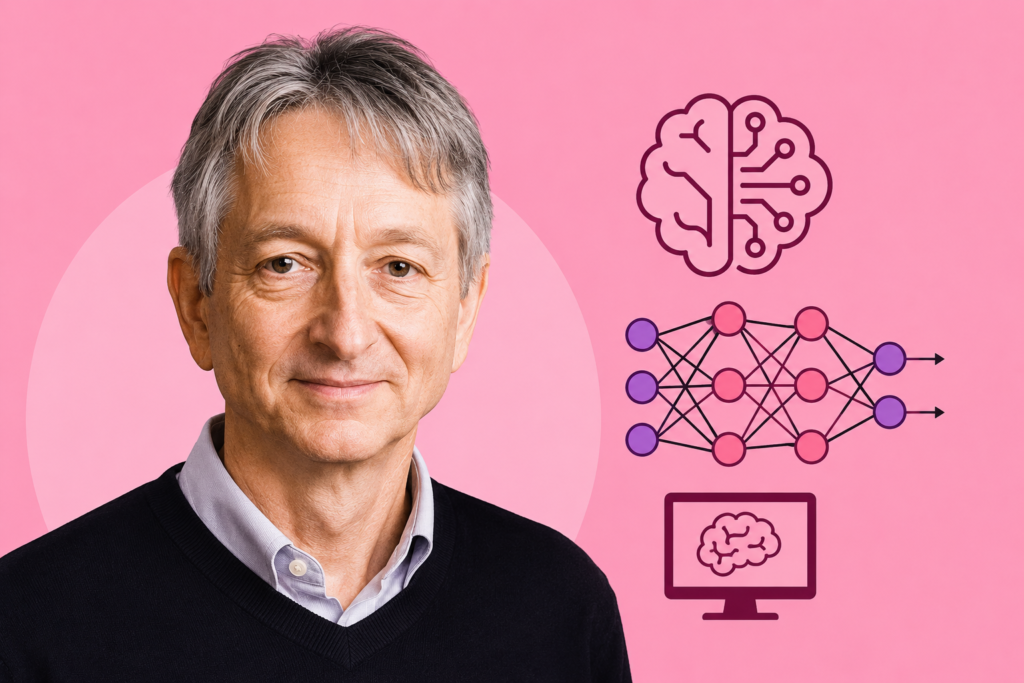
The geoffrey hinton biography is one of the most important stories in artificial intelligence history. Often called the “Godfather of Deep Learning,” Geoffrey Hinton helped transform neural networks from a nearly abandoned research field into the foundation of modern AI systems.
Today, nearly every major AI breakthrough connects in some way to Hinton’s work. From image recognition and speech processing to large language models and generative AI, the influence of Geoffrey Hinton can be seen across the entire technology industry.
The story of the geoffrey hinton biography is not just about scientific discovery. It is also about persistence, visionary thinking, and surviving decades of skepticism during the AI winters when many researchers believed neural networks had failed forever.
Hinton’s research on distributed representations, Boltzmann Machines, deep neural networks, and backpropagation eventually launched the deep learning revolution that changed the modern world.
In this article, we will explore the complete geoffrey hinton biography, his early life, scientific breakthroughs, struggles during the AI winters, and how he became one of the most influential researchers in computer science history.
Early Life of Geoffrey Hinton (1947 – 1970)
The story of the geoffrey hinton biography begins with Geoffrey Hinton, born in London, England, in 1947.
Hinton came from a highly intellectual family connected to science and mathematics. From a young age, he became fascinated by:
- Human intelligence
- Cognitive psychology
- Neural computation
- Brain function
- Machine learning
He studied experimental psychology at University of Cambridge.
Unlike many computer scientists of his era, Hinton focused heavily on how the human brain processes information.
This interest later shaped the entire direction of the geoffrey hinton biography and his future work in neural networks.
The AI World Before Hinton
Before the rise of the geoffrey hinton biography, artificial intelligence research was divided between two major approaches:
Symbolic AI
Researchers focused on:
- Logical reasoning
- Rule-based systems
- Knowledge representation
- Expert systems
Connectionism
Researchers believed intelligence could emerge from artificial neural networks inspired by biological brains.
This movement became central to:
Hinton strongly supported connectionism during a period when many scientists considered neural networks unrealistic.
The Perceptron Controversy and AI Winter (1969 – 1980)
One of the biggest challenges in the geoffrey hinton biography involved the collapse of neural network research during the 1970s.
The famous perceptron controversy damaged confidence in neural systems after Marvin Minsky and Seymour Papert criticized perceptrons in 1969.
This controversy contributed heavily to the first ai winter.
During this period:
- Funding disappeared
- Neural research declined
- Symbolic AI dominated
- Academic skepticism increased
Many researchers abandoned neural networks completely.
However, Geoffrey Hinton refused to give up on connectionism.
This persistence became one of the defining characteristics of the geoffrey hinton biography.
Hinton’s Belief in Neural Networks
Unlike many researchers, Hinton believed the real problem was not neural networks themselves but the technological limitations of the time.
Computers lacked:
- Powerful hardware
- Large datasets
- Efficient training algorithms
Hinton believed future neural systems would eventually outperform symbolic AI.
This belief strongly connected to:
His determination helped keep neural network research alive during one of the most difficult periods in AI history.
The Backpropagation Revolution (1980 – 1990)
The biggest breakthrough in the geoffrey hinton biography came during the 1980s.
In 1986, Geoffrey Hinton, David Rumelhart, and Ronald Williams published groundbreaking research on backpropagation training for multi-layer neural networks.
This work became central to:
Backpropagation solved one of AI’s biggest problems:
How can deep neural networks learn efficiently?
The algorithm allowed error signals to move backward through hidden layers, enabling advanced learning.
This breakthrough revived neural network research worldwide.
The geoffrey hinton biography became deeply connected to the rebirth of deep learning.
Boltzmann Machines and Restricted Boltzmann Machines
One of the most important parts of the geoffrey hinton biography involved Boltzmann Machines.
Hinton explored probabilistic neural systems capable of learning internal representations.
These systems became foundational to:
- Restricted Boltzmann Machines (RBM)
- Deep belief networks
- Unsupervised learning
- Distributed representations
His work helped neural networks learn features automatically without manual feature engineering.
This breakthrough dramatically improved machine learning performance.
The Toronto School of AI
The geoffrey hinton biography also includes the rise of the famous Toronto school of AI.
At University of Toronto, Hinton trained many future AI leaders.
His mentorship influenced researchers across the entire field of deep learning.
Students and collaborators helped advance:
- Computer vision
- Speech recognition
- Neural optimization
- Deep architectures
The Toronto AI community became one of the most influential research groups in AI history.
AlexNet and the Deep Learning Explosion (2012)
A defining moment in the geoffrey hinton biography came in 2012.
Hinton and his students created AlexNet, a deep convolutional neural network that achieved massive success in the ImageNet competition.
This breakthrough became strongly connected to:
AlexNet dramatically outperformed traditional computer vision systems.
The victory shocked the AI community and launched the modern deep learning revolution.
Deep learning suddenly became the dominant approach in artificial intelligence.
Geoffrey Hinton at Google Brain
Following the success of deep learning, Geoffrey Hinton joined Google.
His work at Google Brain helped improve:
- Speech recognition
- Search systems
- AI infrastructure
- Neural learning models
The geoffrey hinton biography became increasingly important as AI systems spread across the world.
His research strongly influenced modern generative AI systems and large neural architectures.
Turing Award and Global Recognition (2018)
In 2018, Geoffrey Hinton received the Turing Award alongside Yann LeCun and Yoshua Bengio.
The three researchers became widely known as the godfathers of deep learning.
The award recognized their contributions to neural networks and modern AI.
This achievement became one of the biggest milestones in the geoffrey hinton biography.
Capsule Networks and Later Research
Even after revolutionizing deep learning, Hinton continued exploring new ideas.
One major project involved capsule networks.
Hinton believed traditional neural networks still had limitations in understanding spatial relationships and object hierarchies.
His continued research showed his commitment to improving AI systems even after becoming globally famous.
The geoffrey hinton biography demonstrates continuous scientific curiosity and innovation.
Geoffrey Hinton and AI Safety
In recent years, the geoffrey hinton biography has also become connected to AI safety concerns.
Hinton publicly discussed risks involving:
- Superintelligent AI
- Misinformation
- Autonomous systems
- Ethical AI development
His warnings gained global attention because of his enormous influence in artificial intelligence.
Despite helping create modern AI, Hinton also emphasized the importance of responsible technological development.
Geoffrey Hinton’s Lasting Legacy
The impact of the geoffrey hinton biography can now be seen everywhere.
His work helped create technologies powering:
- Chatbots
- AI assistants
- Image generation
- Medical AI
- Self-driving systems
- Speech recognition neural networks
Even modern best free ai tools depend heavily on neural systems inspired by Hinton’s research.
The deep learning revolution transformed science, healthcare, education, entertainment, and communication worldwide.
Frequently Asked Questions (FAQs)
Why is Geoffrey Hinton called the Godfather of Deep Learning?
He helped revive neural networks and developed key techniques that made modern deep learning possible.
What is Geoffrey Hinton famous for?
He is famous for backpropagation research, Boltzmann Machines, AlexNet, and neural network revival.
Did Geoffrey Hinton invent deep learning?
He did not invent deep learning alone, but he became one of its most important pioneers.
What award did Geoffrey Hinton win?
He won the Turing Award in 2018 alongside Yann LeCun and Yoshua Bengio.
Why is Geoffrey Hinton important to AI?
His research transformed neural networks into the foundation of modern artificial intelligence.
Conclusion
The geoffrey hinton biography represents one of the most extraordinary journeys in computer science history. Geoffrey Hinton’s persistence during the AI winters, his belief in neural networks, and his groundbreaking research on deep learning transformed artificial intelligence forever.
From backpropagation and Boltzmann Machines to AlexNet and modern neural systems, Hinton’s contributions helped create the foundation of today’s AI revolution. His work not only revived neural networks but also changed how machines learn, recognize patterns, and process information.
Today, the legacy of the geoffrey hinton biography continues shaping the future of artificial intelligence, proving that visionary scientific ideas can eventually transform the entire world.