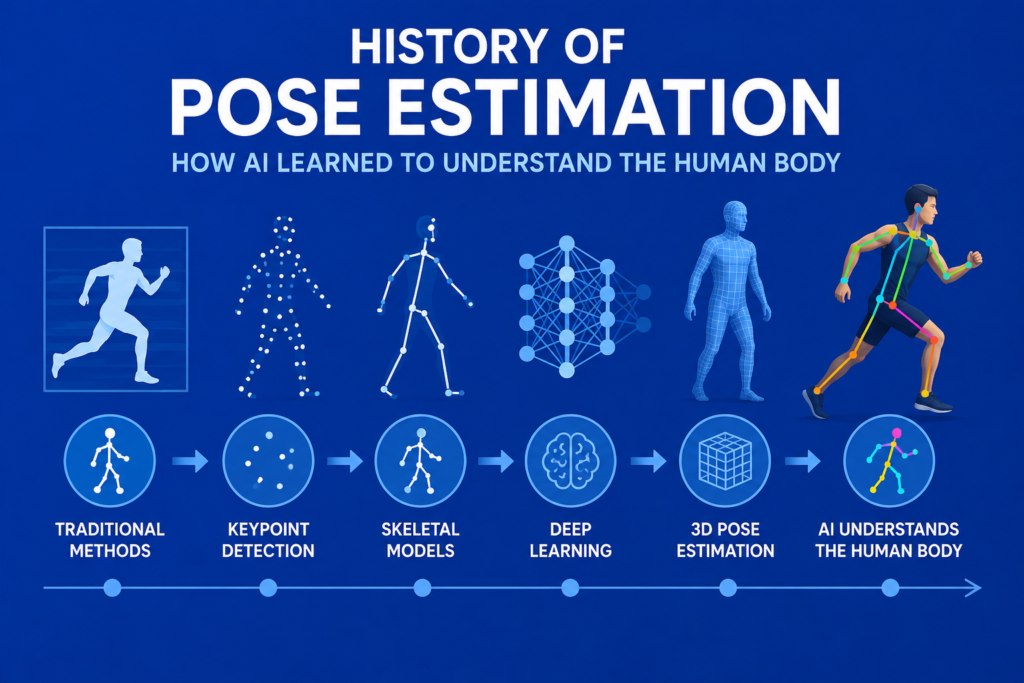
Long before computer vision could track a person’s movements in real time for a fitness app or animate a video game character based on someone’s live performance, researchers faced a deceptively difficult question: how does a machine know where a person’s elbow is in a photograph? The history of pose estimation is the story of answering that question, evolving from rigid geometric models to deep learning systems capable of tracking dozens of body, hand, and facial landmarks across multiple people in real time video.
What Pose Estimation Actually Involves
Articulated body parts model represents the foundational concept underlying the history of pose estimation. The human body is not a single rigid shape but a collection of connected parts, the torso, upper arms, forearms, thighs, shins, and so on, joined at joints that allow movement within certain ranges. Human skeleton kinematic chains describe these connections, with each body part’s position constrained by its connections to neighboring parts.
Pose estimation, at its core, involves identifying the positions of key points on this skeleton, joints like elbows, knees, shoulders, and hips, from an image or video. Landmark coordinate regression describes the general task of predicting the coordinates of these key points, a task that connects to the broader history of computer vision but presents unique challenges given how much the human body can vary in pose, clothing, and appearance.
Pictorial Structures: An Early Framework (2000 – 2010)
From pictorial structures to deep pose estimation describes the major conceptual shift that defines much of this history. Pictorial structures represented an early framework for pose estimation, modeling the human body as a collection of parts connected by springs, mathematically representing the flexible but constrained relationships between body parts.
Deformable part models (DPM) extended this concept, representing each body part with its own appearance model while also modeling the spatial relationships between parts. A DPM-based system might search an image for regions that looked like an upper arm, a forearm, and so on, while also checking whether the relative positions of these candidate parts were consistent with how a human body could actually be arranged.
This period connects to the broader history of pattern recognition, since pictorial structures and deformable part models represented hand-engineered approaches to a problem that would later be addressed quite differently through deep learning, but that nonetheless established the fundamental vocabulary, parts, joints, and spatial relationships, that later approaches would continue to use, even as the underlying methods changed dramatically.
DeepPose: Deep Learning Arrives (2014)
DeepPose Google research history 2014 represents one of the earliest and most influential applications of deep learning to pose estimation. Published by researchers at Google, DeepPose framed pose estimation as a direct regression problem, training a deep neural network to take an image as input and directly output the coordinates of body joints.
This approach represented a significant departure from the part-based models that had dominated previous approaches. Rather than explicitly modeling individual body parts and their relationships through separate components, DeepPose used a single deep network, drawing on the broader deep learning transformed computer vision narrative following the history of AlexNet in 2012, to learn the mapping from images to joint coordinates directly from training data.
History of 2D and 3D pose tracking branches significantly from this point. While DeepPose and many subsequent approaches focused on 2D pose estimation, identifying joint positions within the two-dimensional image plane, a parallel line of research focused on 3D pose estimation, attempting to recover the three-dimensional positions of joints in space from 2D images, a substantially harder problem given the inherent ambiguity of inferring depth from a single 2D image.
Heatmaps Replace Direct Regression (2015 – 2017)
Spatial heatmaps alignment represents an important architectural shift that followed DeepPose’s direct regression approach. Rather than having a network directly output coordinate values for each joint, heatmap-based approaches train a network to output a separate heatmap for each joint, essentially a probability map indicating how likely that joint is to be located at each position in the image.
This heatmap-based approach proved generally more effective than direct coordinate regression for several reasons. Heatmaps provide a richer training signal, since the network learns to produce a smooth probability distribution rather than a single point estimate, and heatmaps naturally handle uncertainty and ambiguity, situations where a joint’s exact location might be genuinely unclear due to occlusion or unusual poses, more gracefully than direct coordinate prediction.
Occluded joint tracking became an increasingly important consideration during this period. Real-world images and video frequently show people with body parts hidden behind other objects, other people, or even other parts of their own body. Heatmap-based approaches, by representing uncertainty explicitly, could handle these situations somewhat more gracefully than approaches that required a definite coordinate prediction for every joint regardless of visibility.
OpenPose and Multi-Person Tracking (2017)
History of OpenPose multi person tracking framework represents a major milestone in the history of pose estimation, introduced in 2017. Before OpenPose, many pose estimation systems were designed to track a single person, assuming an image contained one clearly defined human subject. Real-world images and video, however, often contain multiple people, sometimes overlapping or interacting closely with each other.
History of top down vs bottom up pose estimation describes two fundamentally different strategies for addressing this multi-person challenge. Top down approaches first detect individual people within an image, often using techniques related to the history of object detection, and then run pose estimation separately on each detected person. Bottom up approaches, by contrast, first identify all body part candidates across the entire image, regardless of which person they belong to, and then group these candidates into individual people afterward.
Part Affinity Fields (PAF), introduced as part of OpenPose’s bottom up approach, represented a key technical innovation for this grouping problem. Part Affinity Fields encode information about how body parts connect to each other, essentially providing a vector field that indicates, for any pair of detected body parts, how likely they are to belong to the same person and how they should be connected. This allowed OpenPose to efficiently associate detected joints with the correct individual, even in images containing many people, without needing to first detect and crop each person separately.
OpenPose’s bottom up approach offered an important practical advantage: its processing time did not necessarily increase as dramatically with the number of people in an image, compared to top down approaches that needed to run a separate pose estimation pass for each detected person.
Benchmarks and Standardization
MPII Human Pose Dataset and Microsoft COCO keypoint evaluation became standard benchmarks within the history of pose estimation, providing large collections of images with annotated joint positions that researchers could use to train and compare different approaches. These benchmarks played a role similar to the one the history of imagenet played for image classification, providing a common reference point that allowed meaningful comparison between different methods and tracked progress over time.
Temporal consistency constraint became an important consideration as pose estimation moved from analyzing individual images to processing video. A person’s pose typically changes smoothly from one frame to the next, rather than jumping erratically. Incorporating this temporal consistency into pose estimation systems, often by considering information from neighboring frames rather than analyzing each frame entirely independently, improved both accuracy and the visual smoothness of tracked poses in video applications.
Beyond Body Joints: Hands and Faces
History of hand and facial keypoint estimation extends the core ideas of body pose estimation to more detailed and challenging targets. Hands, with their many small joints and wide range of possible configurations, and faces, with their subtle and expressive movements, present distinct challenges compared to the larger, more constrained joints of the body’s main skeleton.
Real time body tracking software history increasingly incorporated these extended capabilities, with systems capable of simultaneously tracking body pose, hand gestures, and facial expressions, providing much richer information for applications ranging from sign language recognition to detailed animation and motion capture.
This extension connects to the broader history of multimodal AI and video understanding in ai, as systems increasingly combine information about body pose, hand gestures, and facial expressions with other modalities to build richer understanding of human behavior and communication.
Applications in Sports and Beyond (2017 – 2026)
Applications of pose estimation in sports analytics represent one of the most visible practical uses of this technology. Computer vision in sports applications use pose estimation to analyze athlete movements, tracking joint angles and body positions to provide insights into technique, identify potential injury risks from improper form, and generate statistics about player movement and positioning during games.
Evolution of human pose estimation models has also found applications in fitness apps, which can provide real-time feedback on exercise form by comparing a user’s tracked pose against ideal reference poses, and in animation and motion capture, where pose estimation can convert video of a person’s movements into data that can drive animated characters, without requiring the specialized motion capture suits and marker systems that were previously necessary for this kind of work.
This connects to the broader history of depth estimation as well, since many advanced pose estimation applications, particularly those operating in 3D, benefit from or directly incorporate depth information, whether from specialized depth sensors or from monocular depth estimation techniques applied to standard camera input.
Frequently Asked Questions
What is pose estimation in computer vision?
Pose estimation is the task of identifying the positions of key points on a subject, typically a human body, such as joints like elbows, knees, shoulders, and hips, from an image or video. It allows computer vision systems to understand body posture, movement, and gestures.
What is the difference between top down and bottom up pose estimation?
Top down approaches first detect individual people in an image and then estimate the pose for each detected person separately. Bottom up approaches first detect all body part candidates across the entire image and then group these candidates into individual people, an approach used by frameworks like OpenPose to handle multiple people efficiently.
What are Part Affinity Fields?
Part Affinity Fields, introduced as part of the OpenPose framework, are a technique for encoding how body parts connect to each other within an image. They provide a vector field indicating how likely pairs of detected body parts are to belong to the same person, helping bottom up pose estimation systems correctly group detected joints into individual people.
How has pose estimation evolved from 2D to 3D?
Early pose estimation systems primarily focused on identifying joint positions within the two-dimensional plane of an image. 3D pose estimation attempts to recover the three-dimensional positions of joints in space, a more challenging problem given the inherent ambiguity of inferring depth from a single 2D image, often addressed using multiple camera views, depth sensors, or learned depth estimation techniques.
How is pose estimation used in sports?
Pose estimation is used in sports analytics to track athlete movements, analyzing joint angles and body positions to evaluate technique, identify injury risk factors related to form, and generate detailed statistics about player movement and positioning during games, all without requiring specialized motion capture equipment.
Conclusion
The history of pose estimation traces a path from early pictorial structures and deformable part models, hand-engineered representations of the human body as a collection of connected parts, through DeepPose’s direct deep learning regression approach, to heatmap-based methods and multi-person frameworks like OpenPose that introduced Part Affinity Fields to solve the grouping problem.
Within the broader story of computer vision technology, pose estimation represents a particularly human-centered application of computer vision, one where understanding the structure and movement of the human body has applications spanning sports analytics, fitness, animation, accessibility, and human-computer interaction. Understanding the history of pose estimation means understanding how AI learned to see not just objects, but the living, moving structure of the human body itself.