Picture an elevator that never stops between floors, one moment sitting on the third floor, the next instantly appearing on the fifth, without ever passing through the fourth. This bizarre behavior sounds impossible in our everyday world, yet it perfectly describes how electron energy jumps actually work inside every atom in existence. When Danish physicist Niels Bohr first proposed this idea in 1913, it represented one of the strangest, most genuinely revolutionary concepts in the history of physics.
Understanding electron energy jumps means confronting one of quantum mechanics’ most counterintuitive truths, that particles do not gradually transition between states the way classical physics always assumed, but instead vanish from one energy level and instantaneously reappear at another, with nothing meaningful happening in between.
The Classical Assumption That Failed
Before Bohr’s breakthrough, classical physics assumed that any change in a system’s energy should happen smoothly and continuously. If an electron gained or lost energy, physicists naturally expected it to gradually spiral through a continuous range of orbital positions, much like a satellite slowly changing altitude as it loses momentum to atmospheric drag.
This assumption, however reasonable it seemed, completely failed to explain what scientists actually observed when studying atomic radiation emission from energized gases. Hydrogen and other elements produced light only at specific, sharply defined wavelengths, never smoothly across a continuous range. Something about how electrons changed energy states clearly did not follow ordinary classical rules.
Bohr’s Radical Proposal: Instant Transitions (1913)
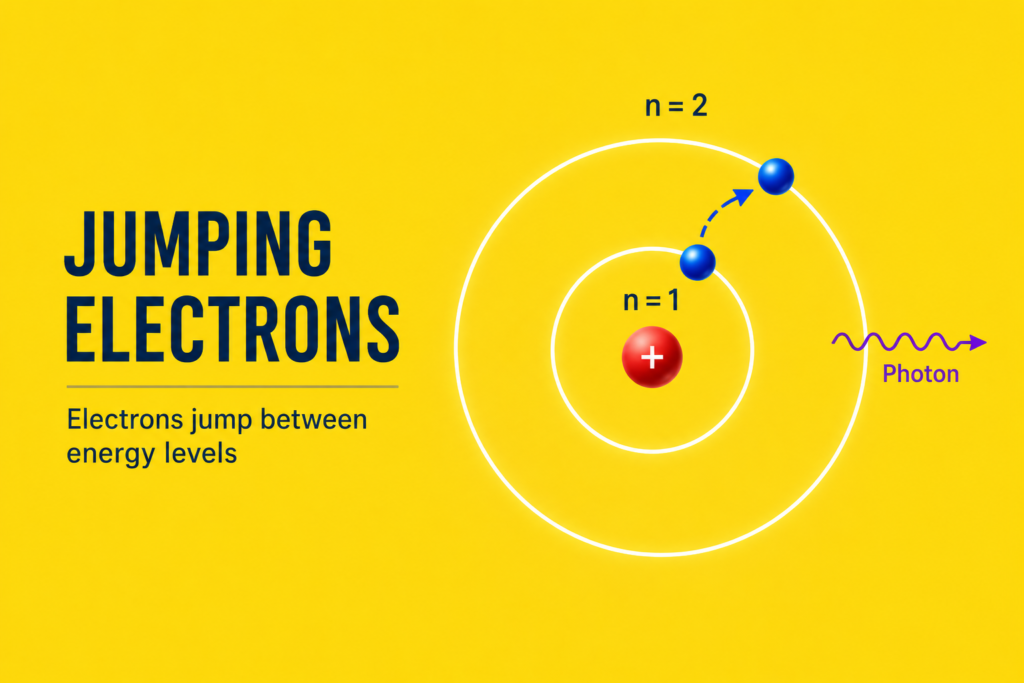
In 1913, Niels Bohr proposed something that seemed almost absurd within the classical scientific framework of his era. He suggested that electrons occupy specific, quantized electron orbits and energy levels, and crucially, that transitions between these levels happen through sudden, instant transition events rather than any gradual, continuous movement whatsoever.
According to Bohr’s model, an electron undergoing quantum state change simply disappears from its original orbital position and immediately reappears at another permitted energy level, without ever occupying any theoretically intermediate position along the way. This concept, later popularized through the phrase quantum leap, described genuine quantum jump mechanism behavior fundamentally unlike anything observed within classical physics.
The Mathematics Behind Electron Energy Jumps
Central to understanding electron energy jumps is Bohr’s precise mathematical framework describing exactly how much energy each transition involves. Every allowed electron orbital position corresponds to a specific energy value, calculated for hydrogen through the formula:
E_n = -13.6 eV / n²
Here, E_n represents the total energy associated with quantum level n, where n represents any positive integer value. When an electron undergoes energy level transition, moving from one quantum state to another, the exact energy difference calculation between these two levels determines precisely how much energy gets absorbed or released during the process.
This crucial relationship, known as Bohr’s frequency condition or sometimes the planck Einstein relation, connects this energy differential directly to the frequency of light involved, expressed through the equation:
ΔE = hf
Here, ΔE represents the delta E energy difference between the electron’s initial and final quantum states, h represents Planck’s constant, and f represents the resulting photon frequency equation value. This elegant relationship reveals precisely why atoms interact with light only at very specific frequencies, corresponding exactly to the calculable gaps between permitted electron orbital energies.
Absorption: Electrons Jumping to Higher States
Understanding electron energy jumps requires examining both directions this process can occur. During light absorption atom events, an incoming photon carrying precisely the correct amount of energy strikes an electron occupying a lower orbital position. If that photon’s energy matches exactly the required energy difference calculation between two permitted levels, the electron immediately undergoes photon absorption, jumping instantly to a higher, excited electron state.
Crucially, if the incoming photon’s energy does not precisely match any available energy gap within the atom, that photon simply passes through unaffected, since electron energy jumps require exact energy matching rather than any approximate or partial absorption process. This selective behavior explains why atoms produce such sharply defined absorption spectrum lines rather than absorbing light across broad, continuous wavelength ranges.
Emission: Electrons Falling Back Down
The reverse process occurs when an electron occupying a higher, excited atomic excitation state falls back toward a lower, more stable energy configuration. During this spontaneous emission event, the electron releases its excess energy as a single discrete photon release, precisely matching the energy differential between its starting and ending quantum positions.
This process, sometimes described through atomic fluorescence phenomena, explains exactly why energized gases produce their characteristic glow. Countless individual electrons throughout the gas sample simultaneously undergo these ground state transition events, each releasing electromagnetic photon energy corresponding to specific, predictable wavelengths, collectively producing the distinctive spectral emission patterns scientists observe and measure.
Why Nothing Happens “In Between”
Perhaps the most philosophically challenging aspect of electron energy jumps involves their fundamentally instantaneous nature. Classical intuition strongly suggests that any transition between two states should involve passing through intermediate positions along the way, similar to how a car accelerating from one speed to another briefly occupies every velocity in between.
Electron energy jumps simply do not work this way. The electron does not gradually decrease in energy while slowly spiraling toward a lower orbital position. Instead, it exists definitively within one specific quantum state, then, through a process still generating philosophical debate today, undergoes what physicists sometimes call quantum state collapse, appearing definitively within a completely different quantum state, with no meaningful physical description existing for whatever might happen during the transition itself.
Transition Probability and Decay Rates
While Bohr’s original theory described electron energy jumps as effectively instantaneous, physicists eventually developed more sophisticated mathematical tools describing transition probability and decay rate calculations. Not every excited electron immediately falls back toward its ground state; instead, quantum mechanics assigns specific probabilities determining how likely a particular transition becomes within any given time period.
This probabilistic framework explains phenomena like luminescence, where certain materials continue emitting light for extended periods after initial excitation, since their excited electrons undergo gradual, statistically distributed electron energy jumps back toward lower energy configurations rather than transitioning immediately and simultaneously.
Stimulated Emission: The Foundation of Lasers
Beyond ordinary spontaneous emission, physicists eventually discovered stimulated emission, an important variant of electron energy jumps where an incoming photon actually triggers an excited electron to release its own matching photon prematurely, rather than waiting for random, natural decay. This discovery, building directly upon Bohr’s original framework, eventually provided the essential theoretical foundation enabling laser technology, one of the most practically significant applications emerging from Bohr model to modern technology developments throughout the twentieth century.
Bridging Classical and Quantum Understanding
As quantum theory developed further beyond Bohr’s original 1913 framework, his correspondence principle helped ensure that electron energy jumps, however strange they appeared, remained mathematically consistent with classical physics predictions under appropriate limiting conditions involving very large quantum numbers. This principle provided crucial theoretical reassurance that quantum mechanics represented a genuine expansion of physical understanding rather than a complete rejection of previously validated classical theories.
The Deeper Philosophical Debate
The genuinely strange nature of electron energy jumps eventually became central to broader philosophical disagreements within quantum mechanics, particularly regarding the famous Niels Bohr vs Einstein debates concerning the fundamental nature of quantum reality. While Bohr defended the probabilistic, seemingly discontinuous nature of quantum jump debate discussions as genuine physical reality, Einstein remained deeply skeptical throughout his life regarding whether nature truly behaved this strangely at its most fundamental level.
This disagreement extended into related concepts including wave-particle duality and the broader copenhagen interpretation framework Bohr helped establish, illustrating how even seemingly technical questions about electron energy jumps connected directly to profound philosophical questions regarding the fundamental nature of physical reality itself.
From Hydrogen to Modern Technology
Bohr’s original insights regarding electron energy jumps, first developed through Bohr’s hydrogen atom solution, eventually became foundational to numerous practical technologies used throughout modern life. Fluorescent lighting, neon signs, LED displays, and laser systems all rely directly on precisely controlled electron energy jumps occurring within carefully engineered materials, demonstrating how thoroughly this century-old theoretical breakthrough continues shaping contemporary technology.
Why This Discovery Still Matters Today
Understanding electron energy jumps remains absolutely essential for modern chemistry, materials science, and quantum computing research. Bohr’s quantum contributions regarding this fundamental atomic behavior, developed extensively throughout his career at the influential Bohr Institute, continue providing the theoretical foundation underlying countless technologies and ongoing scientific research programs worldwide.
Frequently Asked Questions
What are electron energy jumps in simple terms?
Electron energy jumps refer to the sudden, instantaneous transitions electrons make between specific quantized energy levels within an atom, absorbing or releasing photons with precisely matching energy values.
Why don’t electrons gradually move between energy levels?
According to quantum mechanics, electrons occupy only specific, discrete energy states, and transitions between these states happen instantaneously rather than through any gradual, continuous movement.
How do electron energy jumps relate to light emission?
When electrons fall from higher to lower energy levels, they release the energy difference as a photon, with the photon’s frequency directly determined by the size of the energy jump.
What is stimulated emission?
Stimulated emission occurs when an incoming photon triggers an already excited electron to release its own matching photon, a process that forms the theoretical foundation of laser technology.
Did all physicists agree on how electron energy jumps work?
No, this concept became central to disagreements between Bohr and Einstein regarding quantum mechanics, with Einstein remaining skeptical of the probabilistic, discontinuous nature Bohr’s theory described.
Conclusion
The discovery of electron energy jumps through Niels Bohr’s revolutionary 1913 framework revealed one of quantum mechanics’ strangest and most fundamental truths, that atoms change energy states through sudden, instantaneous transitions rather than smooth, gradual movement. This counterintuitive behavior, explaining everything from atomic spectral lines to modern laser technology, sparked profound philosophical debates about the true nature of reality that continue influencing physics today. More than a century after Bohr first proposed this radical idea, understanding electron energy jumps remains essential for chemistry, materials science, and countless technologies built upon this foundational quantum principle.